Coming Together to Harmonize Epilepsy Terminology in Mondo
The Challenge
Coming Together to Harmonize Epilepsy Terminology in Mondo
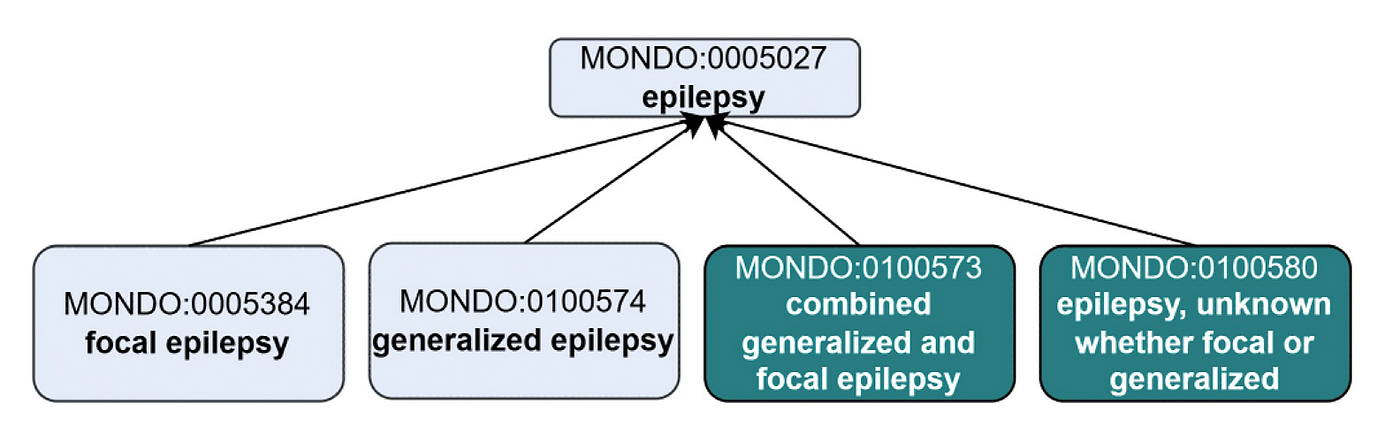
Creation of new ‘epilepsy type’ terms to align with the ILAE. Existing Mondo terms are depicted in lighter shading and new terms that were added as an outcome of the workshop are depicted in darker shading. Note, this is just a partial representation of the classification, not all of the asserted subclasses of ‘epilepsy’ are depicted. (This is Figure 2 from the recent Epilespy Disease Classification publication.)
The Challenge
Epilepsy is not a single disease but a broad and heterogeneous group of neurological disorders affecting millions of people worldwide. While common epilepsy types are relatively well characterized, rare epilepsies remain difficult to diagnose, study, and treat as they are genetically complex and often severe. One major challenge is that different communities describe these disorders in different ways. Clinicians, epileptologists, geneticists, and researchers often rely on distinct classification systems or terminology, leading to inconsistencies across databases, publications, and clinical records. Without a shared vocabulary, integrating data across resources becomes challenging and slows progress in both research and patient care.
Collaborative Harmonization Effort
To address this challenge, the Mondo community launched a collaborative effort to harmonize epilepsy terminology within the Mondo Disease Ontology. In partnership with members from the Critical Path Institute’s Data Collaboration Center’s Data Science team, we convened a series of expert-driven workshops bringing together specialists in ontology development, epileptology, neurodevelopmental genetics, biomedical ontology, and patient advocacy. Through focused working sessions, participants reviewed the existing epilepsy hierarchy in Mondo and compared it with current clinical standards, including the classification framework developed by the International League Against Epilepsy (ILAE). These discussions helped identify inconsistencies, gaps, and opportunities to better represent epilepsy diseases and syndromes in a way that supports both clinical and research use cases.
Outcomes
The outcome of this Mondo community effort was a substantial update to the epilepsy branch of Mondo. Working collaboratively, the group introduced new disease terms, refined definitions, revised classifications, and aligned existing concepts with the latest ILAE framework. These changes provide a more granular and interoperable representation of epilepsy diseases which help to bridge terminology across clinical care, genetics, and biomedical research. All revisions are now available in the latest release of Mondo.
To document the process and provide a detailed overview of the changes we recently published a paper describing the work: “Epilepsy disease classification: a community effort to enhance the Mondo Disease Ontology.” The paper outlines the collaborative workshop process, the rationale behind key modeling decisions, and the resulting improvements to epilepsy representation in Mondo.
Together, these updates move us closer to a shared framework for representing rare epilepsies and support improved data integration, research, and better outcomes for patients.
메타데이터
- post_id
- 1c415d2cc978
- slug
- coming-together-to-harmonize-epilepsy-terminology-in-mondo-1c415d2cc978
- url
- https://medium.com/@monarchinit/coming-together-to-harmonize-epilepsy-terminology-in-mondo-1c415d2cc978
- canonical_url
- https://medium.com/@monarchinit/coming-together-to-harmonize-epilepsy-terminology-in-mondo-1c415d2cc978
- author_url
- https://medium.com/@monarchinit
- status
- ok
- fetched_at
- 2026-06-26 03:39:16