The Invisible Chokepoint: Why We Should Be Way More Worried About Undersea Cables Than Oil
We’ve spent the last half-century obsessing over the Strait of Hormuz for one reason: oil
The Invisible Chokepoint: Why We Should Be Way More Worried About Undersea Cables Than Oil
We’ve spent the last half-century obsessing over the Strait of Hormuz for one reason: oil
We watch tanker traffic like a hawk, track the price per barrel daily, and build massive strategic petroleum reserves just in case the worst happens.
But while we’ve been busy preparing for a 20th-century energy crisis, a much quieter, potentially catastrophic threat has been flying under the radar.
Recent warnings and shifting geopolitics have made one thing terrifyingly clear: Iran’s leverage over the undersea fiber-optic cables running through the region is a much bigger weapon than an oil embargo could ever be. And honestly? We are nowhere near ready for it.
The Reality of Our Digital Fragility
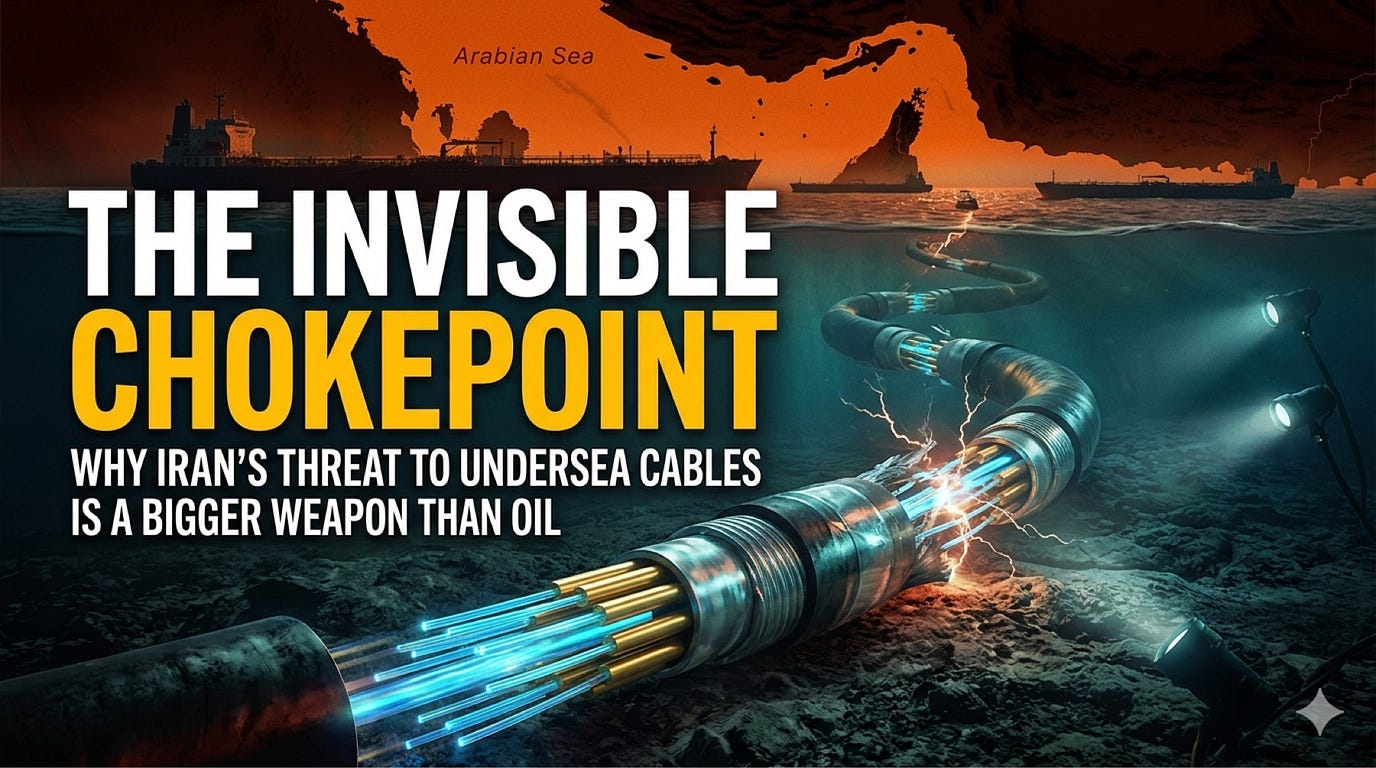
Most of us think of “the cloud” as something floating invisibly above us. In reality, the global internet is held together by a fragile web of underwater cables – some no thicker than a garden hose – resting on the ocean floor. Over 95% of all international data traffic flows through these cables.
The Strait of Hormuz isn’t just a shipping lane for crude oil; it is an absolute digital bottleneck. If you sever an oil pipeline or block a tanker, the world can draw from reserves or reroute ships around Africa. It’s expensive, but doable.
If you cut a multi-terabit subsea cable? You can’t just “reroute” that volume of data overland through active conflict zones without massive latency and systemic failures. We are talking about a dual-shock scenario: the simultaneous freezing of physical logistics and the digital infrastructure that controls them.
The “Hostage Strategy” No One Is Talking About
What worries me most isn’t just the threat of physical sabotage – it’s the insidious, administrative strategy being floated by Iranian state-linked media and military figures. They aren’t just talking about blowing things up; they are talking about taking the infrastructure hostage through a three-pronged bureaucratic stranglehold:
-
Forced Transit Licensing: Claiming sovereignty over the seabed to force Western tech giants (like Alphabet, Meta, and Microsoft) to pay massive fees just to let global data pass through the strait.
-
Legal Jurisdiction: Attempting to force these multi-billion-dollar companies to operate under the legal oversight and regulations of the Islamic Republic.
-
Monopolizing Repairs: Giving domestic companies exclusive rights to maintain and repair the subsea cables.
This last point is the real kicker. An overt attack on a cable invites immediate military retaliation. But delaying a civilian repair ship by denying it access permits to a tense maritime zone? That leaves critical digital networks degraded for months. Cable repair crews do not operate under fire, and geopolitical friction can freeze maintenance indefinitely.
Why This is an Existential Risk
The global economy currently pumps roughly $10 trillion in daily financial transactions through these undersea networks. A prolonged disruption wouldn’t just mean your Netflix stream buffers; it means frozen banking liquidity, failed automated trade settlements, and a complete paralysis of the digital control systems that manage everything from global shipping to power grids.
Furthermore, it threatens the massive AI and data center booms currently happening across emerging tech hubs in the Gulf and India, which are utterly dependent on high-speed, low-latency connectivity to Europe.
The Bottom Line: You can ration oil, but you cannot ration the real-time data that keeps the modern world alive. By shifting the threat from oil tankers to the seabed, the vulnerability moves from an economic headache to an existential risk for our cloud-driven society.
We need to start treating digital infrastructure with the same strategic urgency we give to physical energy. If we keep ignoring the vulnerability of the ocean floor, we might find out just how fragile our connected world really is – the hard way.
메타데이터
- post_id
- 1c673daf0f69
- slug
- the-invisible-chokepoint-why-we-should-be-way-more-worried-about-undersea-cables-than-oil-1c673daf0f69
- url
- https://medium.com/@yhteong/the-invisible-chokepoint-why-we-should-be-way-more-worried-about-undersea-cables-than-oil-1c673daf0f69
- canonical_url
- https://medium.com/@yhteong/the-invisible-chokepoint-why-we-should-be-way-more-worried-about-undersea-cables-than-oil-1c673daf0f69
- author_url
- https://medium.com/@yhteong
- status
- ok
- fetched_at
- 2026-06-16 19:09:56