Mac mini M5: Apple’s Strategic Gambit in May 2026
Why a “Quiet” Desktop Release Will Be the Ecosystem’s Most Vital Event Before WWDC.
Mac mini M5: Apple’s Strategic Gambit in May 2026
Why a “Quiet” Desktop Release Will Be the Ecosystem’s Most Vital Event Before WWDC.
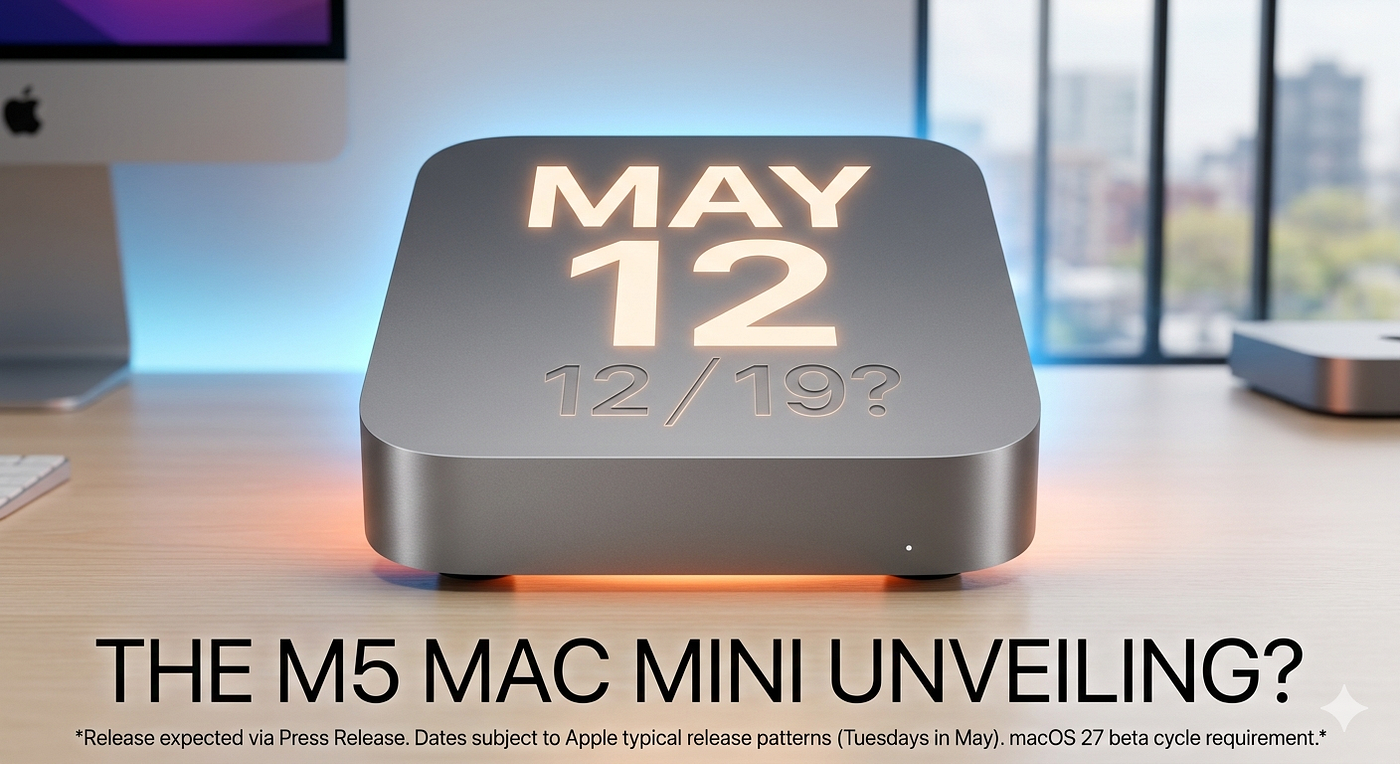
While the global press is fixated on semiconductor shortages and sky-high memory prices, Cupertino is preparing the board for a grand chess match. If you’re planning to upgrade your workspace, forget the traditional fall events. All indicators — from supply chains to the code of current macOS — point to May 2026.
In this article, we’ll break down why the M5 Mac mini isn’t just “another update,” but a critical tool that Apple must release now.
Economic Pragmatism: The Samsung Surrender
In February 2026, an unprecedented event shook the industry: Apple officially accepted Samsung’s terms for a 100% price hike on LPDDR5X modules. Instead of the usual $30–35 per module, the company is now paying roughly $70 for base memory capacity.
Why is this an argument for a May release? Many analysts mistakenly saw this as a signal for delay (“Apple will wait for prices to drop”). But Tim Cook operates differently. Apple has already secured priority capacity for the entire first and second quarters of 2026. The funds are invested; the contracts through mid-2026 are closed. Holding hardware that has already been paid for at a “double price” in a warehouse until October is financial nonsense. The product must start generating ROI immediately to offset the increased manufacturing costs.
The stable shipments of M5 MacBook Pros (released in March) prove that Apple has no physical shortage of M5 chips or the RAM to accompany them. It’s purely a margin question, which they will likely solve with a slight bump in retail pricing.
M5 Architecture: More Than Just Speed
The transition from M4 to M5 is not just evolution. It is a shift to TSMC’s enhanced 3nm process (N3P).
What does this mean for the Mac mini? Neural Engine 2.0: In 2026, AI became the standard. The M5 features an updated NPU specifically optimized for local execution of Large Language Models (LLMs). This is critical for Apple Intelligence, which will become fully autonomous in macOS 27.
Thunderbolt 5 in the Pro Model: Thanks to the integrated controller in the M5 Pro chip, the new Mac mini will finally support speeds up to 120Gbps. For professionals working with 8K video or massive datasets on external RAID arrays, this is the primary reason to upgrade.
Thermal Efficiency: The N3P process allows for higher clock speeds with less heat. In the ultra-compact Mac mini chassis (redesigned in 2024), this will prevent throttling even during heavy project compilation.
The Developer Cycle: Why May is the Deadline
This is perhaps the strongest argument. WWDC 2026 (June) will be entirely dedicated to macOS 27. This system, according to all leaks, finally kills off Intel processor support and bets everything on native neural networks.
Developers need time. If Apple releases the M5 Mac mini in mid-May (most likely dates being May 12 or May 19), developers will receive the units 2–3 weeks before the conference.
They will set up their environments on stable macOS 26.4, which already contains identifiers for the new J873g/s models.
On Keynote day, they will simply hit “Update” and begin testing their apps on the macOS 27 Beta using the most relevant hardware.
If Apple delayed the release until June or October, it would create a “vacuum” — developers would be presenting software for a system they couldn’t physically test on mass-market hardware with the latest Neural Engine.
Historical Parallels and Market Context
Looking back, Apple often refreshes its “workhorses” via spring press releases. Think of the M4 iPad Pro (May 2024) or the M3 MacBook Air (March 2024). The Mac mini is the perfect candidate for this format. It doesn’t need a 40-minute presentation with light shows because its design is already perfected. It just needs a new “heart.”
Competition: The market has already seen second-generation Snapdragon X Elite and new Intel Lunar Lake mini-PCs. Apple cannot afford to lose the “performance-per-dollar” segment for six months while waiting for a fall event. The Mac mini must remain the top choice for offices and developers here and now.
Inventory Status: The Final Piece of the Puzzle
As of April 24, 2026, we see an anomalous pattern: base Mac mini configurations (16GB and 24GB RAM) in the US, Canadian, and European Apple Stores have delivery estimates of 3–4 weeks or are marked as “unavailable.”
This is a classic “clearance” maneuver. Apple has stopped replenishing old models. They are flushing out stock to avoid a situation where, after the M5 launch, they’d have to sell old M4 units at significant discounts.
Verdict: What to Expect?
The M5 Mac mini will arrive quietly. On a Tuesday in May, the Apple Newsroom will update with a brief but impactful release.
For Developers: This is a must-have. The updated Neural Engine and Thunderbolt 5 will pay for themselves within the first month of working with macOS 27.
For Users: This is the best entry point into the ecosystem. The base model will likely increase to $699, but for that price, you get the most future-proof AI-ready computer available.
Mark your calendars: May 12 or May 19…
메타데이터
- post_id
- 1c819ee7e16b
- slug
- mac-mini-m5-apples-strategic-gambit-in-may-2026-1c819ee7e16b
- url
- https://medium.com/@reznik.pavlo.ca/mac-mini-m5-apples-strategic-gambit-in-may-2026-1c819ee7e16b
- canonical_url
- https://medium.com/@reznik.pavlo.ca/mac-mini-m5-apples-strategic-gambit-in-may-2026-1c819ee7e16b
- author_url
- https://medium.com/@reznik.pavlo.ca
- status
- ok
- fetched_at
- 2026-06-09 15:37:30




