Smart Routing and Multi‑Account Aggregation: Enhancing India’s Account Aggregator Network
India’s Account Aggregator (AA) framework , launched in September 2021, has rapidly evolved from a niche experiment into a pillar of…
Smart Routing and Multi‑Account Aggregation: Enhancing India’s Account Aggregator Network
India’s Account Aggregator (AA) framework , launched in September 2021, has rapidly evolved from a niche experiment into a pillar of digital public infrastructure. By 2025, it handled hundreds of millions of consent‑based data exchanges and enabled lenders, insurers and wealth managers to access verified financial information in near‑real time. Sahamati, the industry alliance that advocates for the AA ecosystem, celebrated its fourth anniversary in September 2025 by noting that more than 740 financial institutions and 16 licensed AAs were live, with over 212 crore accounts enabled for consent‑based data sharing.
Yet behind these impressive numbers lie real‑world frictions: users frequently abandon consent journeys, and financial institutions suffer from downtime and coverage gaps. This blog post explores how multi‑AA (multi‑account aggregator) strategies, including smart‑routing gateways, are emerging as a solution to these challenges and why governance standards are essential to ensure fairness.
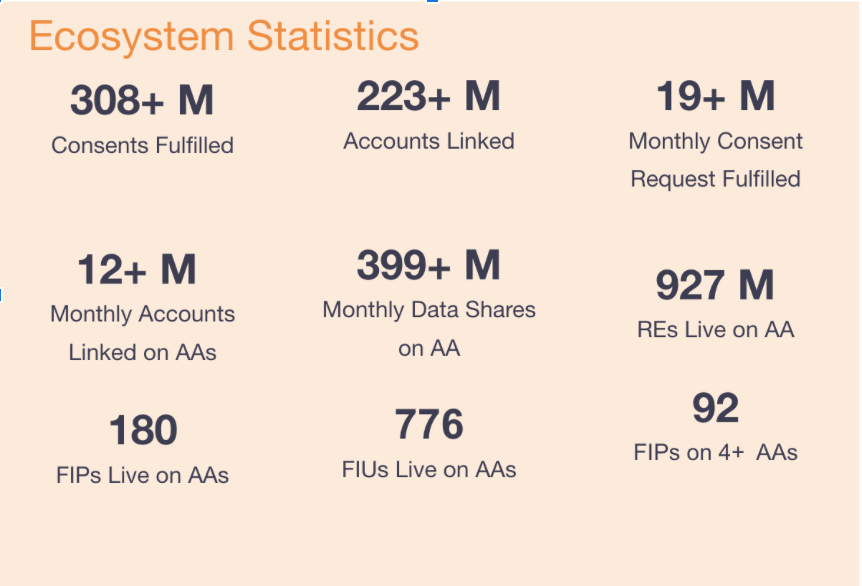
Ecosystem Statistics
The Scale and Challenges of the AA Network
The AA network allows any regulated Financial Information Provider (FIP) — banks, insurers, mutual funds — to share customer data with a Financial Information User (FIU) with the customer’s explicit consent. Adoption has exploded: by September 2025 more than 22 crore financial accounts were enabled for AA services and the network had processed 30 crore+ consent‑based data sharing transactions, growing continuously.
Despite this scale, real‑world user experience remains uneven. Loans, insurance policies and wealth‑management transactions that should complete in minutes often falter because the underlying infrastructure is fragile:
- High drop‑off rates. Consider Gopal, an MSME owner from a tier-III city. He tries to obtain a ₹1,00,000 loan via a lending app but encountered multiple interfaces, repeated One‑Time Passwords (OTPs) and system outages. When his bank’s systems or the chosen AA were down, the consent screen hung and he eventually abandoned the process. Each user drop‑off can cost lenders in wasted acquisition spend.
- Coverage gaps and data quality. Not all FIPs have integrated with every AA. By integrating with 7 AAs, Finfactor provides 100% FIP coverage.
- Complex regulatory environment. The AA framework sits within India’s broader data‑protection ecosystem. New regulations such as the Digital Personal Data Protection Act (DPDP Act, 2023) introduce additional compliance obligations, and the interplay between AA and consent‑manager frameworks remains a governance challenge.
These issues risk eroding user trust and slowing adoption. If customers cannot reliably consent and retrieve data, the promise of seamless, paperless financial services will remain unfulfilled.
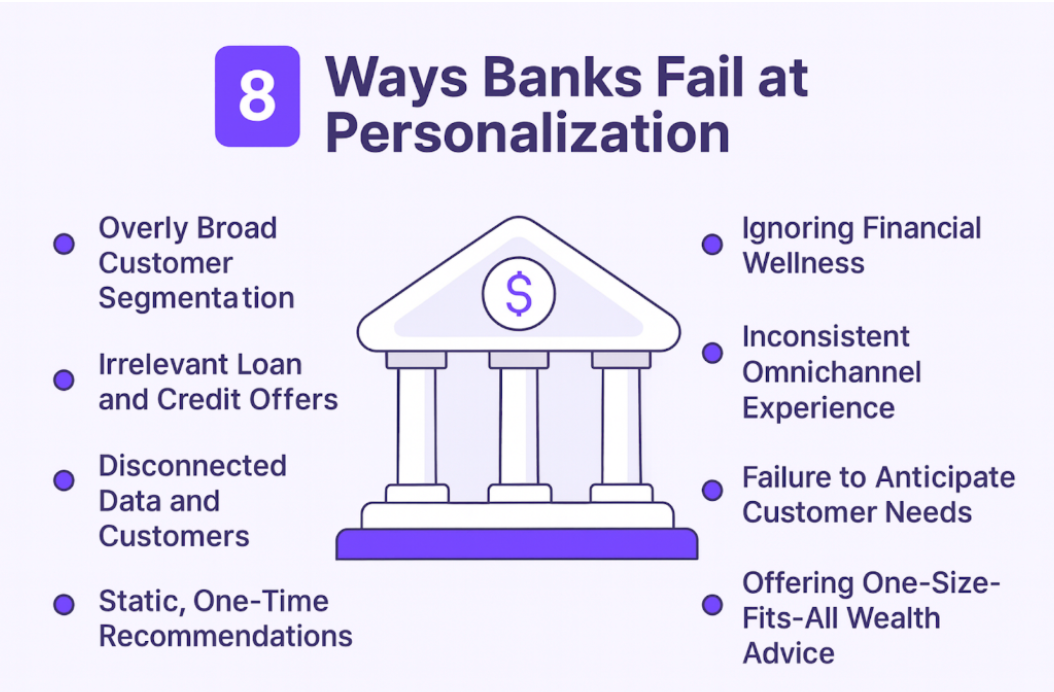
8 ways banks fail at personalization
What Is Multi‑AA and Smart Routing?
Multi‑AA refers to strategies that allow a financial institution or technology service provider (TSP) to work with multiple account aggregators simultaneously rather than integrating with just one. Because each AA has its own roster of integrated FIPs and performance characteristics, routing a consent journey through the most suitable AA can significantly improve success rates. Two primary approaches have emerged:
- Multi‑AA gateways — middleware solutions offered by TSPs such as Finfactor that automatically select the best AA based on real‑time conditions. Finfactor’s Multi AA engine intelligently selects the best-performing AA in real-time to ensure your journeys start strong. The gateway also provides redundancy: if an AA is down, the system automatically retries via another, ensuring that consent journeys remain uninterrupted.
- Smart routing — an intelligence layer that assesses the applicant’s bank availability and recommends the optimal data‑collection path. Finfactor’s AA & FIP health monitoring checks the live status of AA-FIP combinations, fetch success rates, latency, and failure trends. The system then routes the user to the path most likely to succeed — whether through the most reliable AA or alternative modes such as netbanking or statement upload — and includes an invisible fallback mechanism so the user does not need to restart the journey if a particular AA fails.
Both approaches aim to reduce drop‑offs and improve the likelihood that a user will complete the consent flow, thereby converting more borrowers, policyholders or investors.
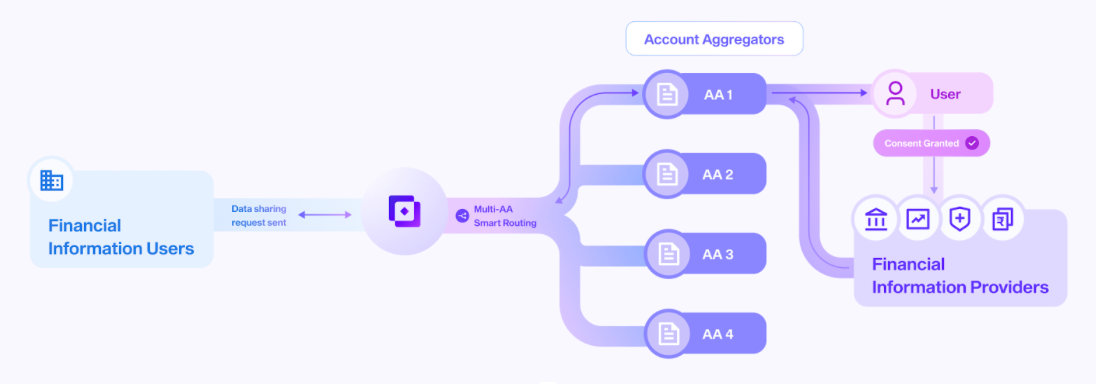
Multi — AA Routing
Why Multi‑AA Matters: Quantifying the Benefits
1. Higher conversion rates
High drop‑off rates are a major drag on digital lending and insurance. By routing consent requests through the AA with the highest success rate for the user’s bank, multi‑AA gateways can significantly improve conversion. As per Finfactor’s estimates, a lender can significantly improve consent fulfillment when using multi‑AA routing.
2. Redundancy and reliability
Integrating with multiple AAs reduces the risk that a single provider’s downtime will disrupt service. While consent flows are still governed by bank and AA availability, a multi-AA setup ensures that lenders are not operationally tied to one AA for all journeys. This improves overall resilience, allows teams to route traffic at a workflow level, and reduces the impact of prolonged outages or performance issues at any single AA.
3. Broader FIP coverage
By connecting to multiple AAs, FIUs ensure that more users can link their accounts. A leading nonprofit focusing on financial inclusion advises financial institutions to avoid relying on a single AA because each aggregator has varied coverage; partnering with an alternate AA or an aggregator‑of‑aggregators ensures better reach and continuity.
4. Simplified integration and customisation
TSPs offering multi‑AA gateways provide a single integration layer for FIUs. Instead of individually integrating with several AAs, lenders and fintechs can integrate once and let the gateway handle all subsequent routing, thereby reducing development time. By partnering with a TSP like Finfactor, lenders can directly inherit logics and data funnel flows.
5. Improved user experience
Smart routing reduces friction by hiding complexity from users. Because the user sees only the path most likely to succeed, the journey feels seamless, building trust in digital consent flows. Lenders can visualize user journey from consent initiation to FI fetch, with stage-wise drop-off insights to improve user experience.
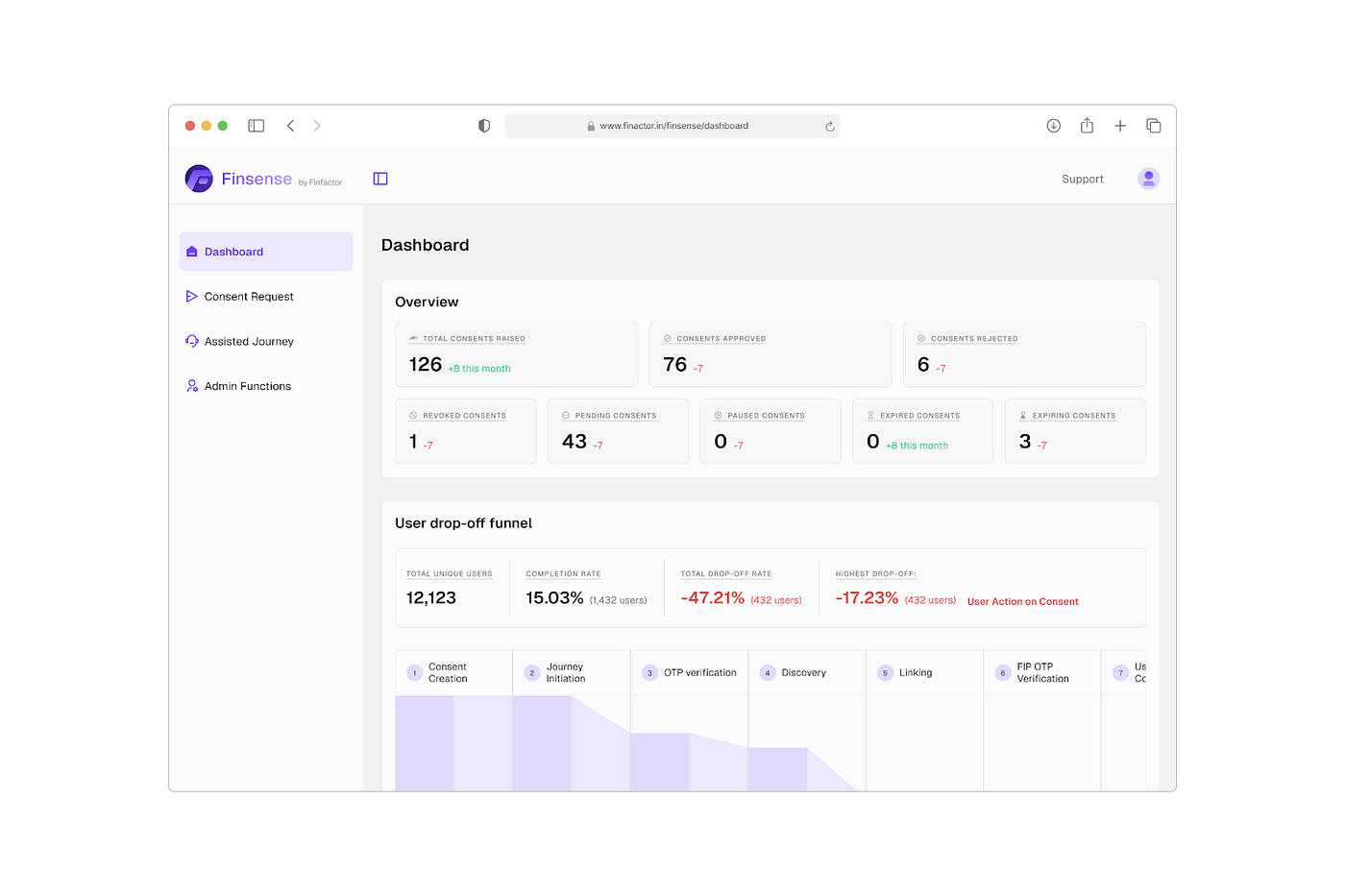
Finsense Dashboard
*Finsense from Finfactor has an intuitive dashboard that shows real-time dashboards with user drop-off data that can be used to draw insights and fix issues.*
Governance and Standards for a Multi‑AA Future
While multi‑AA technologies promise better performance, they also introduce governance considerations. The AA framework is regulated by the Reserve Bank of India (RBI), and industry alliances like Sahamati have established Fair Use Guidelines to ensure that FIUs and TSPs handle user data responsibly. These guidelines cover onboarding checks, customer‑experience best practices, UI design, service‑level certifications and data‑quality standards. They also include a Fair Use Template Library that defines standard consent attributes and purpose codes so that consents are meaningful and not overly broad. Participatory governance — involving regulators, AAs, FIPs, FIUs and consumer advocates — is essential to maintain trust; user expectations around privacy, security and choice must be met.
Conclusion: Towards Reliable and Inclusive Data Empowerment
The Account Aggregator framework has already altered India’s financial landscape, offering secure, consent‑driven access to data at scale. Yet rapid growth has exposed frictions — from high drop‑off rates and inconsistent FIP coverage to complex regulatory expectations. Multi‑AA strategies, implemented through smart‑routing gateways, address these gaps by dynamically selecting the best available AA or alternative data path, thereby improving conversion rates, reliability and user experience. Coupled with strong governance standards and participatory oversight, multi‑AA solutions can ensure that India’s consent‑based data empowerment revolution achieves its potential: more inclusive, resilient and user‑friendly financial services for all.
메타데이터
- post_id
- 1c8a84b2a8d2
- slug
- smart-routing-and-multi-account-aggregation-enhancing-indias-account-aggregator-network-1c8a84b2a8d2
- url
- https://medium.com/@finfactorCeo/smart-routing-and-multi-account-aggregation-enhancing-indias-account-aggregator-network-1c8a84b2a8d2
- canonical_url
- https://medium.com/@finfactorCeo/smart-routing-and-multi-account-aggregation-enhancing-indias-account-aggregator-network-1c8a84b2a8d2
- author_url
- https://medium.com/@finfactorCeo
- status
- ok
- fetched_at
- 2026-06-11 06:59:45