Scientists Say Blowing Up an Asteroid Might Be Humanity’s Best Bet
In 2022, NASA rammed a spacecraft into a small asteroid at 14,000 mph — and it worked. The mission, known as DART (Double Asteroid…
Scientists Say Blowing Up an Asteroid Might Be Humanity’s Best Bet
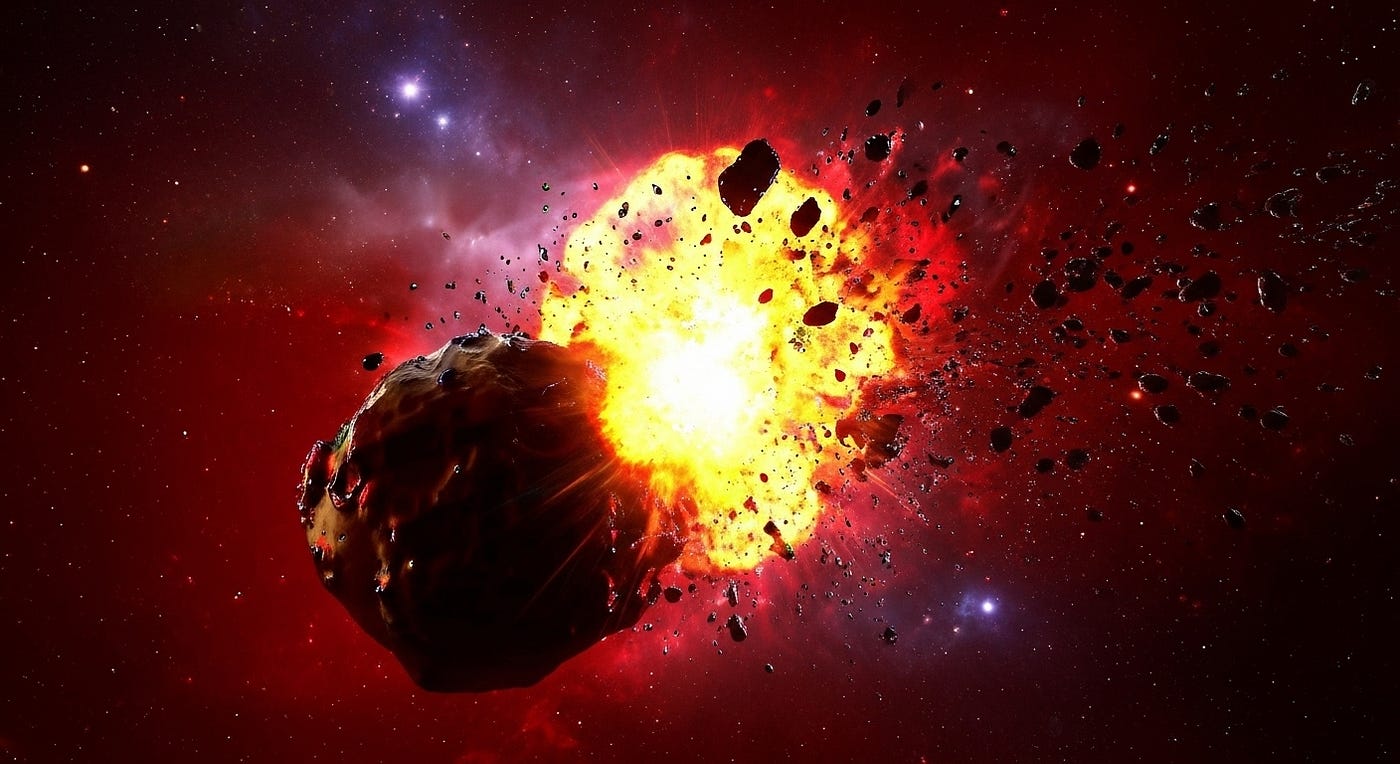
In 2022, NASA rammed a spacecraft into a small asteroid at 14,000 mph — and it worked. The mission, known as DART (Double Asteroid Redirection Test), proved we can push a space rock off its course. For the first time in human history, we shifted the trajectory of an object in the solar system on purpose.
But DART was just the beginning. Now scientists are considering a much higher-stakes target: an asteroid called 2024 YR4. And instead of nudging it gently aside, some experts say the best strategy may be to blow it up before it can cause trouble.
Introducing Asteroid 2024 YR4
2024 YR4 made headlines when it was discovered because it initially carried one of the highest recorded probabilities of hitting Earth. Thankfully, later calculations showed the risk of Earth impact was almost negligible — a vanishingly small 0.00081% chance.
However, there’s a 4% chance it could strike the Moon in December 2032. While that may sound harmless (after all, the Moon has survived countless impacts), even a lunar collision could create problems for humanity:
- Satellite safety: A crash could eject thousands of tons of debris into space, creating a temporary storm of micrometeoroids. Satellites orbiting Earth would suddenly be in a shooting gallery.
- Astronaut risk: Any crewed missions, whether aboard the ISS or future lunar outposts, could be vulnerable to high-velocity projectiles.
- Chain reaction potential: Think of it like cosmic shrapnel. Even if Earth isn’t the direct target, our technology and explorers could still get caught in the blast radius.
Why Deflection Won’t Work This Time
The key to asteroid deflection is knowing its mass — because moving a small rock requires much less energy than nudging a gargantuan one.
Here’s the problem: while telescopes have given us YR4’s size (around 300 feet across), its mass is still uncertain. Estimates range from 72 million to nearly 2 billion pounds. That’s like the difference between moving a ferry boat and an aircraft carrier.
This uncertainty makes planning a precise DART-style maneuver extremely risky. Miscalculate the asteroid’s mass, and instead of saving the Moon… we might accidentally redirect YR4 closer to Earth.
The Nuclear (and Kinetic) Option
Since sending a reconnaissance mission in time to refine these numbers isn’t feasible — the earliest possible launch would be 2028, giving only ~3 years for follow-up — scientists are seriously considering destructive options.
There are two main categories:
Kinetic Robust Disruption
- Instead of a gentle nudge, we hit YR4 with such force that it shatters into many smaller pieces.
- Some fragments might still reach the Moon, but they’d create far less ejecta and risk.
- A mission of this kind would likely require a 5–7 year development timeline, making it compatible with the 2032 deadline.
Nuclear Disruption
- Involves deploying a nuclear explosive device near or at the asteroid.
- A carefully planned detonation could vaporize, fracture, or at least disperse the object enough to remove the risk.
- Launch windows range from 2029 to 2031, providing more flexibility but also raising political and ethical dilemmas.
Why Blowing It Up Might Be Necessary
Unlike DART, which was a surgical demonstration, dealing with YR4 is about speed, scale, and certainty. With unpredictable mass, limited prep time, and high stakes for satellites and astronauts, the “blow it up” school of thought is becoming less about spectacle and more about practicality.
Beyond safety, scientists argue that pursuing nuclear disruption experiments — even if YR4 turns out to miss entirely — would provide critical proof-of-concept data for future planetary defense. In other words: the asteroid might just be our training dummy for a day when something bigger, faster, and far more threatening is truly on a collision course with Earth.
Broader Implications
There’s a reason asteroids loom large in both scientific journals and pop culture: the stakes are existential. While YR4’s chances of hitting Earth are minuscule, the ongoing debate shines light on pressing questions:
- Should nuclear devices be allowed in space under emergency planetary defense scenarios?
- How do we balance the environmental risks of nuclear detonation with the survival risks of an asteroid impact?
- Who gets to make the final call — the U.S., an international coalition, NASA, or the United Nations?
These aren’t just technical puzzles — they’re ethical, political, and deeply human ones.
Wrapping Up
Asteroid 2024 YR4 is unlikely to slam directly into Earth. But the possibility of it hitting the Moon — and unleashing collateral chaos on satellites and astronauts — has rekindled a serious conversation: when deflection isn’t good enough, do we dare go nuclear?
For now, scientists are running the numbers, refining launch timelines, and debating the trade-offs. But one thing is certain: humanity needs to be ready, whether the threat comes in 2032 or a century from now.
메타데이터
- post_id
- 1ccd2187be8a
- slug
- scientists-say-blowing-up-an-asteroid-might-be-humanitys-best-bet-1ccd2187be8a
- url
- https://medium.com/@ava_ariadnee/scientists-say-blowing-up-an-asteroid-might-be-humanitys-best-bet-1ccd2187be8a
- canonical_url
- https://medium.com/@ava_ariadnee/scientists-say-blowing-up-an-asteroid-might-be-humanitys-best-bet-1ccd2187be8a
- author_url
- https://medium.com/@ava_ariadnee
- status
- ok
- fetched_at
- 2026-06-26 21:52:29