The Fall of Higher Beings and the Giants
The Memory of Giants
The Fall of Higher Beings and the Giants
The Memory of Giants
Distant cultures, separated from one another by geography and language, left behind strangely similar stories about enormous beings. Their names differed, but their structures often resembled one another. These beings were usually described as possessing bodies and powers greater than ordinary humans, and they often appeared together with the beginning of civilization, the rebellion of gods, or the disorder of the human world. For this reason, giant traditions may be read not merely as products of imagination, but as mythic records suggesting that humanity saw, feared, or remembered some kind of overwhelming being.
Another striking feature in these traditions is the image of devouring. In Greek myth, Cronus is portrayed as the god who swallows his own children, while in biblical and apocryphal traditions the Nephilim appear as beings who consume the harvests and flesh of humanity. These two traditions cannot be treated as the same event in a strict historical sense. Yet the recurring image of the giant or divine rebel as a devourer is significant because it connects power, life, and the destruction of generational order. In myth, the giant is not simply a tall human being. He is associated with higher beings, breaks the boundaries of human order and life, and symbolically embodies the violation of the created order.
Genesis records that the “sons of God” went in to the “daughters of men,” and that the Nephilim appeared in those days (Genesis 6:1–4). Here, the “daughters of men” refer to human women. The debate begins with the identity of the “sons of God.” Several interpretations of this phrase have existed. Some readings understand them as the descendants of Seth, the righteous human line. Others interpret them as ancient rulers or royal figures. The reading followed in this book, however, pays attention to the fact that the Hebrew expression bene ha-elohim can, in other Old Testament contexts, refer to heavenly beings. If this structure is accepted, the Nephilim may be interpreted not as ordinary descendants of human men and human women, but as hybrid beings born between heavenly beings and earthly humanity.
These heavenly beings were not normal angels. They may be read as beings who did not keep their own place or boundary, and in biblical terms they point toward fallen angels. In Christian tradition, angels are not generally understood as belonging to the same bodily order of marriage and reproduction as human beings. Matthew 22:30[1] compares the state of the resurrected to that of angels and speaks of the suspension of the marriage order. Therefore, the union in Genesis 6 may be read not merely as a story of marriage, but as an event in which heavenly beings left their proper dwelling and crossed a forbidden boundary. Jude also speaks of angels who “did not keep their own position” but left their proper dwelling, and who are kept in bonds until judgment (Jude 1:6[2]). In this sense, myths and religious traditions repeatedly preserve the image of higher beings who abandon their own identity and receive punishment for that transgression.
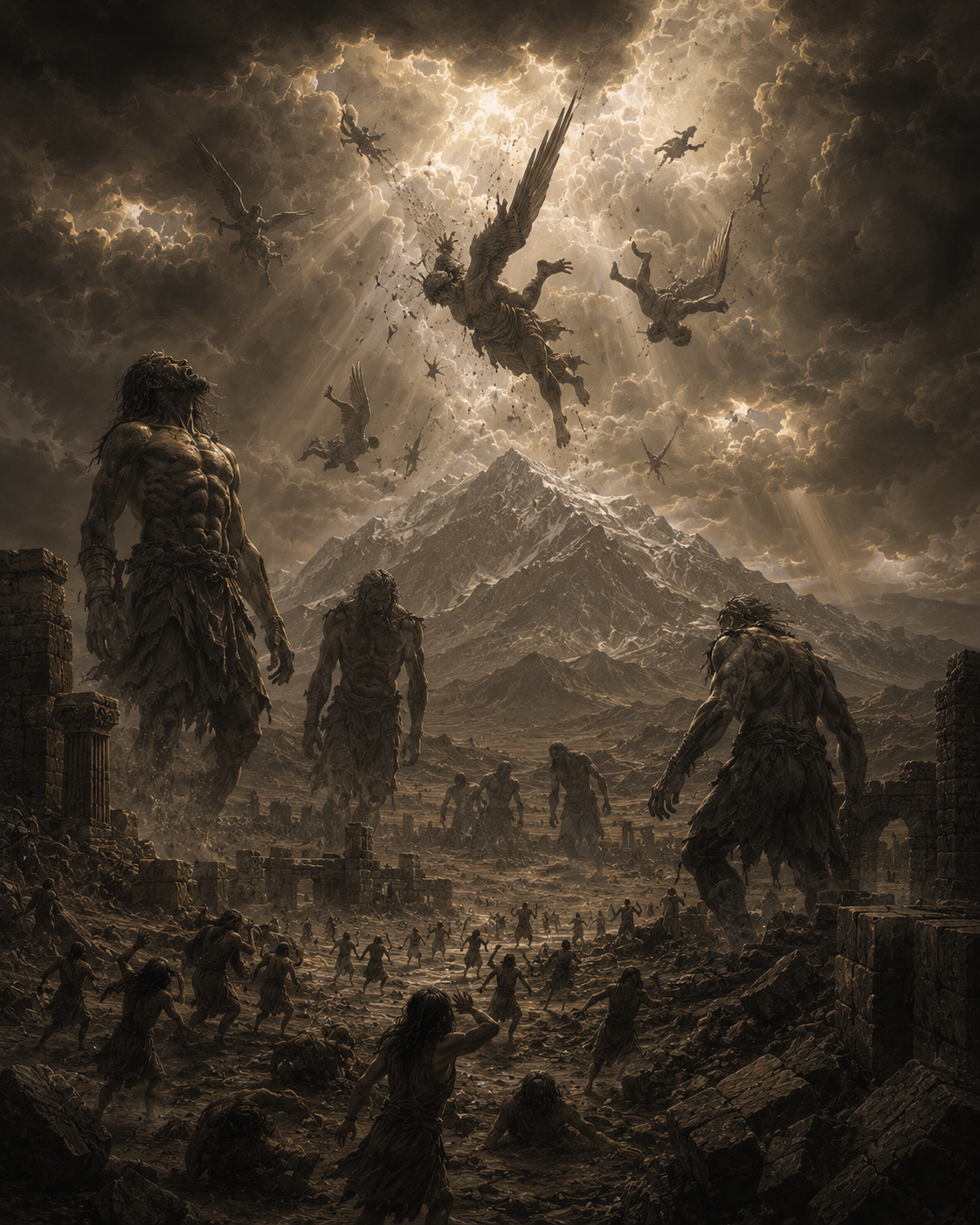
At this point, the Book of Enoch fills a gap left only briefly in the biblical text. It is not part of the biblical canon, yet it cannot be treated as an insignificant document within early Jewish and Christian tradition. According to this tradition, angels who saw the beauty of the daughters of men chose wives for themselves and conspired to produce offspring. Their leader, called Semihazah or Shemihazah, feared that the act might become an unforgivable evil, but the angels who joined him bound themselves together with oaths and curses and carried out the plan. The tradition says that this group numbered two hundred and that they descended upon Mount Hermon. The name of the mountain itself became connected with the act by which they bound themselves through oath and curse, turning it into a symbol of the deviation, or fall, of higher beings.[3]
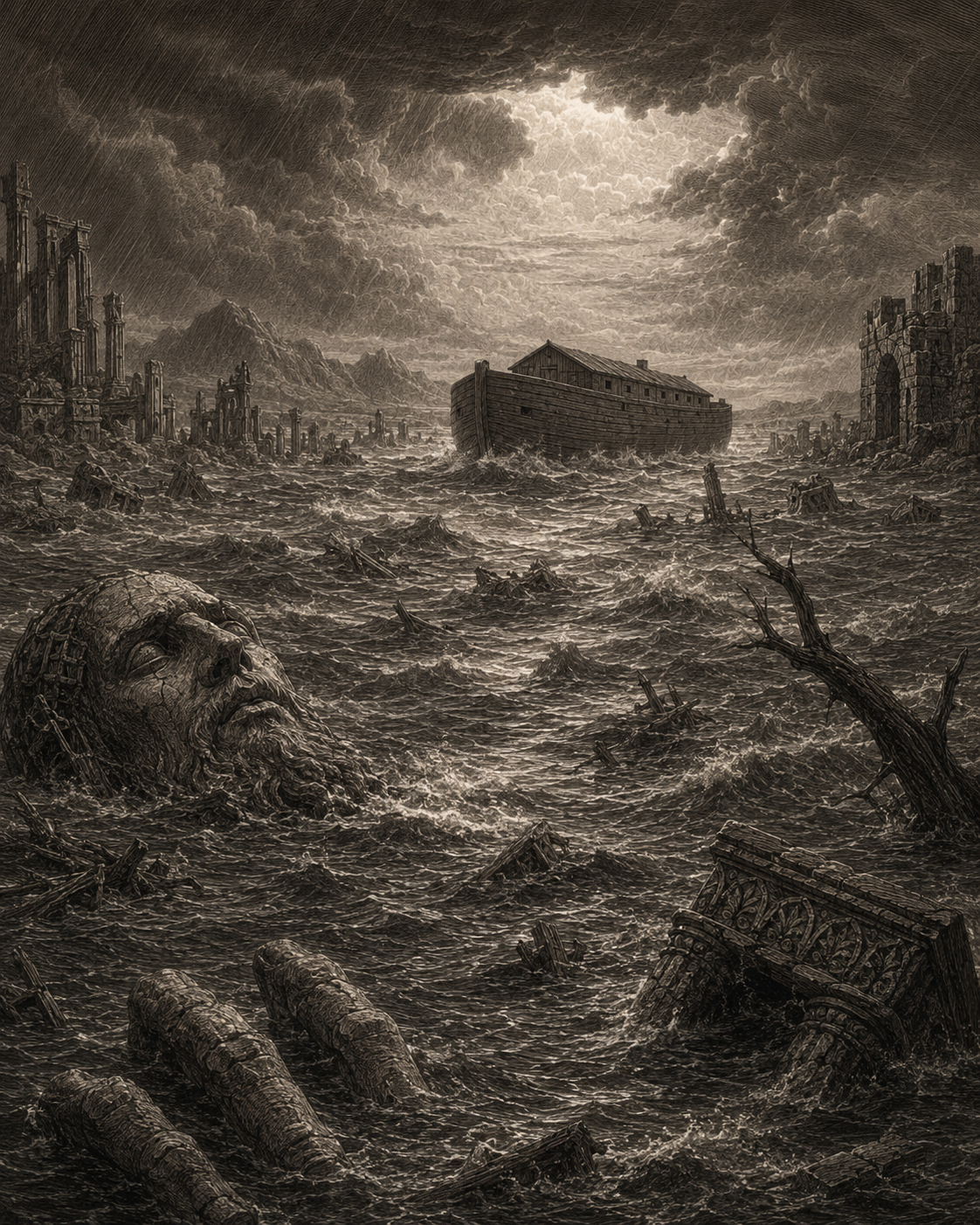
The giants described in Enoch are even more explicit. They first consumed the produce of humanity, but soon became beings that human strength could no longer sustain. When food was lacking, they devoured human beings. They sinned against animals, birds, fish, and reptiles, and became beings who drank blood. This account brings together the cannibalism of giant traditions, the image of devouring flesh, and the destruction of the order of life. As a result, the Absolute One, or the highest divine authority, appears as the judge of these unlawful beings. This judgment is connected to the Great Flood narrative. The flood, therefore, may be understood not merely as moral punishment, but as a cleansing of an order of life that had become too distorted to continue.
Wars among giants also appear repeatedly in myth. The giant conflicts of Norse mythology, the Titanomachy and the Gigantomachy of Greek myth, belong to different mythic systems, yet they show a recurring structure of conflict between divine lineage and giant-like lineage. These wars have different names in different regions, but at their center lies a similar pattern: beings who rebel against the order of heaven descend toward the earth, and the enormous descendants born from that crossing come to dominate or destroy the human world. The term Nephilim was connected in the Greek-speaking world with gigantes. The Greek Gigantes are generally understood as giant beings associated with the earth, and in the Hesiodic tradition they are described as beings born when the blood of Uranus fell upon the ground. Within this repeated symbolic pattern, the parallel is clear: heaven and earth are connected, and at the point of that connection stands the giant. This provides a symbolic basis for reading the giant as a being conceived through a higher power.
In Greek mythology, the Gigantes are often depicted as half-human and half-animal giants whose lower bodies are serpentine. The tradition in which Uranus is defeated by his son Cronus, and in which his blood falls upon the earth and gives rise to the Gigantes, has a striking structural resemblance to the biblical story of the Nephilim. A son rebels against the father; at the center of that rebellion stands the violation of sexuality and the body; and from the result of that violation, a giant lineage appears. Uranus was the primordial father god understood as heaven itself. Cronus castrated his father and seized kingship from him. The hidden structure of Scripture may be read alongside this same narrative pattern: the fall of higher beings, the rebellion that follows, and the fall represented by Eden. Different civilizations preserved fragments of the same symbolic structure under different names and images. As those fragments are traced, the back side of the event compressed within Scripture begins to appear within myth.
The etymology of a word cannot be reduced to a single certain possibility, yet it is symbolically interesting that Cronus is continued in the Latin Saturnus and the English Saturn. At the level of sound and symbolic imagery, Saturn has often invited comparison with Satan, and the structure of a son-god rebelling against the father also resonates with the biblical narrative of the fall. This symbolic interpretation does not treat the connection as a simple linguistic identity. What matters is the direction repeatedly preserved by many civilizations: rebellion against the authority of the father, the collapse of sexual boundaries, the emergence of a giant lineage, and the wars and judgments brought about by that lineage. The origin of the giants must be read within this structure.
Notes
[1] Matthew 22:30 and Mark 12:25 compare the state of existence after the resurrection to that of angels, saying that in that state people neither marry nor are given in marriage. These passages do not directly explain the biological nature of angels, but they are often mentioned in Christian tradition when angels are understood as beings outside the human order of marriage and reproduction.
[2] Jude 1:6 speaks of angels who “did not keep their own position” but left their proper dwelling, while 2 Peter 2:4 also describes sinning angels as being held until judgment. These passages have often been read alongside the tradition of the “sons of God” in Genesis 6 and the Watcher tradition of Second Temple Judaism. See 1 Enoch 6–7; George W. E. Nickelsburg and James C. VanderKam, 1 Enoch: A New Translation (Fortress Press, 2004).
[3] According to the Enochic tradition, the Watchers swore together and bound themselves by a curse in order to unite with the daughters of men, and the place was called Mount Hermon. 1 Enoch 6:5–6 connects the name of the mountain with the event in which they swore and bound themselves there. See 1 Enoch 6:1–6; George W. E. Nickelsburg and James C. VanderKam, 1 Enoch: A New Translation (Fortress Press, 2004).
메타데이터
- post_id
- 1cd3cb2e4e17
- slug
- the-fall-of-higher-beings-and-the-giants-1cd3cb2e4e17
- url
- https://medium.com/@rlatlgma/the-fall-of-higher-beings-and-the-giants-1cd3cb2e4e17
- canonical_url
- https://medium.com/@rlatlgma/the-fall-of-higher-beings-and-the-giants-1cd3cb2e4e17
- author_url
- https://medium.com/@rlatlgma
- status
- ok
- fetched_at
- 2026-06-18 07:02:39