Food Chains and Food Webs
The Living World: Ecosystems and Biodiversity Part 6
Science Tutorials
Food Chains and Food Webs
The Living World: Ecosystems and Biodiversity Part 6
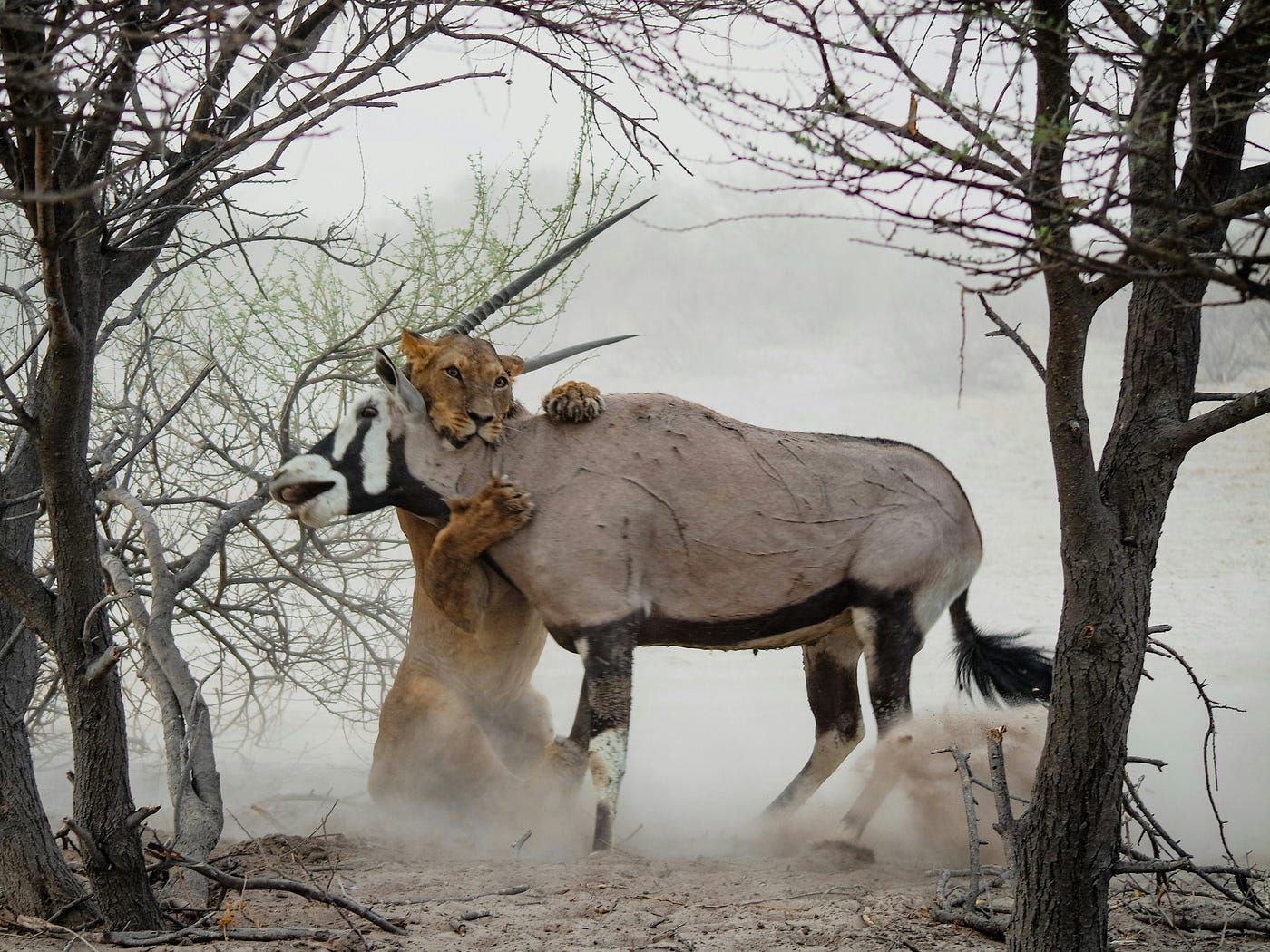
Photo by Thomas Evans on Unsplash
Food Chains and Food Webs
These are the living, biotic components of the Earth. Together, all of the living things on Earth constitute the biosphere.
All living things can be classified by how they obtain food. Plants and cyanobacteria are capable of making their own food through photosynthesis, and that some animals (for example, mice) eat plants. Some animals (for example, humans) eat both plants and animals, and some animals (for example, wolves) eat only other animals. There are two terms that are normally used to describe these broad categories of organisms: autotrophs — organisms that can produce their own organic compounds from inorganic chemicals, while heterotrophs obtain food energy by consuming other organisms or products created by other organisms.
Some animals feed only on the remains of other plants and animals! All of these different types of living things fall into specific categories.
Producers
Producers are organisms that are capable of converting radiant energy or chemical energy, into carbohydrates. The group of producers includes plants and algae, both of which can carry out photosynthesis. The overall reaction of photosynthesis is below:

While most producers make food through photosynthesis, a few autotrophs make food from inorganic chemicals in anaerobic (without oxygen) environments, through the process of chemosynthesis. Chemosynthesis is only carried out by a few specialized bacteria, called chemotrophs, some of which are found in hydrothermal vents deep in the ocean. This unbalanced reaction is shown below:

Some Environmental Science Terms
Net Primary Productivity (NPP)
This is the amount of energy that plants pass on to the community of herbivores in an ecosystem. It is calculated by taking the Gross Primary Productivity, which is the amount of sugar that the plants produce in photosynthesis, and subtracting from it the amount of energy that the plants need for growth, maintenance, repair, and reproduction. NPP is measured in kilocalories per square meter per year (kcal/m²/y). The Gross Primary Productivity of an ecosystem is the rate at which the producers are converting solar energy to chemical energy (or, in a hydrothermal ecosystem, the rate of productivity of the chemotrophs.) The Net Productivity of an ecosystem is a limiting factor for its number of consumers. A limiting factor is a factor that controls a population’s growth. It can be many things; space, available food, water, nutrients, and the net productivity of an ecosystem.
Consumers
Consumers are organisms that must obtain food energy from secondary sources, for example, by eating plant or animal matter. There are a number of different types of consumers.
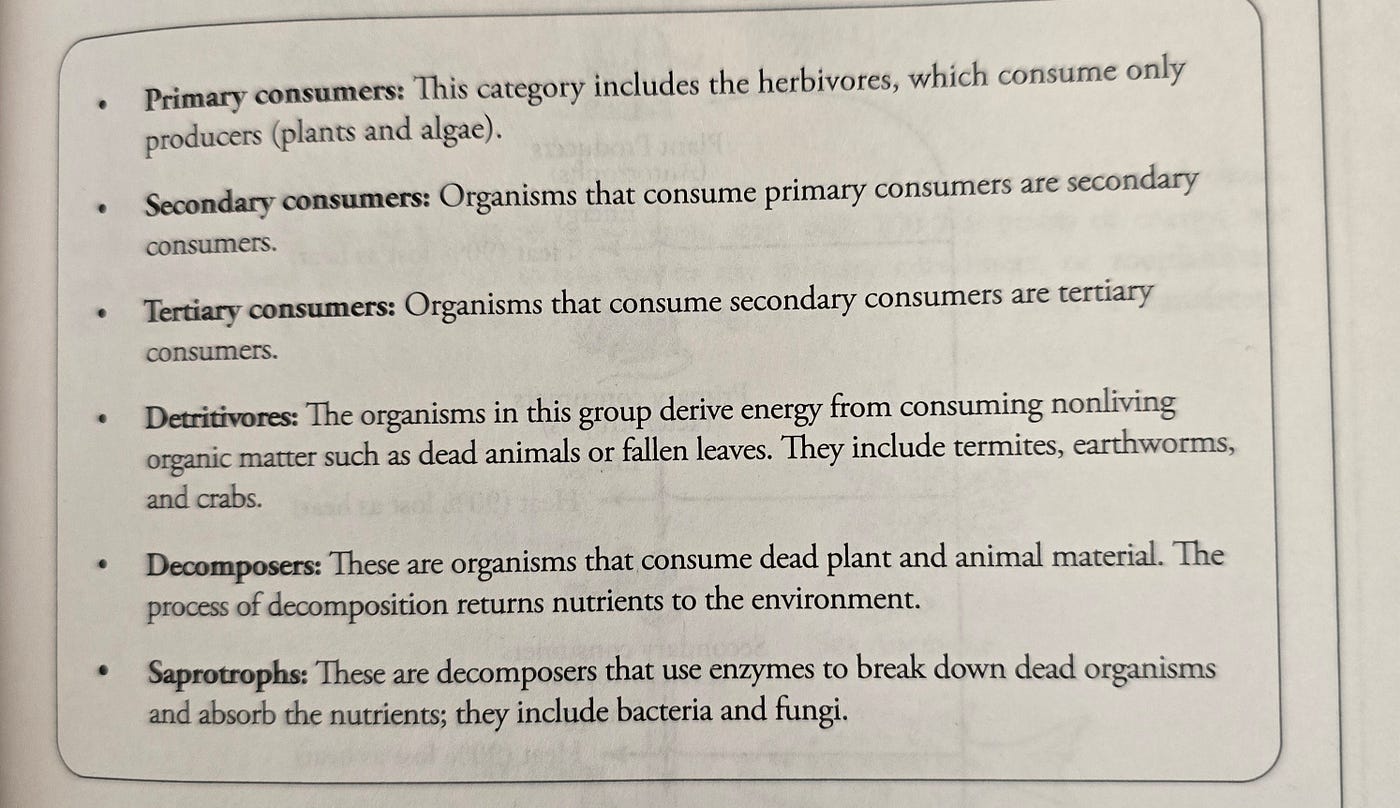
One organism may occupy multiple levels of a food chain. A human that eats a hamburger with toppings, they are a primary consumer because they are eating tomatoes and lettuce, and a secondary consumer by eating the beef.
Food Chains
Energy flows in one direction through ecosystems: from the Sun to producers, to primary consumers, to secondary consumers, to tertiary consumers. In an ecosystem, each of these feeding levels is referred to as a trophic level. With each successive trophic level, the amount of energy that’s available to the next level decreases. The laws of thermodynamics dictate that only about 10 % of the energy from one trophic level is passed to the next; most is lost as heat, and some is used for metabolism and anabolism. This is why the food chains rarely have more than four trophic levels.
Food chains are usually represented as a series of steps, in which the bottom step is the producer and the top step is a secondary or tertiary consumer. In food chains, the arrows depict the transfer of energy through the levels, and in fancier food chains, the relative biomass (the dry weight of the group of organisms) of each trophic level will often be represented.
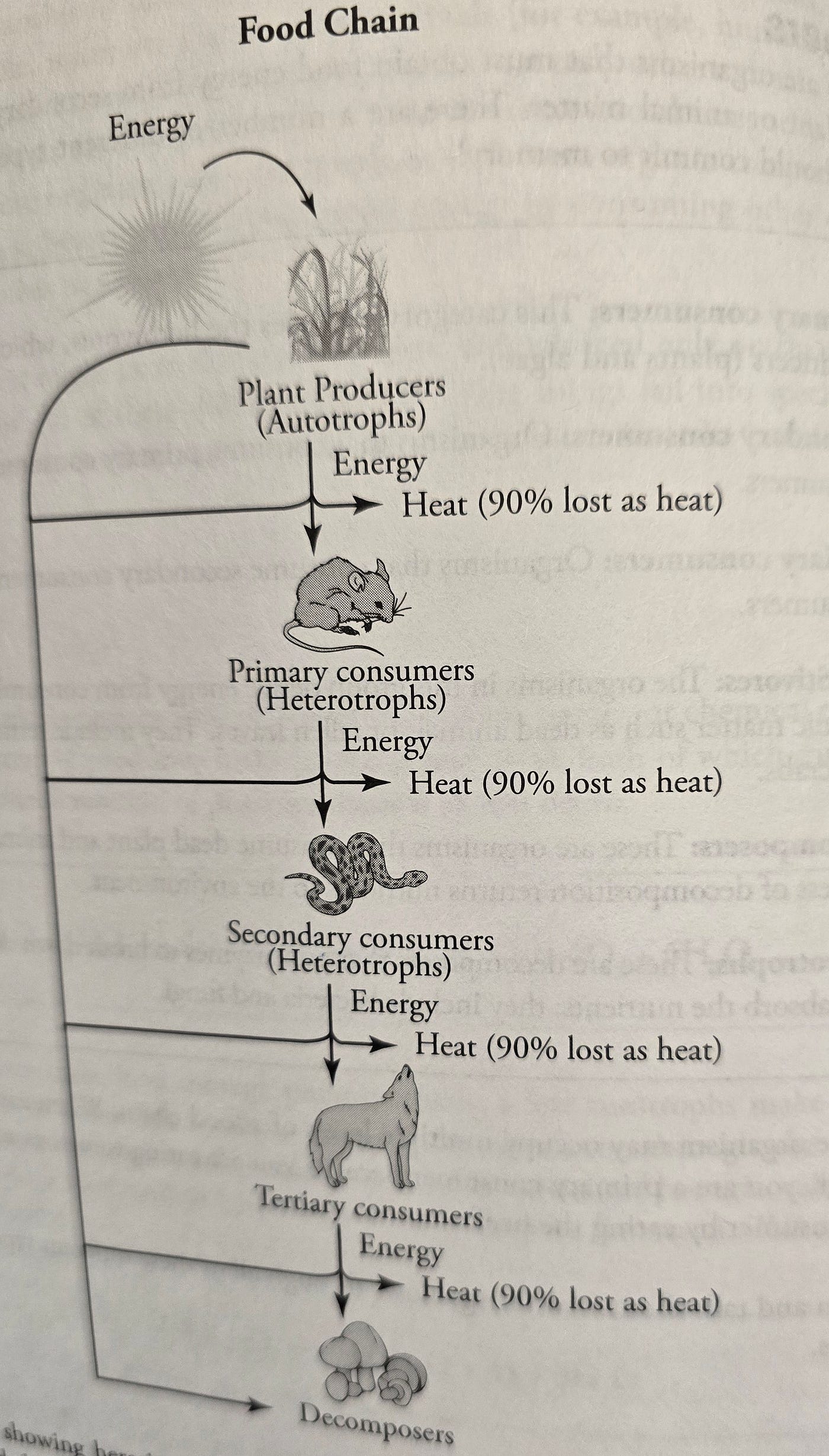
Above is a typical terrestrial food chain. However, there are also aquatic food chains, that contain algae and different types of fish.
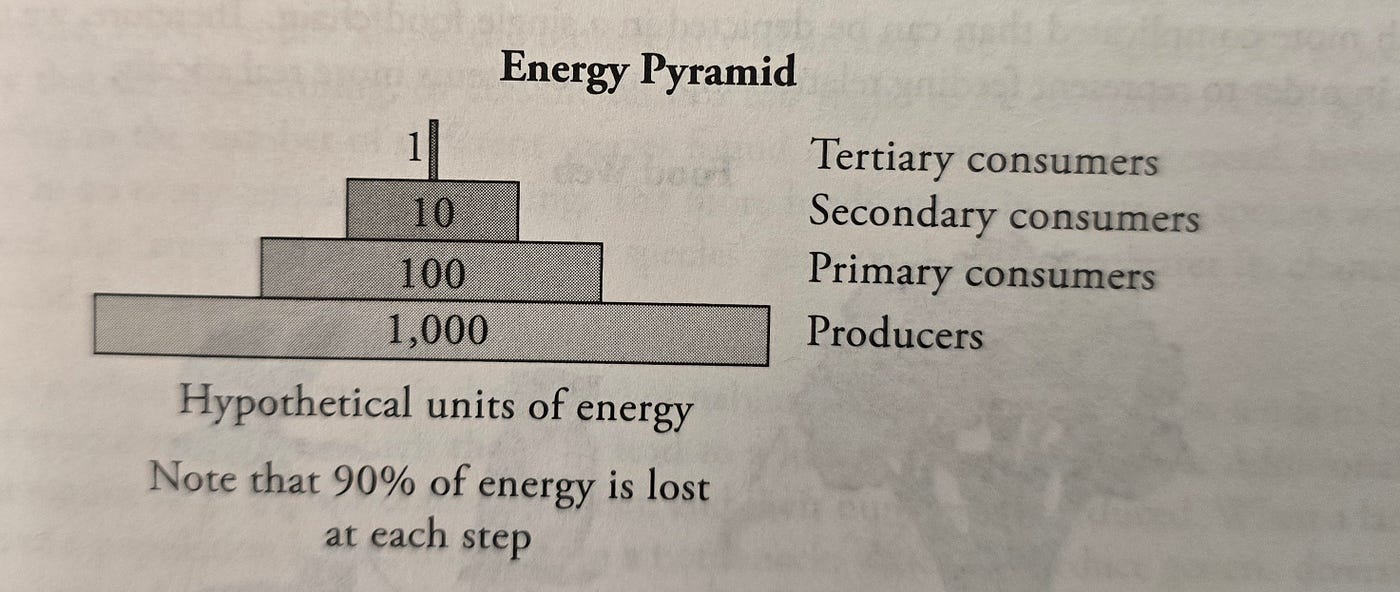
In a food chain, only about 10% of the energy is transferred from one level to the next. The other 90% is used for things like respiration, digestion, running away from predators- that is, it’s used to power the organism doing the eating! This is known as the 10% rule. The producers have the most energy in an ecosystem; the primary consumers have less energy than the producers; the secondary consumers have less energy than the primary consumers; and the tertiary consumers with have the least energy of all. The amount of energy (in kilocalories) available at each trophic level organized from greatest to least is an energy pyramid.
Food Webs — Tangled Food Chains
Food chains are an oversimplified way of demonstrating the myriad feeding relationships that exist in ecosystems. Because there are so many different types of species of plants and animals in ecosystems, their relationships in real-world ecosystems are much more complicated that can be depicted in a single food chain. We use a food web in order to represent feeding relationships in ecosystems more realistically.
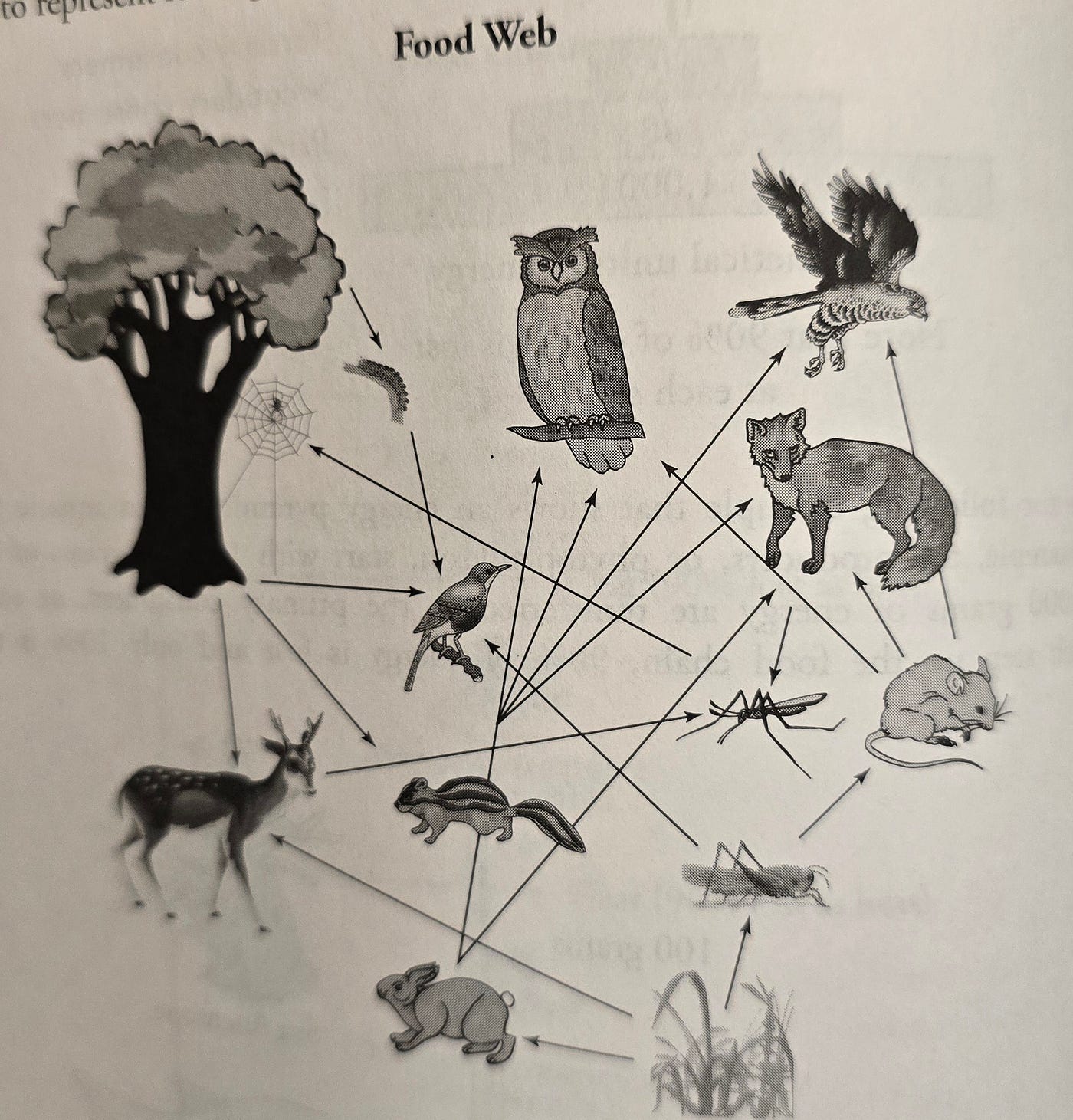
When something changes in an ecosystem, the effects of that change can quickly spread, partly because food webs link together. Food webs contain positive and negative feedback loops, so that when one species is added or removed, the rest of the food web is removed,
References and Further Reading
[embed]Food Chain The food chain describes who eats whom in the wild.education.nationalgeographic.org
메타데이터
- post_id
- 1cf7bfbf1c3b
- slug
- food-chains-and-food-webs-1cf7bfbf1c3b
- url
- https://medium.com/@Erin23/food-chains-and-food-webs-1cf7bfbf1c3b
- canonical_url
- https://medium.com/@Erin23/food-chains-and-food-webs-1cf7bfbf1c3b
- author_url
- https://medium.com/@Erin23
- status
- ok
- fetched_at
- 2026-06-10 12:26:30