I Almost Spent $849 on an Espresso Machine Without Reading This
The Breville Barista Pro is excellent. It’s also $400 more expensive than advertised — once you do the math honestly.
I Almost Spent $849 on an Espresso Machine Without Reading This
The Breville Barista Pro is excellent. It’s also $400 more expensive than advertised — once you do the math honestly.
Let me tell you about the number three.
Not in any mystical sense. Just — the number that kept showing up when I ran the actual cost of owning a Breville Barista Pro across twelve months. Three seconds (the headline warm-up claim). Thirty seconds (the real warm-up time). Three hundred dollars (the rough midpoint of what you’ll spend on accessories and maintenance before the year is out).
I’m not here to bury the machine. It’s genuinely good. But I’ve watched too many people — myself included, nearly — walk into a purchase like this with the marketing math and walk out needing the real math. So here it is.
──────────────────────
The 3-Second Claim and What It Doesn’t Include
──────────────────────
The ThermoJet heating system is the Barista Pro’s flagship feature, and the 3-second figure is real. Water exits the heating element at proper brewing temperature — around 93°C — in approximately three seconds after you switch the machine on. Breville isn’t lying.
Physics, however, doesn’t care about marketing copy.
The 54mm stainless steel portafilter and the group head — the metal parts that coffee actually touches during extraction — are still at whatever temperature your kitchen is. In winter in a drafty apartment, that might be 18°C. Your water hits metal that’s 75 degrees colder than it needs to be, loses thermal energy almost immediately, and what ends up in your cup is under-extracted and sour in a way that makes you wonder if you bought bad beans.
The fix, well-documented across Home-Barista.com and the r/espresso community, is to run a blank shot before you brew — water only through the empty portafilter, which warms up the metal path. This takes 20–30 seconds. For light roasts specifically, waiting 60–90 seconds after that gives the PID time to reach stable operation, which is when you actually start tasting what your beans are capable of.
So: practical startup is closer to 35 seconds, with another minute or two if you’re serious about light roasts. Still faster than the thermocoil machines the Barista Pro competes against. But different from three seconds in a way that matters for how you’ll actually use this machine on a Tuesday morning.
──────────────────────
The Grinder Upgrade Nobody Advertised
──────────────────────
In October 2020, Breville acquired Baratza — a Seattle-based grinder company with a reputation for consistent, repairable, specialty-focused machines — for $60 million. The acquisition was well-covered in coffee media. What was less covered is what Breville eventually did with it.
Starting in 2023, Barista Pro units began shipping with what Breville markets as “Baratza European Precision Burrs.” CoffeeGeek’s Mark Prince confirmed these are the M2 burr set — the same burrs found in the Baratza Virtuoso and Encore ESP, manufactured by Etzinger in Switzerland.
The practical difference between M2 burrs and the earlier Breville-sourced burrs is a more unimodal particle distribution — which is a technical way of saying fewer very fine particles and fewer very coarse ones, with more grounds clustered around the target size. In a cup, this translates to cleaner flavour and better extraction consistency, especially with lighter roasts that punish imprecise grinding.
If you’re buying second-hand, the manufacture date matters more than almost anything else. Pre-2023 units grind fine. Post-2023 units grind noticeably better.
──────────────────────
The 30 Settings vs. 8 Settings Problem
──────────────────────
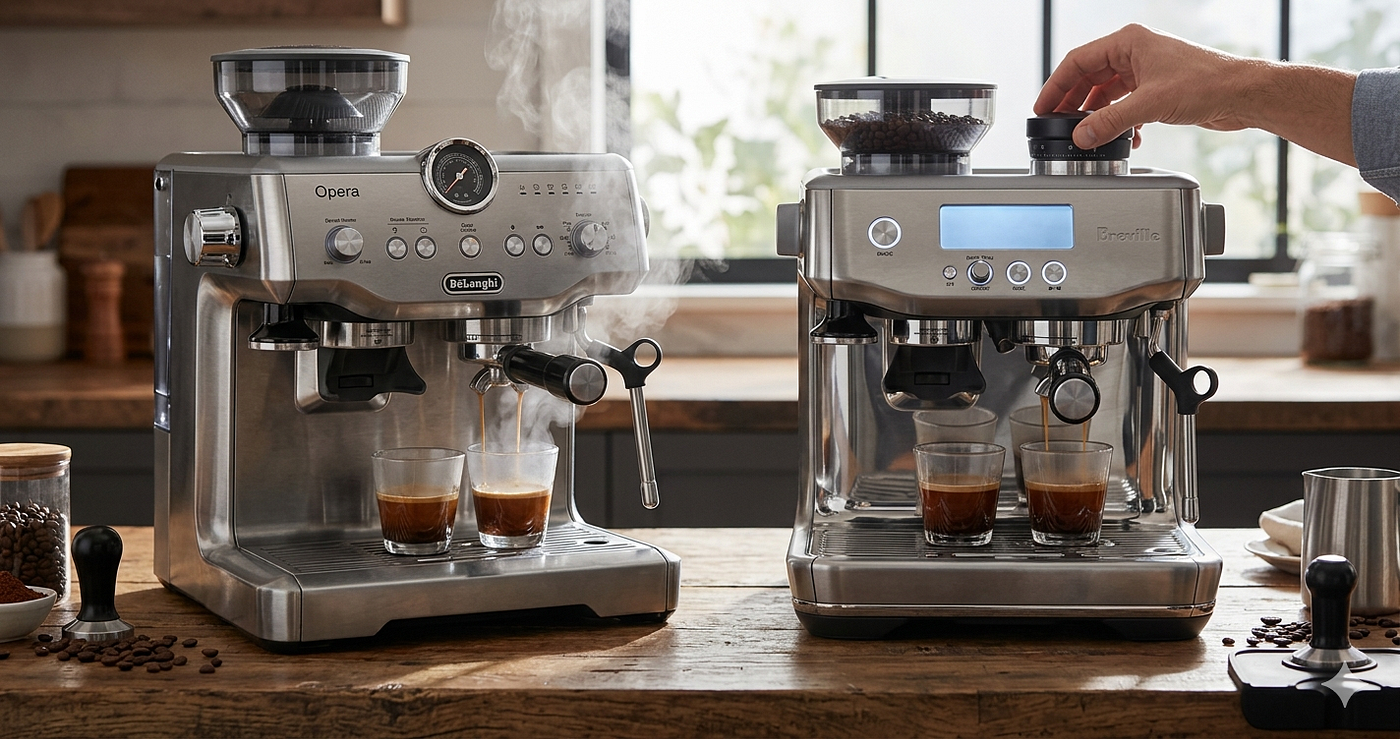
The Barista Pro offers 30 digital grind positions. The De’Longhi La Specialista Arte EC9155 — the Barista Pro’s main competitor in the sub-$900 bracket — offers 8.
For medium and dark roasts, 8 is probably enough. You dial it in once, leave it there, and get on with your life. For light roasts and single-origin specialty beans, 8 positions is like trying to tune a guitar with a wrench. You’ll get close to in tune. You will not get there.
The Barista Pro also allows internal burr calibration for edge cases that fall outside even the 30-position range — something that sounds esoteric until you’ve spent a week trying to coax a natural-process Ethiopian into something drinkable.
──────────────────────
The Actual Cost of Owning This Machine
──────────────────────
Here is where I want to be blunt, because this is the part of almost every espresso machine review that gets softened into uselessness.
The purchase price — sub-$679 on sale, sub-$849 at full retail — is not the cost of the machine. It’s the cost of the machine arriving on your doorstep.
After that:
A precision scale costs $15–50. The machine includes a timed dosing function, but bean density and freshness cause enough variation that timed doses can swing ±2g, which is the difference between a shot you’re proud of and one you dump down the sink.
A knock box costs $30–45. Without one, you’re banging a wet coffee puck into your kitchen bin while the portafilter drips on everything.
A WDT tool costs $20–50. The integrated grinder clumps — all integrated grinders clump — and a needle distribution tool breaks those clumps before they channel during extraction. Skipping this is a real option. Your consistency will suffer for it.
A bottomless portafilter costs $50–100. This one is optional in a different sense: it’s a diagnostic tool, not a daily essential. But if you’re trying to learn, watching extraction through the bottom of the portafilter tells you more about your puck preparation in ten seconds than three months of guessing.
Annual consumables add $95–120 for DIY maintenance — water filters, cleaning tablets, descaling powder. Add professional servicing and that becomes $300–410.
First-year realistic total: somewhere between $950 and $1,400 depending on which accessories you buy and how intensive your use is.
Out-of-warranty, Breville’s flat-rate repair programme typically runs $250–455. Community reports — and there are a lot of them on Home-Barista.com — suggest the rate doesn’t flex much based on what’s actually wrong. A minor sensor issue gets priced similarly to a ThermoJet replacement. That’s a known risk worth pricing in before purchase.
──────────────────────
Who This Machine Is Actually For
──────────────────────
The Barista Pro is a genuinely excellent machine for someone who wants one appliance that handles grinding and brewing, values fast workflow in the morning, and is serious enough about coffee to learn but not yet at the level where they want to maintain three separate pieces of equipment.
The LCD shot timer is better than it sounds. Being able to watch your shot time in real time — rather than squinting at a separate timer while also trying to watch the cup — is a small quality-of-life improvement that makes dialling in considerably less frustrating.
The PID temperature control creates consistency that cheaper machines can’t reliably match, and paired with the post-2023 M2 burrs, the extraction quality ceiling is meaningfully higher than the competition at this price point.
It is not the machine for someone who:
· Is primarily a dark-roast drinker who wants strong, simple espresso and doesn’t want to think about particle distribution
· Cares deeply about repairability (the De’Longhi Arte EC9155 is $300–550 cheaper; the modular Bambino Plus + Baratza Encore ESP combo offers more upgrade flexibility)
· Is buying a second-hand unit without checking the manufacture date first
──────────────────────
The Alternative Worth Knowing
──────────────────────
The setup that coffee nerds often quietly recommend: a Bambino Plus (around $500) paired with a standalone Baratza Encore ESP (around $230). That’s approximately $730 — potentially cheaper than the Barista Pro at full retail, depending on when you catch it on sale.
The advantages: each component can be repaired or upgraded independently. The Bambino Plus is a better steaming machine for milk drinks. The Encore ESP is dedicated to grinding and therefore better at it than any integrated grinder can be.
The disadvantages: two devices means two power cables, two footprints on your counter, and a slightly more involved workflow. For some people, that friction matters more than the technical advantages.
──────────────────────
The Actual Verdict
──────────────────────
Buy the Barista Pro if you understand the real startup time (35 seconds, not 3), have budgeted for the real cost (add $200–300 to your baseline), and are buying a post-2023 unit.
Skip it — or at least seriously consider the modular alternative — if repairability matters to you more than workflow simplicity, or if you’re a dark-roast drinker who doesn’t need 30 grind positions.
The machine does what it says. The fine print just lives in the blank-shot pre-heating routine, the accessory list, and the repair cost sheet. Now you’ve read it.
**Brew Precision publishes detailed espresso machine comparisons and buying guides.**
메타데이터
- post_id
- 1d195a2f2cc6
- slug
- i-almost-spent-849-on-an-espresso-machine-without-reading-this-1d195a2f2cc6
- url
- https://medium.com/@brewprecision/i-almost-spent-849-on-an-espresso-machine-without-reading-this-1d195a2f2cc6
- canonical_url
- https://medium.com/@brewprecision/i-almost-spent-849-on-an-espresso-machine-without-reading-this-1d195a2f2cc6
- author_url
- https://medium.com/@brewprecision
- status
- ok
- fetched_at
- 2026-07-15 02:14:29