The Real Stability Challenge in Large Robotic Milling: How You Hold the Part
Fixturing strategies that prevent deformation and vibration.
The Real Stability Challenge in Large Robotic Milling: How You Hold the Part
Fixturing strategies that prevent deformation and vibration.
Robotic-HiTech Solutions
When machining large parts with robots, it’s easy to focus on spindle speed, cutting tools, or robot model selection.
But ask any experienced integrator what causes unexpected dimensional issues, and the answer often points somewhere else:
The fixture.
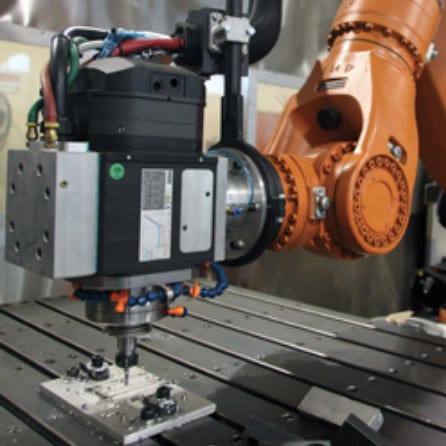
Large composite panels can store internal stress. Aluminum structures can flex slightly under clamping force. If the fixture over-constrains or under-supports the part, machining quality suffers — even if the robot path is perfect.
Vacuum systems work well for thin composites and large panels, providing even pressure distribution. Mechanical clamping offers stronger stability for heavy parts. In many real-world applications, hybrid solutions provide the best results.
The key is not maximum clamping force — it’s controlled and distributed support.
In robotic milling, part stability compensates for posture-dependent robot stiffness. When fixturing is engineered correctly, the entire process becomes more predictable.
Before optimizing feed rates, optimize how the part is held.
FAQ’s
- Why is part holding critical in large robotic milling? Because even minor vibrations or shifts in the fixture can compromise accuracy, surface finish, and tool life.
2. What are the most common mistakes when securing large parts? Underestimating clamping forces, using inadequate fixtures, and ignoring thermal expansion effects.
3. How does poor stability affect productivity? It increases rework, slows down cycle times, and raises maintenance costs due to tool wear.
4. What technologies improve part stability in robotic milling? Modular fixturing systems, adaptive clamping, vibration‑damping materials, and real‑time monitoring sensors.
5. Can stability challenges be solved with software alone? No — simulation helps predict issues, but mechanical fixturing and process design remain essential.
Checklist
✓ Verify fixture rigidity and alignment before machining.
✓Apply sufficient clamping force without deforming the part.
✓ Use vibration‑damping pads or materials where possible.
✓ Monitor thermal expansion and adjust clamping strategy.
✓ Run a test cut to validate stability before full production.
Robotic-HiTech Solutions does not simply sell technology: it drives a new way of understanding manufacturing, where industrial precision meets creativity. Its work reflects the future of automation: robots capable of producing, sculpting, building, and expanding the limits of what is possible.
메타데이터
- post_id
- 1d2875ff1f10
- slug
- the-real-stability-challenge-in-large-robotic-milling-how-you-hold-the-part-1d2875ff1f10
- url
- https://medium.com/@robotichitechsolutions/the-real-stability-challenge-in-large-robotic-milling-how-you-hold-the-part-1d2875ff1f10
- canonical_url
- https://medium.com/@robotichitechsolutions/the-real-stability-challenge-in-large-robotic-milling-how-you-hold-the-part-1d2875ff1f10
- author_url
- https://medium.com/@robotichitechsolutions
- status
- ok
- fetched_at
- 2026-07-07 05:53:12