Why Warm Sake Might Be the Healthiest Drink You’re Not Having
The ancient Japanese art of nurukan — and what it does to your body, your skin, and your bathtub
Why Warm Sake Might Be the Healthiest Drink You’re Not Having
The ancient Japanese art of nurukan — and what it does to your body, your skin, and your bathtub
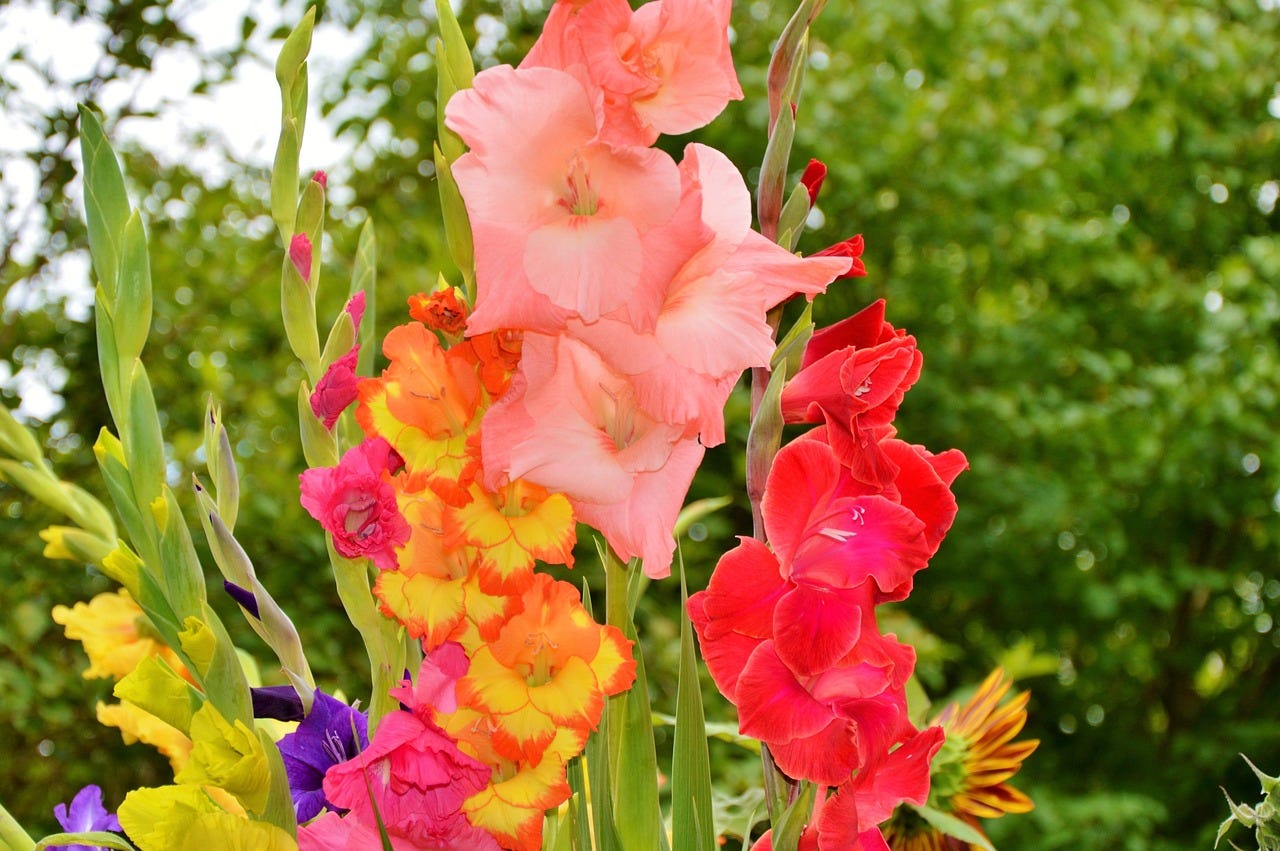
Photo by Mina Rad on Unsplash
Sake has been part of Japanese culture for over a thousand years. But while most people in the West encounter it cold or in a tiny cup at a sushi restaurant, there has always been an assumption in Japan that how you drink sake shapes the experience as much as the sake itself.
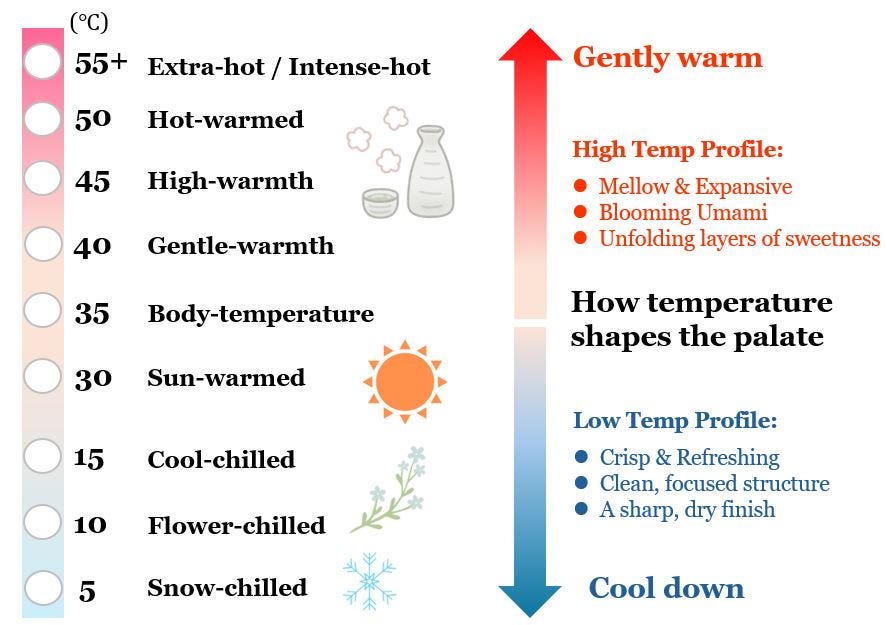
One winter evening, I poured myself a cup of nurukan (gentle warmth)— sake gently warmed to around 40–45°C — and felt something I hadn’t expected. The warmth settled into my chest slowly, and there was a quiet sense of comfort that a cold glass simply never gives me. It felt, honestly, like the drink was being kind to my body.
What struck me even more was what happened to the flavor. The same sake I had tried cold tasted almost like a different bottle. Warming it seemed to concentrate everything — the umami, the faint sweetness, a gentle dryness at the finish. It’s difficult to describe precisely, but the closest I can get is this: it tasted like the very essence of rice had been folded in on itself, dense and deeply satisfying in a way that cold sake rarely achieves. I want anyone reading this to try it at least once and find that out for themselves.
What happens when you warm sake to body temperature
Warming sake doesn’t just change its temperature — it transforms the drinking experience entirely. At nurukan, the heat gently opens up the sake’s aromatics, making the umami, sweetness, and subtle dryness far more perceptible than they are when cold. A sake that seems flat and one-dimensional straight from the fridge can reveal real complexity once warmed.
Beyond flavor, there is a physiological reason the Japanese consider this the gentle way to drink. When sake is served close to body temperature, the alcohol is absorbed more smoothly — your body doesn’t have to work as hard to process it. A useful rule of thumb is that nurukan should feel warm in the hand but never hot when you take a sip. If it feels hot, it has gone too far.
Cold drinks, on the other hand, cause the stomach to constrict slightly, slowing digestion and putting more strain on the gut lining over time. Warm sake does the opposite — it relaxes the digestive tract and is far kinder to people with sensitive stomachs. Think of it like the difference between gulping an icy drink on a winter morning versus wrapping your hands around something warm. Your body simply doesn’t have to fight it.
How to make nurukan at home
The traditional vessel for warming sake is called a tokkuri — a ceramic or porcelain flask with a narrow neck that slows the rate at which heat escapes. The shape is functional as much as it is beautiful: the constricted opening keeps the sake warm longer in the cup, and the narrow neck makes it easy to pour without spilling. If you ever visit Japan, you will find tokkuri in almost every izakaya, usually paired with small ceramic cups called ochoko.
If you don’t have a tokkuri at home, that is absolutely fine. What you need is something heat-safe, with a narrow neck — the shape matters more than the material. A few good alternatives to consider:
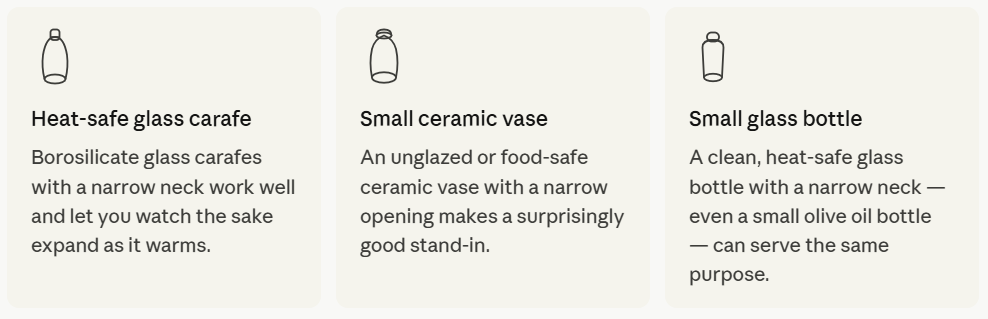
Recommended sake vessels for warm sake
One thing to avoid: wide-mouthed vessels like mugs or bowls. The sake cools too quickly, and you lose the gentle, sustained warmth that makes nurukan what it is.
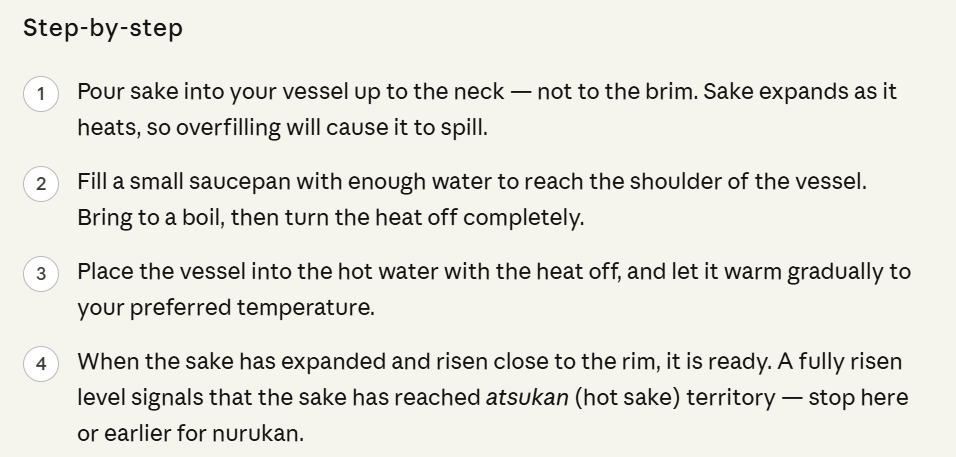
How to prepare warm sake
If you have a single-serving mini bottle (180ml) from Japan or a specialty retailer, you can skip the vessel entirely — simply open the cap slightly and place the bottle directly into the hot water bath.
The amino acid story — why sake is different from other alcohol
Because sake is brewed using rice koji, it naturally develops a remarkably rich profile of amino acids — far more than most other alcoholic beverages. You can see evidence of this in the market: Japan has a long tradition of sake-derived skincare, and a growing number of cosmetic brands now use fermented rice extracts as a core ingredient. That isn’t coincidence.
These amino acids contribute to sake’s well-documented moisturizing and warming properties. People who drink it regularly, or use it in baths, often notice that their skin feels noticeably more hydrated and that the warmth from sake lingers longer than that from plain hot water. Sake is also considered, from a traditional Japanese health perspective, to be a drink that warms rather than chills the body — a meaningful distinction in a culture that has long placed importance on keeping the body’s core temperature stable.
Kojic acid — an approved brightening ingredient
Among the compounds produced during sake’s fermentation process, kojic acid is perhaps the most studied. It works by inhibiting melanin production — helping to fade dark spots and even out skin tone over time.
In Japan, kojic acid has been formally approved as an active ingredient with demonstrated brightening efficacy. It is not simply a trend or a marketing claim — its effects have been evaluated and recognized through an official regulatory process. Walk into any Japanese drugstore or skincare aisle and you will find it listed as an active ingredient across a wide range of brightening products, from serums to lotions to face washes.
Beyond the glass — the Japanese sake bath ritual
Most people stop at drinking sake. But in Japan, the relationship between sake and the body goes much further — all the way to the bathtub.
Adding sake to a warm bath is a practice with a long history in Japan, and the reasoning is straightforward. Because sake is rich in amino acids from the rice koji fermentation process, soaking in sake-infused water is thought to leave the skin noticeably smoother and more hydrated. The warmth it produces also tends to linger — sake is considered beneficial for circulation and metabolism, which may explain why many people find that a sake bath leaves them feeling genuinely warmer for longer than a plain hot bath.
There is also a detoxifying dimension to it. Soaking slowly in warm sake-infused water is said to encourage the release of waste products through the skin, while the combination of warmth and the gentle properties of sake contributes to a deep sense of relaxation that is difficult to achieve any other way.
The preparation is simple: add two to three cups of sake — junmai (pure rice sake, with no added alcohol) is particularly recommended — to a slightly cooler than usual bath, and take your time. If you are sensitive to alcohol, start with one cup and see how your skin responds.
A note on yukimi-zake (snow-viewing sake) — drinking in the bath
In Japan, there is a tradition called yukimi-zake — literally “snow-viewing sake” — which refers to the quietly pleasurable act of sipping sake while soaking in a bath, a tray resting on the edge of the tub, a cup within easy reach. It is an unhurried, deeply restorative way to spend a winter evening, and judging by conversations I have had with friends in the US, the idea has already found a quiet following outside Japan.
If you try it, one gentle reminder: the combination of heat, steam, and alcohol is more potent than either alone. Keep it to a small cup, drink slowly, and treat it as a ritual rather than a drinking occasion. The goal is to feel restored — not to overindulge.

yukimi-zake (snow-viewing sake)
Sake has been quietly doing all of this for centuries — warming the body, nourishing the skin, turning an ordinary evening into something worth savoring. It just needed someone to explain why. I hope this gives you a new way to think about what’s in your cup. Whether you try nurukan for the first time this winter, or find yourself adding a splash to your bath out of curiosity, I’d love to know what you notice. The experience has a way of speaking for itself.
As someone who has spent years working in cosmetic development and holds the Sake Diploma, I write about sake where science, skincare, food, and ritual meet. There is still so much to explore.
메타데이터
- post_id
- 1d3aa52113da
- slug
- why-warm-sake-might-be-the-healthiest-drink-youre-not-having-1d3aa52113da
- url
- https://medium.com/@norikosake/why-warm-sake-might-be-the-healthiest-drink-youre-not-having-1d3aa52113da
- canonical_url
- https://medium.com/@norikosake/why-warm-sake-might-be-the-healthiest-drink-youre-not-having-1d3aa52113da
- author_url
- https://medium.com/@norikosake
- status
- ok
- fetched_at
- 2026-07-13 06:23:13