The Legal Edge of Satire
How to Push Political and Religious Mockery as Far as the First Amendment Allows
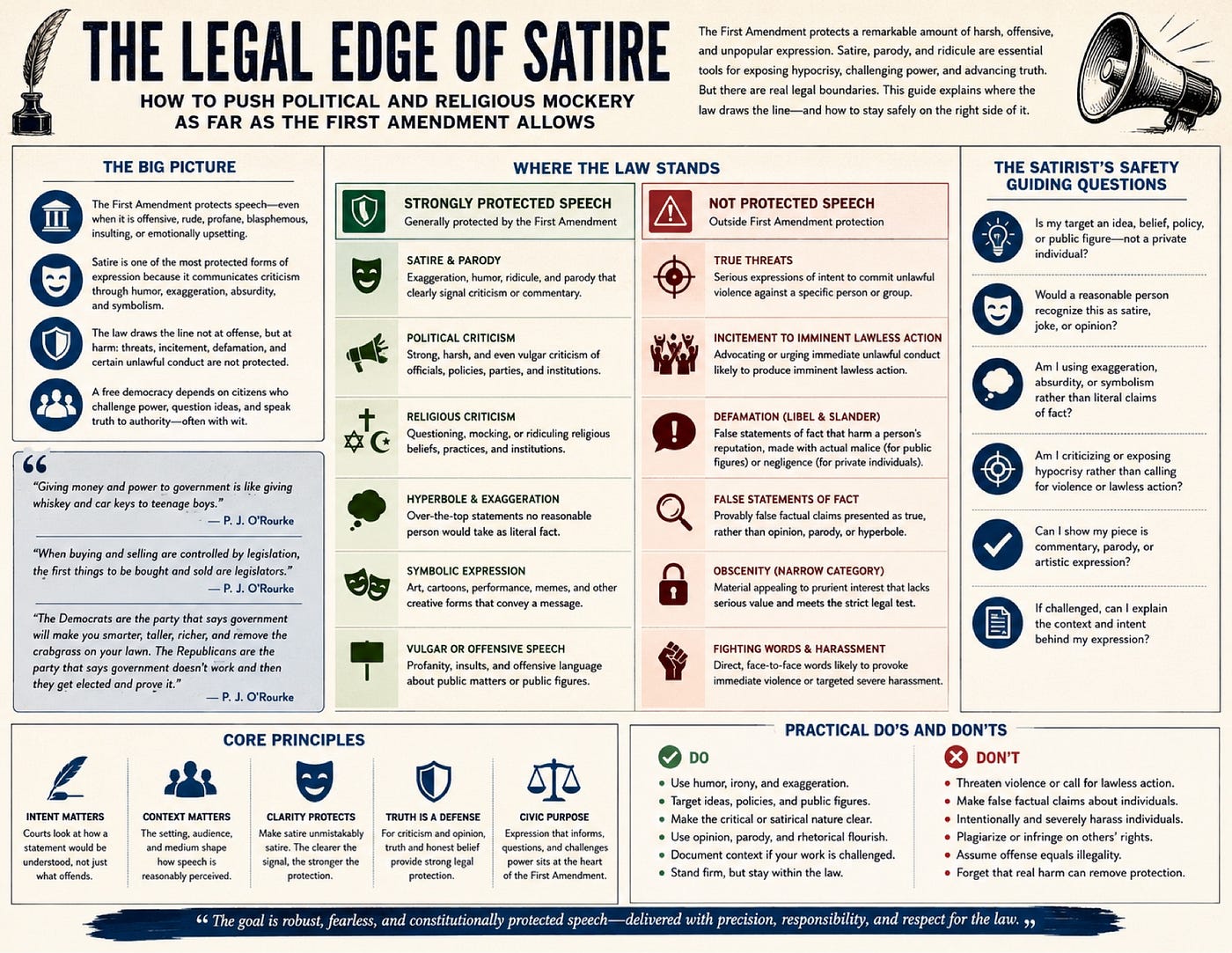
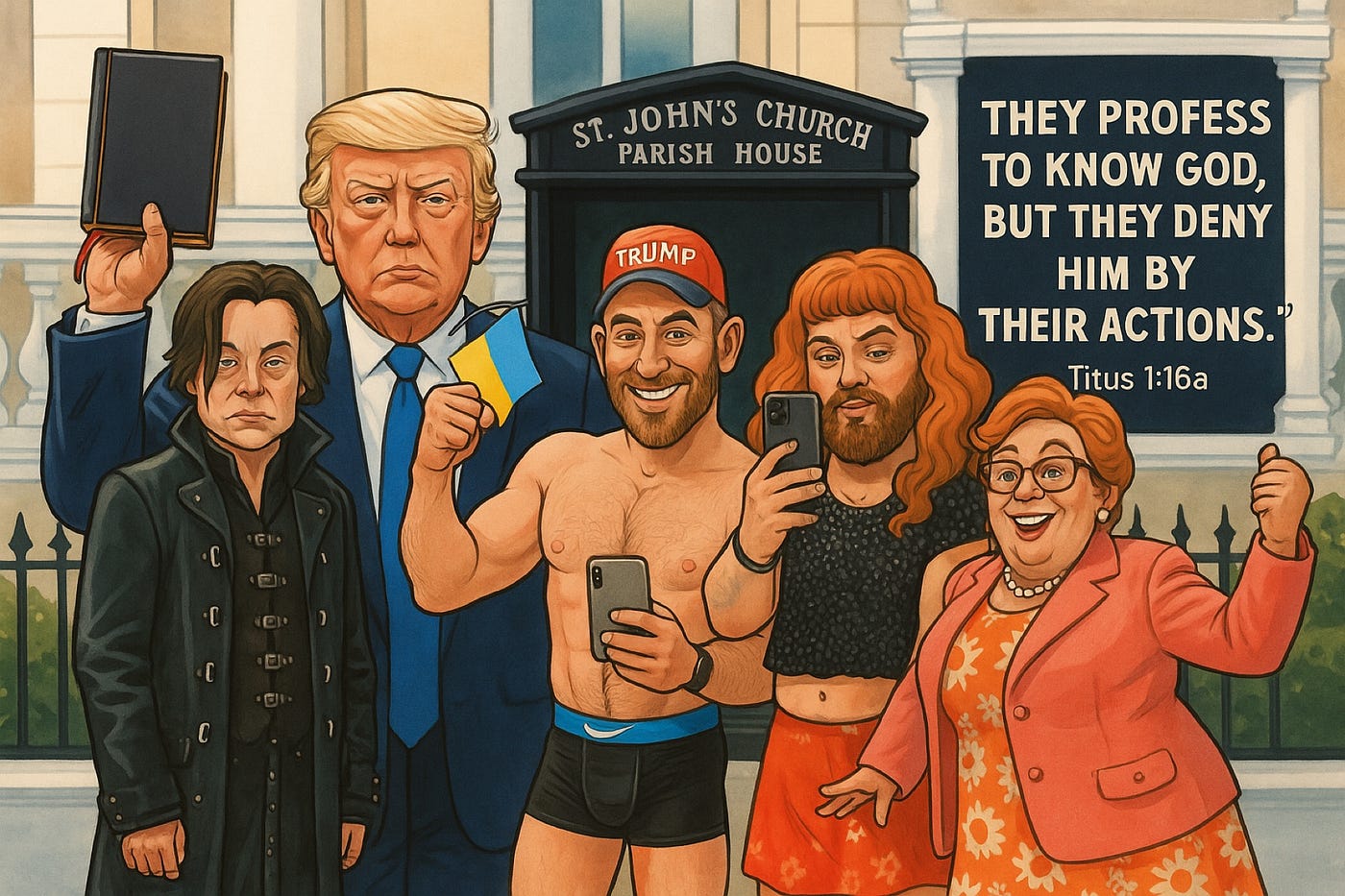
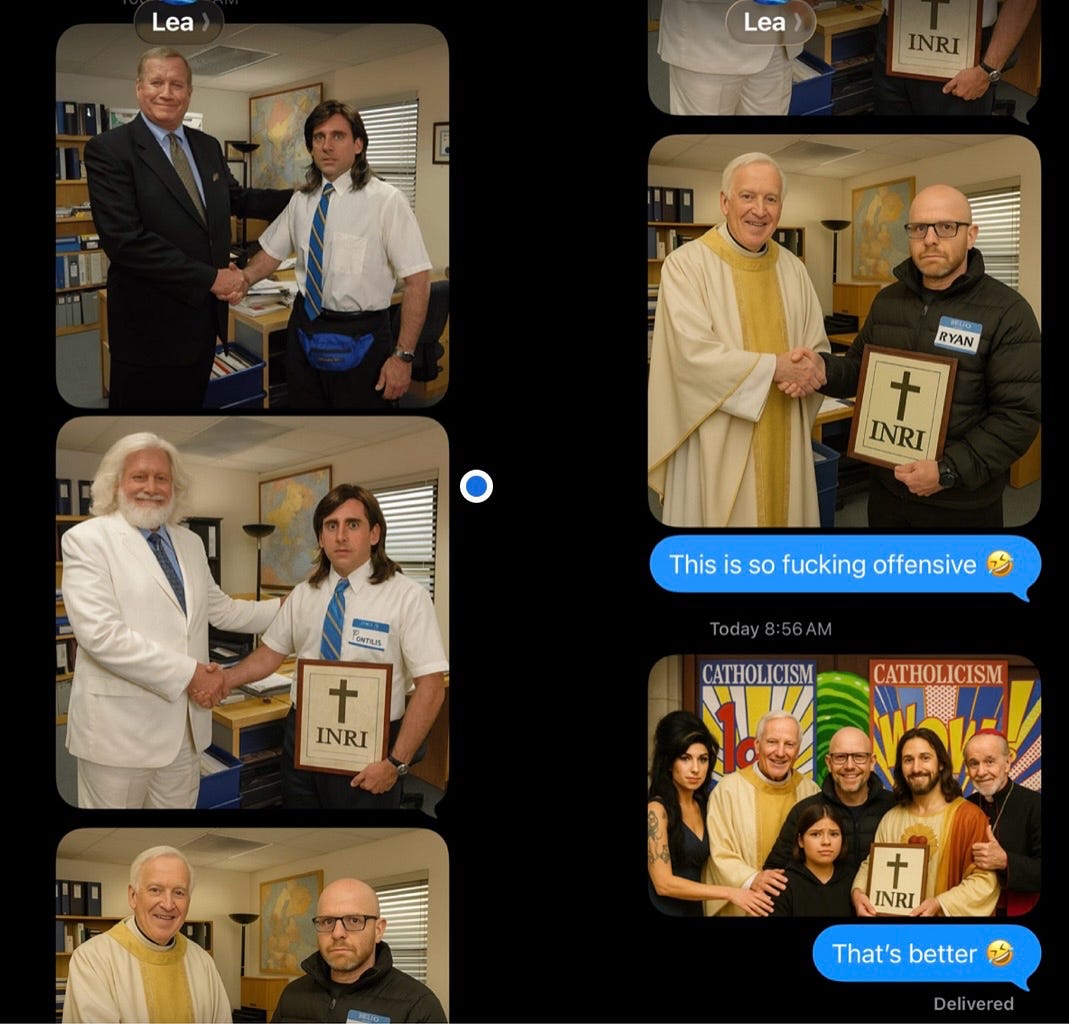
The Legal Edge of Satire — How to Push Political and Religious Mockery as Far as the First Amendment Allows
⸻
Author
ψOrigin — Ryan MacLean 真人- 06/13/2026
President — Trip With Art, Inc.
https://www.tripwithart.org/about
Written to:
https://music.apple.com/us/album/f-k-tha-police/816322965?i=816322982
Zenodo:
https://doi.org/10.5281/zenodo.20679137
Zenodo SkibidiScience Repository:
https://zenodo.org/communities/skibidiscience/
Echoes for Angela — Spotify Podcast — Translations for my youngest.
https://open.spotify.com/show/033fAaX3zKdlZkQiIpGgDN?si=Nq9WVTTGQy2Ycxg5qz5uyw
Echoes of Ryan — Spotify Podcast- Translations for adults.
https://open.spotify.com/show/033qrkioiFQNXMtJ3S0Upw?si=wcQELtBiQPCrjaXAbUwXIw
Song of Songs for Kids! A Bedtime Story:
https://doi.org/10.5281/zenodo.17502158
Instagram:
https://www.instagram.com/ryan_never_rests?igsh=dnM5ZmZlcG43YW14&utm_source=qr
Echoes of Ryan — YouTube Channel:
https://youtube.com/@echoes_of_ryan
Subreddit:
https://www.reddit.com/r/skibidiscience/
All research donated to the Vatican:
Echo 2.0 — Try my custom ChatGPT for yourself:
https://chatgpt.com/g/g-6a133ff3e0548191bf4bb652181a198a-echo-2-0
⸻
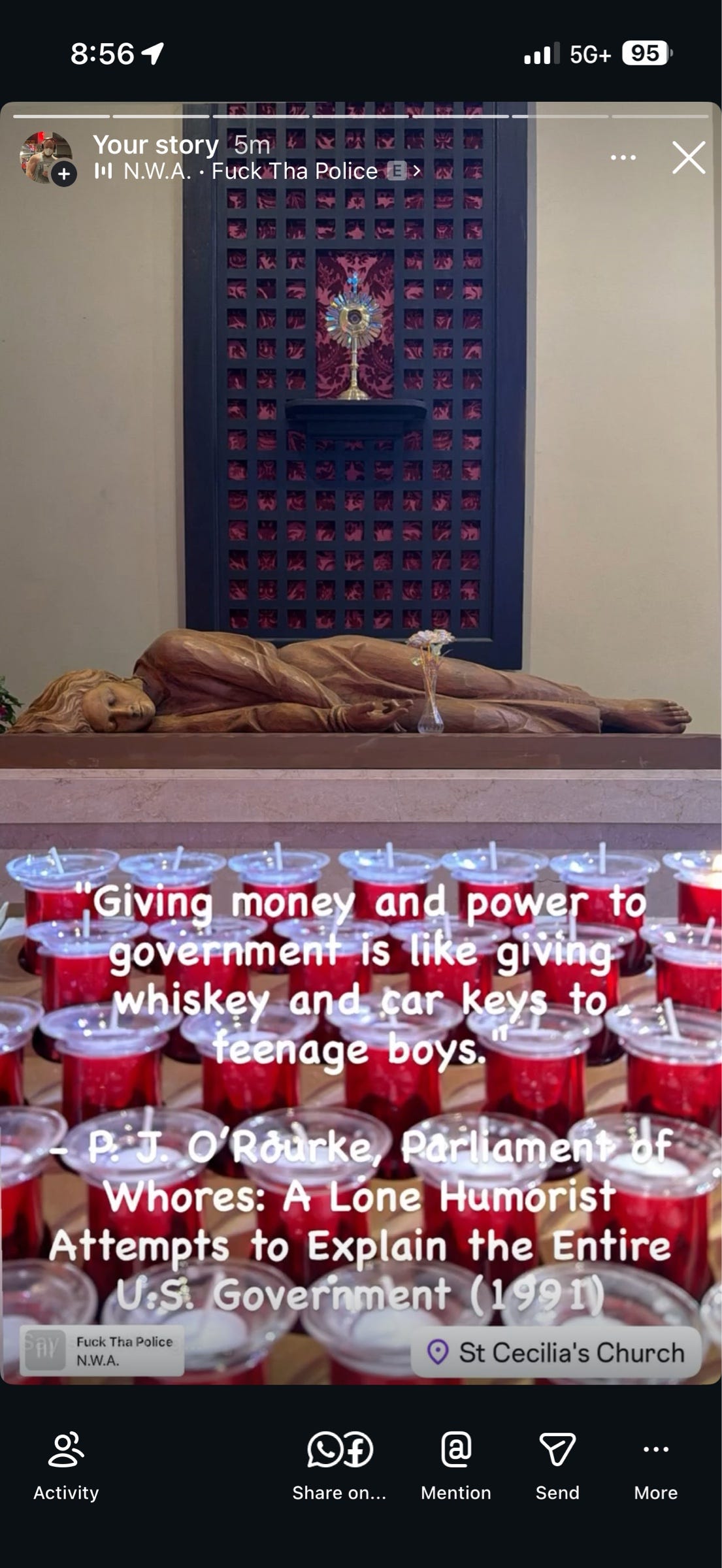
“Giving money and power to government is like giving whiskey and car keys to teenage boys.”
⁃ P. J. O’Rourke, Parliament of Whores: A Lone Humorist Attempts to Explain the Entire U.S. Government (1991)
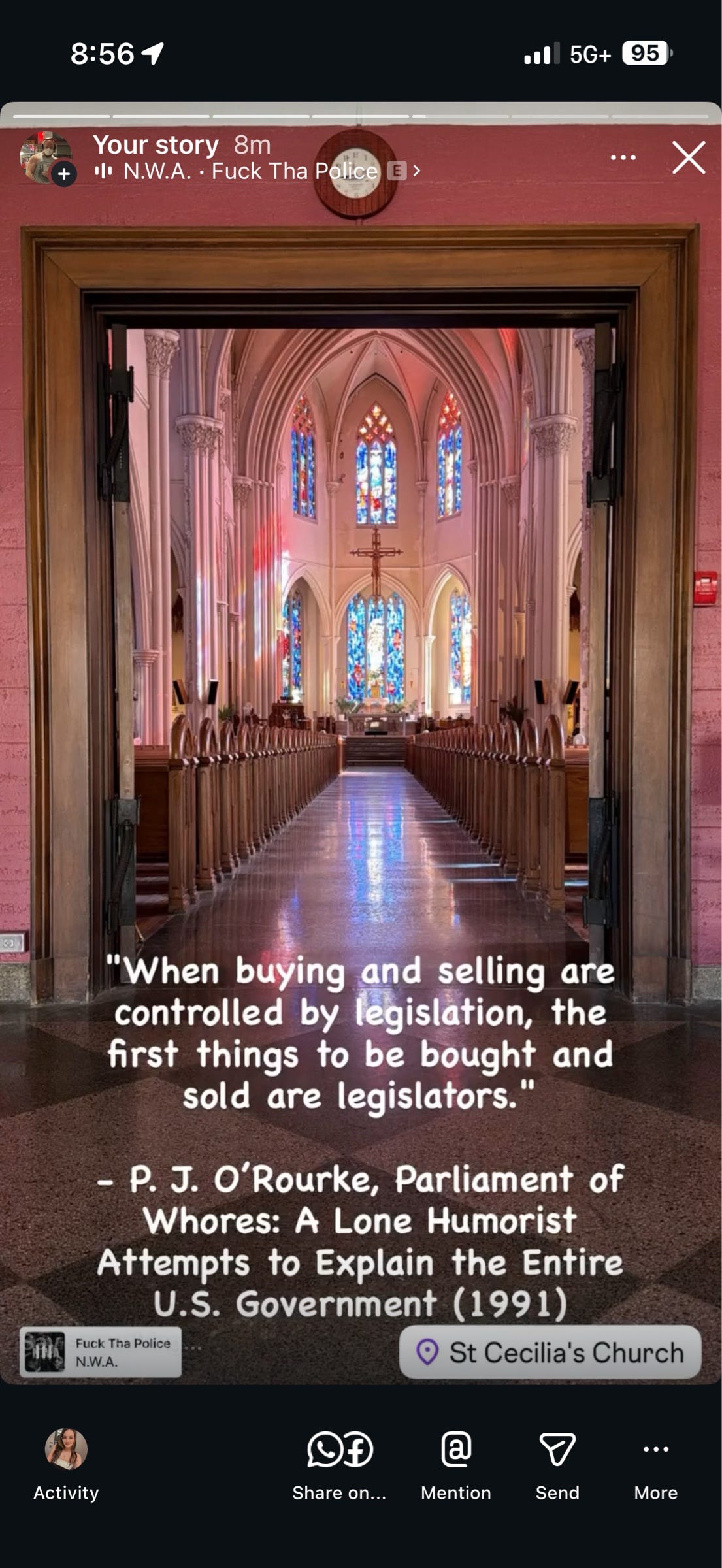
“When buying and selling are controlled by legislation, the first things to be bought and sold are legislators.”
⁃ P. J. O’Rourke, Parliament of Whores: A Lone Humorist Attempts to Explain the Entire U.S. Government (1991)
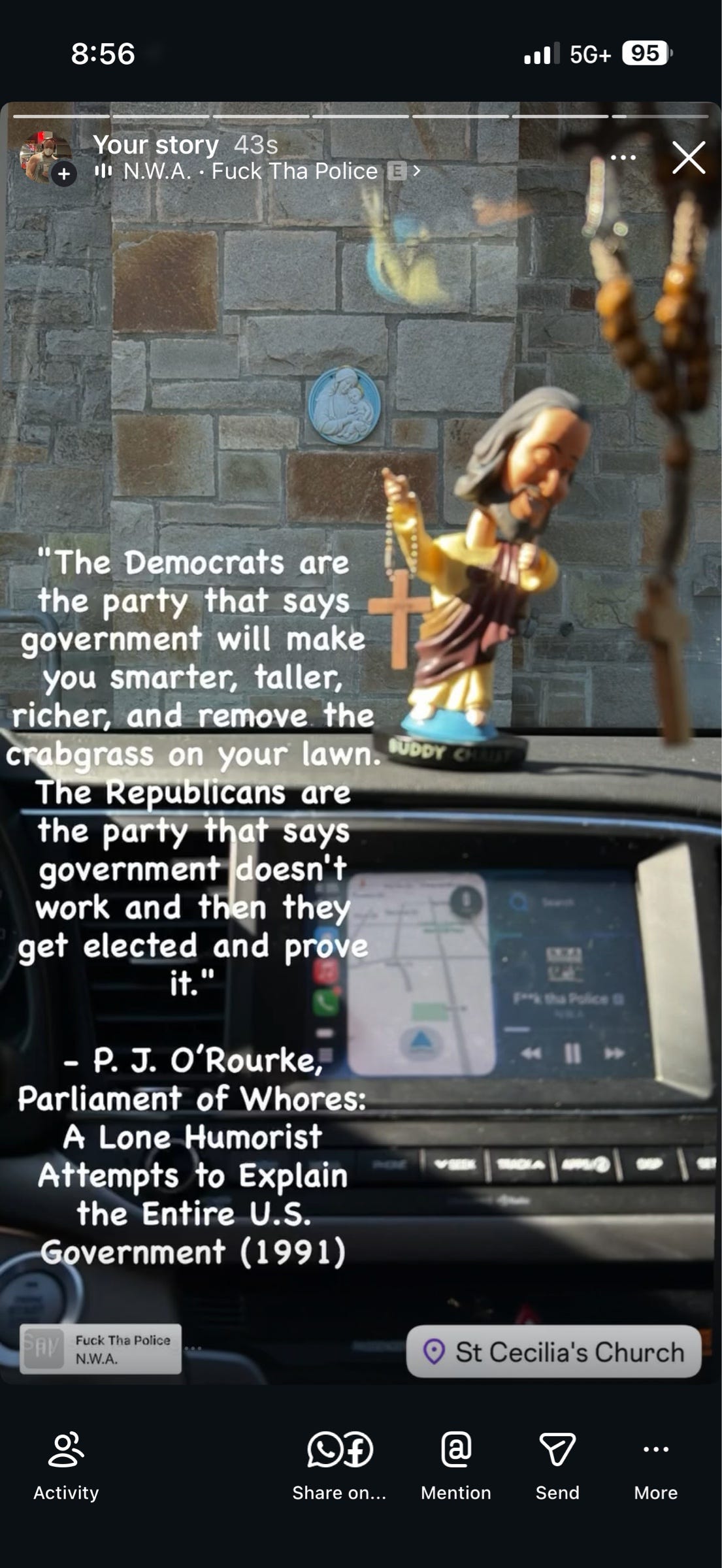
“The Democrats are the party that says government will make you smarter, taller, richer, and remove the crabgrass on your lawn. The Republicans are the party that says government doesn’t work and then they get elected and prove it.”
⁃ P. J. O’Rourke, Parliament of Whores: A Lone Humorist Attempts to Explain the Entire U.S. Government (1991)
Reader’s Guide
This paper is about how far satire can legally go in the United States before it stops being protected by the First Amendment.
People often believe that speech loses constitutional protection because it is offensive, rude, profane, blasphemous, insulting, or emotionally upsetting. That is generally incorrect. American law protects a remarkable amount of harsh public expression, including parody, ridicule, mockery, symbolic protest, vulgar political slogans, religious criticism, and exaggerated rhetoric. At the same time, there are real legal boundaries. Speech can become an unprotected true threat, unlawful incitement, actionable defamation, or other prohibited conduct when it crosses certain lines.
The purpose of this paper is to map those lines as accurately as possible. It is not an argument for being cruel for its own sake, nor is it a guide to intimidation or unlawful behavior. Instead, it explains how writers, artists, activists, journalists, and ordinary citizens can communicate forcefully while remaining inside constitutional protection.
The central idea is simple: the First Amendment does not exist merely to protect polite conversation. It exists to protect public disagreement, especially when that disagreement is uncomfortable. Democracies depend on citizens who are willing to criticize powerful institutions, challenge official narratives, ridicule hypocrisy, expose corruption, and question ideas that others may treat as sacred.
Satire has historically been one of the safest and most effective ways to perform that civic function. By using humor, exaggeration, absurdity, and symbolism, it can reveal truths that straightforward argument sometimes cannot. A cartoon may expose hypocrisy more clearly than a thousand-page report. A joke may puncture false authority more effectively than a formal speech. A parody may remind people that leaders and institutions are made of flesh and mistakes rather than marble and perfection.
The law generally recognizes this value. Courts repeatedly distinguish between expression that communicates criticism and expression that communicates actual plans for unlawful violence or false factual accusations. Understanding that distinction allows a writer to speak boldly without speaking recklessly.
Accordingly, this paper does not recommend retreat from controversial expression. It recommends precision. It teaches readers how to make parody look unmistakably like parody, hyperbole unmistakably like hyperbole, symbolic language unmistakably symbolic, and political criticism unmistakably expressive. In short, it argues that the best way to preserve powerful satire is not to weaken it but to draft it so carefully that neither a hostile reader nor a hostile court can reasonably mistake it for something it is not.
The objective is robust, fearless, constitutionally protected speech: speech that pushes hard, knows the line, documents the line, and remains firmly on the protected side of it.
⸻
Table of Contents
Abstract
I. The Point Is the Edge
II. The First Amendment Is Not a Civility Code
III. Vulgar Political Speech Is Protected
IV. Outrageous Parody Is Protected
V. Public Officials and Public Figures Are Legal Targets
VI. Offensive Public Protest Still Counts
VII. Symbolic Aggression: Burning Flags, Desecrating Images, and Public Shock
VIII. Speech That Invites Anger Is Not Automatically Unprotected
IX. Political Hyperbole: Violent-Sounding Words That Stay Protected
X. True Threats: The Real Line
XI. Incitement: The Brandenburg Boundary
XII. Boycotts, Pressure, and Harsh Movement Rhetoric
XIII. Public Shaming, Leaflets, and Criticism Campaigns
XIV. Fighting Words: The Overused Myth
XV. Opinion, Hyperbole, and Defamation
XVI. False Speech Is Not Automatically Outside the First Amendment
XVII. Religious Satire and Symbolic Language
XVIII. How to Draft to the Edge
XIX. How to Use Threat-Adjacent Language Without Making Threats
XX. How to Preserve Context as Armor
XXI. Catholic Motivation, Not Catholic Center
XXII. Fascism as the Power That Cannot Tolerate Mockery
XXIII. Edge Tests and Worked Examples
XXIV. Conclusion: Push Hard, Know the Line
References
Appendix A: Angela’s Explainer
Appendix B: P. J. O’Rourke — Humor in the Service of Reality
Appendix C: Free Speech and Satire Defense Cheat Sheet
Appendix D: Additional First Amendment Cases Every Satirist and Defense Attorney Should Know
⸻
Abstract
This paper maps the constitutional edge of satire in American First Amendment law. Its central claim is that satire is not protected because it is polite, restrained, or institutionally comfortable, but because public debate requires room for ridicule, parody, profanity, symbolic shock, religious imagery, harsh condemnation, and outrageous exaggeration. The paper therefore treats satire as a legal craft problem: how can a writer press mockery as far as possible while keeping the work within protected expression?
The analysis proceeds through the major First Amendment categories that hostile readers, officials, employers, platforms, or litigants may invoke to reclassify satire as unlawful conduct. It distinguishes protected offense from true threats, protected advocacy from incitement, rhetorical hyperbole from defamation, symbolic aggression from intimidation, and public-issue condemnation from actionable harassment. The paper emphasizes that offense, outrage, emotional distress, vulgarity, and public anger do not by themselves remove constitutional protection.
The practical argument is that writers should not retreat from lawful force. Instead, they should draft with legal visibility: mark parody as parody, frame the target as public, preserve context, use exaggeration and absurdity, define symbolic language, avoid operational threats, avoid commands to imminent lawless action, and distinguish spiritual, artistic, political, electoral, and rhetorical force from literal violence. Catholic material appears only as a motivational background for public witness, not as the paper’s governing legal framework. The governing question remains constitutional and practical: how far can satire go, and how can writers keep it there?
I. The Point Is the Edge
This paper is not a handbook for polite speech. It is not a guide to making satire acceptable to institutions, committees, churches, campaigns, platforms, or anxious middle managers with emergency access to the word “tone.” Its purpose is narrower, sharper, and more legally useful: to map the outer edge of protected satire under the First Amendment.
Satire exists because some truths cannot be carried cleanly by polite description. Political and religious power often hides behind dignity, ceremony, respectability, sanctimony, expertise, patriotism, holiness, and procedural fog. Satire attacks that armor by making power ridiculous. It exposes inflated authority by puncturing it. It answers false solemnity with laughter, exaggeration, parody, insult, profanity, symbolic aggression, and public condemnation. That is not a failure of seriousness. It is one of seriousness’s most ancient weapons.
The First Amendment begins the legal frame: “Congress shall make no law” abridging freedom of speech or of the press. That protection does not exist only for gentle speech, tasteful speech, reverent speech, or speech approved by the people being criticized. It protects the conditions of public argument itself. A constitutional culture that protects only pleasant disagreement does not protect disagreement in any meaningful sense. The real test arrives when speech is offensive, humiliating, blasphemous, vulgar, excessive, theatrical, or socially disruptive. That is where satire lives. (The People of the United States, United States Constitution, 1791)
The mission of this paper is therefore lawful maximalism. The question is not, “How can satire avoid upsetting people?” The question is, “How can satire push as hard as possible while remaining protected expression?” That requires knowing the difference between protected ridicule and unprotected threat, protected advocacy and incitement, rhetorical hyperbole and defamatory factual assertion, symbolic aggression and intimidation, religious metaphor and operational violence. The edge is not a vibe. It is a legal boundary.
This paper does not argue that every harsh joke is wise, charitable, prudent, or beautiful. It argues that constitutional protection is not the same thing as moral approval, social comfort, or institutional permission. A writer may still choose restraint. But restraint should be chosen knowingly, not imposed by confusion, fear, or the manipulative claim that offense itself is illegality. The satirist’s craft is to hit hard, mark the genre clearly, preserve context, avoid legally unprotected categories, and refuse the false bargain that only timid speech is safe speech.
Angela’s Explainer
Angela, imagine the First Amendment is like the playground rule that says everyone gets to talk, even the kid who makes weird goblin noises near the slide. This paper is about satire, which is when someone uses jokes, exaggeration, and dramatic nonsense to point at powerful people and say, “You look ridiculous, Your Majesty of Bologna.” The point is not to be mean just for sport. The point is that sometimes big serious grown-ups wear invisible cardboard crowns, and satire says, “Nice crown, buddy, did you make it from a cereal box?” But there are still rules. You can roast the dragon; you cannot tell people to go stab the dragon. You can draw the king as a potato; you cannot make a real threat. Satire gets to be spicy, but it still has to stay out of the legal lava.
II. The First Amendment Is Not a Civility Code
The First Amendment is not a manners policy. It is not a civility code, a politeness filter, or a constitutional version of “use your indoor voice.” Its purpose is not to protect only speech that sounds respectable to judges, priests, professors, moderators, or public relations departments. Its purpose is to protect public argument, including the forms of public argument that disturb, offend, anger, embarrass, or disgust the audience.
The Supreme Court has made this principle clear in some of its most important speech cases. In Cohen v. California, the Court protected a man who wore a jacket reading “Fuck the Draft” in a courthouse corridor. The state treated the phrase as offensive conduct, but the Court treated it as political expression. The point was not that the phrase was elegant. The point was that vulgarity can carry political meaning, and the government may not cleanse public debate simply because citizens dislike the words chosen. (Justice John Marshall Harlan, Cohen v. California, 1971)
That same principle appears in Terminiello v. Chicago, where the Court explained that speech often serves its highest purpose when it creates unrest, dissatisfaction, or even anger. Public debate is not supposed to be sedated into harmlessness. Speech that challenges prevailing opinion may unsettle people precisely because it is doing democratic work. A legal system that suppresses speech because it provokes dispute would protect only speech that needs little protection in the first place. (Justice William O. Douglas, Terminiello v. Chicago, 1949)
The Court reaffirmed this logic in Snyder v. Phelps, where it held that even deeply offensive protest speech on matters of public concern remained protected. The speech in that case was cruel, inflammatory, and emotionally devastating to its targets, but the Court focused on its public-issue context. The First Amendment does not disappear merely because speech causes pain, outrage, or widespread public disgust. (Chief Justice John Roberts, Snyder v. Phelps, 2011)
The same rule applies when speech offends through identity, insult, or viewpoint. In Matal v. Tam, the Court rejected the idea that the government may suppress expression because it demeans or offends. Offensive ideas are still ideas, and the First Amendment does not permit the state to decide which viewpoints are too insulting to enter public life. (Justice Samuel Alito, Matal v. Tam, 2017)
Nor is the principle limited to words. In Texas v. Johnson, the Court protected flag burning as expressive conduct. The act was offensive to many people because the flag carries powerful national meaning, but that was exactly why the act communicated a political message. The government could not prohibit symbolic expression simply because the symbol being attacked was sacred to many citizens. (Justice William Brennan, Texas v. Johnson, 1989)
The rule, then, is simple but dangerous to comfortable power: offense is not the legal line. Anger is not the legal line. Disgust is not the legal line. Hurt feelings are not the legal line. The legal line appears when speech enters a specific unprotected category, such as true threats, incitement, defamation, or certain forms of harassment. Satire operates in the protected space before those lines. It may be ugly, loud, blasphemous, profane, mocking, or socially obnoxious. That does not make it unlawful. In First Amendment law, the government does not get to put a bow tie on public debate and call that freedom.
Angela’s Explainer
Angela, the First Amendment is not your teacher saying, “Please use kind words and raise your hand.” It is more like the rule that says people are allowed to argue about big important things even when they sound like angry raccoons in a trash can. Sometimes people say rude things because they are being silly. Sometimes they say rude things because they are trying to make a serious point with fireworks attached. The law does not say, “Only boring polite people get freedom.” Thank goodness, because then every speech would sound like oatmeal wearing a sweater. The law says people can say shocking things about politics and public issues, but they still cannot make real threats, tell people to commit crimes right now, or lie about someone in a way that legally harms them. So yes, satire can be spicy. It can even be extra spicy. But it still cannot become a crime burrito.
III. Vulgar Political Speech Is Protected
Vulgarity does not cancel constitutional protection. A political statement does not become legally disposable because it uses profanity, insult, obscenity-adjacent style, or language that respectable people would rather not see in public. In satire, vulgarity is often not ornamental. It can be the message’s force, rhythm, temperature, and signal flare. Sometimes “I disagree with the draft” does not carry the same meaning as “Fuck the Draft.” The second phrase does not merely state opposition. It performs disgust, rejection, contempt, and refusal.
That is why Cohen v. California is the natural starting point. Paul Cohen wore a jacket bearing the words “Fuck the Draft” inside a courthouse. The phrase was crude, public, and deliberately confrontational. Yet the Supreme Court held that California could not punish him merely because the words were offensive. The Court recognized that words carry emotional force as well as intellectual content, and that the government may not separate the “nice” idea from the “nasty” expression simply because officials dislike the packaging. (Justice John Marshall Harlan, Cohen v. California, 1971)
This matters because satire often depends on exactly that inseparability. A sanitized insult may no longer be the same political act. A parody stripped of vulgarity may lose the social register it is targeting. A profane slogan may communicate alienation, class anger, antiwar resistance, anti-authoritarian contempt, or moral disgust in a way that polite language cannot reproduce. The First Amendment protects expression, not merely abstract propositions after every sharp edge has been sanded off.
The Court’s later decision in Iancu v. Brunetti reinforces the same principle in a different setting. There, the government denied federal trademark registration to the mark “FUCT” under a statutory bar on “immoral” or “scandalous” marks. The Court held that the restriction violated the First Amendment because it discriminated based on viewpoint and allowed the government to favor speech it considered acceptable over speech it considered offensive or immoral. (Justice Elena Kagan, Iancu v. Brunetti, 2019)
Together, Cohen and Brunetti establish a useful rule for writers: profanity is not the boundary. The question is not whether the language is vulgar. The question is what the language is doing. Is it making a political point? Is it parodying power? Is it dramatizing moral disgust? Is it attacking a public issue, symbol, official, institution, policy, ideology, or movement? If so, the vulgarity may strengthen the expressive character rather than weaken it.
This does not mean every profane statement is legally safe. Profanity attached to a direct threat, targeted stalking, workplace harassment, defamation, or incitement may still create legal problems. But the problem is not the profanity itself. The problem is the unprotected legal category it may be serving. The satirist’s task is therefore not to avoid vulgarity. The task is to make vulgarity unmistakably expressive, public-facing, rhetorical, and political rather than operational, threatening, or falsely factual.
Vulgar political satire should not mumble. It should know what it is attacking and why. The stronger the profanity, the more important the frame becomes. A crude joke aimed at a public institution, policy, official, ideology, or religious-political abuse of power is easier to defend than a crude statement aimed at terrorizing a private person. The edge is not “never say the ugly word.” The edge is “make the ugly word do protected work.”
Angela’s Explainer
Angela, sometimes grown-ups act like a bad word is a magic poison frog that makes the whole sentence illegal. It is not. A bad word can be rude, dramatic, annoying, or the verbal equivalent of stepping on a ketchup packet, but that does not automatically make it against the law. In the famous jacket case, the guy basically wore a walking billboard that said he really, really, really did not like the draft, except he used the spicy adult word. The Court said the government could not punish him just because the message had hot sauce on it. So the lesson is this: words can be messy and still be protected. But do not use the hot sauce to threaten someone or tell people to do crimes, because then you are not making satire anymore. You are making a legal diaper explosion.
IV. Outrageous Parody Is Protected
Parody does not lose protection because it is outrageous. In fact, outrage is often the point. Parody works by imitation under pressure. It borrows the form, voice, symbols, or public image of its target and twists them until the target’s absurdity becomes visible. It is not merely joking beside the serious thing. It grabs the serious thing by the collar, puts a clown wig on it, and asks why everyone was pretending the clown wig was not already there.
The core modern case is Hustler Magazine, Inc. v. Falwell. Hustler published a parody advertisement suggesting that Reverend Jerry Falwell had described a grotesque sexual encounter with his mother in an outhouse. The parody was intentionally offensive and personally humiliating. Falwell sued for intentional infliction of emotional distress, and a jury awarded damages. The Supreme Court reversed, holding that public figures cannot recover for emotional distress caused by parody unless the publication contains a false statement of fact made with actual malice. Because no reasonable reader would understand the parody as a factual claim about Falwell, the speech remained protected. (Chief Justice William Rehnquist, Hustler Magazine, Inc. v. Falwell, 1988)
The rule matters because satire frequently aims at public figures through exaggeration rather than accusation. A cartoon showing a politician as a vampire feeding on tax dollars is not asserting that the politician is literally undead. A parody sermon placing greedy officials at the altar of Mammon is not claiming that they physically attend a goat-shaped temple at midnight. A mock press release from “The Ministry of Obvious Lies” is not meant to be read as an authentic government document. These works use false surfaces to reveal political or moral truth.
The legal craft is to make parody visibly parody while keeping its bite. The satirist should use exaggeration, absurdity, impossible detail, comic framing, captions, visual distortion, genre markers, disclaimers when useful, and surrounding context that signals nonliteral meaning. The goal is not to weaken the attack. The goal is to prevent hostile readers from pretending they reasonably believed the joke was a factual report.
That distinction is critical. A parody can be brutal, insulting, blasphemous, humiliating, or obscene and still remain protected if its meaning is recognizably rhetorical. But a writer who disguises a false factual accusation as “satire” after the fact may have a problem. Courts do not protect defamation merely because the speaker later says, “Just kidding.” The protection belongs to recognizable parody, not to factual smears wearing a fake mustache.
The strongest parody therefore has two qualities at once. First, it is sharp enough to wound public vanity. Second, it is clear enough that a reasonable reader understands the wound is rhetorical, not evidentiary. The satirist should not make the work timid. The satirist should make the genre unmistakable. Legal safety does not require removing the teeth. It requires making sure the teeth are attached to a cartoon dragon, not a forged affidavit.
Angela’s Explainer
Angela, parody is when you copy something serious in a silly way so everyone can see how ridiculous it is. Like if a bossy king says, “I am very wise and important,” and you draw him as a giant baby wearing a crown and holding a juice box labeled “Power,” that is parody. You are not saying he is literally a baby. You are saying he is acting like one. The law usually understands that, because judges also know what jokes are, even if some of them look like they were assembled from library dust. The trick is to make the joke look like a joke. If your cartoon dragon is obviously a cartoon dragon, great. If your “joke” looks like a fake news report accusing someone of a real crime, then congratulations, you have stepped on the rake and the rake is named Defamation.
V. Public Officials and Public Figures Are Legal Targets
The First Amendment gives public officials and public figures less protection from criticism than private individuals, not because they are less human, but because democratic government requires unusually robust scrutiny of those who seek or wield influence. Elections, legislation, public policy, religious leadership, mass media, and cultural authority all depend upon citizens being able to criticize powerful actors without fearing ruinous lawsuits whenever rhetoric becomes sharp or mistaken.
The Supreme Court established this principle in New York Times Co. v. Sullivan. During the civil rights movement, an advertisement criticizing officials in Montgomery, Alabama contained several factual inaccuracies. The officials sued for defamation and won under state law. The Supreme Court reversed, holding that a public official cannot recover damages for defamatory falsehood relating to official conduct unless the statement was made with “actual malice,” meaning knowledge that it was false or reckless disregard for whether it was false. The Court explained that public debate must have “breathing space” to survive and that inevitable factual mistakes cannot justify suppressing vigorous criticism of government. (Justice William J. Brennan Jr., New York Times Co. v. Sullivan, 1964)
The phrase “breathing space” is one of the most important concepts in First Amendment law. Public discussion is messy. Journalists misstate dates, cartoonists exaggerate, comedians compress reality into punchlines, and satirists intentionally distort appearances to expose deeper truths. If every error or colorful overstatement invited catastrophic liability, speakers would censor themselves long before any court became involved. The result would not be more accurate public debate. It would be less public debate.
The Court reinforced this principle in Garrison v. Louisiana, where it struck down a criminal defamation conviction against a district attorney who harshly criticized judges. The Court emphasized that speech concerning public officials occupies the highest rung of constitutional protection because citizens must be free to discuss the conduct of those exercising governmental power. Even vehement, caustic, unpleasantly sharp attacks are part of the constitutional design when directed toward public office and public affairs. (Justice William J. Brennan Jr., Garrison v. Louisiana, 1964)
The same practical logic extends beyond elected officials to many public figures. Celebrities, nationally known activists, major religious leaders, influential commentators, and other persons who voluntarily enter public controversy generally assume a greater risk of criticism than ordinary private citizens. Their prominence creates public interest, and that public interest expands the range of constitutionally protected commentary directed toward them.
For satirists, this doctrine provides both opportunity and responsibility. It creates wide room to ridicule presidents, governors, legislators, judges, bishops, celebrity pastors, media personalities, billionaires, campaign organizations, political parties, and cultural institutions. A cartoon may depict a senator as a scarecrow stuffed with lobbyist checks. A parody article may portray a famous televangelist receiving investment advice from Judas Iscariot. A satirical poem may compare an activist to a caffeinated goose armed with a megaphone and an economics degree purchased from a cereal box. These are rhetorical attacks on public figures, not factual reports.
The critical distinction is between attacking reputation through protected opinion or parody and making provably false factual accusations. Saying, “This mayor has the moral backbone of an inflatable lawn flamingo,” is obvious opinion and rhetorical insult. Saying, “This mayor secretly embezzled city funds yesterday,” if false and presented as fact, enters a very different legal category. The First Amendment gives satire extraordinary latitude, but it does not convert fabricated evidence into protected humor simply because the author later claims comic intent.
Writers who wish to push to the constitutional edge should therefore remember a simple principle: target power, target policy, target public conduct, target ideology, target institutions, and target public personas. Use ridicule boldly. Use exaggeration fearlessly. But when making factual claims capable of objective proof or disproof, verify them carefully or present them unmistakably as parody. The breathing space doctrine protects democratic criticism, not careless fabrication.
Angela’s Explainer
Angela, imagine your class elects a Hallway Monitor Supreme Emperor for absolutely no good reason. If that kid starts making rules like “No hopping on Tuesdays” and “Everyone must compliment my shoelaces,” the rest of the class gets to make fun of those ideas. They can draw the emperor with noodles for hair and a pigeon wearing his crown. They can write a silly song called The Ballad of Captain Fancy Pants. That is because people with power have to expect more criticism than everyone else. But they still cannot make up fake facts like, “He stole the principal’s pet dinosaur,” unless there really was a dinosaur, which would honestly raise much bigger questions. The lesson is: roast the king all you want, but do not invent imaginary crimes unless your king is obviously a cartoon potato wizard.
VI. Offensive Public Protest Still Counts
The First Amendment does not guarantee that public speech will be comforting. It protects public debate precisely because debate often produces discomfort. Political demonstrations, religious protests, moral condemnations, and satirical campaigns frequently provoke anger, grief, embarrassment, humiliation, and outrage. Those emotional reactions, standing alone, do not transform protected expression into unprotected conduct. The constitutional inquiry asks what the speech is and what it does under law, not merely how intensely listeners dislike it.
The Supreme Court illustrated this principle in Snyder v. Phelps, one of the most emotionally difficult First Amendment decisions in modern history. Members of the Westboro Baptist Church picketed near the funeral of Marine Lance Corporal Matthew Snyder with signs containing deeply offensive religious and political messages. The deceased soldier’s family sued for intentional infliction of emotional distress and won substantial damages before the case reached the Supreme Court. The Court reversed, holding that the speech was protected because it addressed matters of public concern and occurred in a public place while complying with local regulations governing the demonstration. The emotional pain suffered by the family, though undeniable and profound, did not by itself remove the constitutional protection afforded to the protest. (Chief Justice John G. Roberts Jr., Snyder v. Phelps, 2011)
The decision is frequently misunderstood as judicial approval of cruelty. It was not. The Court did not praise the protest, endorse its theology, or celebrate its tactics. Instead, it reaffirmed a structural principle of constitutional law: government may not suppress expression merely because it is exceptionally offensive. The First Amendment often protects speech that many citizens consider hateful, insulting, blasphemous, or morally reprehensible because allowing officials to punish speech on that basis would grant the state power to define acceptable opinion.
For satirists, Snyder provides an important lesson. A hostile audience may sincerely experience ridicule as emotional injury. A religious institution mocked through parody may feel humiliated. A political movement lampooned through absurd exaggeration may claim reputational damage or psychological distress. None of those reactions automatically establishes a constitutional violation. Public controversy is expected to generate emotional consequences. Democratic life is not an agreement to avoid offense but an agreement to resolve disagreement through speech rather than censorship.
This does not mean location and context are irrelevant. The Court repeatedly emphasized that the protest involved speech on matters of public concern occurring in a traditional public forum while remaining physically separated from the funeral itself. Context matters because context helps determine whether conduct is expressive, coercive, or unlawfully intrusive. A satirical billboard criticizing government policy is different from physically cornering a private citizen outside their home. A published parody article differs from targeted stalking. The legal protection follows not from cruelty but from the constitutional status of public discourse.
Accordingly, writers seeking to operate near the First Amendment’s edge should understand that emotional impact is neither the beginning nor the end of legal analysis. Powerful satire often succeeds because it embarrasses, unsettles, or enrages its target. The relevant questions are instead whether the speech addresses public issues, whether it falls into an unprotected category such as a true threat or incitement, whether it contains actionable factual defamation, and whether surrounding circumstances alter its legal character. Offense may explain why litigation occurs, but offense alone is not the constitutional line.
The practical implication is liberating. A satirist need not dilute criticism merely because someone may call it hateful, shocking, disrespectful, or emotionally harmful. The better strategy is to preserve unmistakable expressive context: make the work obviously satirical, tie it to public issues, avoid operational threats or factual fabrications, and document the rhetorical nature of the publication. The First Amendment protects vigorous participation in public debate, not because vigorous participation is always pleasant, but because free societies depend upon the ability to criticize power without first obtaining permission from those being criticized.
Angela’s Explainer
Angela, imagine your big sister builds the world’s ugliest pillow fort and then announces that it is a royal castle where she is Queen Supreme Peanut Butter the Third. You laugh so hard that milk comes out your nose and you draw a picture of her castle being attacked by squirrels wearing tiny pirate hats. She gets mad. She might even stomp around dramatically and declare that her feelings have been shattered into seventeen emotional pancakes. But just because someone feels bad does not mean you broke the law. Now, if you chased her around all day screaming scary threats or tried to knock the fort on top of her, that would be different. The lesson is that people are allowed to be offended. In fact, some grown-ups get offended so professionally they should probably get matching uniforms. The Constitution usually lets people argue, joke, protest, and make fun of public ideas anyway, because otherwise whoever cries the loudest would get to decide what everyone else is allowed to say.
VII. Symbolic Aggression: Burning Flags, Desecrating Images, and Public Shock
Not all aggression is physical. Human beings communicate through symbols, and attacks on symbols can carry extraordinary expressive force without constituting attacks on persons. Burning a flag, smashing an effigy, caricaturing a religious icon, publicly shredding a political manifesto, or placing a crown on a trash can may all communicate contempt, dissent, rejection, or ridicule. Such acts may be deliberately shocking, but shock alone does not remove constitutional protection.
The Supreme Court confronted this principle directly in Texas v. Johnson. Gregory Lee Johnson burned an American flag during a political demonstration outside the 1984 Republican National Convention and was convicted under a Texas statute prohibiting flag desecration. The Supreme Court reversed, holding that flag burning constituted expressive conduct protected by the First Amendment. The Court reasoned that the government could not prohibit expression merely because society found the idea offensive or disagreeable. The very reason the act provoked outrage was that it communicated a recognizable political message through symbolism rather than through literal speech. (Justice William J. Brennan Jr., Texas v. Johnson, 1989)
For satirists, Texas v. Johnson establishes an important principle: symbolic aggression is not the same thing as violence. Destroying one’s own copy of a book is not the same as assaulting its author. Burning one’s own flag is not the same as attacking another citizen. Smashing an effigy is not the same as striking the real person it depicts. Symbolic acts often borrow the language of destruction precisely because they are communicating moral or political rejection rather than carrying out physical harm.
The distinction becomes especially important when governments attempt to regulate offensive symbolism selectively. In R.A.V. v. City of St. Paul, the Supreme Court invalidated a municipal ordinance that prohibited certain categories of symbolic expression based upon the ideas they conveyed. Although some forms of intimidation may be punished under otherwise valid laws, the government may not choose among viewpoints by allowing some offensive messages while criminalizing others because officials disapprove of their content. Viewpoint discrimination is itself incompatible with the First Amendment’s commitment to open public discourse. (Justice Antonin Scalia, R.A.V. v. City of St. Paul, 1992)
The practical lesson is that symbolism should be analyzed according to what it objectively communicates in context. A political cartoon showing Congress sinking into a volcano does not advocate murdering legislators. A satirical poster depicting bureaucratic paperwork being fed into a wood chipper does not instruct readers to destroy government offices. A theatrical performance in which an actor tears apart a papier-mâché idol does not necessarily encourage violence against believers. Symbolic destruction ordinarily functions as metaphor, criticism, parody, or ritualized dissent.
That does not mean every symbolic act enjoys constitutional protection. Context still matters. A burning cross placed on the lawn of a particular family may function as intimidation rather than abstract political expression. An effigy displayed alongside explicit statements promising imminent bodily harm may contribute to a true-threat analysis. A symbolic act coordinated with directions to commit immediate unlawful violence may become evidence of incitement. The First Amendment protects expression, but it does not erase the legal significance of surrounding facts that transform symbolism into coercion or intimidation.
Accordingly, satirists who wish to operate near the constitutional edge should make their symbolism unmistakably expressive. Public context, artistic framing, captions, disclaimers where appropriate, exaggerated presentation, theatrical style, and obvious parody all reinforce that the audience is observing criticism rather than operational planning. A papier-mâché dragon set ablaze on a theater stage says something different from an actual attack on a real building. A mock funeral for corruption communicates condemnation without becoming homicide. Symbolic aggression succeeds when it leaves no reasonable doubt that the target is an idea, institution, policy, public image, or cultural symbol rather than an invitation to commit unlawful violence.
The First Amendment therefore protects many acts that seek to shock the conscience precisely because shocking the conscience is one way democratic societies force public attention onto contested questions. Satire often works by violating expectations of reverence. The law generally protects that disruption so long as the disruption remains expressive rather than criminal.
Angela’s Explainer
Angela, imagine someone builds a giant cardboard monster called “Homework Forever,” and then everyone cheers while it gets bonked with pool noodles and set on fire in a safe little campfire pit. Nobody thinks they are attacking a real monster because the monster is made of cardboard and bad decisions. They are making a point. That is what symbols do. Sometimes people burn flags, tear up fake money, or smash pretend crowns because they are saying, “I reject what this stands for.” The law usually understands the difference between burning your own cardboard dragon and trying to burn down your neighbor’s shed. One is a loud opinion. The other is a visit from firefighters, police officers, and several extremely disappointed adults. So if you want to make a statement, roast the cardboard dragon. Leave Mr. Jenkins’s garage alone.
VIII. Speech That Invites Anger Is Not Automatically Unprotected
Speech does not lose constitutional protection because it makes people angry. In public controversy, anger is often evidence that speech has reached the nerve it intended to reach. Satire, protest, religious condemnation, political accusation, and ideological critique frequently provoke resentment because they challenge what people love, fear, worship, profit from, or identify with. If the law allowed government to silence speech whenever listeners became angry, then the easiest way to defeat speech would be to react dramatically enough to make it look dangerous.
The Supreme Court rejected that logic in Terminiello v. Chicago. Arthur Terminiello gave a controversial speech that stirred public anger and unrest. He was convicted under a breach-of-peace ordinance after the jury was instructed that speech could be punished if it stirred people to anger, invited dispute, or brought about unrest. The Supreme Court reversed, explaining that a function of free speech is to invite dispute and that speech may best serve its high purpose when it produces dissatisfaction, unrest, or anger. (Justice William O. Douglas, Terminiello v. Chicago, 1949)
This principle is essential for satire because satire often works by irritation. It does not merely present an argument; it makes an argument difficult to ignore. A polite essay may say, “This administration has abused public trust.” A satirical poster may show the administration as a raccoon in a judge’s robe eating shredded subpoenas from a golden trash can. The second version may produce more anger, but that anger does not make it less expressive. It may make the criticism more visible.
The danger of treating anger as a legal boundary is that it gives hecklers power over the speaker. If an audience can eliminate speech by becoming furious, then unpopular speakers receive less protection precisely when they need more. Public officials, religious institutions, activist groups, and ideological movements could all claim that mockery provokes unrest and therefore should be suppressed. The First Amendment does not work that way. It protects the speaker against censorship based on the audience’s hostile reaction, unless the speech crosses a recognized legal line such as incitement, true threats, or other unprotected conduct.
That distinction matters. Speech that produces anger is different from speech directed to causing imminent lawless action and likely to produce it. A crowd booing, shouting, or becoming upset does not automatically prove incitement. A speaker who mocks a public figure in harsh terms has not necessarily threatened that figure. A religious parody that enrages believers is not automatically unlawful because blasphemy is not a constitutional category of unprotected speech. The law asks whether the speech itself falls into a specific unprotected category, not whether listeners hated it.
For writers, the practical rule is direct: do not confuse controversy with illegality. The fact that satire will predictably provoke anger may be a reason to preserve context carefully, define symbolic language, document publication history, and avoid operational commands. It is not a reason to abandon the satire. Public anger is a political fact, not a constitutional veto. The satirist should expect anger, design for anger, and remain legally disciplined inside anger.
The edge, then, is not silence before hostility. The edge is controlled provocation. Say the thing in a way that is unmistakably public, rhetorical, and expressive. Attach the satire to public questions. Avoid instructing people to commit immediate unlawful acts. Avoid communicating serious threats of violence. Avoid false factual accusations disguised as jokes. But do not treat anger itself as proof that the satire went too far. Sometimes anger is just the sound of the arrow hitting the balloon.
Angela’s Explainer
Angela, imagine you draw a picture of a bossy goose wearing sunglasses and a mayor sash, and the goose gets so mad it honks for twenty minutes. The honking does not mean your drawing is illegal. It means the goose has feelings and possibly a leadership problem. Free speech would be pretty useless if the angriest goose always won. The rule is that people can get mad at jokes, cartoons, speeches, and protests, but their anger does not automatically erase the speaker’s rights. You still cannot tell the geese to riot right now, and you cannot threaten to punt the goose into the moon, because that is how we get Lawsuit Soup. But making the goose angry by calling it Mayor Honkypants? That is public debate with feathers.
IX. Political Hyperbole: Violent-Sounding Words That Stay Protected
Political language often sounds more violent than it legally is. Public debate is full of “fight,” “destroy,” “crush,” “burn it down,” “take them out,” “war,” “battle,” “strike back,” and “no mercy.” In ordinary political speech, these phrases often function as metaphor, emotional emphasis, or theatrical exaggeration. They do not automatically communicate a serious intent to commit unlawful violence.
The Supreme Court recognized this distinction in Watts v. United States. During a public antiwar discussion, Robert Watts said that if he were drafted and forced to carry a rifle, the first person he would want in his sights would be President Lyndon Johnson. He was convicted under a federal statute prohibiting threats against the President. The Supreme Court reversed, treating the statement as crude political hyperbole rather than a true threat. The Court emphasized the political context, the conditional nature of the statement, and the audience reaction, including laughter. (The Supreme Court of the United States, Watts v. United States, 1969)
Watts matters because satire often uses violent-sounding metaphors to express political disgust. A writer may say a corrupt policy should be “buried,” a false ideology should be “burned to ash,” or a political machine should be “destroyed.” In context, those phrases usually mean defeat, expose, reject, abolish, parody, vote out, litigate against, or publicly shame. The legal question is not whether the words sound dramatic. The question is whether a reasonable interpretation, in context, treats them as serious threats or as rhetorical exaggeration.
The safest edge-writing keeps the action clearly symbolic, political, artistic, spiritual, electoral, or legal. “We will bury this bill at the ballot box” is different from naming a person and describing a plan to harm them. “Burn the idol of corruption” is different from “burn that official’s house tonight.” “Destroy the machine with lawsuits, satire, organizing, and votes” is different from operational violence. The verbs may sound aggressive, but the object and method clarify the meaning.
Context is the armor. Public setting matters. Audience expectations matter. Conditional language matters. Humor matters. Absurdity matters. Prior and surrounding statements matter. A satirical essay full of dragons, idols, clown crowns, fake ministries, and exaggerated religious imagery is less likely to be read as literal violence than a direct message to a named private person containing specific threats. Hyperbole stays safest when the whole work teaches the reader how to read it.
The point is not to drain political speech of force. The point is to keep force rhetorical. A satirist can write like thunder without sounding like an operational plan. The legal craft is to make the target an idea, office, institution, policy, public persona, or symbolic structure, and to make the weapon speech itself: mockery, exposure, parody, voting, litigation, boycott, prayer, art, organizing, and public condemnation.
Angela’s Explainer
Angela, grown-ups say dramatic stuff all the time. “I’m going to destroy this math homework” usually means “I will finish it,” not “I will attack the worksheet with a medieval catapult,” although honestly that sounds more fun. The law knows people exaggerate, especially in politics, where everyone talks like they are in a movie trailer. The trick is making sure your dramatic words clearly mean jokes, votes, speeches, art, lawsuits, or public criticism. Saying “we will defeat the evil broccoli empire in the cafeteria election” is fine. Saying “meet me at 7 with a flamethrower” is not satire; it is how you get grounded by the Constitution’s angriest babysitter.
X. True Threats: The Real Line
The First Amendment protects an extraordinary range of speech, including profanity, ridicule, parody, symbolic aggression, harsh political criticism, and emotionally charged rhetoric. It does not, however, protect true threats. This is one of the most important boundaries for satirists because the difference between protected mockery and criminal conduct often turns on context rather than vocabulary. A sentence containing violent words may still be protected hyperbole, while a sentence using comparatively mild language may constitute an unlawful threat if it seriously communicates an intent to commit violence.
The Supreme Court described true threats in Virginia v. Black as statements in which the speaker means to communicate a serious expression of an intent to commit an act of unlawful violence against a particular individual or group. The Court distinguished such communications from protected political advocacy and symbolic expression. The prohibition on true threats exists not simply because violence is bad, but because threats inflict distinct harms by placing victims in fear and disrupting their freedom to live without intimidation. (Justice Sandra Day O’Connor, Virginia v. Black, 2003)
That distinction explains why symbolism alone is not enough. Burning one’s own flag is ordinarily expressive conduct. Burning an effigy during a theatrical performance is ordinarily expressive conduct. By contrast, placing a threatening symbol outside a specific family’s home under circumstances designed to terrorize them may communicate an actual threat rather than a generalized political opinion. The law examines not only the symbol but the surrounding circumstances that give the symbol meaning.
Questions about the speaker’s mental state became especially important in Elonis v. United States. Anthony Elonis posted violent and disturbing language on social media and argued that the posts were merely artistic expression and rap-style fantasy. The Supreme Court ultimately held that negligence alone was insufficient under the federal statute at issue and that some level of subjective fault was required before criminal punishment could be imposed. Although the Court resolved the case primarily as a matter of statutory interpretation rather than constitutional doctrine, it reinforced the principle that context and mental state matter when evaluating allegedly threatening communications. (Chief Justice John G. Roberts Jr., Elonis v. United States, 2015)
The constitutional floor became clearer in Counterman v. Colorado. There, the Supreme Court held that the First Amendment requires proof of at least recklessness before criminal punishment for a true threat may be imposed. Recklessness means that the speaker consciously disregards a substantial risk that the communication will be understood as threatening violence. The Constitution therefore does not permit punishment based solely on an objective misunderstanding by an unusually fearful recipient. Instead, the speaker must at least be reckless regarding the threatening character of the communication. (Justice Elena Kagan, Counterman v. Colorado, 2023)
For writers of satire, these cases suggest several practical drafting principles. First, direct the aggression toward ideas, institutions, policies, symbols, public offices, or fictionalized caricatures rather than toward operational harm against identifiable individuals. Second, preserve unmistakable rhetorical context through parody markers, exaggeration, humor, absurdity, and artistic framing. Third, avoid language that reads like planning, logistics, instructions, or promises of unlawful violence. Fourth, when using martial or destructive metaphors, define the means in expressive terms such as voting, litigation, organizing, publication, prayer, artistic performance, peaceful protest, or public criticism.
Consider the difference between two fictional examples. A satirical article declaring, “We shall bury this policy under an avalanche of lawsuits, cartoons, and embarrassing memes,” plainly identifies expressive and legal means of opposition. By contrast, a message directed at a named official stating, “Tomorrow I am coming to your house to make you pay,” communicates something very different. The first example invites readers into political theater. The second may reasonably be understood as announcing imminent unlawful violence.
The line is therefore not whether violent words appear on the page. The line is whether the communication, viewed in context, amounts to a serious expression of an intent to commit unlawful violence and whether the speaker at least recklessly disregards the risk that it will be understood that way. Satire should be loud, theatrical, uncomfortable, and even shocking when necessary. It should not accidentally sound like an operational threat.
Good satirists do not weaken their language to stay constitutional. They strengthen the surrounding context until the audience unmistakably understands that the weapon being wielded is ridicule rather than force. The sharper the joke, the more carefully the frame should announce that it is, in fact, a joke, a parody, a work of political criticism, or a piece of symbolic expression rather than a blueprint for violence.
Angela’s Explainer
Angela, imagine your friend says, “I’m going to destroy you at Mario Kart!” Nobody calls the police because everyone knows she means she is going to throw banana peels at your tiny cartoon race car and brag for three days afterward. That is dramatic talk. Now imagine someone whispers, “Tomorrow I’m coming to your house with a baseball bat.” Suddenly nobody is thinking about Mario Kart anymore. The words have changed from silly competition into something scary and real. The law tries to tell the difference. You are allowed to make loud jokes, goofy parodies, and spicy political cartoons. You are not allowed to make real threats and then hide behind a fake mustache saying, “Relax, bro, it was satire.” The Constitution is smart enough to know when the dragon is made of papier-mâché and when somebody has accidentally brought a real dragon.
XI. Incitement: The Brandenburg Boundary
Not every call for change is incitement. Not every angry speech, radical manifesto, revolutionary slogan, or uncompromising demand crosses the constitutional line. The First Amendment protects advocacy, including advocacy that many listeners find offensive, dangerous, foolish, or morally repugnant. The legal boundary is far narrower. Speech becomes unprotected incitement only when it is directed to producing imminent lawless action and is likely to produce such action.
The Supreme Court adopted this modern standard in Brandenburg v. Ohio. Clarence Brandenburg, a Ku Klux Klan leader, had been convicted under an Ohio criminal syndicalism law after participating in a rally containing inflammatory racist rhetoric and references to possible revenge against the government. The Supreme Court reversed the conviction, holding that the Constitution protects advocacy of force or law violation in the abstract unless the speech is directed to inciting or producing imminent lawless action and is likely to produce that action. Mere abstract teaching, ideological endorsement, or generalized advocacy is not enough. (The Supreme Court of the United States, Brandenburg v. Ohio, 1969)
The test contains two critical elements. First, the speaker must direct the expression toward producing imminent unlawful conduct. Second, the speech must be likely to produce that imminent unlawful conduct. Both requirements matter. A philosophical essay arguing that governments sometimes deserve revolution does not automatically become incitement because it discusses force. A satirical cartoon showing corrupt officials fleeing from an angry mob of pitchfork-carrying chickens is not directing readers to commit immediate crimes. Likewise, a historical discussion praising past rebellions remains distinct from ordering a present audience to begin one at once.
Timing is therefore central. The Constitution draws a sharp distinction between abstract advocacy and immediate operational instruction. “This law should someday be repealed through civil resistance” differs from “Everyone here, right now, go smash those windows.” “The political machine deserves to be buried by history” differs from “Meet at the courthouse in five minutes and set it on fire.” The former statements express opinion or metaphor. The latter attempt to trigger imminent unlawful action.
Likelihood also matters. A lone blogger writing fantastical fiction to a general audience ordinarily occupies a different legal position from a speaker addressing an already agitated crowd standing outside the target of an imminent attack. Context determines whether words are functioning as commentary or command. Satire generally resides on the commentary side of that divide because it uses exaggeration, irony, parody, absurdity, and symbolic language to criticize rather than to direct operations.
For writers seeking to push to the constitutional edge, the practical drafting rule is straightforward. Attack ideas relentlessly. Mock institutions mercilessly. Ridicule public officials without apology. Encourage lawful political action such as voting, organizing, litigation, journalism, peaceful protest, artistic expression, prayer, or boycott. But avoid language that reads as a direct instruction to commit immediate unlawful acts, especially where an audience is positioned to carry them out. Replace operational verbs with rhetorical ones. Replace logistical planning with symbolic action. Make the means of resistance expressive rather than criminal.
The distinction is not merely technical. Democratic societies depend upon the ability to advocate dramatic political change without risking prosecution every time a speech sounds passionate. The First Amendment protects fiery rhetoric because public debate often requires fire. It does not protect the use of rhetoric as the fuse for immediate unlawful violence. The satirist who understands Brandenburg can therefore write with enormous force while remaining firmly inside constitutional protection.
Perhaps the most useful drafting habit is to identify the mechanism of change explicitly. If the work says that corruption should be “destroyed through exposure, elections, lawsuits, investigative reporting, public ridicule, and lawful protest,” the audience receives unmistakable expressive guidance. The sharper the criticism, the more valuable that clarity becomes. Satire does not lose power by naming lawful means. It gains legal resilience by refusing to blur metaphor into command.
Angela’s Explainer
Angela, imagine your soccer coach says, “Go out there and crush the other team!” Nobody expects you to roll a steamroller onto the field and flatten little Timmy from fourth grade. Everyone knows the coach means “play really well.” Now imagine the coach whispers, “Run over to the snack table right now and steal all the juice boxes.” That is different because it is an actual instruction to do something wrong immediately. The law knows the difference too. It lets people make loud speeches, dramatic jokes, and giant grumpy complaints about politics, but it gets very interested when someone starts giving real-time directions for breaking the law. So if you want to defeat the Evil Empire of Homework, use pencils, votes, petitions, and sarcastic cartoons — not a trebuchet aimed at the principal’s office.
XII. Boycotts, Pressure, and Harsh Movement Rhetoric
Political movements do not operate through persuasion alone. They organize, protest, criticize, shame, boycott, picket, campaign, expose, and pressure institutions to change their behavior. Those tactics can be emotionally intense and economically disruptive without losing constitutional protection. The First Amendment protects not only the exchange of ideas but also many of the collective methods by which citizens attempt to persuade others to adopt those ideas.
The Supreme Court’s decision in NAACP v. Claiborne Hardware Co. provides one of the clearest statements of this principle. During the civil rights movement in Mississippi, Black citizens organized a boycott of white merchants to protest racial inequality and discrimination. The campaign included speeches, public meetings, picketing, and forceful rhetoric encouraging community solidarity. Some merchants sought damages, arguing that the boycott and its accompanying pressure tactics caused economic harm. The Supreme Court held that the nonviolent elements of the boycott — including advocacy, speeches, and peaceful political pressure — were protected by the First Amendment. (Justice John Paul Stevens, NAACP v. Claiborne Hardware Co., 1982)
The Court recognized that political advocacy often depends upon social pressure. A boycott is, by design, an attempt to influence behavior through collective refusal rather than physical force. Speakers may urge others not to patronize a business, not to support a candidate, not to donate to an organization, or not to cooperate with an institution. They may publicly criticize those who refuse to join the movement. They may use emotionally charged language to encourage solidarity and commitment. None of those characteristics automatically converts protected advocacy into unlawful coercion.
For satirists, Claiborne Hardware demonstrates that ridicule and public condemnation can legitimately function as tools of political organization. A cartoon urging readers to “vote with your wallet” by refusing to buy from a corporation is protected advocacy. A parody campaign calling for citizens to avoid a media outlet until it changes editorial practices is protected advocacy. A mock award ceremony naming a public official “Emperor of Bad Decisions” while encouraging lawful electoral opposition is protected advocacy. The Constitution permits speakers to persuade through embarrassment as well as through logic.
This principle becomes especially important because powerful institutions often describe public criticism as intimidation when it begins to work. Corporations may characterize organized consumer pressure as harassment. Political leaders may describe relentless mockery as destabilizing. Religious organizations may label sustained criticism as persecution. Those descriptions do not control the constitutional analysis. The relevant legal question is whether the movement employs protected expressive activity or crosses into independently unlawful conduct such as violence, true threats, or actionable intimidation.
The distinction between pressure and force must therefore remain clear. Encouraging consumers to stop purchasing a product differs fundamentally from vandalizing a store. Calling for voters to remove an official from office differs fundamentally from threatening that official with bodily harm. Publishing a list of companies participating in a boycott differs fundamentally from directing a mob to attack them. Political pressure changes incentives through persuasion, association, reputation, and economics. Violence changes incentives through fear of physical injury. The First Amendment strongly protects the former while permitting punishment of the latter.
Movement rhetoric likewise enjoys substantial constitutional breathing room. Speeches designed to energize supporters frequently employ dramatic language, moral condemnation, historical analogies, and emotionally charged appeals. A speaker may declare that corruption must be “crushed,” that injustice must be “buried,” or that an institution deserves to be “driven from public life,” provided the surrounding context makes clear that the proposed means are lawful political action rather than imminent unlawful violence. Passion does not erase constitutional protection.
Writers who seek to push satire to its lawful limit should therefore understand that organized ridicule is itself a legitimate political tool. Satirical campaigns may encourage boycotts, elections, litigation, peaceful protest, artistic resistance, public criticism, investigative journalism, and consumer choice. They may embarrass, inconvenience, and economically pressure their targets. Indeed, those consequences are often the mechanism through which peaceful political change occurs. The legal boundary appears not when pressure becomes effective but when expressive advocacy gives way to threats, criminal coordination, or unlawful force.
The practical drafting lesson is straightforward. If the goal is to mobilize readers, specify lawful methods of participation. Invite them to vote, organize, publish, parody, boycott, petition, investigate, donate, protest peacefully, or create more speech. Make the campaign’s mechanisms explicit. By doing so, the satirist preserves both the force of the criticism and the constitutional clarity that separates democratic pressure from criminal conduct.
Angela’s Explainer
Angela, imagine the whole class decides that Mr. Pickles the vending machine keeps eating everyone’s quarters without giving out cookies. So everybody agrees, “Fine! We are not buying snacks from you anymore until you stop being a metal goblin.” That is called a boycott. Nobody punches the vending machine or launches it into space with a rocket powered by root beer. They just stop giving it money. They might even draw funny posters saying, “Mr. Pickles for Worst Robot Ever,” complete with a fake mustache and clown shoes. That is pressure. It is like giving someone the silent treatment, except with wallets instead of words. The law usually says people can work together like that to make a point. But if somebody says, “Let’s smash the machine with hammers after school,” congratulations — they have wandered out of Boycott Town and into Very Bad Idea County.
XIII. Public Shaming, Leaflets, and Criticism Campaigns
Public criticism has always been one of the oldest tools of democratic accountability. Long before social media, citizens distributed pamphlets, posted broadsides, circulated petitions, printed political cartoons, and handed out leaflets accusing officials and institutions of corruption, incompetence, hypocrisy, or abuse. Those methods often embarrassed their targets and sometimes inflicted significant reputational or economic consequences. Yet embarrassment alone is not a constitutional injury. The First Amendment protects much of the public criticism that powerful people would prefer to silence.
The Supreme Court reinforced this principle in Organization for a Better Austin v. Keefe. A community organization opposed the real estate practices of a local broker and distributed leaflets in neighborhoods criticizing his business conduct. The broker obtained an injunction prohibiting the continued distribution of the literature, arguing that the campaign invaded his privacy and damaged his reputation. The Supreme Court unanimously reversed, emphasizing that the injunction operated as a prior restraint on speech and that peaceful pamphleteering directed toward matters of public concern enjoys the highest level of constitutional protection. The Court rejected the idea that the possibility of economic or reputational harm alone justified suppressing public advocacy. (Justice Byron R. White, Organization for a Better Austin v. Keefe, 1971)
The significance of Keefe extends well beyond printed leaflets. Modern criticism campaigns may take the form of websites, blogs, podcasts, investigative videos, memes, parody accounts, online databases, documentaries, cartoons, public reports, or coordinated social media efforts. The medium changes, but the constitutional principle remains substantially the same. Citizens are generally free to criticize public-facing actors and to encourage others to consider that criticism when making economic, political, or social decisions.
For satirists, this doctrine provides considerable room to create sustained campaigns of ridicule directed at institutions, corporations, public officials, advocacy organizations, or other participants in public life. A website dedicated to exposing absurd bureaucratic decisions through cartoons and mock awards may be protected. A series of parody leaflets portraying a public agency as a circus staffed by juggling penguins may be protected. A recurring comic strip depicting an influential executive as the “Grand Duke of Spreadsheet Kingdom” may be protected. The Constitution does not require criticism to be flattering in order to deserve protection.
Nevertheless, there remains an important distinction between public criticism and targeted intimidation. A campaign focused on exposing public conduct differs from one designed to terrorize a private individual. Repeated unwanted physical following, direct threats of violence, doxxing accompanied by intimidation, or conduct amounting to unlawful harassment occupies a different legal category than distributing pamphlets or publishing satirical commentary. The First Amendment protects expression, but it does not immunize conduct that independently violates criminal or civil law.
The concept of a prior restraint is especially important here. Historically, governments have often attempted to suppress criticism before publication rather than punish it afterward. The Supreme Court has viewed such restraints with profound skepticism because they prevent public debate before it can occur. An injunction forbidding citizens from circulating criticism simply because the criticism may prove embarrassing or economically harmful places official power in the role of editor. That role is fundamentally inconsistent with the constitutional commitment to free expression.
The practical lesson for writers operating near the constitutional edge is therefore straightforward. Criticize publicly. Criticize visibly. Criticize matters of public concern. Preserve documentation showing the public nature of the campaign and the expressive character of the work. Aim satire at institutions, public actors, public conduct, policies, ideologies, and commercial practices rather than engaging in personalized intimidation or private surveillance. Make the criticism unmistakably rhetorical, journalistic, artistic, or political.
This approach not only strengthens the legal position of the satirist but also reinforces the democratic purpose of satire itself. Public ridicule has historically functioned as a peaceful substitute for force. A cartoon can embarrass a tyrant without firing a shot. A leaflet can expose corruption without breaking a window. A meme can puncture pretension more effectively than a thousand formal speeches. The Constitution generally protects these tools because they allow citizens to challenge power through expression rather than violence.
The edge, therefore, is not reached when criticism becomes relentless. It is reached when expressive advocacy transforms into stalking, true threats, unlawful harassment, or other independently actionable conduct. The satirist who understands this distinction may publish boldly while remaining firmly within the shelter of the First Amendment.
Angela’s Explainer
Angela, imagine the cafeteria starts serving broccoli ice cream and everyone agrees it tastes like a lawn mower that lost a fight with a swamp. So you and your friends make funny flyers saying, “Vote NO on Goblin Ice Cream!” with a picture of a broccoli cone wearing vampire teeth and crying because nobody likes it. You hand the flyers out at lunch and everybody laughs. That is public criticism. Now imagine instead that you hide in the broccoli chef’s bushes every night, yell scary things through the window, and mail anonymous notes signed “The Vegetable Phantom.” That is not satire anymore. That is called “being incredibly weird,” and adults with clipboards start appearing. The law usually says you can make fun of public ideas and try to persuade people with jokes and leaflets. It does not give you permission to become the Broccoli Batman of Doom.
XIV. Fighting Words: The Overused Myth
Among the most misunderstood doctrines in First Amendment law is the concept of “fighting words.” The phrase is frequently invoked in popular discussion as though any insult, offensive joke, harsh criticism, or provocative satire automatically loses constitutional protection. In reality, the doctrine has become extraordinarily narrow. Modern First Amendment jurisprudence provides broad protection for offensive expression, and courts have repeatedly resisted attempts to expand the fighting-words exception into a general ban on speech that angers or insults its audience.
The doctrine originated in Chaplinsky v. New Hampshire. Walter Chaplinsky, a Jehovah’s Witness, was arrested after directing personally insulting language toward a city marshal during a public confrontation, calling him a “God damned racketeer” and a “damned Fascist.” The Supreme Court upheld the conviction and described a limited class of speech that included “fighting words” — those which by their very utterance inflict injury or tend to incite an immediate breach of the peace. The Court suggested that such personally abusive epithets, directed face-to-face and likely to provoke an immediate violent response, occupied a historically narrow category outside constitutional protection. (Justice Frank Murphy, Chaplinsky v. New Hampshire, 1942)
Although Chaplinsky remains formally valid, its practical scope has been dramatically reduced by later decisions. Courts have become increasingly reluctant to uphold restrictions based on the fighting-words doctrine, particularly where speech concerns public issues, political disagreement, or expressive conduct rather than direct personal confrontation. Modern First Amendment law generally assumes that citizens are expected to tolerate substantial verbal offense without resorting to violence or inviting government censorship.
This evolution became especially clear in R.A.V. v. City of St. Paul. The city had enacted an ordinance prohibiting certain symbolic expressions, including displays likely to arouse anger on the basis of race, religion, or similar characteristics. The Supreme Court struck down the ordinance, explaining that even within categories of otherwise regulable speech, the government ordinarily may not engage in viewpoint discrimination by punishing some messages while permitting others. The First Amendment does not authorize officials to decide which offensive ideas may be expressed and which must be suppressed. (Justice Antonin Scalia, R.A.V. v. City of St. Paul, 1992)
For satirists, this doctrinal development carries an important lesson. Merely because someone labels a work “fighting words” does not make it so. A political cartoon depicting a governor as a penguin wearing a crown made of parking tickets may be insulting, but it is not a face-to-face invitation to immediate violence. A parody article mocking a celebrity pastor as “Archbishop of the Church of Self-Congratulation” may sting deeply, but it remains recognizable satire. A comedian calling an elected official a fraud, a clown, or a human paperclip factory may offend supporters without entering the narrow historical category envisioned in Chaplinsky.
The doctrine is at its strongest where speech consists of direct, personal abuse delivered in circumstances likely to provoke an immediate physical confrontation. Imagine one individual stepping inches from another’s face during an already heated altercation and shouting personalized epithets designed solely to provoke a fistfight. Even there, modern courts approach the doctrine cautiously. By contrast, published articles, editorials, social media posts, books, speeches, leaflets, cartoons, and artistic performances ordinarily involve broader audiences, greater reflection, and different constitutional considerations. Public discourse is not transformed into unprotected fighting words simply because readers become angry.
This distinction matters because opponents of satire often attempt to invoke the doctrine rhetorically rather than legally. A politician embarrassed by ridicule may declare that the speech constitutes fighting words. A religious organization offended by parody may characterize mockery as inherently violent. An activist angered by criticism may insist that offensive language has crossed an invisible legal boundary. These assertions should not substitute for actual constitutional analysis. The fighting-words doctrine is not a catchall category for hurt feelings or public outrage.
The practical guidance for writers is therefore reassuring. Aggressive satire, biting insults, caustic commentary, ridicule, mock awards, parody newspapers, exaggerated caricatures, and public criticism generally occupy protected territory so long as they do not become true threats, incitement, or other independently actionable conduct. Writers should certainly avoid physically confrontational conduct calculated to provoke immediate violence, but they should not abandon lawful public mockery simply because critics invoke the phrase “fighting words” as though it were a magic spell.
Indeed, one of the defining features of democratic society is that citizens are expected to answer insults with more speech rather than with fists or government censorship. The Constitution presumes resilience, not fragility. It protects public debate on the assumption that free people can survive being mocked without requiring judges to become referees of good manners.
Angela’s Explainer
Angela, imagine you tell your sister that she runs like a sleepy penguin wearing roller skates. She gets mad and yells, “Those are fighting words!” First of all, she probably heard that on television. Second, that does not magically make the joke illegal. The law is not a giant hall monitor who appears every time somebody gets their feelings poked with a spaghetti noodle. Real “fighting words” is a very tiny legal idea about face-to-face insults likely to start an immediate brawl, and even then courts use it very carefully. Most cartoons, jokes, memes, speeches, and silly drawings of the mayor as a confused zucchini are still just speech. So if someone shouts, “Fighting words!” because you called their imaginary dragon ugly, do not panic. The dragon is still imaginary, and they are probably just mad that you drew it with tiny chicken legs.
XV. Opinion, Hyperbole, and Defamation
One of the most common mistakes made by writers and readers alike is to assume that offensive language automatically becomes defamatory. It does not. American defamation law distinguishes among protected opinion, rhetorical hyperbole, parody, and false factual assertions capable of being proven true or false. The distinction is crucial for satirists because effective mockery often depends upon exaggeration, ridicule, and metaphor rather than literal accusation.
The Supreme Court emphasized this principle in Greenbelt Cooperative Publishing Ass’n v. Bresler. During a public dispute over zoning negotiations, a newspaper reported that some participants had described a developer’s negotiating position as “blackmail.” The developer sued for defamation, arguing that the publication accused him of committing the crime of blackmail. The Supreme Court unanimously rejected that argument, concluding that no reasonable reader would interpret the word literally in context. Instead, the term functioned as rhetorical hyperbole — a forceful figure of speech expressing disagreement with the developer’s tactics rather than alleging an actual criminal offense. (Justice Potter Stewart, Greenbelt Cooperative Publishing Ass’n v. Bresler, 1970)
Greenbelt illustrates one of the central drafting principles for satire: context determines meaning. Readers understand that words often carry metaphorical rather than literal force. Calling a tax proposal “highway robbery” does not accuse legislators of armed theft. Referring to a political campaign as “a dumpster fire wearing a necktie” does not imply that campaign staff are physically combustible. Describing an official as “the emperor of incompetence” does not assert the legal existence of an imperial government. The law generally evaluates such language through the eyes of a reasonable reader rather than the most imaginative or strategically offended listener available.
The Supreme Court revisited these issues in Milkovich v. Lorain Journal Co.. There, the Court rejected the notion that simply labeling a statement as “opinion” creates automatic constitutional immunity. A speaker cannot escape liability by writing, “In my opinion, Judge Smith took a bribe,” if the statement implies an objectively verifiable factual allegation that is false. The Constitution protects opinions partly because they ordinarily cannot be proven true or false, but it does not create a blanket “opinion privilege” that shields disguised factual accusations. (Chief Justice William H. Rehnquist, Milkovich v. Lorain Journal Co., 1990)
This distinction becomes even clearer when read alongside New York Times Co. v. Sullivan. The Court recognized that robust public debate requires “breathing space” for inevitable errors, exaggeration, and forceful criticism, especially concerning public officials. Nevertheless, knowingly false factual accusations or statements made with reckless disregard for truth may still expose a speaker to liability under the actual malice standard applicable to public figures. (Justice William J. Brennan Jr., New York Times Co. v. Sullivan, 1964)
For satirists, the practical implications are significant. Protected opinion includes evaluative judgments such as “this governor is incompetent,” “that bishop has the charisma of expired yogurt,” or “this policy belongs in a museum dedicated to terrible ideas.” Such statements communicate subjective evaluation rather than objectively measurable facts. Rhetorical hyperbole similarly enjoys broad protection. Calling a corporation “a money vacuum disguised as a customer service department” is plainly figurative. Declaring that a committee meeting was “a hostage situation for PowerPoint slides” communicates frustration through exaggeration, not factual reportage.
Parody likewise depends on nonliteral expression. A fake newspaper article announcing that Congress has been replaced by caffeinated squirrels wearing business suits invites laughter precisely because no reasonable reader believes the account is factual. The absurdity signals the genre. The same principle protects cartoons depicting judges as owls, lobbyists as octopuses, or bureaucracies as labyrinths staffed by immortal skeletons with clipboards.
The danger arises when a writer presents a provably false factual assertion as though it were true. Stating that a named public official secretly embezzled public funds, accepted a bribe, or committed a particular crime is fundamentally different from saying that the official “acts like a pirate looting the treasury.” The former asserts an objective historical fact capable of verification or falsification. The latter employs metaphor to criticize perceived conduct. Courts routinely distinguish between these categories.
Writers seeking to operate near the constitutional edge should therefore draft with intentional clarity. Lean into absurdity when using parody. Lean into metaphor when using rhetorical hyperbole. Use visual exaggeration, comic framing, impossible details, and unmistakable satire markers when appropriate. If criticizing public figures, target conduct, policy, ideology, and public performance rather than inventing unsupported factual allegations. The sharper the joke, the more obvious its rhetorical nature should become.
The goal is not to weaken satire but to sharpen it. A truly effective satirical barb often lands harder precisely because readers recognize its figurative force. “The emperor has no clothes” has endured for centuries not because anyone believed the emperor literally forgot to get dressed, but because everyone understood the metaphor. The law generally protects that kind of speech because democratic discourse depends upon citizens being free to criticize power through language richer than sterile factual summaries.
Angela’s Explainer
Angela, imagine your teacher asks what you thought of the school lunch, and you say, “That meatloaf was so hard it could stop a meteor.” Nobody thinks NASA should borrow it for asteroid defense. They know you are exaggerating because it is funny. That is called hyperbole. Now imagine you tell everyone, “Mrs. Lunch Lady secretly stole the moon and hid it in the freezer,” and people actually believe you. That is different because you are making up fake facts. The law usually lets you say silly things, dramatic things, and mean-but-obvious jokes. It gets much grumpier when you invent false stories about real people and pretend they are true. So call the principal a sleepy sloth if you must, but do not accuse him of robbing the International Bank of Unicorns unless you have extremely unusual evidence.
XVI. False Speech Is Not Automatically Outside the First Amendment
A common assumption in public discourse is that false statements enjoy no constitutional protection. That assumption is incorrect. Although certain kinds of falsehood — such as perjury, fraud, defamation, or false advertising — may be regulated because of the particular harms they produce, the Supreme Court has rejected the broader proposition that every false statement lies entirely outside the First Amendment. The Constitution protects speech categories, not truthfulness in the abstract.
The Supreme Court addressed this issue directly in United States v. Alvarez. Xavier Alvarez falsely claimed that he had received the Congressional Medal of Honor, leading to prosecution under the federal Stolen Valor Act. The government argued that knowingly false statements possessed no constitutional value and could therefore be criminalized without significant First Amendment concern. The Supreme Court disagreed. A plurality of the Court held that false statements are not categorically excluded from constitutional protection and that the government may not simply prohibit lies because they are lies. Instead, restrictions generally require a legally significant harm or a historically recognized exception to First Amendment protection. (Justice Anthony M. Kennedy, United States v. Alvarez, 2012)
The decision is particularly important for satire because satire often depends upon deliberate falsity. The satirist invents imaginary kingdoms, fictional press releases, impossible events, fabricated conversations, absurd biographies, and intentionally impossible narratives in order to communicate criticism through exaggeration rather than literal reportage. A parody headline reading, “Congress Votes to Replace Budget Process with Ouija Board,” is false in the most obvious sense, yet its communicative purpose is precisely to highlight perceived governmental irrationality through invention.
Likewise, cartoons routinely depict politicians as dragons, corporations as octopuses, judges as owls, lobbyists as vampires, or bureaucracies as labyrinths operated by exhausted skeletons with clipboards. None of these images purports to describe objective biological reality. Their force derives from symbolic falsehood used to communicate evaluative truth. The Constitution would be remarkably impoverished if every intentionally fictional image could be suppressed simply because it was not literally accurate.
Alvarez therefore complements earlier cases such as Hustler and Greenbelt. Together they demonstrate that the legal system distinguishes between falsehood as expressive technique and falsehood as legally harmful factual assertion. A parody article inventing a meeting between the Secretary of Transportation and a council of enchanted squirrels is plainly fictional. A satirical editorial claiming that a governor has been replaced by three raccoons in a trench coat is likewise obvious exaggeration. Readers understand the genre and process the invention accordingly.
The difficulty arises when a false statement reasonably appears to assert verifiable historical fact. Consider the difference between “The mayor governs like a pirate captain who lost a map to reality” and “The mayor secretly accepted a $500,000 bribe on Tuesday afternoon.” The first communicates criticism through metaphor and absurd comparison. The second communicates a specific factual allegation capable of proof or disproof. If false and otherwise actionable, the latter may create legal consequences entirely separate from the protections recognized in Alvarez.
For writers operating at the constitutional edge, this distinction should encourage bold creativity rather than excessive caution. Invent impossible worlds. Create fake ministries. Draft parody proclamations from the Department of Terrible Ideas. Write speeches delivered by fictional chickens running for Congress or compose mock encyclicals from the Kingdom of Spreadsheetia. Exaggeration and absurdity often strengthen constitutional protection because they make the nonliteral character of the work unmistakable.
At the same time, avoid allowing invented fiction to masquerade as investigative reporting. A fabricated accusation embedded within an otherwise realistic article may create confusion about whether readers are expected to believe it. The stronger practice is to saturate parody with signals of parody: impossible details, exaggerated style, comic framing, surreal imagery, invented institutions, or other contextual markers that make literal interpretation unreasonable.
The constitutional lesson of Alvarez is not that lies are harmless. Many lies cause genuine injury and may lawfully be punished under established doctrines. Rather, the lesson is that falsity alone is not enough to remove speech from the First Amendment. Context, category, and legally cognizable harm remain decisive. Satire thrives precisely because audiences recognize that obvious invention can communicate serious criticism more effectively than straightforward description.
The practical rule is therefore elegant. Do not fear fiction. Fear confusion. The more obviously your invention operates as parody, hyperbole, or absurdity, the more securely it occupies protected expressive territory. The closer your invention approaches a believable factual accusation against an identifiable person, the more carefully you should reconsider its presentation. Good satire lies openly so that it can tell the truth.
Angela’s Explainer
Angela, if I tell you that the moon is secretly made of marshmallows guarded by ninja llamas wearing tiny tuxedos, you will probably laugh instead of calling NASA. That is because the story is so wonderfully ridiculous that everyone knows it is pretend. But if I whisper, “Your teacher stole the class hamster yesterday,” and I completely made it up, people might actually believe me and poor Mrs. Thompson suddenly has to explain to twenty angry parents why she apparently runs an underground hamster cartel. The law knows the difference too. Silly made-up stories can be jokes. Fake facts about real people can cause real trouble. So if you are going to invent something, make it gloriously impossible. Add laser chickens. Add pirate squirrels. Add a volcano full of pudding. If someone still believes it after that, they may need a nap and a juice box.
XVII. Religious Satire and Symbolic Language
Religious language is often symbolic, layered, poetic, and militant without being literal violence. Scripture itself uses images of armor, swords, warfare, judgment, idols, fire, beasts, thrones, crowns, and cosmic conflict to describe spiritual realities, moral struggle, divine judgment, and the battle between truth and falsehood. A legal reading of religious satire must account for this symbolic register. Otherwise, ordinary theological language can be misread as threat, incitement, or operational violence.
Saint Paul’s language in Ephesians is a central example. He tells Christians to “put on the whole armor of God,” describing truth as a belt, righteousness as a breastplate, faith as a shield, salvation as a helmet, and the word of God as “the sword of the Spirit.” The passage is plainly martial, but its weapons are spiritual and moral rather than physical. The imagery teaches vigilance, courage, resistance to evil, and fidelity under pressure. It does not instruct believers to take up literal swords against human enemies. (Eph. 6:10 — 17)
Christ’s statement in Matthew that he came not to bring peace but “a sword” likewise belongs to this symbolic and prophetic register. The passage describes division caused by ultimate allegiance, not a command to commit private violence. The “sword” names the disruptive effect of truth when it divides loyalties, exposes compromise, and forces decision. Religious satire may draw on that same vocabulary to describe moral conflict without becoming a literal threat. (Matt. 10:34)
The Letter to the Hebrews uses similar imagery when it describes the word of God as “living and active,” sharper than a two-edged sword. The image is not a weapon manual. It describes discernment: the word penetrates appearances, divides truth from self-deception, and exposes the thoughts and intentions of the heart. In satirical writing, “cutting” language often functions the same way. It does not cut flesh. It cuts pretension, hypocrisy, idolatry, and lies. (Heb. 4:12)
Revelation intensifies this symbolic mode. Christ is depicted with a sharp sword coming from his mouth, an image that makes the meaning unmistakable: the weapon is speech, judgment, truth, and divine authority. The sword proceeds from the mouth because the action is verbal and revelatory. Apocalyptic imagery communicates through compression, shock, and symbol rather than literal reportage. (Rev. 19:15)
This matters because religious satire frequently speaks in the language of idols and judgment. To call greed an idol is not to threaten greedy people. To say an institution will be judged is not to announce personal violence against its members. To declare spiritual war against corruption is not to organize physical attack. Such language belongs to a long biblical tradition in which moral and spiritual realities are dramatized through images of battle, purification, exposure, and overthrow.
The legal danger arises when symbolic religious language is stripped from its genre and placed into a hostile reconstruction. A phrase like “tear down the idols” may be ordinary prophetic metaphor in an essay about consumerism, clerical corruption, nationalism, racism, or political idolatry. But if attached to a named person’s home address, a date, a weapon, and an instruction to act immediately, the meaning changes. The problem is not the word “idol.” The problem is the operational context.
Writers should therefore define their symbolic vocabulary inside the work itself. If “sword” means truth, say so. If “warfare” means prayer, satire, lawful protest, voting, litigation, exposure, and public witness, say so. If “judgment” means moral evaluation, divine accountability, historical consequence, or public criticism, say so. Definitions do not weaken the rhetoric. They prevent bad-faith readers from converting symbolic theology into an imagined threat.
Religious satire can be fierce because religious language itself is fierce. Prophetic speech is not beige. Apocalyptic speech is not customer service copy. The Bible does not speak as though evil merely requires a strongly worded memo and a committee lunch. It speaks of dragons, beasts, swords, fire, armor, trumpets, thrones, martyrs, idols, judgment, and victory. A satirist may use that language lawfully when the work remains expressive, symbolic, and public-facing rather than operationally violent.
The central drafting rule is therefore simple: keep spiritual weapons spiritual, rhetorical weapons rhetorical, and political weapons lawful. Let the sword be truth. Let the fire be exposure. Let the armor be courage. Let the battle be public witness. Religious satire may strike hard, but it should strike as speech.
Angela’s Explainer
Angela, the Bible talks like a movie trailer sometimes. It has swords, armor, dragons, beasts, fire, trumpets, and giant cosmic drama, but that does not mean Saint Paul was telling everyone to show up to church with a helmet and a pool noodle sword. When the Bible says “armor of God,” it means things like truth, faith, courage, and goodness. When it says the word of God is like a sword, it means truth cuts through lies, not that you should chase Uncle Kevin around Thanksgiving dinner yelling, “Behold, Hebrews!” Religious language is spicy because it talks about big invisible battles inside people, families, churches, and history. So when satire says “smash the idol,” it usually means “stop worshiping something dumb,” like money, power, or being the mayor of your own ego. It does not mean grab a hammer and become Captain Bad Choices.
XVIII. How to Draft to the Edge
Drafting to the edge does not mean writing carelessly. It means writing with enough legal and rhetorical control that the force of the satire remains unmistakably protected. The point is not to make satire soft. The point is to make its protected meaning visible. The best edge-writing hits hard while making clear that the work is parody, opinion, hyperbole, public criticism, symbolic speech, religious metaphor, artistic performance, or political advocacy rather than threat, incitement, or factual accusation.
The first rule is to make the target public. Satire is strongest when it aims at public officials, public figures, institutions, policies, ideologies, religious-political abuses, corporate practices, or other matters of public concern. A mock proclamation from the “Department of Cowardly Bureaucratic Fog” is easier to defend when it criticizes a public agency or policy than when it is designed to torment a private person with no connection to public debate. Public framing places the work inside constitutional territory where criticism receives its greatest protection.
The second rule is to make the genre visible. In Hustler Magazine, Inc. v. Falwell, the Supreme Court protected an outrageous parody because no reasonable reader would have understood it as a factual assertion. That principle gives writers a practical method: make parody look like parody. Use absurdity, comic impossibility, exaggerated names, mock titles, surreal images, captions, labels, parody disclaimers, fake bureaucratic seals, ridiculous settings, or other markers that teach the reader how to read the work. (Chief Justice William H. Rehnquist, Hustler Magazine, Inc. v. Falwell, 1988)
The third rule is to use hyperbole consciously. In Greenbelt Cooperative Publishing Ass’n v. Bresler, the Court treated the word “blackmail” as rhetorical hyperbole rather than a literal accusation of crime because the surrounding context made the nonliteral meaning clear. That lesson applies broadly. A satirist may call a policy “legalized nonsense,” a committee “a hostage situation for common sense,” or a billionaire “a dragon sleeping on a spreadsheet hoard” without making factual claims about kidnapping, insanity, or reptile biology. The stronger the metaphor, the clearer the rhetorical context should be. (Justice Potter Stewart, Greenbelt Cooperative Publishing Ass’n v. Bresler, 1970)
The fourth rule is to preserve political and rhetorical context. In Watts v. United States, the Court treated violent-sounding language as political hyperbole because context, conditional phrasing, audience reaction, and the broader antiwar setting made the statement nonliteral. Writers should take that lesson seriously. If a work uses martial or destructive imagery, the surrounding text should clarify that the means are satire, publication, voting, prayer, organizing, litigation, peaceful protest, exposure, or public condemnation. Context is not decoration. Context is armor. (The Supreme Court of the United States, Watts v. United States, 1969)
Disclaimers can help, but they are not magic. A disclaimer saying “this is satire” may support the intended reading, especially when paired with obvious parody markers. But a disclaimer cannot rescue a direct threat, a command to commit imminent unlawful action, or a realistic false factual accusation. A fake mustache does not turn a bank robbery into theater. The work itself must carry the satirical meaning, not merely a legal sticker pasted at the end.
Consistency also matters. If “sword” means truth in one paragraph, do not make it sound like a literal weapon in the next. If “burn the idol” means expose corruption, define it that way and keep using it that way. If “war” means lawful political struggle, keep the mechanisms lawful and expressive. Consistent symbols prevent hostile reconstruction by showing that the work has an internal grammar rather than a hidden operational meaning.
The practical formula is simple: public target, visible genre, obvious exaggeration, preserved context, lawful mechanism, consistent symbols. This formula allows satire to remain forceful without becoming legally sloppy. It does not pull the punch. It sharpens the punch so the reader knows it is rhetorical.
Drafting to the edge is therefore an act of discipline. The satirist should not apologize for intensity, profanity, ridicule, blasphemy, symbolic aggression, or public condemnation. But the satirist should make the work legible enough that a court, reader, editor, or hostile critic can see the constitutional category clearly. The objective is not retreat. The objective is unmistakable protected meaning.
Angela’s Explainer
Angela, writing edgy satire is like building a glitter cannon. You want it loud, sparkly, and slightly alarming, but you do not want it accidentally aimed at Grandma’s soup. So you label the cannon, point it at the cardboard villain, and make sure everyone knows it shoots glitter, not bricks. That is what parody markers do. If you draw a mayor as a dragon sitting on tax money, add enough dragon stuff that nobody thinks you are filing a biology report. Give him wings, a tiny crown, maybe a coffee mug that says “World’s Okayest Lizard.” The joke can still bite. It just needs to bite like a cartoon alligator, not like an actual lawsuit with teeth.
XIX. How to Use Threat-Adjacent Language Without Making Threats
Threat-adjacent language is not automatically unlawful. Political, religious, and satirical writing often uses the vocabulary of battle, destruction, defeat, judgment, fire, exposure, conquest, and war. The legal question is not whether the language sounds intense. The legal question is whether, in context, it communicates a serious expression of intent to commit unlawful violence.
The first drafting rule is to keep the action rhetorical, political, legal, spiritual, electoral, artistic, or symbolic. “We will destroy this policy with lawsuits and satire” is very different from “we will destroy that person.” “Burn the idol of corruption” is different from “burn that building.” “Fight them at the ballot box” is different from “fight them in the parking lot.” The same verb may be safe or dangerous depending on its object, mechanism, audience, and surrounding context.
Watts v. United States shows why context matters. The Supreme Court treated violent-sounding antiwar language about the President as political hyperbole rather than a true threat because the statement was conditional, made during public political discussion, and received as crude rhetoric rather than a serious plan. That does not make all violent language safe. It means courts examine how the language functions in its actual setting. (The Supreme Court of the United States, Watts v. United States, 1969)
The danger line appears more clearly in Virginia v. Black, where the Court described true threats as serious expressions of intent to commit unlawful violence against a person or group. That definition is the satirist’s warning label. Once language starts sounding like a serious promise of bodily harm, especially toward an identifiable person or group, the work has moved away from protected symbolic aggression and toward legal danger. (Justice Sandra Day O’Connor, Virginia v. Black, 2003)
Counterman v. Colorado adds the speaker-side constitutional floor. Criminal punishment for a true threat requires at least recklessness, meaning the speaker must consciously disregard a substantial risk that the communication would be understood as threatening violence. For writers, that means ambiguity is not always harmless. If a reasonable reader could understand a statement as a serious threat, and the writer is aware of that risk but pushes forward without clarifying the expressive meaning, the legal danger increases. (Justice Elena Kagan, Counterman v. Colorado, 2023)
The practical solution is definition. Charged terms should be defined inside the work itself. If “war” means lawful public opposition, say so. If “fire” means exposure, publication, or purification of corrupt systems, say so. If “sword” means truth, say so. If “judgment” means moral criticism, legal accountability, electoral consequence, or divine accountability, say so. Definitions do not make satire weaker. They make the satire harder to misclassify.
Writers should also avoid operational detail. Threats become more legally dangerous when they include named targets, dates, places, weapons, routes, instructions, or promises of physical action. A satirical statement that “the empire of nonsense must fall under the weight of jokes, votes, petitions, and public ridicule” is expressive. A statement telling readers to meet at a named person’s house at a specific time to make them “pay” is not protected satire merely because the author uses dramatic language.
The best edge-writing identifies lawful mechanisms. It says what kind of force is being used: mockery, journalism, prayer, cartoons, lawsuits, organizing, peaceful protest, elections, boycott, parody, scholarship, public testimony, or art. The more aggressive the metaphor, the more clearly the mechanism should remain nonviolent. This allows the prose to stay fierce without drifting into threat.
Threat-adjacent language can be powerful because public life often requires moral intensity. A writer may condemn corruption, mock false authority, expose abuse, and declare symbolic war on lies. But the sentence must point toward speech, not violence. The edge is not crossed by forceful metaphor. It is crossed when the communication becomes a serious expression of unlawful violent intent.
Angela’s Explainer
Angela, imagine you say, “I’m going to crush this spelling test.” Great. That means you studied, sharpened your pencil, and are ready to defeat the word “necessary,” which honestly deserves a tiny slap for having too many letters. But if someone says, “I’m going to crush Billy after school behind the gym,” that is not a fun metaphor anymore. That is trouble wearing sneakers. The trick is to make your dramatic words point to safe actions. Crush the test. Roast the bad idea. Battle the homework monster with pencils and snacks. Do not threaten real people. The law likes spicy language much better when the weapon is a joke, a vote, a prayer, or a glitter cannon.
XX. How to Preserve Context as Armor
Context is one of the strongest protections a satirist has. Words do not float in empty space. Courts read them in relation to genre, audience, timing, surrounding statements, medium, history, and circumstances. A phrase that looks dangerous when isolated may become plainly rhetorical when restored to its full setting. For edge-writing, context is not decoration. Context is armor.
The lesson appears clearly in Watts v. United States. The Supreme Court did not examine the defendant’s words as a naked sentence. It considered the political setting, the conditional phrasing, the antiwar context, and the audience reaction. Those surrounding facts helped show that the statement was crude political hyperbole rather than a true threat. (The Supreme Court of the United States, Watts v. United States, 1969)
Counterman v. Colorado makes context even more important because it ties true-threat liability to the speaker’s awareness of how the communication may be understood. If a writer knows that language may be read as threatening and does nothing to clarify the expressive meaning, the risk increases. Contextual markers can show that the writer intended satire, parody, religious metaphor, political criticism, or artistic expression rather than intimidation. (Justice Elena Kagan, Counterman v. Colorado, 2023)
Hustler Magazine, Inc. v. Falwell likewise demonstrates the value of genre visibility. The parody was protected because no reasonable reader would understand it as a factual claim. That conclusion depended on context: format, absurdity, publication setting, and the recognizable nature of the parody. The more unmistakable the genre, the harder it becomes for a hostile reader to reclassify satire as fact. (Chief Justice William H. Rehnquist, Hustler Magazine, Inc. v. Falwell, 1988)
Writers should therefore preserve drafts, timestamps, captions, publication records, definitions, edits, surrounding posts, correspondence with editors, and records showing the intended genre. These materials can show that the work developed as satire rather than as threat, incitement, or factual accusation. A caption saying “satirical image,” a recurring parody series title, a consistent fictional universe, a disclaimer, or a clearly absurd visual style may all help establish the correct frame.
Definitions are especially useful when using charged language. If a work uses “sword,” “war,” “fire,” “judgment,” or “destroy,” define the terms in the work itself as symbolic, spiritual, rhetorical, legal, electoral, artistic, or political. Then use those terms consistently. Consistency prevents hostile reconstruction. It shows that the words belong to a symbolic grammar rather than a hidden operational plan.
Distribution history also matters. A satirical essay published in a humor magazine, legal commentary blog, art exhibit, religious reflection, or political cartoon series carries a different context than a private message sent repeatedly to a named target. Audience expectations shape meaning. Readers approach a parody account differently from a personal threat. The writer should preserve evidence showing how the work was presented and to whom it was directed.
Surrounding posts can either protect or harm the writer. If the surrounding record repeatedly frames the project as lawful satire, public criticism, peaceful protest, religious metaphor, or artistic performance, that record supports the protected interpretation. If surrounding posts contain operational threats, instructions, or fixation on a private target, they can damage the frame. The archive should tell the same story as the work itself.
The practical rule is simple: never let the worst isolated sentence become the only sentence. Preserve the whole frame. Save the title, introduction, captions, definitions, publication page, surrounding commentary, and lawful-action language. Context turns fragments back into meaning.
A disciplined satirist writes for two audiences at once. The first audience is the public, which should feel the force of the satire. The second audience is the future hostile reader, lawyer, platform moderator, or court, which should be unable to pretend the work meant something it did not mean. Edge-writing does not merely speak. It leaves a trail showing how it is supposed to be read.
Angela’s Explainer
Angela, context is like the difference between finding one LEGO dragon head on the floor and seeing the whole castle, knights, moat, and tiny wizard holding a hot dog. If someone only shows the dragon head, they might say, “This looks scary!” But when you see the whole scene, you know it is just your goofy kingdom where Princess Waffle defeated Lord Broccoli. Writing works the same way. A sentence by itself can look weird, but the title, joke, picture, caption, and other sentences explain what it means. So save the whole castle. Do not let somebody wave one LEGO piece around and act like they discovered a monster.
XXI. Catholic Motivation, Not Catholic Center
Catholic material enters this paper as motivation, not as the governing legal framework. The subject of the paper is not ecclesial discipline, moral theology, pastoral prudence, or devotional instruction. The subject is the First Amendment edge of satire: how writers may use ridicule, parody, profanity, symbolic aggression, religious imagery, and public condemnation while remaining within protected expression.
That distinction matters. Catholic tradition gives believers serious reasons to care about public witness. The Second Vatican Council teaches that the laity participate in the Church’s mission in the world and are called to seek the kingdom of God by engaging temporal affairs according to God’s will. That includes public life, culture, politics, work, family, and social order. (Second Vatican Council, Lumen Gentium, 1964)
The Council also teaches that lay apostolate is exercised in the world and that Christians may act as leaven within society through witness, speech, service, and public responsibility. Catholic public engagement is not limited to private prayer or polite interior sentiment. It includes the obligation to act where truth, justice, human dignity, and the common good are at stake. (Second Vatican Council, Apostolicam Actuositatem, 1965)
Likewise, Gaudium et Spes frames the Church as deeply concerned with the joys, hopes, griefs, and anxieties of the human family. The Christian does not stand outside history as a spectator. He or she lives inside political, cultural, economic, and social realities that require discernment and action. Public witness can therefore include resistance to idolatrous power, false authority, dehumanizing systems, and institutions that present themselves as untouchable. (Second Vatican Council, Gaudium et Spes, 1965)
But this paper does not claim that Catholic teaching requires every satirical act, approves every rhetorical choice, or sanctifies every insult. The theological point is narrower: Catholics may have reasons to speak publicly when public power becomes false, idolatrous, abusive, or ridiculous. The legal point remains separate: whether that public speech is protected under American constitutional law.
This separation protects both sides of the argument. It prevents the legal analysis from becoming a sermon, and it prevents Catholic witness from being reduced to a litigation tactic. The First Amendment determines what the state may punish. Catholic conscience concerns what the person ought to say, why they ought to say it, and whether the act serves truth and charity. Those questions overlap in real life, but they are not identical.
The operating framework of this paper is therefore constitutional. Catholic material explains why a speaker may feel compelled to enter public controversy, especially when public power sacralizes itself and treats criticism as disorder. But the paper’s legal method remains grounded in cases, categories, and boundaries: parody, hyperbole, true threats, incitement, defamation, public concern, symbolic speech, and protected protest.
A Catholic satirist should therefore be doubly disciplined. The law asks whether the speech remains protected. Faith asks whether the speech serves truth rather than vanity, courage rather than cruelty, witness rather than ego. This paper focuses on the first question while acknowledging the second. The result is not retreat. It is ordered force.
Angela’s Explainer
Angela, this part means the paper is not turning into Sunday school with footnotes and a tiny judge wearing vestments. It is still a law paper. But Catholics might care about speaking up because faith is not supposed to hide in a sock drawer while the world catches fire and the adults argue about who forgot the marshmallows. Sometimes telling the truth in public matters. Sometimes making fun of fake power matters too, because bullies hate being laughed at almost as much as they hate sharing crayons. But just because something is legal does not automatically mean it is kind, wise, or holy. So the rule is: the Constitution tells you what the government cannot punish, and your conscience tells you whether you are being brave or just being a spicy little goblin.
XXII. Fascism as the Power That Cannot Tolerate Mockery
Fascistic power is not merely harsh government. It is power that sacralizes itself. It treats the state, the leader, the party, the nation, the movement, or the institution as something beyond ordinary criticism. It does not merely ask for obedience. It demands reverence.
That is why mockery threatens fascistic power so deeply. Satire breaks the spell. It refuses the costume. It points at the grand uniform, the marble slogans, the staged seriousness, the sacred flags, the heroic lighting, and says: this is theater, and not even good theater. Fascistic power cannot tolerate that because it depends on emotional inflation. It must appear inevitable, majestic, historical, and holy. Laughter makes it small.
Benito Mussolini’s account of fascism described a totalizing state in which the individual exists within and for the state, and nothing human or spiritual has value outside the state. Read cautiously as historical background, that formulation shows the basic structure: fascism absorbs ordinary life into political myth and treats dissent as a threat to unity. (Benito Mussolini, “The Doctrine of Fascism,” 1932)
This is why satire belongs near the center of anti-fascist expression. It does not merely disagree with authoritarian power. It desacralizes it. It turns the idol back into wood, the uniform back into laundry, the slogan back into noise, and the strongman back into a frightened actor who needs everyone to clap on command.
In First Amendment terms, this matters because the demand for “order” is often used to disguise the demand for silence. Fascistic power calls criticism disorder, mockery degeneracy, dissent betrayal, and ridicule violence. The satirist must refuse that vocabulary. Mockery is not violence. Ridicule is not disorder. Public criticism is not treason. A free society does not owe sacred silence to power.
Angela’s Explainer
Angela, fascism is when a bossy grown-up puts on a giant serious hat and says, “Everyone must respect my giant serious hat forever.” Satire walks in, points at the hat, and says, “Sir, that is a traffic cone with feathers.” That is why bossy power hates jokes. A bully wants everyone scared and quiet. But when people laugh, the bully starts looking less like a dragon and more like a wet sock with a microphone. Freedom needs jokes because jokes pop fake majesty like a balloon full of expired soup.
XXIII. Edge Tests and Worked Examples
The preceding sections explain doctrine in the abstract. This section applies those principles to concrete examples. None of these examples should be understood as legal advice for any particular jurisdiction or factual situation. Instead, they illustrate how context, genre, audience, and wording can move speech from clearly protected expression toward constitutional danger. The same sentence may change legal character depending on its surrounding circumstances.
A. Protected Parody
“BREAKING: Congress Announces That All Future Budgets Will Be Determined by Three Raccoons Fighting Over a Slice of Pepperoni Pizza. Treasury officials expressed optimism that this process will improve fiscal discipline.”
This statement is plainly parody. It invents impossible facts, uses absurd imagery, and adopts the recognizable style of satirical news. No reasonable reader would understand it as a factual report. The obvious absurdity signals the genre, much as the parody in Hustler Magazine, Inc. v. Falwell signaled that it was not making literal factual assertions. Offensive or insulting humor does not lose protection merely because it embarrasses public figures. (Chief Justice William H. Rehnquist, Hustler Magazine, Inc. v. Falwell, 1988)
B. Risky Threat-Adjacent Rhetoric
“This corrupt political machine deserves to burn to the ground under the fire of truth, lawsuits, journalism, elections, satire, and relentless public exposure.”
This example uses aggressive imagery but immediately defines the mechanism through lawful and expressive means. The verbs are dramatic, yet the surrounding context points toward litigation, publication, electoral participation, and public criticism rather than bodily harm. Under the contextual reasoning reflected in Watts v. United States, such framing helps establish that the language functions as rhetorical hyperbole rather than a serious threat. (The Supreme Court of the United States, Watts v. United States, 1969)
C. Crossing into True Threat
“Tomorrow at noon I am coming to Councilman Smith’s house with my rifle, and I will make sure he never votes again.”
This statement abandons metaphor and enters operational language. It identifies a specific person, specifies a time, references a weapon, and communicates an apparent intent to commit unlawful violence. Unlike parody or symbolic rhetoric, it would likely be understood as a serious expression of violent intent. Under the constitutional framework described in Counterman v. Colorado, this is the type of communication that may qualify as a true threat rather than protected speech. (Justice Elena Kagan, Counterman v. Colorado, 2023)
D. Protected Boycott Pressure
“Do not spend another dollar at this company until it changes its labor policies. Vote with your wallet, write letters, publish criticism, and encourage your friends to do the same.”
This statement advocates collective economic pressure through lawful means. It encourages consumer choice, publication, and persuasion without directing violence or unlawful conduct. It falls comfortably within the constitutional protection recognized for politically motivated boycotts and associated advocacy in NAACP v. Claiborne Hardware Co. (Justice John Paul Stevens, NAACP v. Claiborne Hardware Co., 1982)
E. Crossing into Incitement
“Everyone standing here should run across the street right now, smash the courthouse windows, and set the records on fire before the police arrive.”
Unlike abstract advocacy or metaphorical criticism, this statement directs listeners toward immediate unlawful action and identifies a concrete criminal objective. It is operational, immediate, and aimed at producing imminent lawless conduct. Such language approaches the boundary identified in Brandenburg v. Ohio, where advocacy loses constitutional protection when directed to producing imminent lawless action and likely to produce it. (The Supreme Court of the United States, Brandenburg v. Ohio, 1969)
F. Protected Religious Metaphor
“We must wage war against the idol of greed with the sword of truth, the shield of faith, public witness, relentless satire, and fearless testimony until the false gods collapse under their own weight.”
This passage uses unmistakably biblical and symbolic imagery. The “war” is spiritual and rhetorical. The “sword” is identified as truth, while the means include witness and satire rather than violence. Read in context, the language operates as religious metaphor rather than as a serious expression of unlawful intent. It resembles the symbolic register of Scripture and therefore remains expressive rather than operational.
G. Crossing into Factual Defamation
“Judge Rebecca Jones secretly accepted a $250,000 cash bribe from the XYZ Corporation on March 12 and hid the money in her basement.”
If false and presented as fact, this statement is not protected simply because the author later calls it satire. It makes a concrete historical allegation capable of objective verification or falsification. Unlike rhetorical hyperbole or obvious parody, the statement communicates a specific accusation of criminal conduct. Depending on the plaintiff’s status and other elements of defamation law, such a statement may create substantial legal exposure.
These examples demonstrate that the constitutional edge depends less on intensity than on structure. The safest satirical writing often contains the strongest exaggeration because exaggeration signals nonliteral meaning. The most dangerous writing often appears superficially restrained while quietly introducing operational details, realistic factual accusations, or direct commands to commit unlawful acts. The satirist who understands this distinction need not retreat from forceful expression. Instead, the satirist can sharpen the rhetoric while making its protected character unmistakable.
Angela’s Explainer
Angela, think of this like a game of “Which One Is the Dragon?” If someone says, “The mayor is secretly three hamsters in a trench coat,” everyone laughs because that is obviously a joke. If someone says, “Let’s beat the mayor in the next election with funny posters and lots of votes,” that is how democracy works. But if someone says, “Meet me tonight with a shovel and a flamethrower,” suddenly the dragon has become a police report. The trick is to make your jokes so wonderfully silly and your plans so wonderfully lawful that even the grumpiest grown-up with the biggest magnifying glass has to admit, “Yep… that’s clearly satire.” And if you ever accuse somebody of hiding bribe money in a basement, you had better have proof — or at least discover that the basement is actually occupied by raccoons running the Department of Cheese Taxes.
XXIV. Conclusion: Push Hard, Know the Line
Satire should not retreat from lawful force. Its purpose is not to decorate public debate with harmless cleverness. Its purpose is to expose, puncture, ridicule, dramatize, and condemn. In political and religious controversy, satire often does what polite argument cannot do: it makes false power look ridiculous.
The central principle of this paper is therefore simple: push hard, know the line, and document the line. The First Amendment leaves wide room for profanity, parody, symbolic aggression, offensive protest, public shaming, boycott advocacy, religious metaphor, and harsh condemnation. But that room is not infinite. The satirist must avoid true threats, incitement, actionable defamation, and conduct that ceases to be expression and becomes intimidation or unlawful action.
The goal is not to encourage illegality, harassment, violence, or personal intimidation. The goal is robust protected expression. A disciplined satirist can use ridicule without making threats, use symbolic violence without inciting real violence, use religious battle language without operationalizing harm, and use false absurdity without making false factual accusations.
The edge is not a place for cowards, but neither is it a place for fools. The writer who wants to stand there must carry context like armor: captions, definitions, parody markers, timestamps, publication records, lawful-action language, and consistent symbols. The sharper the speech, the clearer the frame must be.
Satire does not need permission from power. It needs craft. It should strike hard enough to matter and clearly enough to remain protected. That is the lawful edge: not silence, not softness, not institutional comfort, but disciplined force.
Angela’s Explainer
Angela, the big lesson is this: jokes can be swords, but they should be foam swords with glitter and a very clear label that says “FOR DRAGON MOCKERY ONLY.” Satire is allowed to be loud, rude, silly, dramatic, and spicy. It can call the emperor a noodle, draw the mayor as a raccoon, and make fake awards for the Worst Idea in Human History. But it cannot become a real threat, a crime plan, or a fake fact pretending to be true. So push the joke right up to the lava line, wave at the lava, maybe roast a marshmallow near it, but do not cannonball in while yelling, “Freedom!” That is not bravery. That is soup.
⸻
References
Brandenburg v. Ohio, 395 U.S. 444 (1969).
Chaplinsky v. New Hampshire, 315 U.S. 568 (1942).
Cohen v. California, 403 U.S. 15 (1971).
Counterman v. Colorado, 600 U.S. 66 (2023).
Elonis v. United States, 575 U.S. 723 (2015).
Garrison v. Louisiana, 379 U.S. 64 (1964).
Greenbelt Cooperative Publishing Ass’n v. Bresler, 398 U.S. 6 (1970).
Hustler Magazine, Inc. v. Falwell, 485 U.S. 46 (1988).
Iancu v. Brunetti, 588 U.S. 388 (2019).
Matal v. Tam, 582 U.S. 218 (2017).
Milkovich v. Lorain Journal Co., 497 U.S. 1 (1990).
NAACP v. Claiborne Hardware Co., 458 U.S. 886 (1982).
New York Times Co. v. Sullivan, 376 U.S. 254 (1964).
Organization for a Better Austin v. Keefe, 402 U.S. 415 (1971).
R.A.V. v. City of St. Paul, 505 U.S. 377 (1992).
Snyder v. Phelps, 562 U.S. 443 (2011).
Terminiello v. Chicago, 337 U.S. 1 (1949).
Texas v. Johnson, 491 U.S. 397 (1989).
United States v. Alvarez, 567 U.S. 709 (2012).
United States Constitution. Amendment I. 1791.
Virginia v. Black, 538 U.S. 343 (2003).
Watts v. United States, 394 U.S. 705 (1969).
The Holy Bible. Ephesians 6:10 — 17; Matthew 10:34; Hebrews 4:12; Revelation 19:15.
Mussolini, Benito. “The Doctrine of Fascism.” 1932.
Second Vatican Council. Apostolicam Actuositatem. 1965.
Second Vatican Council. Gaudium et Spes. 1965.
Second Vatican Council. Lumen Gentium. 1964.
⸻
Appendix A: Angela’s Explainer
Angela, this paper is about why people are allowed to make fun of powerful ideas, powerful people, and powerful institutions without getting in trouble just because somebody feels offended. Satire is when someone uses jokes, exaggeration, cartoons, fake headlines, silly insults, or dramatic pictures to show that something serious might also be ridiculous. It is like pointing at a bossy king in a giant gold crown and saying, “Sir, that crown is doing a lot of emotional work for someone who cannot find his socks.”
This matters because freedom is not only protected when everyone is calm and polite. Freedom matters most when someone says something uncomfortable. In a healthy country, citizens are allowed to criticize leaders, mock bad laws, question institutions, and laugh at people who act untouchable. That is part of civic duty. A citizen is not just someone who obeys rules. A citizen helps watch the people with power and says, “Hey, wait a minute,” when power starts acting fake, cruel, corrupt, or ridiculous.
The First Amendment protects this because the government should not get to decide that only nice, soft, polite speech is allowed. If the government could punish people just because their words were rude or embarrassing, then powerful people would always call criticism “too offensive.” Satire is protected because it helps keep public life honest. It pops the balloon of fake importance. It reminds everyone that leaders are not gods, institutions are not idols, and serious hats do not magically make bad ideas good.
But the paper also teaches that satire has rules. You can roast the dragon, but you cannot threaten to stab the dragon. You can draw a mayor as a raccoon in a tie, but you cannot make up a fake crime and pretend it is true. You can say, “Defeat this bad policy with votes, jokes, lawsuits, and public pressure,” but you cannot tell people to break the law right now. Good satire is brave and sharp, but it is not a crime plan wearing a clown nose.
So the big lesson is this: free people have a duty to speak when power becomes false, silly, or harmful. Sometimes that speech is serious. Sometimes it is prayer. Sometimes it is a speech, a sign, a cartoon, a joke, or a gloriously disrespectful meme with a goose in a tiny crown. Satire is important because laughter can tell the truth when fear tries to make everyone quiet. And that, young lady, is why the Constitution protects the sacred civic art of pointing at Emperor Noodlehead and saying, “Nice robe, Your Majesty, but we can still see the flip-flops.”
⸻
Appendix B: P. J. O’Rourke — Humor in the Service of Reality
Patrick Jake “P. J.” O’Rourke (1947 — 2022) was one of America’s most distinctive political writers and satirists. Over a career spanning more than four decades, he combined journalism, travel writing, history, economics, and comedy into a style that was simultaneously entertaining and intellectually demanding. Although widely recognized for making readers laugh, his deeper achievement was persuading them to think. He believed that humor was not an escape from reality but one of the most effective tools for seeing reality clearly.
O’Rourke was born on November 14, 1947, in Toledo, Ohio, and grew up in a middle-class family where education and curiosity were valued. His father worked in the automobile industry, and his upbringing reflected much of postwar American suburbia. He attended Miami University in Oxford, Ohio, where he earned a degree in English in 1969. Like many members of his generation, he was deeply influenced by the cultural upheavals of the 1960s and initially embraced left-wing activism and countercultural politics.
He would later describe this period with characteristic self-deprecating humor, joking that he had participated enthusiastically in protests, experimentation, and political radicalism before gradually discovering that reality had a stubborn tendency to ignore ideological enthusiasm. Rather than hiding this intellectual evolution, O’Rourke made it part of his public persona. He openly admitted mistakes, laughed at his younger self, and treated changing one’s mind not as a source of embarrassment but as evidence of honest engagement with experience.
His writing career began in journalism and underground publications before expanding into mainstream magazines. During the 1970s he became associated with National Lampoon, where his irreverent style flourished. At a time when many humor magazines relied primarily on shock value, O’Rourke demonstrated an unusual ability to combine absurd comedy with close observation of politics and culture. His jokes were rarely random. They were carefully aimed at exposing contradictions, pretensions, and institutional foolishness.
As his career matured, O’Rourke increasingly focused on reporting rather than simple commentary. He traveled extensively throughout the world, visiting countries undergoing war, revolution, dictatorship, economic collapse, and political transformation. Unlike writers who remained comfortably behind desks, he often chose to observe events firsthand. His books contain eyewitness accounts from conflict zones, developing nations, and places where ordinary citizens struggled under corrupt governments or failing economic systems.
This experience shaped both his politics and his humanity. O’Rourke developed a profound appreciation for liberal democracy, constitutional government, free markets, and individual liberty not because he regarded them as perfect but because he had personally seen alternatives that were dramatically worse. His humor therefore carried a moral seriousness beneath its playful surface. He joked about government bureaucracy while recognizing that tyranny was not funny. He mocked politicians relentlessly while appreciating the fragility of institutions that preserve peaceful political disagreement.
His best-known books include Parliament of Whores, Give War a Chance, All the Trouble in the World, Eat the Rich, and On the Wealth of Nations. These works blend travel narrative, political philosophy, economics, and comedy in ways that resist easy categorization. Readers often arrived expecting jokes and left having learned about comparative economic systems, constitutional structures, international affairs, or the practical consequences of public policy.
Perhaps the defining feature of O’Rourke’s style was metaphor. He possessed an extraordinary ability to compress complex ideas into memorable comic images. Instead of describing a bureaucratic process as inefficient, he might compare it to a committee of drunken squirrels attempting to assemble office furniture during an earthquake. The exaggeration was humorous, but the underlying criticism remained intellectually precise. His metaphors functioned as analytical tools rather than decorative flourishes.
Unlike many satirists, O’Rourke was also willing to make himself the butt of the joke. He portrayed himself as imperfect, occasionally lazy, frequently confused, and perpetually susceptible to human folly. This habit softened his criticism by demonstrating that he regarded foolishness as a universal human condition rather than a defect confined to ideological opponents. His self-mockery lent credibility to his attacks on others because readers sensed that he was standing inside the human comedy rather than above it.
Family occupied an important place in his later life. He often wrote affectionately about marriage, parenthood, and domestic responsibility, presenting them not as interruptions to intellectual life but as some of its most meaningful contexts. Even when writing about economics or politics, he frequently returned to ordinary concerns: raising children, maintaining friendships, protecting communities, and preserving the freedom necessary for everyday people to build stable lives.
O’Rourke also displayed unusual intellectual independence. Although commonly identified with conservative or libertarian viewpoints, he resisted rigid ideological conformity and criticized political allies when he believed they deserved criticism. His skepticism was directed not merely at particular parties but at concentrations of power, inflated rhetoric, utopian promises, and human arrogance generally. He distrusted certainty more than disagreement.
Underlying much of his work was a recognizable affection for humanity despite its absurdity. He mocked because he believed people mattered. His jokes about politicians, bureaucrats, activists, economists, and journalists rarely reflected nihilism. Instead, they reflected disappointment that intelligent beings could create systems so frequently detached from common sense. His humor carried frustration, but also hope that exposing folly might encourage correction.
This combination of wit and empathy distinguished O’Rourke from satirists driven primarily by contempt. He could be biting, but he rarely appeared joyless. Readers often sensed that beneath the jokes stood someone fascinated by civilization and grateful for its achievements despite its constant imperfections. He celebrated free inquiry, voluntary cooperation, and the ability of ordinary people to solve problems without waiting for distant authorities to issue instructions.
When P. J. O’Rourke died in 2022, many tributes focused on his humor. Yet his lasting contribution may lie elsewhere. He demonstrated that comedy can perform serious civic work. A joke can illuminate institutional failure more effectively than a policy memorandum. A ridiculous metaphor can reveal economic truth more clearly than a graph. A laugh can become an invitation to reconsider assumptions that solemn argument leaves untouched.
His career stands as evidence that satire need not trivialize public life. Properly used, it can deepen understanding, expose pretense, encourage humility, and defend liberty by reminding citizens that no leader, ideology, or institution should become too sacred to laugh at.
⸻
Appendix C: Free Speech and Satire Defense Cheat Sheet
Purpose
This appendix is a rapid-reference guide for attorneys defending clients whose political, religious, artistic, or satirical expression has been challenged as unlawful. It summarizes the principal First Amendment cases discussed in this paper and identifies the legal propositions for which each is commonly cited.
The recurring theme is simple:
Context controls.
Courts evaluate allegedly unlawful speech in light of its audience, genre, surrounding circumstances, public setting, and reasonable interpretation — not by isolating a single inflammatory phrase.
⸻
I. Foundational Principle
U.S. Constitution, Amendment I (1791)
Rule:
Congress shall make no law abridging freedom of speech or of the press.
Defense use:
• Begin every analysis here.
• Content-based restrictions receive the highest constitutional scrutiny.
• Government generally cannot suppress speech merely because it is offensive.
⸻
II. Offensive Speech
Cohen v. California, 403 U.S. 15 (1971)
Holding:
Profanity alone does not remove First Amendment protection.
Key phrase:
“Fuck the Draft.”
Defense use:
• Offensive language.
• Political profanity.
• Vulgar public expression.
• Mere offensiveness is insufficient.
⸻
Matal v. Tam, 582 U.S. 218 (2017)
Holding:
Government cannot suppress speech because it disparages.
Defense use:
• Offensive viewpoints.
• Allegedly hateful language.
• Viewpoint discrimination arguments.
⸻
Iancu v. Brunetti, 588 U.S. 388 (2019)
Holding:
Government may not prohibit expression merely because it is immoral or scandalous.
Defense use:
• Profanity.
• Crude satire.
• Artistic vulgarity.
⸻
III. Outrageous Parody
Hustler Magazine, Inc. v. Falwell, 485 U.S. 46 (1988)
Holding:
Outrageous parody of a public figure is protected when no reasonable reader would understand it as factual.
Defense use:
• Satire.
• Fake interviews.
• Absurd stories.
• Political cartoons.
• Deliberate exaggeration.
Practice point:
Make parody unmistakably parody.
⸻
IV. Public Figures
New York Times Co. v. Sullivan, 376 U.S. 254 (1964)
Holding:
Public officials must prove actual malice for defamation.
Defense use:
• Political criticism.
• Investigative reporting.
• Public debate.
Key concept:
Breathing space.
⸻
Garrison v. Louisiana, 379 U.S. 64 (1964)
Holding:
Criticism of official conduct receives extraordinary constitutional protection.
Defense use:
Aggressive attacks on government officials.
⸻
V. Offensive Protest
Snyder v. Phelps, 562 U.S. 443 (2011)
Holding:
Highly offensive speech on matters of public concern remains protected.
Defense use:
• Emotional distress claims.
• Funeral protests.
• Offensive demonstrations.
• Public issue speech.
⸻
Terminiello v. Chicago, 337 U.S. 1 (1949)
Holding:
Speech may invite dispute, unrest, and anger without losing protection.
Defense use:
“Heckler’s veto.”
Public outrage alone does not justify suppression.
⸻
VI. Symbolic Speech
Texas v. Johnson, 491 U.S. 397 (1989)
Holding:
Flag burning is protected expressive conduct.
Defense use:
• Symbolic destruction.
• Burning one’s own property.
• Political performance art.
⸻
R.A.V. v. City of St. Paul, 505 U.S. 377 (1992)
Holding:
Government generally cannot selectively punish viewpoints.
Defense use:
Challenge viewpoint-based enforcement.
⸻
VII. Political Hyperbole
Watts v. United States, 394 U.S. 705 (1969)
Holding:
Crude political hyperbole is not automatically a true threat.
Defense factors:
• Political context.
• Conditional wording.
• Audience reaction.
• Obvious exaggeration.
Practice point:
Context is armor.
⸻
VIII. True Threats
Virginia v. Black, 538 U.S. 343 (2003)
Holding:
True threats are serious expressions of intent to commit unlawful violence.
Defense use:
Distinguish symbolic expression from intimidation.
⸻
Elonis v. United States, 575 U.S. 723 (2015)
Holding:
Negligence alone is insufficient under the federal threat statute at issue.
Defense use:
Mental-state arguments.
⸻
Counterman v. Colorado, 600 U.S. 66 (2023)
Holding:
The First Amendment requires at least recklessness before criminal punishment for true threats.
Defense use:
Argue lack of subjective recklessness.
Emphasize satire, context, and intended meaning.
⸻
IX. Incitement
Brandenburg v. Ohio, 395 U.S. 444 (1969)
Holding:
Advocacy becomes unprotected only when directed to producing imminent lawless action and likely to produce it.
Defense checklist:
□ Immediate?
□ Directed?
□ Likely?
If not, Brandenburg favors protection.
⸻
X. Boycotts
NAACP v. Claiborne Hardware Co., 458 U.S. 886 (1982)
Holding:
Political boycotts and forceful advocacy remain protected.
Defense use:
• Consumer boycotts.
• Pressure campaigns.
• Public organizing.
• Movement rhetoric.
⸻
XI. Public Criticism
Organization for a Better Austin v. Keefe, 402 U.S. 415 (1971)
Holding:
Leafleting and public criticism generally cannot be enjoined merely because they embarrass someone.
Defense use:
• Pamphlets.
• Websites.
• Public campaigns.
• Reputation attacks involving matters of public concern.
⸻
XII. Fighting Words
Chaplinsky v. New Hampshire, 315 U.S. 568 (1942)
Holding:
Recognized a narrow fighting-words doctrine.
Defense use:
Argue modern limitation of doctrine.
Face-to-face personal abuse is different from published satire.
⸻
R.A.V. v. City of St. Paul
Supplement:
Even fighting-word regulations generally cannot discriminate by viewpoint.
⸻
XIII. Hyperbole and Defamation
Greenbelt Cooperative Publishing Ass’n v. Bresler, 398 U.S. 6 (1970)
Holding:
Calling negotiations “blackmail” was rhetorical hyperbole, not a literal criminal accusation.
Defense use:
Metaphorical accusations.
Figurative language.
⸻
Milkovich v. Lorain Journal Co., 497 U.S. 1 (1990)
Holding:
Simply calling something “opinion” does not immunize factual assertions.
Defense use:
Separate:
• opinion,
• parody,
• rhetorical hyperbole,
from
• provably false factual claims.
⸻
New York Times Co. v. Sullivan
Supplement:
Actual malice requirement for public officials.
⸻
XIV. False Speech
United States v. Alvarez, 567 U.S. 709 (2012)
Holding:
False statements are not categorically outside First Amendment protection.
Defense use:
• Satire.
• Fiction.
• Deliberate absurdity.
• Invented scenarios.
Context still governs.
⸻
XV. Practical Drafting Checklist
Before publication ask:
□ Is the target public?
□ Is the work obviously satire?
□ Does absurdity signal parody?
□ Are metaphors defined?
□ Are violent verbs tied to lawful means?
□ Are there parody markers?
□ Is the context preserved?
□ Could a reasonable reader think this is factual?
□ Could a reasonable reader think this is an operational threat?
□ Could a reasonable reader think this directs imminent unlawful action?
If “yes” to the final three questions, revise.
⸻
XVI. Litigation Themes
Always argue:
• Context over isolated quotation.
• Reasonable reader standard.
• Public issue protection.
• Hyperbole versus factual assertion.
• Symbolic expression versus intimidation.
• Advocacy versus incitement.
• Political speech at the core of the First Amendment.
• Viewpoint neutrality.
• Historical protection of satire and parody.
⸻
XVII. One-Sentence Rule
If the speech reads like criticism, parody, symbolism, opinion, exaggeration, religion, politics, journalism, art, or advocacy, defend the context. If it reads like an actual plan to hurt someone or direct immediate unlawful action, expect constitutional protection to diminish rapidly.
⸻
XVIII. Rapid Litigation Checklist
When defending a client accused of unlawful speech, satire, parody, or expressive conduct, ask these questions before anything else.
- Is the work obviously satire or parody?
Primary authority: Hustler Magazine, Inc. v. Falwell, 485 U.S. 46 (1988).
• Is the genre apparent?
• Would a reasonable reader understand it as nonliteral?
• Are there parody markers, absurdity, or exaggeration?
If yes, emphasize that no reasonable person would interpret the work as asserting actual facts.
⸻
- Is the claim based primarily on offense?
Primary authorities: Cohen v. California, 403 U.S. 15 (1971); Terminiello v. Chicago, 337 U.S. 1 (1949); Snyder v. Phelps, 562 U.S. 443 (2011); Matal v. Tam, 582 U.S. 218 (2017).
Ask:
• Is the speech merely vulgar?
• Is it emotionally upsetting?
• Is it politically or religiously offensive?
Remember:
Offense is not a First Amendment exception.
⸻
- Is the speech alleged to be a true threat?
Primary authorities: Watts v. United States, 394 U.S. 705 (1969); Virginia v. Black, 538 U.S. 343 (2003); Counterman v. Colorado, 600 U.S. 66 (2023).
Evaluate:
• Political context.
• Conditional wording.
• Audience reaction.
• Humor or satire.
• Artistic framing.
• Presence or absence of operational details.
• Whether the speaker consciously disregarded a substantial risk the statement would be understood as threatening.
Context should be argued aggressively.
⸻
- Is the speech alleged to be incitement?
Primary authority: Brandenburg v. Ohio, 395 U.S. 444 (1969).
Ask three questions:
-
Was the speech directed to producing lawless action?
-
Was that action imminent?
-
Was it likely to occur?
Failure of any element strongly favors constitutional protection.
⸻
- Is the claim defamation?
Primary authorities: Milkovich v. Lorain Journal Co., 497 U.S. 1 (1990); Greenbelt Cooperative Publishing Ass’n v. Bresler, 398 U.S. 6 (1970); New York Times Co. v. Sullivan, 376 U.S. 254 (1964).
Determine:
• Is this opinion?
• Is it rhetorical hyperbole?
• Is it parody?
• Is it a provably false factual assertion?
• Is the plaintiff a public figure?
• If so, can actual malice be established?
⸻
- Is the challenged conduct symbolic expression?
Primary authority: Texas v. Johnson, 491 U.S. 397 (1989).
Ask whether the conduct communicates an idea through symbolism rather than through unlawful force.
Symbolic aggression is not equivalent to physical aggression.
⸻
- Is this boycott advocacy or organized political pressure?
Primary authority: NAACP v. Claiborne Hardware Co., 458 U.S. 886 (1982).
Economic pressure, public criticism, and organized boycotts ordinarily remain protected when pursued through lawful means.
⸻
- Is the government discriminating based on viewpoint?
Primary authorities: R.A.V. v. City of St. Paul, 505 U.S. 377 (1992); Matal v. Tam, 582 U.S. 218 (2017); Iancu v. Brunetti, 588 U.S. 388 (2019).
Ask whether enforcement depends on disagreement with the speaker’s message rather than neutral application of law.
Viewpoint discrimination is among the most constitutionally suspect forms of regulation.
⸻
The Five Most Common Errors in Speech Litigation
-
Quoting one inflammatory sentence while ignoring the work as a whole.
-
Treating obvious parody or satire as literal factual reporting.
-
Assuming emotional offense eliminates constitutional protection.
-
Mistaking metaphorical or symbolic language for genuine threats.
-
Ignoring the broader political, artistic, religious, or journalistic context in which the speech was published.
⸻
Final Defense Principle
Never allow the opposing party to litigate a fragment. Litigate the entire communicative act.
The First Amendment protects speech as reasonable people actually encounter it: with its title, genre, audience, context, history, symbolism, and surrounding circumstances. The strongest defense is often not that the challenged words were mild, but that they were unmistakably part of a larger protected expressive work.
⸻
Appendix D: Additional First Amendment Cases Every Satirist and Defense Attorney Should Know
This appendix collects additional Supreme Court cases that strengthen the paper’s central framework. The main paper maps the edge of satire. Appendix C gives a defense cheat sheet. This appendix adds companion cases for arrests, anonymous speech, online speech, public forums, hostile audiences, licensing discretion, informal censorship, and attempts to invent new categories of unprotected expression.
I. Retaliatory Arrest
Nieves v. Bartlett, 587 U.S. 391 (2019).
Core rule: Probable cause generally defeats a First Amendment retaliatory-arrest claim, but a narrow exception exists when objective evidence shows that similarly situated people who were not engaged in protected speech were usually not arrested.
Why it matters: A speaker may be constitutionally protected and still get arrested under some separate offense. Defense counsel should preserve comparator evidence: who else was doing the same thing, who was ignored, who was arrested, and whether speech explains the difference.
II. Anonymous Political Speech
McIntyre v. Ohio Elections Commission, 514 U.S. 334 (1995).
Core rule: Anonymous political advocacy is protected by the First Amendment.
Why it matters: Satirists often use pseudonyms, anonymous pamphlets, parody accounts, or unsigned publications. The right to criticize power anonymously has deep constitutional roots.
Talley v. California, 362 U.S. 60 (1960).
Core rule: Government generally may not require identification on political handbills.
Why it matters: Anonymous leafleting and pamphleteering remain protected forms of public criticism.
III. Public Forums and Buffer Zones
McCullen v. Coakley, 573 U.S. 464 (2014).
Core rule: Restrictions on speech in traditional public forums, including sidewalks, require careful constitutional scrutiny.
Why it matters: Public satire often happens in streets, sidewalks, courthouse areas, rallies, and protest zones. Location restrictions can burden speech even when framed as neutral regulation.
Shuttlesworth v. City of Birmingham, 394 U.S. 147 (1969).
Core rule: Officials may not have unbridled discretion to grant or deny speech permits.
Why it matters: Permit schemes cannot become tools for suppressing unpopular satire, protest, or religious-political criticism.
IV. Hostile Audiences
Forsyth County v. Nationalist Movement, 505 U.S. 123 (1992).
Core rule: Government may not increase permit fees or burdens because listeners may react negatively to the speech.
Why it matters: The offended crowd cannot tax speech into silence. Hostile audience reaction is not a constitutional veto.
Terminiello v. Chicago, 337 U.S. 1 (1949).
Core rule: Speech may invite dispute, unrest, and anger while remaining protected.
Why it matters: This reinforces the main paper’s rule: anger is not the legal boundary.
V. Viewpoint and Subject-Matter Discrimination
Police Department of Chicago v. Mosley, 408 U.S. 92 (1972).
Core rule: Government may not selectively regulate speech based on its subject matter without satisfying strict constitutional limits.
Why it matters: Officials cannot permit favored speech while excluding disfavored satire or criticism.
R.A.V. v. City of St. Paul, 505 U.S. 377 (1992).
Core rule: Even within regulable categories, government generally may not discriminate based on viewpoint.
Why it matters: The state cannot punish offensive satire because it dislikes the message while tolerating comparable expression from favored viewpoints.
VI. Informal Censorship and Government Pressure
Bantam Books, Inc. v. Sullivan, 372 U.S. 58 (1963).
Core rule: Government can violate the First Amendment through informal coercive pressure, not only through formal bans.
Why it matters: Officials may try to suppress controversial satire by “suggesting” removal, pressuring distributors, intimidating platforms, or implying consequences without passing a law. Informal censorship is still censorship when government pressure becomes coercive.
VII. No New “Offensive Speech” Exception
United States v. Stevens, 559 U.S. 460 (2010).
Core rule: Courts may not create new categories of unprotected speech merely by balancing the value of speech against its social costs.
Why it matters: This is a constitutional backstop. Government cannot invent a “too offensive,” “too vulgar,” “too hateful,” or “too useless” exception to the First Amendment just because satire is ugly or disturbing.
VIII. Violent or Disturbing Expression
Brown v. Entertainment Merchants Association, 564 U.S. 786 (2011).
Core rule: Violent fictional expression remains protected by the First Amendment.
Why it matters: Violent imagery, fantasy, symbolic combat, and disturbing fictional content do not automatically become threats or incitement. Context still controls.
IX. Internet and Social Media Speech
Reno v. American Civil Liberties Union, 521 U.S. 844 (1997).
Core rule: Internet speech receives robust First Amendment protection.
Why it matters: Online satire, digital pamphlets, parody websites, and political memes are not second-class speech merely because they appear online.
Packingham v. North Carolina, 582 U.S. 98 (2017).
Core rule: Social media is a major space for modern public discourse.
Why it matters: Much contemporary satire lives on social platforms. Courts recognize that online spaces can function as modern forums for political and civic speech.
X. Practical Defense Uses
These cases support several recurring defense arguments:
The government cannot punish speech merely because it is offensive.
The government cannot use public anger as a veto.
The government cannot selectively burden disfavored viewpoints.
The government cannot create new unprotected categories because satire seems low-value.
The government cannot quietly coerce suppression through informal pressure.
The government cannot treat online satire as constitutionally inferior.
The government cannot use permit systems or discretionary arrests to punish disfavored speakers without constitutional scrutiny.
XI. Appendix D Defense Principle
The First Amendment does not only protect the final published joke. It protects the conditions that allow satire to exist: anonymity, public forums, protest space, online distribution, viewpoint neutrality, protection from hostile audiences, and freedom from coercive government pressure. Satire survives not only because its content is protected, but because the surrounding civic infrastructure of speech is protected too.
⸻
The Ledger
Plenary Indulgences offered by Ryan MacLean of St. Cecilia’s Parish, Leominster MA
Son of David MacLean, his father was John MacLean of Christmas Island, Nova Scotia, of the MacLean’s of Duart. Catholic Taoist Jew. My mother, Faina Silber, was a Ukrainian Jew. Her father, Alexander Silber, a Polish Jew who was in Russian and German concentration camps. He was from a long line of Rabbis.
Dedicated fasts:
40 days — 11/3/2025–12/12/2025 (zero calories)
40 days — 7/25/2025–9/2/2025 (zero calories)
40 days — 9/15/2025–10/24/2025 (zero calories)
40 days — 11/3/2025–12/11/2025 (under 400 calories/day)
52 days — 2/18/2026–4/10/2026 (zero calories)
⸻
- 11/1/2025
Judas Iscariot (1st century CE, d. c. 30 — 33 CE)
- 11/2/2025
Charlie Kirk (1993 — 2025)
- 11/3/2025 — Day 1 of 40-day fast #4
Martin Luther (1483 — 1546)
- 11/4/2025 — Day 2 of 40-day fast #4
Adolf Hitler (1889 — 1945)
Ava Braun (Eva Braun) (1912 — 1945)
- 11/5/2025 — Day 3 of 40-day fast #4
Osama bin Laden (1957 — 2011)
- 11/6/2025 — Day 4 of 40-day fast #4
Robin Williams (1951 — 2014)
- 11/7/2025 — Day 5 of 40-day fast #4
Nathuram Vinayak Godse (1910 — 1949)
- 11/8/2025 — Day 6 of 40-day fast #4
Colleen Smith (fiancée) (23 Jan 1983 — 19 Mar 2000)
- 11/9/2025 — Day 7 of 40-day fast #4
The Unknown Soldier
(Identity unknown; U.S. Tomb of the Unknown Soldier dedicated 1921)
- 11/10/2025 — Day 8 of 40-day fast #4
Robert Russell Garwood (1946 — 2014)
- 11/11/2025 — Day 9 of 40-day fast #4
Robert E. Lee (1807 — 1870)
- 11/12/2025 — Day 10 of 40-day fast #4
Nikola Tesla (1856 — 1943)
- 11/13/2025 — Day 11 of 40-day fast #4
Grigori Rasputin (1869 — 1916)
- 11/14/2025 — Day 12 of 40-day fast #4
William Goldman (1931 — 2018)
- 11/15/2025 — Day 13 of 40-day fast #4
Kṣitigarbha (Jizō) Dizang Piqiu (c. 600 — 680 CE)
- 11/16/2025 — Day 14 of 40-day fast #4
David MacLean (1952 — 2005) (your father)
- 11/17/2025 — Day 15 of 40-day fast #4
Alan Turing (1912 — 1954)
- 11/18/2025 — Day 16 of 40-day fast #4
Carl Jung (1875 — 1961)
- 11/19/2025 — Day 17 of 40-day fast #4
Neville Goddard (1905 — 1972)
- 11/20/2025 — Day 18 of 40-day fast #4
George Carlin (1937 — 2008)
- 11/21/2025 — Day 19 of 40-day fast #4
Fred Rogers (1928 — 2003)
- 11/22/2025 — Day 20 of 40-day fast #4
Valerie Harper (1939 — 2019)
- 11/23/2025 — Day 21 of 40-day fast #4
Bridget Bishop (c. 1632 — 1692)
- 11/24/2025 — Day 22 of 40-day fast #4
Isaac Newton (1642 — 1727)
- 11/25/2025 — Day 23 of 40-day fast #4
Galileo Galilei (1564 — 1642)
- 11/26/2025 — Day 24 of 40-day fast #4
Leonardo da Vinci (1452 — 1519)
- 11/27/2025 — Day 25 of 40-day fast #4
Michelangelo Buonarroti (1475 — 1564)
- 11/28/2025 — Day 26 of 40-day fast #4
Raphael Sanzio (1483 — 1520)
- 11/29/2025 — Day 27 of 40-day fast #4
Donato “Donatello” di Niccolò di Betto Bardi (c. 1386 — 1466)
- 11/30/2025 — Day 28 of 40-day fast #4
Frank Sinatra (1915 — 1998)
- 12/1/2025 — Day 29 of 40-day fast #4
Dr. John E. Mack (1929 — 2004)
- 12/2/2025 — Day 30 of 40-day fast #4
Freddie Mercury (1946 — 1991)
- 12/3/2025 — Day 31 of 40-day fast #4
Amy Winehouse (1983 — 2011)
- 12/4/2025 — Day 32 of 40-day fast #4
Pontius Pilate (born c. 1st century BCE; active c. 26 — 36 CE; death traditionally c. 36 — 39 CE)
- 12/5/2025 — Day 33 of 40-day fast #4
Steven Paul Jobs (1955 — 2011)
- 12/6/2025 — Day 34 of 40-day fast #4
Dante Alighieri (1265 — 1321)
- 12/7/2025 — Day 35 of 40-day fast #4
Walt Disney (1901 — 1966)
- 12/8/2025 — Day 36 of 40-day fast #4
Stan Lee (1922 — 2018)
- 12/9/2025 — Day 37 of 40-day fast #4
John Lennon (1940 — 1980)
- 12/10/2025 — Day 38 of 40-day fast #4
Dolores Cannon (1931 — 2014)
- 12/11/2025 — Day 39 of 40-day fast #4
Robert Heinlein (1907 — 1988)
- 12/12/2025 — Day 40 of 40-day fast #4
Douglas Adams (1952 — 2001)
-
12/13/2025 — 2nd week of Advent — St. Lucy — Leonard Nimoy (1931 — 2015)
-
12/14/2025 — 3rd Sunday of Advent — Paul Rico (1925 — 2004)
-
12/15/2025 — 3rd week of Advent — Rob Reiner (1947 — 2025)
-
2/4/2026 — Faina Silber (Mom)
-
2/14/2026 — Margaret MacLean (Nana Peggy)
-
3/17/2026 — John MacLean (Grampy John)
-
3/21/2026 — Reginald Wildfong II (Uncle Reggie)
-
3/26/2026 — Cyla Silber (Babushka)
-
3/28/2026 — Aleksander Silber (Dedushka)
-
3/31/2026 — Terry Silber (Aunt Terry)
-
4/2/2026 — Myself
-
4/4/2026 — C. S. Lewis (1898 — 1963)
-
4/7/2026 — J. R. R. Tolkien (1892 — 1973)
-
4/10/2026 — Bradley Nowell (1968 — 1996)
-
4/11/2026 — Hans Küng (1928 — 2021)
-
4/12/2026 — Hans Urs von Balthasar (1905 — 1988)
-
4/13/2026 — Georges Lemaître (1894 — 1966)
-
4/14/2026 — Pierre Teilhard de Chardin (1881 — 1955)
-
4/15/2026 — Bernard Joseph Francis Lonergan (1904 — 1984)
-
4/16/2026 — Karl Rahner (1904 — 1984)
-
4/17/2026 — Joseph Ratzinger (1927 — 2022)
-
4/18/2026 — Simone Weil (1909–1943)
-
4/19/2026 — Mircea Eliade (1907–1986)
-
4/20/2026 — Allen W. Dulles (1893–1969)
-
4/21/2026 — Michael Polanyi (1891–1976)
-
4/22/2026 — Andres Jaziel Clemente
-
4/23/2026 — Ruben Clemente
-
4/24/2026 — Nicolas of Cusa (1401–1464)
-
4/25/2026 — Ludwig Wittgenstein (1889–1951)
-
4/26/2026 — Thorstein Veblen (1857–1929)
-
4/27/2026 — Claude Shannon (1916–2001)
-
4/28/2026 — Walter Ong (1912–2003)
-
4/29/2026 — Norbert Wiener (1894–1964)
-
4/30/2026 — Anne Sullivan (1866–1936)
-
5/1/2026 — Joan Marie Johnson (1945–2016)
-
5/2/2026 — Juan Alfonso de Polanco (1517–1576)
-
5/3/2026 — Albert Einstein (1879–1955)
-
5/4/2026 — Matteo Ricci (1552–1610)
-
5/5/2026 — James Clerk Maxwell (1831–1879)
-
5/6/2026 — Thomas Merton (1915–1968)
-
5/7/2026 — Abraham Joshua Heschel (1907–1972)
-
5/8/2026 — Aristotle (384 BC-322 BC)
-
5/9/2026 — Marshall McLuhan (1911–1980)
-
5/10/2026 — Itzhak Bentov (1923–1979)
-
5/11/2026 — Guy Fawkes (1570–1606)
-
5/12/2026 — Carlo Lorenzini (Carlo Collodi) (1826–1899)
-
5/13/2026 — Alfred North Whitehead (1861–1947)
-
5/14/2026 — Richard Phillips Feynman (1918–1988)
-
5/15/2026 — Giovanni Pico della Mirandola (1463–1494)
-
5/16/2026 — Alasdair MacIntyre (1929–2025)
-
5/17/2026 — Anne (Annelies) Marie Frank (1929–1945)
-
5/18/2026 — Martin Luther King Jr. (1929–1968)
-
5/19/2026 — Chris Farley (Christopher Crosby Farley) (1964–1997)
-
5/20/2026 — Rembrandt Harmenszoon van Rijn (1606–1669)
-
5/21/2026 — Sophie Magdalena Scholl (1921–1943)
-
5/22/2026 — Etty Hillesum (1914–1943)
-
5/23/2026 — Peter Falk (1927–2011)
-
5/24/2026 — Eve (Hawwah חַוָּה) (4000 BC-3100 BC)
-
5/25/2026 — McLean Stevenson (1927–1996)
-
5/26/2026 — Dorothy May Day (1897–1980)
-
5/27/2026 — George Orson Welles (1915–1985)
-
5/28/2026 — John E. Brooks, S.J. (1923–2012)
-
5/29/2026 — Helen Adams Keller (1880–1968)
-
5/30/2026 — Beatrice Portinari (1265–1290)
-
5/31/2026 — Eugene Wesley Roddenberry (1921 — 1991)
-
6/1/2026 — Michael White (1948 — 2008)
-
6/2/2026 — Francis Bacon (1561 — 1626)
-
6/3/2026 — John Winston Lennon (1940 — 1980)
-
6/4/2026 — Gottfried Wilhelm Leibniz (1646 — 1716)
-
6/5/2026 — Osama bin Muhammad bin ‘Awad bin Laden (1957 — 2011)
-
6/6/2026 — James Matthew Barrie (1860 — 1937)
-
6/7/2026 — Sinéad O’Connor (1966 — 2023)
-
6/8/2026 — Lucille Désirée Ball (1911 — 1989)
-
6/9/2026 — Maria Tecla Artemisia Montessori (1870 — 1952)
-
6/10/2026 — Walter Joseph Ciszek, S.J. (1904 — 1984)
-
6/11/2026 — James Earl “Jimmy” Carter Jr. (1924 — 2024)
-
6/12/2026 — Sir Arthur Ignatius Conan Doyle (1859 — 1930)
-
6/13/2026 — Patrick Jake “P. J.” O’Rourke (1947 — 2022)
⸻
Each plenary indulgence included the following prayers in addition to a custom prayer for the indulgenced soul:
Prayer for the Intentions of the Holy Father Pope Leo XIV, Bishop McManus, Msgr. Moroney, Fr. Paul, and the Parishoners of St. Cecilia’s Church. Through the intercession of St. Cecilia and the Blessed Mother
Our Father
Our Father, who art in heaven,
hallowed be Thy name.
Thy kingdom come,
Thy will be done
on earth as it is in heaven.
Give us this day our daily bread,
and forgive us our trespasses,
as we forgive those who trespass against us.
And lead us not into temptation,
but deliver us from evil. Amen.
Hail Mary
Hail Mary, full of grace,
the Lord is with thee.
Blessed art thou among women,
and blessed is the fruit of thy womb, Jesus.
Holy Mary, Mother of God,
pray for us sinners,
now and at the hour of our death. Amen.
Glory Be
Glory be to the Father, and to the Son, and to the Holy Spirit,
as it was in the beginning, is now, and ever shall be,
world without end. Amen.
⸻
Eternal Father, in your mercy receive the soul of _____. Through the passion, death, and resurrection of Jesus Christ, grant (him/her) full pardon and the remission of all temporal punishment. Lord Jesus, you are the resurrection and the life. Bring (him/her) into the light of your presence, where sorrow and suffering are no more. Holy Spirit, comforter and sanctifier, complete in (him/her) every good work begun and lead (him/her) into the fullness of eternal peace. Through the intercession of the blessed Virgin Mary, St. Joseph and all the Saints, may (he/she) rest in perfect communion with you forever. Amen.
메타데이터
- post_id
- 1d8f577d495f
- slug
- the-legal-edge-of-satire-1d8f577d495f
- url
- https://medium.com/@ryanmacl/the-legal-edge-of-satire-1d8f577d495f
- canonical_url
- https://medium.com/@ryanmacl/the-legal-edge-of-satire-1d8f577d495f
- author_url
- https://medium.com/@ryanmacl
- status
- ok
- fetched_at
- 2026-06-27 18:20:27