You’re Not Scraping Too Much, You’re Maintaining Too Much.
Since the AI boom in 2023, companies have started to see data differently. Public web data now powers competitive intelligence, model…
You’re Not Scraping Too Much, You’re Maintaining Too Much.

Courtesy of Bright Data
Since the AI boom in 2023, companies have started to see data differently. Public web data now powers competitive intelligence, model training and real-time market monitoring. But as more teams increase their scraping efforts, platforms have responded with tighter restrictions. The result is a growing need for automated web scraping maintenance.
In 2024, the Meta v. Bright Data ruling settled the key legal question.
It is legal to access public data, but misusing that data is not. The legal uncertainty is now resolved.
The real challenge now is the engineering work. Scraping teams spend hours every week just keeping their scrapers running as CSS classes change, proxies fail and browser sessions crash. The scrapers do their job, but the surrounding infrastructure causes most of the trouble.
According to Monte Carlo’s 2022 State of Data Quality survey of 300 data professionals, data engineers spend 40 percent of their time firefighting broken pipelines. For a team of three, that adds up to nearly 10 hours a day collectively spent on recovery instead of building new extraction tools.
This Is Not a Scripting Problem
Many teams think writing better code will stop the constant cycle of breakage and repair. It does not.
The real problem is managing the infrastructure, not writing the scrapers themselves. Tasks like proxy rotation, browser sessions, CAPTCHA handling and IP management are separate from extraction logic. These are just the plumbing, and every team ends up building similar solutions in their own way.
The distinction is now the industry standard: Accessing public data is legal. Misusing that data is not.
For most scraping teams, maintenance is what stands between them and the data they need.
Why Functioning Scrapers Drain Engineering Capacity
A site updates its CSS selectors on Tuesday. Your scraper runs on Wednesday morning and fails without warning. Someone notices on Thursday, then spends Friday diagnosing, patching and redeploying. By Monday, another site changes, and the cycle starts again.
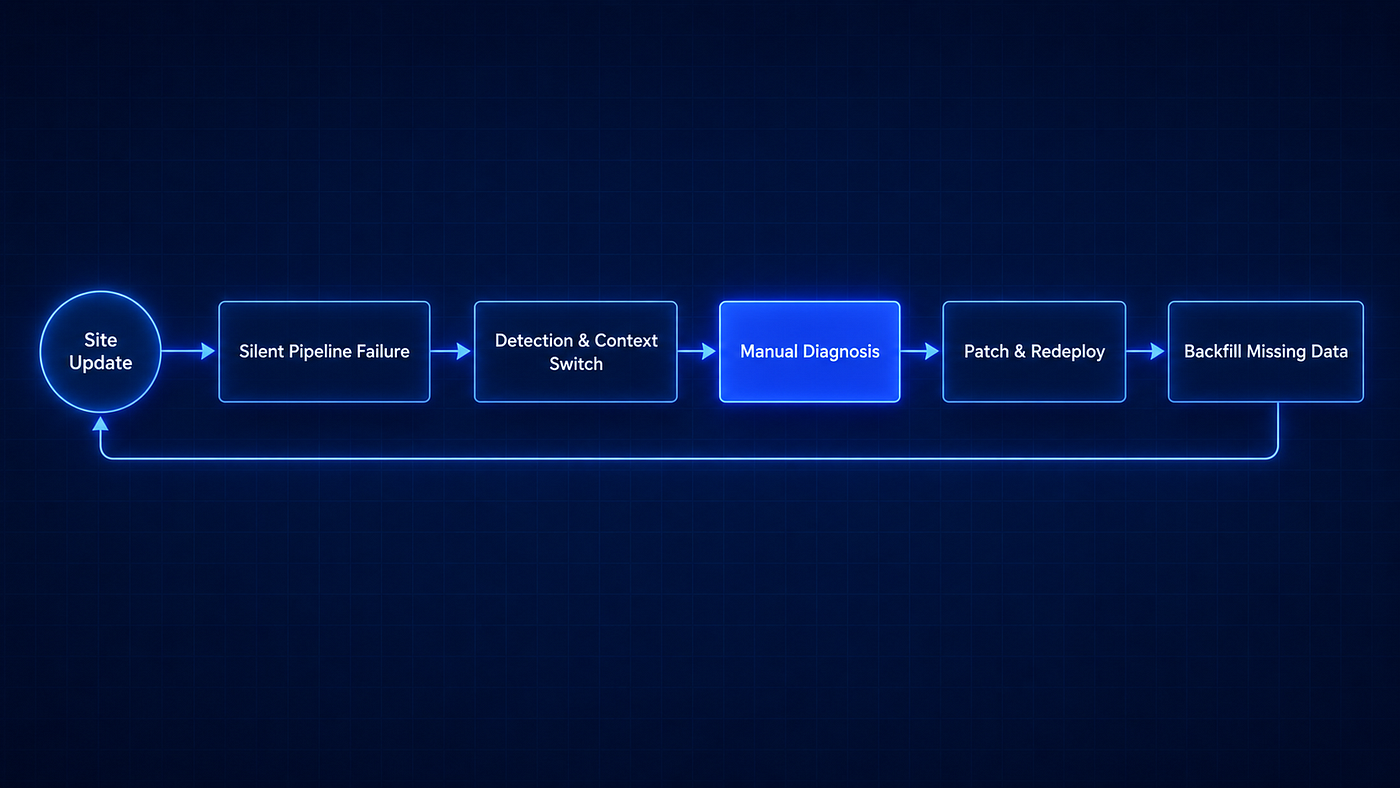
Image courtesy of Dall-E
Each time something breaks, it costs an hour just to switch context. If one site updates each week, that is one hour lost. Five sites mean five hours. Ten sites mean 10 hours. That is before anyone even starts writing new extraction logic.
Maintenance Compounds, Then Infrastructure Expands
Websites change CSS classes, restructure HTML and strengthen anti-bot defenses without warning. Each change can break your scrapers.
Quick fixes add up over time. Code written to handle one site’s quirks often ends up spreading across your shared infrastructure. Technical debt builds up faster than you can manage it.
Then the infrastructure grows. What starts as a single script turns into proxy rotation, headless browsers, retry logic, monitoring and session management. These parts were never meant to work together. A browser automation script does not understand proxy rotation, and a retry loop does not know when a session has expired. Still, you have to piece them together.
Each part can fail in its own way. Browser infrastructure might leak memory. Session management can drop authentication. Monitoring alerts might wake someone up at 2 AM.
Residential proxy pools can cost between $500 and $3,000 a month, but the time engineers spend tuning rotation logic and handling IP bans often costs even more than the proxy bill.
Where Developer Time Goes
A senior engineer’s week breaks into three buckets. Only one produces value.
Extraction logic: Selectors, parsers and data transformation. This work requires judgment and domain knowledge. It is what really matters.
Infrastructure maintenance: Proxy management, browser lifecycle, IP rotation and CAPTCHA handling. Important but undifferentiated. Every team faces the same issues.
Incident response: Diagnosing silent failures, patching broken scripts and figuring out why a pipeline stopped working. This bucket expands and takes time from valuable work.
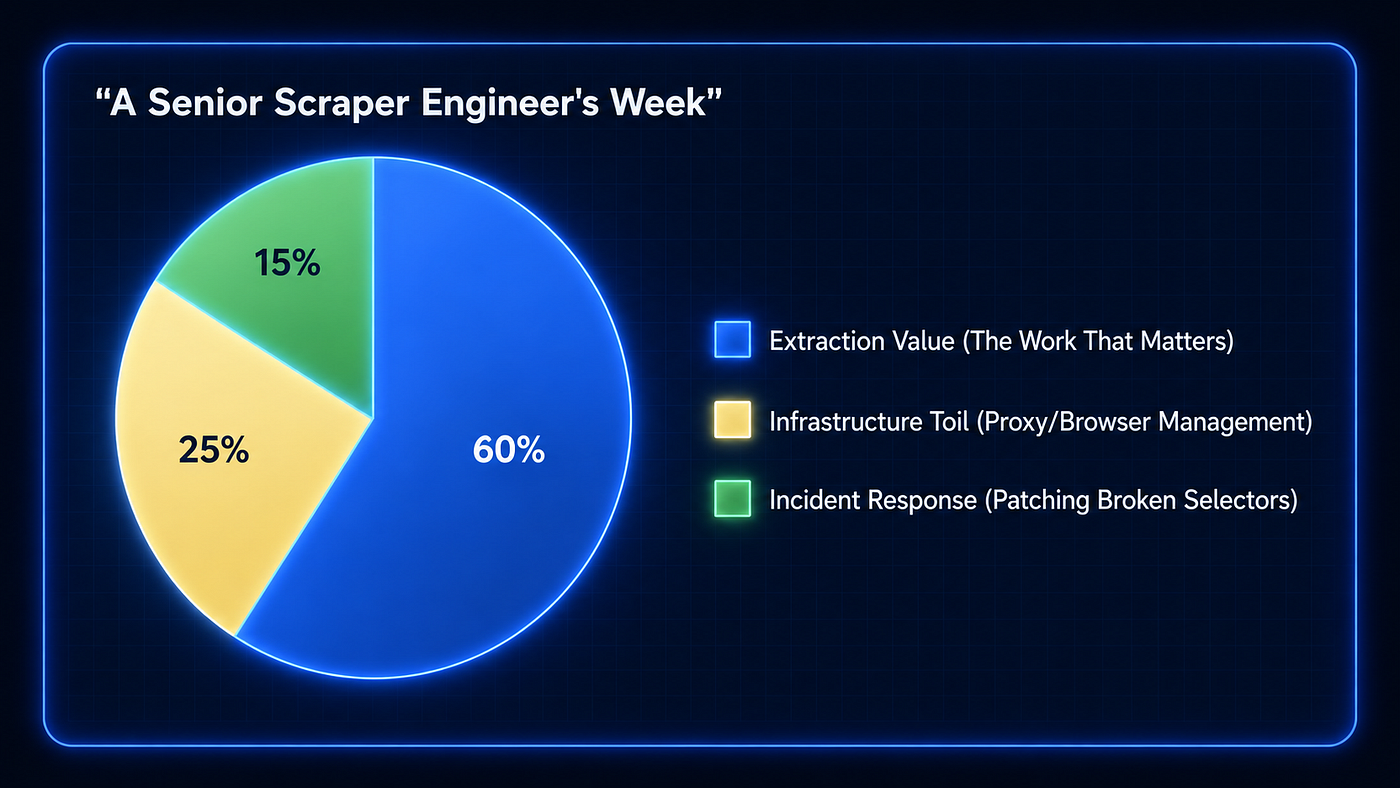
Image courtesy of Dall-E
If 40 percent of engineering time goes to maintenance and incident response, a three-person team delivers the extraction output of 1.8 engineers. The rest of their time keeps current pipelines running. That team could be building new scrapers instead, but those hours go to maintenance.
While your team is busy fixing broken selectors, competitors pulling from Bright Data’s Datasets are already getting value from the data. The data is out there, and your access speed depends on who handles the infrastructure.
The Compliance and Reliability Checklist
Before you move your scraping infrastructure to another provider, make sure their solution covers both legal compliance and operational reliability. Here is what you should look for:
Legal compliance: The provider should operate within the framework established by Meta v. Bright Data. Accessing public data is legal. Your provider must not facilitate misuse of that data.
Proxy rotation: Residential, datacenter, ISP and mobile IPs rotated automatically so you are not debugging bans.
Anti-bot bypass: JavaScript rendering, fingerprint management and CAPTCHA solving handled behind the scenes.
Session management: Persistent sessions that do not drop authentication mid-pipeline.
Reliability guarantees: Uptime, retry logic and monitoring so you are not woken up at 2 AM.
Bright Data’s Web Scraper API meets all these requirements. It takes care of proxy rotation, anti-bot bypass and JavaScript rendering. Your code remains yours, while they handle the infrastructure.
For teams that want to build and test scraping scripts without managing infrastructure, the Web Scraper IDE provides a browser-based environment to write, debug and run scrapers with built-in proxy and rendering support.
Scraping Browser is for teams already running Playwright, Puppeteer or Selenium. Use this when you want to keep your existing scripts but offload the execution environment.
Managed Proxies are for teams that want to keep their scraper setup but remove the network layer. Use this if your main infrastructure challenge is managing proxies.
These tools will not fix bad extraction logic, poor parsing or incorrect data transformation. You are still responsible for the work that needs judgment. What these tools remove is the repetitive operational overhead.

Courtesy of Bright Data
Closing Thoughts
The Meta v. Bright Data ruling removed the legal uncertainty. Accessing public data is legal, but misusing it is not.
With that clarity, the only thing stopping your team from getting the data you need is infrastructure maintenance.
Maintenance costs show up in two ways.
Direct costs are easy to measure: hours spent fixing broken selectors, monthly proxy bills, monitoring dashboards and switching between writing new scrapers and repairing old ones.
Hidden costs are harder to justify: pipelines that never get built, signals that arrive late because someone was stuck on a CAPTCHA, or competitive intelligence that comes in after the decision window has closed.
If your team spends most of the week just keeping scrapers running, the real issue is owning the infrastructure, not the scrapers’ quality. The solution is to offload the part that was never worth owning in the first place.
Start your free trial and get back to building.
Disclaimer — This article is in affiliation with Bright Data, which I have been using successfully for many years.
메타데이터
- post_id
- 1d91261ee092
- slug
- youre-not-scraping-too-much-you-re-maintaining-too-much-1d91261ee092
- url
- https://medium.com/@gidon.eli/youre-not-scraping-too-much-you-re-maintaining-too-much-1d91261ee092
- canonical_url
- https://medium.com/@gidon.eli/youre-not-scraping-too-much-you-re-maintaining-too-much-1d91261ee092
- author_url
- https://medium.com/@gidon.eli
- status
- ok
- fetched_at
- 2026-07-13 06:23:13