Where Does Steve Forbes Rank All-Time Among ETSU Basketball Coaches?
He might be the most popular and was the highest paid. But was he really the best?
Where Does Steve Forbes Rank All-Time Among ETSU Basketball Coaches?
He might be the most popular and was the highest paid. But was he really the best?

Marky Billson
Steve Forbes is back in town.

Steve Forbes with AD Richard Sander upon the latter’s hiring as ETSU head men’s basketball coach.
The former ETSU and current Wake Forest head men’s basketball coach is back in town, first for a banquet tonight and then for a Buccaneers-Demon Deacons game on Wednesday, October 29th at Freedom Hall.
It’s a chance to relive the good old days. Few will ponder if Tennessee had not fired John Currie as Volunteers athletic director in 2017 and simply allowed him to hire Greg Schiano or Mike Leach as head football coach Currie never would have been in a position to become Wake Forest’s AD and lure Forbes from ETSU.
Nor will they wonder why Wake Forest played real games that counted in Johnson City against the Buccaneers in 1977 and 1989 but now, even with ETSU’s former coach at their helm, all the Bucs can get is a lousy exhibition game at home against the Deacs.
Instead, they’ll look back at Forbes final season when ETSU won a school-record 30 games and suggest the Buccaneers could have made a run in the NCAA Tournament had it not been cancelled by COVID-19.
It’s possible. But because ETSU has slumped since Forbes’ departure, and because former coaches like Madison Brooks and Les Robinson are nothing more than names in a media guide to many younger fans, people will be inclined to say Forbes was the best Bucs coach ever.
He’s a candidate. It can be argued no other ETSU coach in history had the concentrated success Forbes did.
And due to his popularity, if a poll was held with Forbes against former coaches, he’d likely win it.
But he doesn’t have the longevity of some of his historical peers.
He didn’t have the revival or building project others had.
And for all Forbes success, he didn’t win an NCAA Tournament game, he never had the Bucs nationally ranked, and he never produced a player that played professionally on the highest level.
Other ETSU coaches did.
Here’s a capsule of the Bucs’ All-Time basketball coaches.
MADISON BROOKS (1948–73)

Brooks won 370 games at ETSC/ETSU
The debate to who the Bucs greatest all-time coach would likely come down to fans not familiar with the school’s history choosing Forbes because of his recent success and those who do know ETSU’s history choosing Brooks because of his longevity.
But consider when Brooks became ETSC’s coach, their arch-rival was Milligan and they competed on the level of Tusculum and King with an all-white roster of locals.
He had to double as an assistant football coach and the gym now named in his honor wasn’t even built yet; the Buccaneers played home games in a building later used for the ROTC and at high school gyms.
When he stopped coaching, ETSU was an integrated Division I NCAA member with an appearance in the Sweet 16 of the NCAA Men’s Basketball Tournament, a player in the American Basketball Association, recruited beyond their local region, had enjoyed victories against the likes of Duke, Florida State, and Ole Miss and were beginning the process of building a 12,000-seat arena to play in.
Against that legacy, Forbes merely looks like a coach who inherited a 16–14 team and made it better.
True, as mentioned above the Buccaneers won a school-record 30 games in Forbes’ final season at ETSU.
But it should be mentioned the most games the Buccaneers ever played in a season for Brooks was 31. College basketball season didn’t begin until December back then.
Brooks’ tenure was not without flaws. One can discuss how in 15 years of eligibility he only took the Buccaneers to the NCAA University Division Men’s Basketball Tournament once.
True, the NCAA Tournament was more exclusive then, but it was still a matter of winning the conference tournament to get in as it is today.
And Brooks was known to get physical with players.
But when he retired, he was the fifth winningest coach in the history of major college basketball.
So, case closed?
Possibly, but also consider:
LES ROBINSON (1985–90)
While Forbes had the most concentrated success as a coach at ETSU, it was Robinson who started the most concentrated era of success the Buccaneers enjoyed as a team.
And it’s quite the rags-to-riches story.
While luring Robinson from The Citadel might have been something of a slight coup (hiring a coach from a conference rival usually is), ETSU struggled mightily in Robinson’s first years at the helm.
He had to overcome probation stemming from violations from the regime of his predecessor, Barry Dowd, and frankly his second team might have been the worst one in modern Buccaneers history.
Just two years later, ETSU was leading the top-ranked team in the nation by 15 points in the NCAA Tournament.
What’s more, Robinson was the most charismatic basketball coach at ETSU until Forbes. He became the Bucs’ athletic director in short order and probably scheduled better than any other ETSU coach in history.
Criticisms? The Bucs lost that 15-point lead against Oklahoma; couldn’t even get the ball past the timeline in their final possession. His tenure as athletic director was a death knell for football; losing a coach to a Division II school and then not hiring his successor until nine days before signing day meant as good as Bucs basketball was from 1988–92, the football team was just as bad.
And let’s face it; after he departed for North Carolina State the Wolfpack basketball program regressed and have never since been able to regain the glories they experienced with Robinson predecessors Jim Valvano, Norm Sloan, and Everett Case.
But should football shortcomings as an athletic director take away from his job as a basketball coach?
Or his failures at NCSU influence his successes at ETSU?
Buccaneers fans have never thought so.

Les Robinson hired longtime College of Charleston head coach Alan LeForce to be his right hand man at ETSU. Today LeForce advises Furman head coach Bob Richey.
ALAN LEFORCE (1990–96)
LeForce brings perhaps the strongest argument to challenge Brooks as the All-Time ETSU coach.
Consider-
A- He is the only basketball coach to ever have ETSU nationally ranked- finishing №17 in the country in the final Associated Press men’s basketball poll of 1991; even enjoying a №10 ranking on Feb. 11.
There was legitimate national discussion the Bucs were Final Four contenders that season.
B- As an assistant he personally recruited the only NBA player ETSU ever produced, Keith “Mister” Jennings. Jennings was not only the key figure of the Bucs’ success back then, but the offense he ran allowed him to average more than nine assists a game as a senior, allowing him to finish his career with the second most assists in NCAA men’s basketball history (987).
So who really was the architect of the four straight NCAA Tournament teams, Robinson or LeForce?
Heck, LeForce even laid the foundation for John Kresse to turn College of Charleston into a nationally ranked Division I program.
C- In front of more than 12,000 fans at the Minidome, LeForce’s Bucs beat Robinson’s Wolfpack, 94–91 on Dec. 29, 1990.
It can be argued this is the biggest sporting event ever held in Johnson City. What else would you suggest is?
D- He’s one of only two ETSU coaches to win an NCAA Tournament game, besting Arizona, 87–80 in 1992.
This is still not only the last time ETSU has won an NCAA Tournament game, but the last time they have defeated a nationally ranked team (the Wildcats were ranked second in the country).
Yes, Brooks has longevity, but that isn’t the end-all, be-all. Few would say Jerry Springer was a better talk show host than Dick Cavett, for instance.
What hurts LeForce’s legacy is the way his tenure at ETSU ended. It could be argued the Buccaneers slowly but surely regressed in every season of LeForce’s career at the helm.
They were 7–20 in his final season of 1995–96, just as the Bucs were 7–21 nine years prior.
ETSU fandom seemed to fall off a cliff. High school basketball often pre-empted Bucs games on their local flagship radio station and received superior placement on the sports page in the Johnson City Press.
Whereas ETSU averaged a school-record 8,410 fans a game in 1992 (perhaps yet another feather in LeForce’s cap), by 1996 the number had fallen to 4,281.
This paved the way for ETSU’s most underrated coach.
ED DeCHELLIS (1996–2003)
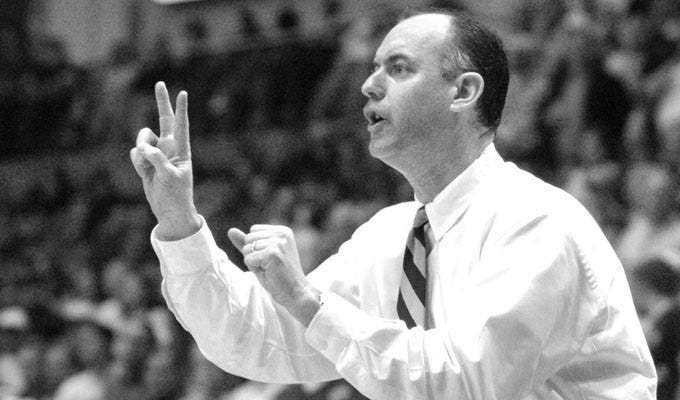
DeChellis retired this season after 29 consecutive years as a major college basketball head coach.
Consider this for DeChellis’ legacy.
No ETSU head men’s basketball coach had a longer tenure as a college head coach (29 seasons).
True, 22 of them were spent at Penn State and Navy.
But he likely accomplished the greatest rebuilding job in ETSU basketball history.
It wasn’t just DeChellis inherited a 7–20 team. The team was failing academically, too. When he arrived in Johnson City, only Kyle Keeton was academically eligible to play in the upcoming season.
In his third game, DeChellis had use of only seven players. In his seventh, only 248 people showed up (the official attendance was listed as 714, but I was there and personally counted the fans at the end of the first half).
It wasn’t like today where transfers can turn a team around overnight. DeChellis did get Greg Stephens to transfer from Navy, and he led the Southern Conference in scoring as a junior at ETSU.
But under the transfer rules of the time, Stephens wasn’t eligible to play in 1996–97.
What DeChellis was able to do was get his initial undermanned team to go from getting their score doubled by major opponents in November to beating Sweet 16 participant Chattanooga in February.
By his third season, ETSU had a winning record. By his fifth, he had recruited highly touted prospect Zakee Wadood out of Arkansas and intimidating wide body Jerald Fields out of Florida.
All this pair of post players did was win a Southern Conference regular season championship in every season of their college careers.
Even Greg Dennis can’t say that. True, he played on four straight NCAA Tournament teams, but the Bucs were only a .500 team in conference during the 1988–89 regular season before catching fire in the Southern Conference Tournament.
ETSU returned to the NCAA Tournament after an 11-year hiatus in DeChellis’ final game. He left a turnkey team for his successor, Murry Bartow, and the foundation for ETSU to enjoy 19 winning seasons in 21 years, an unprecedented reign of long-range success for the program.
MURRY BARTOW (2003–15)
No coach in ETSU history ever took the Bucs to the NCAA Tournament more than Bartow.
That’s his claim to be called “Greatest ETSU Coach Ever.”
It’s not a bad one.

Give credit to Bartow for suspending his best player in 2012 for receiving drugs in the mail. It meant a horrible season, but it was the right thing to do.
STEVE FORBES (2015–20)
When discussing Forbes ETSU legacy among his predecessors, consider:
Is it more impressive to inherit a 16–14 team and mold it into a 30–4 team five years later, or to inherit one eligible player off a 7–20 team and win a conference title in five years?
Is it more impressive to take a small NAIA school and 20 years later play for a spot in the NCAA Tournament quarterfinals than it is to essentially double an established program’s victory total in five?
Was it more impressive for Robinson to take a down program to the NCAA Tournament in four years or Forbes to take an average team to March Madness in two?
Does the end of LeForce’s ETSU career overshadow the fact he likely produced ETSU’s greatest basketball glories with a significant hand in developing them from the start?
Are three conference tournament championships in 12 years on par with or a greater accomplishment than two in five?
How important is longevity as compared with concentrated success, in Forbes case winning two league championships, playing for two others, and reaching the SoCon Tournament semifinals in his other year as ETSU coach?
The Forbes era wasn’t perfect. There was the collapse of the 2018 Bucs, both at the end of the season and in the second half of the tournament final.
Just what was the Vegas 16? Was this really the best tournament ETSU could get in back in 2016? And they still couldn’t win it?
And it’s not a good look when you’re not denying you played M’laden Armus with a concussion in the 2019 Southern Conference Tournament, but rather attacking me for asking while admitting he was “Coo Coo for CoCo Puffs” after the game in question.
Armus would then transfer to Boise State, where he would play in the NCAA Tournament, something he wouldn’t have been able to had he stayed at ETSU.
Still, Forbes is popular enough a party is being thrown for him upon his return to Johnson City.
And while Bartow, DeChellis, and LeForce never had their assistants become head coach at ETSU and Brooks and Robinson only had one, two of Forbes’ former staffers rose to become Bucs head coach in the years that followed.
There wasn’t a bad season in the five he coached here and he’s the only to win 30 games in a season.
Is that greater than his predecessors? You decide.
Nobody knows the history of the Bucs like Marky Billson. Subscribe to his medium page or Marky Billson on ETSU | Substack.
메타데이터
- post_id
- 1d99e2bf459a
- slug
- where-does-steve-forbes-rank-all-time-among-etsu-basketball-coaches-1d99e2bf459a
- url
- https://medium.com/@markybillson/where-does-steve-forbes-rank-all-time-among-etsu-basketball-coaches-1d99e2bf459a
- canonical_url
- https://medium.com/@markybillson/where-does-steve-forbes-rank-all-time-among-etsu-basketball-coaches-1d99e2bf459a
- author_url
- https://medium.com/@markybillson
- status
- ok
- fetched_at
- 2026-07-18 23:07:34