I Built an App That Reads Your Hands Because I Was Tired of Tapping Through Fate
Some things shouldn’t be reduced to a button click. Drawing a card should feel like pulling a thread from the universe.
I Built an App That Reads Your Hands Because I Was Tired of Tapping Through Fate
Some things shouldn’t be reduced to a button click. Drawing a card should feel like pulling a thread from the universe.
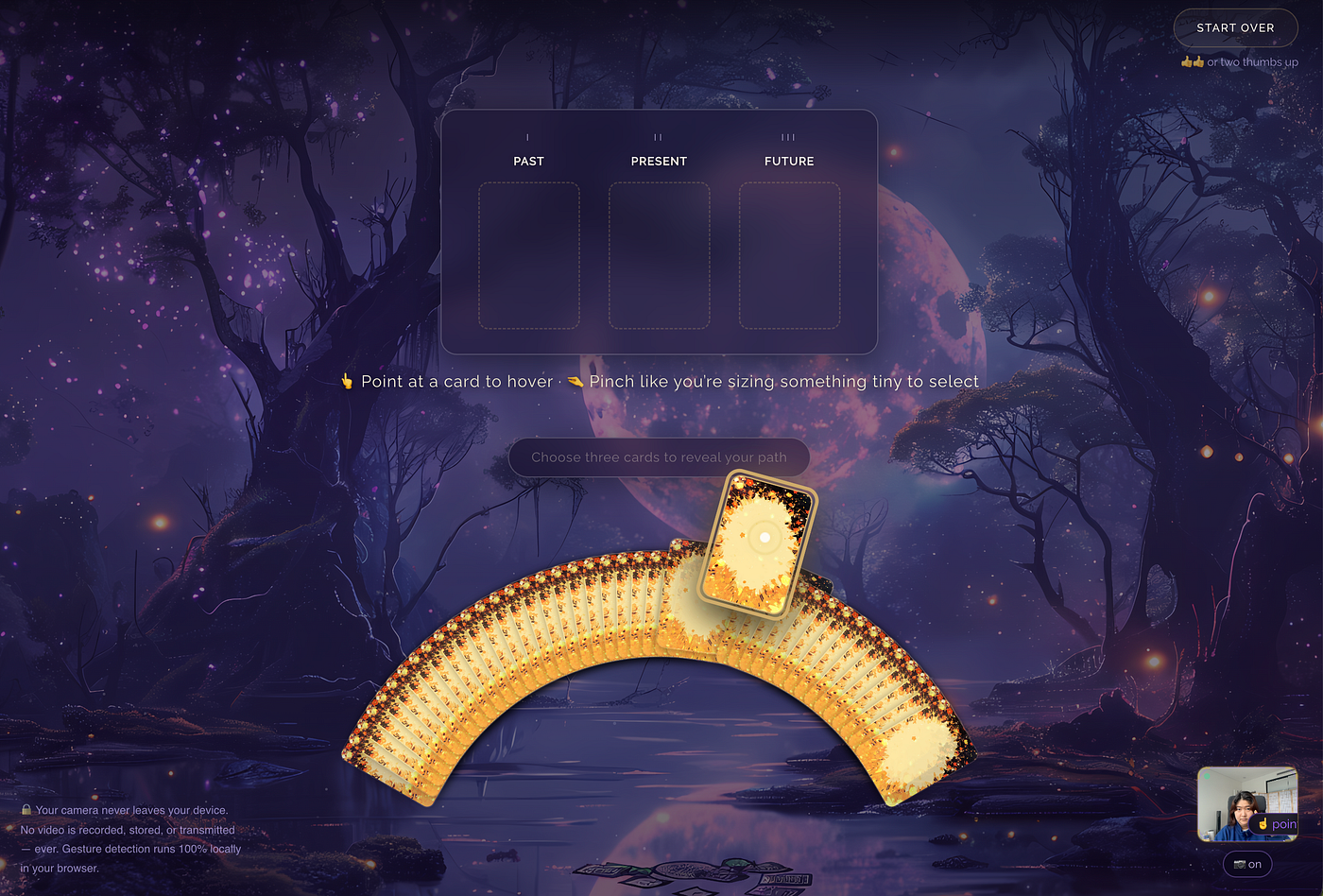
whatwasdrawn.com
There’s something sacred about pulling a card from a deck.
Not the Instagram version of it — where you tap a glowing button and a pre-written paragraph tells you you’re “entering a season of abundance.” I mean the real thing. The weight of the deck in your hands. The pause before you draw. The moment where you don’t know what’s coming, and you pull anyway.
That’s the ritual. And I wanted to build it into a screen.
The backstory no one asked for (but you’re getting anyway)
My wife Kretch and I created the Quiet Whiskers Oracle — a 44-card deck featuring a Turkish Angora cat as the guide through each card’s meaning. If you’re wondering where the cat inspiration came from, his name is Tyche, he lives with us in our tiny apartment in Sydney, and he has the attitude of a creature who definitely knows more than he’s letting on.
We designed the physical deck together. Every card, every illustration, every whisker. And at some point I thought — what if someone could feel the deck before they ever held it?
Not a demo. Not a glorified slideshow. Something that felt like a real draw.
That’s how What Was Drawn was born.
So what does it actually do?
You open the site. You turn on your webcam. And you draw cards with your actual hands.
No buttons. No taps. No clicking “shuffle” like you’re ordering a coffee.
Your hand appears on screen, glowing cyan like some kind of low-budget anime protagonist. The app watches your gestures in real time — a deliberate pull to draw a card, a wave to shuffle, a swipe to move through your spread. Every gesture means something. Every movement is intentional.
And when your cards are drawn, the app doesn’t spit out a canned paragraph pulled from a database. It generates a personalised reading — poetic, specific to the cards you drew, grounded in the actual symbolism of each one.
It knows that “The Wanderer” in the past position and “The Keeper” in the future position mean something very different than the other way around.
Because I taught it.
Why I actually built this (the honest version)
I’d love to tell you this was a calculated product decision. Market research. User personas. Conversion funnels.
It wasn’t.
I built this because I was tired. Tired of job applications that felt like shouting into a void. Tired of imposter syndrome whispering that a career-switcher with a broadcasting degree had no business calling herself an AI engineer. Tired of building things that only existed on localhost.
So I decided to build something real. Something alive. Something that someone could use and feel something from.
The oracle deck was already part of our life. Kretch and I would pull cards together — sometimes for fun, sometimes when we genuinely needed to hear something we couldn’t say to ourselves. It became our small ritual during the hard months. And there were hard months.
What Was Drawn started as my way of giving that ritual to other people. And somewhere in the process of wrestling with hand tracking, debugging gesture detection at 2am, and asking myself “why does the swipe gesture keep triggering when I’m literally just resting my hand” — it became something I was proud of.
Not proud like “look at my side project.” Proud like… I made a thing that works and it matters to me and I don’t need anyone’s permission to ship it.
That was new.
The part where my hand literally glows
I’m not going to turn this into a technical deep dive — you can check the GitHub for that. But here’s the gist for the curious:
MediaPipe Hands tracks your hand through the webcam in real time. I built a gesture detection engine that recognises six different gestures based on hand landmark coordinates. If you’ve ever tried to get a browser to reliably tell the difference between “the user is deliberately swiping” and “the user is just scratching their nose,” you know this is harder than it sounds.
The readings are powered by a RAG pipeline — that’s Retrieval-Augmented Generation for the nerds in the back. Each of the 44 cards has detailed symbolism stored as vector embeddings. When you draw your cards, the app retrieves the actual card meanings and feeds them into the AI alongside your spread layout. So the reading you get isn’t a hallucinated fortune cookie. It’s grounded. Specific. Sometimes uncomfortably accurate.
The whole thing runs on React + FastAPI, containerised with Docker, deployed on Vercel and Railway. It has rate limiting so people can’t abuse it, and a Ko-fi integration so people who want more readings can support the project.
It’s live. Right now. At **whatwasdrawn.com**.
What building this taught me about building anything
Perfection is procrastination in a nicer outfit. I could’ve spent another three months polishing the gesture detection. Instead I shipped it with a confidence threshold that works 90% of the time and a graceful fallback for the other 10%. The app is live. The app is used. The polishing continues.
Your weird, personal, niche thing is your strongest thing. Every tutorial tells you to build a todo app or a weather dashboard. I built a gesture-controlled oracle card reader powered by a RAG pipeline. Guess which one a hiring manager has never seen before.
The ritual matters. I could’ve made this a tap-to-draw app and saved myself weeks of gesture recognition headaches. But the whole point is that you draw with your hands. The friction is the feature. The pause before the pull is where the meaning lives.
What’s next
More spreads. More cards. A mobile tap version for people without webcams (because accessibility matters more than my artistic vision). And eventually, a second deck that’s been living in my head for a while — something rooted in Filipino mythology, which is a whole other story for a whole other blog post.
For now, the cards are waiting.
Fate has spoken. You just haven’t looked yet.
Try it: whatwasdrawn.com
Get the physical deck: unikre.com.au
Support the project: ko-fi.com/whatwasdrawn
See the code: github.com/unicebondoc/whatwasdrawn
I’m Unice — an AI engineer, an overthinker, and someone who believes technology should make you feel something. I write about building things that matter at medium.com/@unicebondoc. You can find my other work at unicebondoc.com.
메타데이터
- post_id
- 1d9ddcc2f8a6
- slug
- i-built-an-app-that-reads-your-hands-because-i-was-tired-of-tapping-through-fate-1d9ddcc2f8a6
- url
- https://medium.com/@unicebondoc/i-built-an-app-that-reads-your-hands-because-i-was-tired-of-tapping-through-fate-1d9ddcc2f8a6
- canonical_url
- https://medium.com/@unicebondoc/i-built-an-app-that-reads-your-hands-because-i-was-tired-of-tapping-through-fate-1d9ddcc2f8a6
- author_url
- https://medium.com/@unicebondoc
- status
- ok
- fetched_at
- 2026-07-22 10:16:32




