Why Sacred Spaces Need Guardians
A symbolic look at shrine guardians, boundary figures, and why important thresholds are rarely left unwatched.
Why Sacred Spaces Need Guardians
A symbolic look at shrine guardians, boundary figures, and why important thresholds are rarely left unwatched.
Designed by Oblivion Rise
Editorial note: This essay was developed with AI-assisted drafting and human editorial direction, then reviewed for tone, structure, and cultural caution.
A gate without a guardian can still be beautiful.
It can be carved, painted, weathered, quiet. It can stand beneath trees or at the edge of a stone path. It can divide one space from another with perfect simplicity.
But a gate with guardians changes the air.
The entrance no longer feels like a passive opening. It feels watched. Not watched in the modern sense of surveillance, camera, suspicion, or control. Watched in an older, stranger sense: given eyes, posture, and presence.
A threshold with guardians asks something from the person approaching it.
Not fear. Not obedience. Attention.
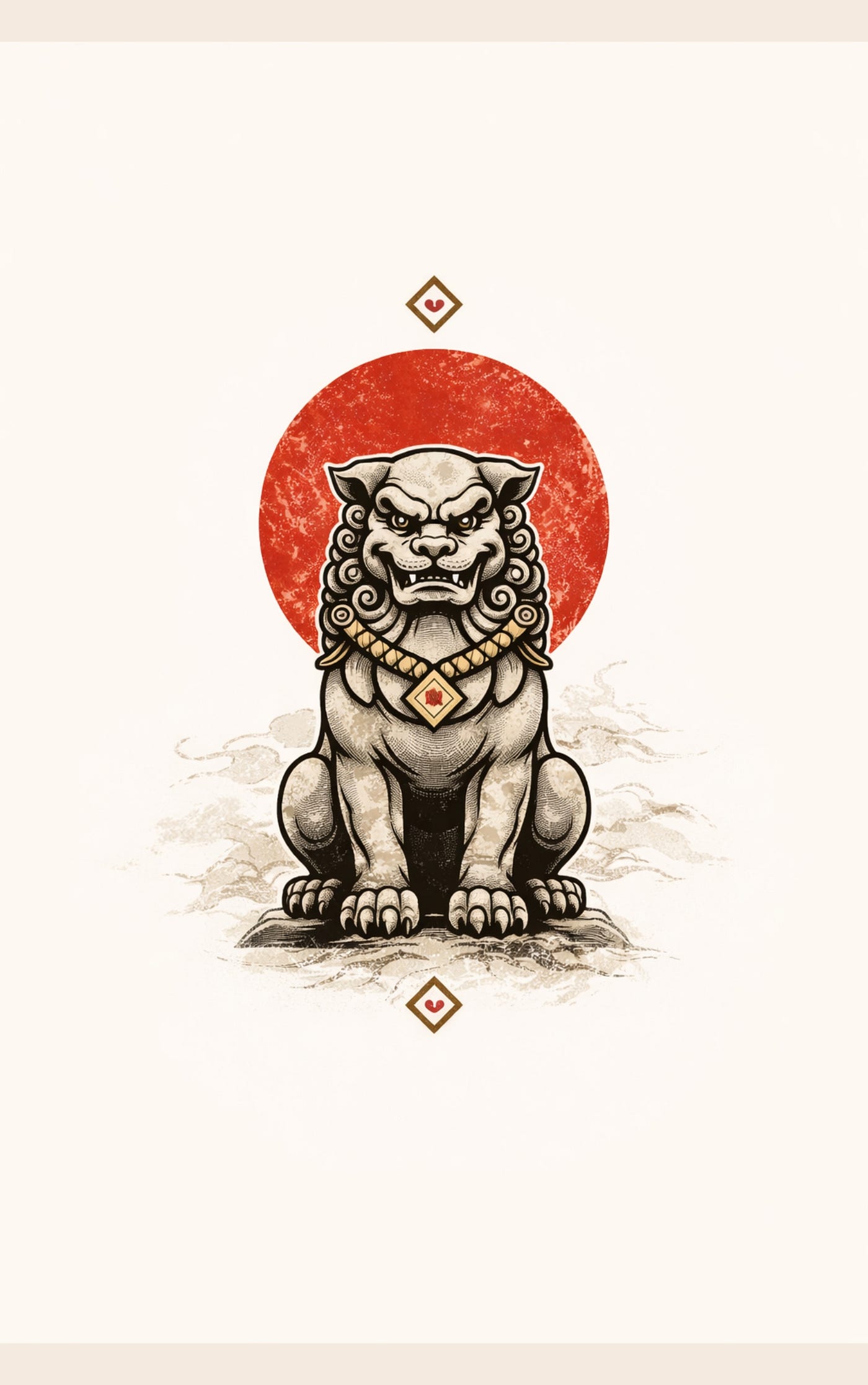
This is why sacred spaces so often gather figures near their entrances. In Japanese shrine symbolism, komainu — often described in English as lion-dogs — are commonly seen in pairs near shrine gates, approaches, or worship halls. They are usually understood as guardian figures, but if we stop at the word “guardian,” we miss much of their symbolic intelligence.
A guardian is not only something that protects.
A guardian changes the way we enter.
The entrance is never neutral
A threshold is one of the most charged forms in human space.
It is the line between outside and inside, approach and arrival, public and marked, ordinary and set apart. Even when nothing explicitly religious is involved, thresholds carry emotional pressure. A courtroom door, a hospital room, a childhood bedroom, a library entrance, a cemetery gate — each one teaches the body a different way to cross.
Sacred thresholds intensify this grammar.
They do not simply allow passage. They prepare it. They tell the visitor, before words, that the space ahead should not be treated as an extension of the road. The entrance becomes a change in condition.
This is where guardian figures become important.
A guardian placed near a threshold gives that change a body.
The boundary is no longer only architectural. It has a face. It has weight. It has a stance. It can meet the eye. Stone, wood, bronze, or another material becomes a form of symbolic attention. The space appears to be aware of its own edge.
That feeling matters.
A meaningful place does not always need to be closed.
But it often needs to be watched.
Guardians are not just monsters
It is easy to misread guardian figures as decorative monsters.
They have teeth, claws, raised bodies, fierce expressions, animal features, mythic shapes. They may seem designed to frighten, dominate, or dramatize the entrance. In a shallow reading, they become exotic creatures placed near a gate for visual intensity.
But guardian figures are usually more precise than that.
Their force is not only aggression. It is posture.
A guardian does not need to attack. It needs to stand. Its task, in symbolic terms, is to make the threshold conscious. It turns the entrance into a place of encounter, even before the visitor crosses.
This is why the body of the guardian matters. A guardian has weight. It belongs to the ground. It faces outward or toward the path. It holds position over time. Rain falls on it. Moss gathers near it. Its features soften slowly, but its function remains.
The guardian does not chase.
It remains.
That remaining is part of its authority.
The watched threshold
A watched threshold is different from an empty threshold.
An empty threshold may still be significant, but it asks less from the visitor. It may be crossed absentmindedly. It may become merely practical. The body passes through while the mind continues elsewhere.
A watched threshold interrupts that automatic movement.
The visitor approaches and sees figures waiting. The path narrows. The entrance becomes less casual. Even without knowing every historical, religious, or regional detail, the body understands the basic grammar: this is not just a gap in space.
Something is keeping the boundary present.
That does not mean the visitor must be frightened. Fear is too crude a reaction for the best guardians. A more interesting response is awareness.
The guardian says: notice where you are.
This is why guardian figures belong to the same symbolic family as gates, ropes, talismans, thresholds, and boundary markers. They do not only divide space. They shape the mental act of approaching it.
A guardian turns entry into a relationship.
The person approaching is not simply moving through an opening. They are entering a field that already has presence.
Stone as attention
Stone is one of the natural languages of guardianship.
A wooden sign may weather quickly. A strip of paper may be replaced. A rope may be renewed. But stone holds duration. It suggests that the boundary is not temporary, even when the surface changes.
A stone guardian does not speak, but it accumulates atmosphere.
The paws darken after rain. Lichen gathers in small recesses. Edges soften. Shadows sit differently across the face in morning and evening. The figure remains in place while generations pass through the entrance it watches.
That long stillness can make the guardian feel less like an object and more like a witness.
This does not require supernatural language. It requires only attention to what a fixed figure does to a moving body. The visitor walks. The guardian remains. The visitor changes mood, age, purpose, and season. The guardian continues to hold the threshold.
There is symbolic power in that imbalance.
The one who crosses is temporary.
The one who watches endures.
The paired guardian
Guardian figures often appear in pairs.
This pairing matters visually before it matters doctrinally. Two figures create a gate within the gate. They frame the approach. The visitor does not simply pass by one object; they move between presences.
A pair changes space through tension.
Left and right. Open and closed. Motion and stillness. Invitation and restraint. One figure may appear more outward, the other more inward. One may seem to announce, the other to contain. Even if these readings vary by tradition and context, the visual effect is clear: the entrance has been balanced by opposing or complementary forces.
The visitor becomes the third point.
To pass between guardians is to become momentarily held inside their arrangement. The body enters the composition. The threshold is not only looked at; it is experienced physically.
This is one reason paired guardians feel different from a single statue placed beside a path. The pair forms a passage. It gives the entrance a double awareness. The space ahead is not merely guarded. It is framed.
The guardian pair makes crossing visible.
Protection as changed behavior
The word “protection” can become too simple.
A guardian protects the shrine. A lion-dog wards off evil. A fierce figure keeps danger away. These explanations may belong to traditional understandings, but symbolic reading can also ask another question: how does the presence of a guardian change human behavior?
A guardian can protect by altering approach.
It slows the visitor. It interrupts careless entry. It makes the boundary emotionally heavier. It asks the eye to adjust before the feet continue. The protected space is not only defended from outside forces; it is protected from being entered without attention.
This is a more subtle form of guardianship.
Many important places need this. Not because they are fragile in a physical sense, but because their meaning can be damaged by careless approach. A shrine, a grave, a memorial, a library, a studio, a room of mourning, a place of ritual, even a private desk where serious work happens — each one can be weakened when treated like any other surface.
Guardianship begins by saying: not like that.
Enter differently.
The guardian as boundary made visible
A boundary can be invisible.
A change of atmosphere. A social rule. A silence. A custom. A memory. A feeling that one should lower the voice or slow the body.
But invisible boundaries are easy to ignore.
Guardian figures make boundary visible.
They give the edge a body that cannot be dismissed as easily as an abstract rule. Instead of explaining the importance of the place, they embody it. They do not need a paragraph. Their posture performs the warning.
Not every visitor will read the details correctly. Not every visitor will know the name, history, or local variation of the guardian. But the broad symbolic effect can still work. The entrance is no longer empty. The space ahead has been given a face.
This is why guardian figures appear across so many cultures, not only in Japan. Lions, sphinxes, dragons, dogs, bulls, serpents, birds, hybrid beings, ancestors, saints, angels, warriors, masks, and carved watchers often gather near gates and sacred places. Their forms differ, but the grammar repeats.
Important spaces are rarely left unwatched.
Komainu and the grammar of shrine approach
Komainu are especially interesting because they bring together animal force, mythic ambiguity, and architectural function.
They are not ordinary dogs. They are not simply lions. They are often described as lion-dogs, which already places them in a hybrid symbolic field. Their bodies carry familiarity and strangeness at once. The visitor recognizes animal posture but also senses something shaped by ritual, history, and imagination.
This hybrid quality matters.
A fully ordinary animal might seem accidental. A purely abstract emblem might feel too distant. The komainu stands between: creature and sign, beast and sculpture, guardian and visual command.
Placed near a shrine approach, it becomes part of the visitor’s movement. The guardian is encountered not in isolation, but in relation to path, gate, stone, offering space, trees, and silence. Its meaning is spatial. It belongs to the choreography of approach.
You do not only look at the guardian.
You pass by it.
That passing is the point.
Mythic guardians and serious thresholds
A serious threshold requires more than decoration.
Decoration beautifies a place. A guardian charges it.
This distinction is important for the Oblivion Rise reading of Japanese symbolism. A guardian is not interesting merely because it looks fierce or mythic. It matters because it teaches the threshold how to be read.
In Guardians of the Sacred Boundary, the guardian figure becomes a way of understanding the watched edge: the place where approach, protection, posture, and attention meet. The book does not treat shrine guardians as monsters to be cataloged or fantasy creatures to be exaggerated. It reads them as boundary figures.
This connects naturally with Codex of Japanese Mythic Guardians, where guardian forms appear inside a broader symbolic field of mythic animals, watchers, and threshold figures. It also connects with The Sacred Boundary in Japanese Symbolism, where the boundary itself becomes the central question: how does a space announce that crossing it matters?
The guardian answers with presence.
Not explanation.
Presence.
The ethics of approach
The deepest function of the guardian may be ethical rather than defensive.
It asks: how should one approach what matters?
Not everything important should be entered casually. Not every room should be treated as available. Not every path should be walked with the same distracted pace. Some spaces require a change of posture before understanding can begin.
The guardian does not produce that change alone.
But it helps.
It makes the visitor aware of being a visitor. It places the body in relation to something older, heavier, or more deliberate than ordinary movement. It creates a pause before entry.
That pause is small, but serious.
A person who pauses at a threshold has already begun to enter differently.
Why sacred spaces need guardians
Sacred spaces need guardians because thresholds are vulnerable.
Not only vulnerable to physical threat, but vulnerable to forgetfulness. A boundary can be crossed so often that its meaning disappears. A gate can become only a shortcut. A shrine road can become only a scenic path. A marked place can become background.
Guardians resist that forgetting.
They sit, stand, crouch, watch, endure. They give the boundary eyes. They remind the visitor that entry is not automatic. Their silence is not emptiness. Their stillness is not passivity.
A guardian does not need to move to change the space around it.
It only needs to remain.
At the entrance, stone becomes attention.
And the threshold is no longer alone.
For readers who want to continue this atmosphere beyond the essay, Guardians of the Sacred Boundary explores shrine guardians, watched thresholds, boundary figures, and symbolic protection through the atmospheric lens of Oblivion Rise Japan.
Related visual works inspired by Japanese shrine guardians, komainu, sacred boundaries, stone figures, shrine roads, and dark Japanese aesthetics may also be available through Oblivion Rise on Redbubble and TeePublic.
메타데이터
- post_id
- 1da7bd8daa65
- slug
- why-sacred-spaces-need-guardians-1da7bd8daa65
- url
- https://medium.com/@oblivionrise0/why-sacred-spaces-need-guardians-1da7bd8daa65
- canonical_url
- https://medium.com/@oblivionrise0/why-sacred-spaces-need-guardians-1da7bd8daa65
- author_url
- https://medium.com/@oblivionrise0
- status
- ok
- fetched_at
- 2026-07-19 12:11:04