From Reaction to Response: The Hidden Power of Equanimity in Everyday Life
What a Child Taught Me About Balance
From Reaction to Response: The Hidden Power of Equanimity in Everyday Life
What a Child Taught Me About Balance
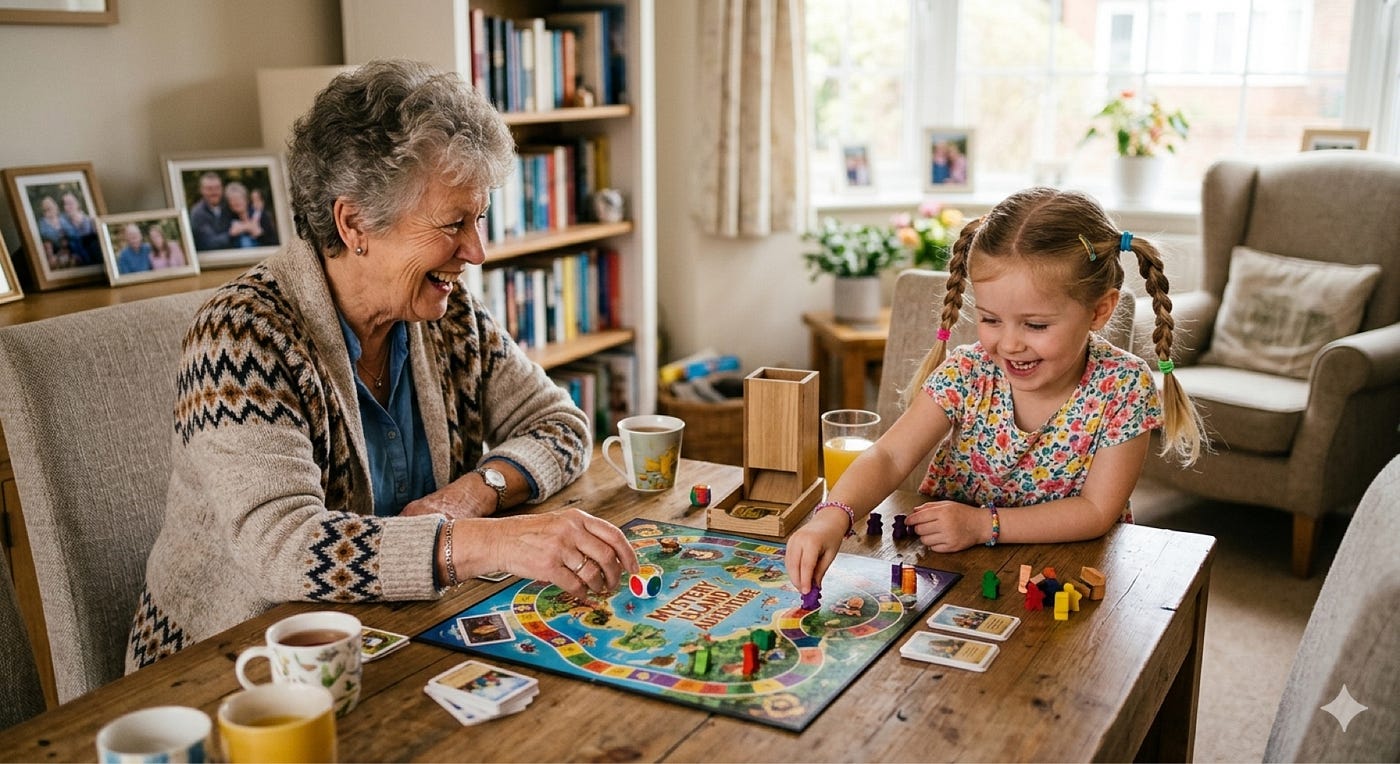
Image generated by Gemini
Recently, I played a simple board game with my granddaughter. We wanted to have fun and enjoy some time together.

Image generated by Gemini
When she lost, her face fell, and she started to cry. To her, it felt like more than just a game. It felt personal.
As I watched her, a question came to mind. It’s a question that has stayed with me through my years as a teacher, counselor, and lifelong learner.
Why do we have so much trouble with losing?
Children aren’t born afraid to fail. They explore, try things, fall down, and get back up.
But as we grow, failure stops being just something that happens and becomes part of who we are. “I failed” slowly becomes “I am a failure.”
That moment with my granddaughter reminded me of something deeper, something we rarely teach explicitly, yet desperately need.
Equanimity
Equanimity doesn't mean hiding your feelings or acting like everything is okay.
It's not about telling a crying child to “be strong” or “stop crying.”
Instead, it’s about creating a space where emotions can exist without overwhelming us.
It’s the ability to stay calm inside even when the outside world is unstable.

Image generated by gemini
As I reflected, I realized that my granddaughter needed not correction but containment in that moment.
Not advice but presence.
She needed someone who could hold the situation with calmness until her storm passed.
And isn’t that what we all need?
In our own lives, how often do we react right away to situations, like feeling defensive in a conversation, getting frustrated in traffic, or feeling disappointed when we fail? We are quick to respond, but we rarely pause.
Rarely do we observe our emotions without becoming them.
Equanimity invites us to do exactly that.
It teaches us to pause between stimulus and response.
To feel, but not be consumed.
To observe, without immediate judgment.
I recall moments in my own life when failure shaped my decisions.
Failing in math once led me to believe I was not capable. That belief quietly redirected my path. Looking back, I wonder what would have happened if I had learned equanimity then? What if I had seen failure not as a conclusion, but as a moment?
Equanimity doesn't remove difficulty from life. Instead, it changes our relationship with difficulty.
It allows us to say:
“This is hard, but I am steady.”
“This hurts, but it will pass.”
“This is not the end of me.”
As educators and caregivers, perhaps our role is not just to teach content, but to model this inner balance.
When a child fails, we can help them see that losing is an event, not a definition.
When they are overwhelmed, we can offer calm instead of correction.
Because children don't learn equanimity from lectures.
They learn it from the emotional climate around them.
That day, I didn’t try to fix my granddaughter's tears. I simply sat beside her. Slowly, her crying softened.
She picked up the game pieces again. Life moved on, as it always does.
And in that quiet moment, I was reminded:
Equanimity is not loud. It does not demand attention.
It simply steadies us again and again through life's wins and losses.
In the end, equanimity is not about controlling life.
It is about learning how to stand calmly within it.
Thanks for reading!
Mamta
메타데이터
- post_id
- 1db8c851194b
- slug
- from-reaction-to-response-the-hidden-power-of-equanimity-in-everyday-life-1db8c851194b
- url
- https://medium.com/the-gravity/from-reaction-to-response-the-hidden-power-of-equanimity-in-everyday-life-1db8c851194b
- canonical_url
- https://medium.com/the-gravity/from-reaction-to-response-the-hidden-power-of-equanimity-in-everyday-life-1db8c851194b
- author_url
- https://medium.com/@mamtaverma10
- status
- ok
- fetched_at
- 2026-06-27 23:56:40