No-Code Testing: A Practical Guide for QA Teams
Software quality assurance has always required a balance between thoroughness and speed. For most of QA’s history, that balance tilted…
No-Code Testing: A Practical Guide for QA Teams
Software quality assurance has always required a balance between thoroughness and speed. For most of QA’s history, that balance tilted toward thoroughness — because speed meant shortcuts, and shortcuts meant defects. The introduction of test automation shifted that equation, but only partially. Automation delivered speed and consistency, yet it introduced a new constraint: the ability to write and maintain code.
For QA teams without dedicated automation engineers, that constraint became a ceiling. Coverage stayed low, regression suites stayed manual, and release cycles stayed slow. No-code testing emerged as a practical response to that ceiling — not as a replacement for traditional automation, but as a way to extend its reach to teams and individuals who could not access it before.
This guide covers what no-code testing is, how it works, and how QA teams can begin adopting it in a structured way.
What is No-Code Testing?
No-code testing refers to the practice of creating and executing automated tests through visual interfaces rather than written code. Instead of authoring test scripts in a programming language, testers interact with a recorder, a drag-and-drop editor, or a step-builder that translates user actions into reusable, runnable test flows.
The underlying automation still executes — browsers launch, elements are located, interactions are performed, assertions are checked. What changes is the layer through which testers interact with that automation. Rather than writing driver.findElement(By.id('submit')).click(), a tester clicks a button in a recorder and the tool captures the action.
Codeless testing 2026 platforms have matured significantly from their early iterations. Modern tools handle dynamic selectors, conditional logic, cross-browser execution, and CI/CD pipeline integration — capabilities that were once exclusive to code-based frameworks. The gap between what a no-code platform can cover and what requires custom scripting has narrowed considerably.
No-code testing is distinct from low-code testing, which still requires some programming knowledge for advanced configurations. It is also distinct from record-and-playback tools of the early 2000s, which were brittle and difficult to maintain. Contemporary no-code platforms are built around stability and maintainability from the ground up.
Key Benefits for QA Teams
Reduced dependency on engineering resources. When test creation requires coding, QA teams must either develop those skills internally or borrow time from developers. No-code testing removes that dependency. Testers can build and own their automation without ongoing engineering support.
Faster test authoring. Capturing a user flow through a browser recorder takes minutes. Writing the equivalent test in a framework — with environment setup, selector logic, and assertion syntax — takes significantly longer. For teams with large regression suites to build or maintain, this difference compounds quickly.
Lower maintenance burden. Tests written against specific DOM selectors break when the application changes. No-code platforms use more resilient identification strategies and often detect element changes automatically, prompting reviewers only when a step genuinely needs attention. This keeps regression suites viable over time without constant manual upkeep.
Broader team involvement. No-code tools make test flows readable to non-technical stakeholders. Product managers can review coverage. Developers can verify that acceptance criteria are encoded correctly. New QA hires can contribute to test authoring within days rather than weeks. Quality becomes a shared responsibility rather than a specialized function.
Consistent execution. Automated tests run identically on every execution. There is no variation based on tester attention, familiarity with the application, or workload. For regression suites that need to run on every release, that consistency is foundational.
Step-by-Step Guide to Getting Started
Getting started with no-code testing does not require a full automation strategy on day one. A focused, incremental approach produces results faster and builds confidence in the tooling before expanding scope.
Step 1 — Identify high-value flows. Start with the five to ten user journeys that are tested manually on every release. These are typically login, core navigation, primary conversion flows, and critical form submissions. Prioritize by frequency of testing and cost of a missed regression.
Step 2 — Select a platform. Evaluate tools based on the browsers and environments your application targets, the integrations your pipeline requires, and the technical profile of your QA team. Most platforms offer trial access — use it to test a representative flow before committing.
Step 3 — Record and review. Use the platform’s recorder to capture the selected flows. After recording, review each step carefully. Remove steps that are not relevant to the assertion, and add explicit checks for the outcomes that matter — page titles, element visibility, response messages.
Step 4 — Add assertions. A test without assertions is a script that navigates without checking anything. Every test flow should verify at least one outcome: that a specific element is visible, that a value matches, that a redirect occurred. Assertions are what make a test meaningful.
Step 5 — Integrate with your pipeline. Once the first suite is stable, connect it to your CI/CD workflow. Tests should run automatically on pull requests or post-deployment, not only when someone manually triggers them. This is where automation delivers its core value — continuous, unsupervised verification.
Step 6 — Expand incrementally. Add new flows as the team grows comfortable with the tooling. Revisit and update tests when the application changes. Treat the test suite as a living document, not a completed project.
Manual Testing vs. Coded Automation vs. No-Code Testing
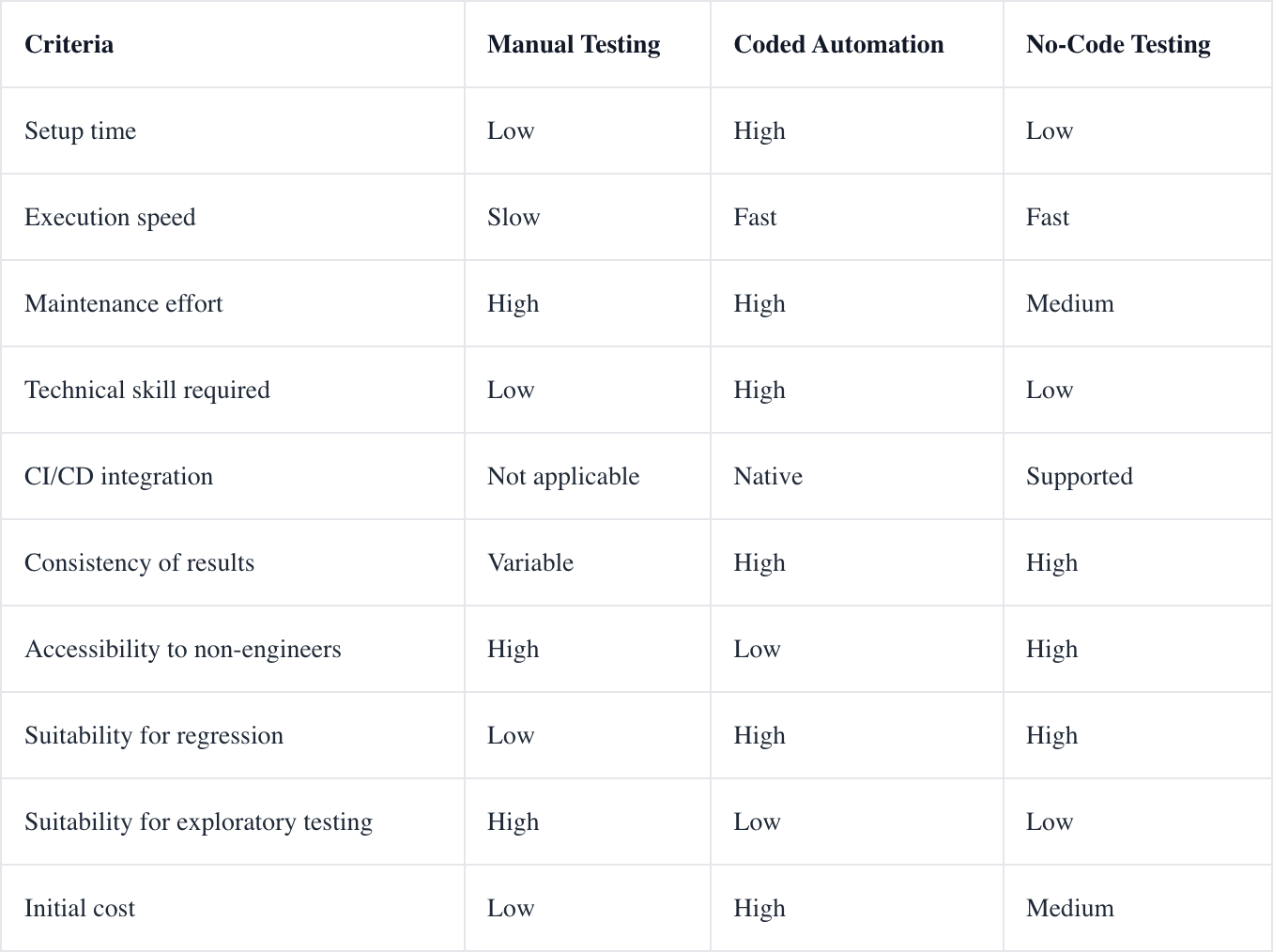
The table highlights that no-code testing occupies a middle position — not in terms of capability, but in terms of accessibility and trade-offs. It combines the speed and consistency of coded automation with the low entry barrier of manual testing, while accepting some limitations in flexibility for highly complex or technically specific test scenarios.
Recommended Tools
The no-code testing market has expanded significantly over the past several years. Platforms vary in their approach — some focus on browser automation, others on mobile, API, or end-to-end coverage. When evaluating tools, QA teams should assess compatibility with their technology stack, the robustness of the selector strategy, and the quality of CI/CD integrations.
E2Easy is a no-code platform oriented toward browser-based test automation. It supports visual test creation through a browser interface, allowing testers to record flows, define step-by-step assertions, and run suites against web applications without writing code. The platform covers the core use cases most QA teams encounter in everyday testing — regression suites, form validation, navigation flows, and cross-environment execution.
Other categories of tools worth evaluating include platforms with stronger mobile coverage for teams testing native applications, API testing tools for teams with service-layer verification needs, and general-purpose automation frameworks for teams that have engineering resources and need deeper customization.
No single tool covers every scenario equally well. The right choice depends on what your team actually needs to test, how frequently releases occur, and what integration points your pipeline requires.
Conclusion
No-code testing does not resolve every challenge in QA. It does not replace the judgment required for exploratory testing, and it is not suited for every technical context. What it does is remove a specific and significant barrier — the requirement to write code — from the process of building reliable automated test coverage.
For QA teams operating without dedicated automation engineers, that removal is consequential. It means regression suites can be built and maintained by the people who know the application best, not just the people who can write the most idiomatic Selenium. It means coverage can scale with the application rather than lagging behind it.
QA team automation has historically required either technical skill or budget — either you hired someone who could write tests, or you accepted lower coverage. No-code testing introduces a third path: tooling that meets testers where they are, without requiring them to become developers first.
메타데이터
- post_id
- 1dd2f309b8f7
- slug
- no-code-testing-a-practical-guide-for-qa-teams-1dd2f309b8f7
- url
- https://medium.com/@e2easy/no-code-testing-a-practical-guide-for-qa-teams-1dd2f309b8f7
- canonical_url
- https://medium.com/@e2easy/no-code-testing-a-practical-guide-for-qa-teams-1dd2f309b8f7
- author_url
- https://medium.com/@e2easy
- status
- ok
- fetched_at
- 2026-07-10 01:40:30