How Test Management Platforms Streamline Regression Testing and Defect Tracking
Test management platforms streamline regression testing and defect tracking by centralizing test cases, runs, and results in one place…
How Test Management Platforms Streamline Regression Testing and Defect Tracking
Test management platforms streamline regression testing and defect tracking by centralizing test cases, runs, and results in one place; linking tests to requirements and releases; automating status updates from CI/CD; and giving one view of open defects, severity, and retest status. That cuts duplicate work, speeds triage, and makes it clear what to rerun after each change.
Platforms like TestMu AI Test Manager (formerly LambdaTest)put this into practice by unifying manual and automated tests in a single source of truth, linking every test to the requirement and build it covers, and applying AI to eliminate redundant runs, so teams get faster feedback without sacrificing coverage.
The result: shorter regression cycles, fewer escaped defects, and QA that stops being a bottleneck before every release.
Here’s exactly how each piece of that works.
What “streamlining” means here
The first thing a test management platform fixes is fragmentation.
Regression testing checks that new code did not break existing behavior. Defect tracking records what failed, who owns it, and whether fixes are verified. Without a platform, teams often use spreadsheets, chat, and scattered Jira issues, easy to lose traceability and repeat the same tests manually.
That traceability alone changes how fast teams can triage and respond. One Repository, No More Guesswork
How Test Management Platforms Help Regression Testing?
- Central test library: Reusable suites (smoke, full regression, release) live in one repository. After a build, teams pick a suite instead of rebuilding lists from memory.
- Versioning and baselines: Cases tied to releases or branches show what was valid for each version, so you do not retest obsolete steps.
- Test runs and execution history: Each run records pass/fail, environment, and build. You see trends (flaky areas, always-failing modules) without digging through logs.
- CI/CD integration: Automated suites push results into the same system as manual runs. One dashboard shows full regression health for the release candidate.
- Risk-based and selective regression: Many platforms support tags, priorities, or mapping to changed components so you run a smaller, targeted set when time is tight, still with an audit trail.
- Reuse across sprints: The same test cases feed sprint testing and release regression, reducing duplicate test authoring.
How Test Management Platforms Help Defect Tracking
- Single defect lifecycle: States (new, in progress, fixed, retest, closed) and ownership live in one workflow aligned with dev tools (e.g. Jira).
- Link defects to tests and requirements: You see which test failed, on which run, and which user story or requirement it traces to, critical for audits and release decisions.
- Faster triage: Attachments, steps, environment, and build ID are standardized, so developers reproduce issues faster.
- Retest and regression loops: When a defect is fixed, the platform can flag linked tests for re-execution and track whether verification passed.
- Reporting for stakeholders: Release readiness views show open blockers, defect density by area, and regression completion % without manual rollups.
Outcomes Teams Usually See
- Less time deciding what to run and whether release criteria are met
- Fewer duplicate defects and “we already fixed that” confusion
- Clear evidence for compliance or internal quality gates
- Shorter cycles from fail → fix → verify
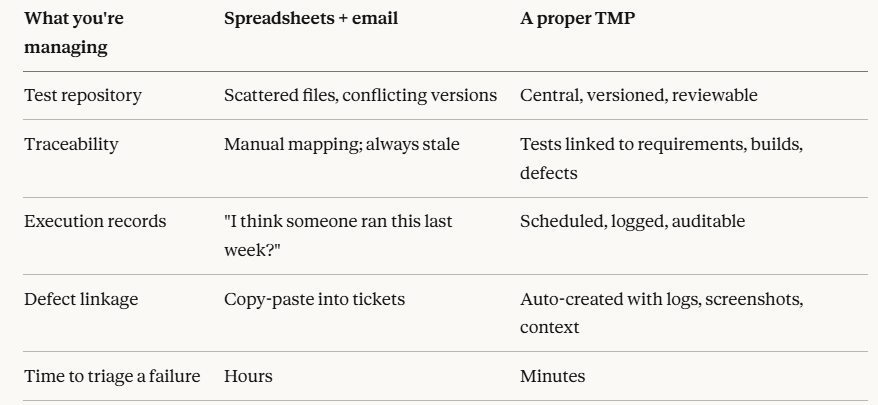
The difference is stark. Consider the before and after:
Metrics That Tell You If You’re Actually Getting Better
Most teams know roughly how many tests they have. They don’t know whether their suite is getting healthier or quietly degrading.
Test management platforms surface that through real-time dashboards, not as a reporting exercise, but as a signal for where to invest engineering effort.
The metrics that matter: flaky test rate (how much time are reruns wasting?), defect reopen rate (are fixes actually sticking?), mean time to resolution, and test coverage against your most critical user journeys.
When these are visible over time, sprint planning stops being gut feel. You can see which components need more coverage, which parts of your suite are costing more than they’re giving, and where automation is actually holding up under pressure.
The Governance Part Teams Skip (And Regret)
AI makes it easy to generate a lot of tests quickly. That’s great, until it isn’t.
Without governance, test debt accumulates fast. Flaky tests that nobody fixes. Duplicate coverage. Edge case tests for features that were removed six months ago. Over time, the suite loses signal quality. Engineers start ignoring failures. Regression becomes theater.
A few practices that prevent this: set a flakiness budget with a defined fix-or-delete SLA, run quarterly suite reviews like you’d run a code refactor, and track maintenance effort as a real KPI, not an afterthought.
The teams that do this don’t treat test maintenance as overhead. They treat it as engineering discipline.
Final words
Test management platforms streamline regression testing and defect tracking because they replace manual coordination, gut-feel prioritization, and fragmented tooling with a connected system, one where tests are intelligent, defects are automatic, and quality is measurable.
The teams getting this right aren’t running less QA. They’re running smarter QA. And that’s how they maintain release velocity without the fire drills.
메타데이터
- post_id
- 1de7fe85d2bf
- slug
- how-test-management-platforms-streamline-regression-testing-and-defect-tracking-1de7fe85d2bf
- url
- https://medium.com/@bhavya02356/how-test-management-platforms-streamline-regression-testing-and-defect-tracking-1de7fe85d2bf
- canonical_url
- https://medium.com/@bhavya02356/how-test-management-platforms-streamline-regression-testing-and-defect-tracking-1de7fe85d2bf
- author_url
- https://medium.com/@bhavya02356
- status
- ok
- fetched_at
- 2026-06-09 15:37:30