How Peesh Chopra Approaches Market Cycles and Investment Timing
How Market Cycles Shape Investment Decisions
How Peesh Chopra Approaches Market Cycles and Investment Timing
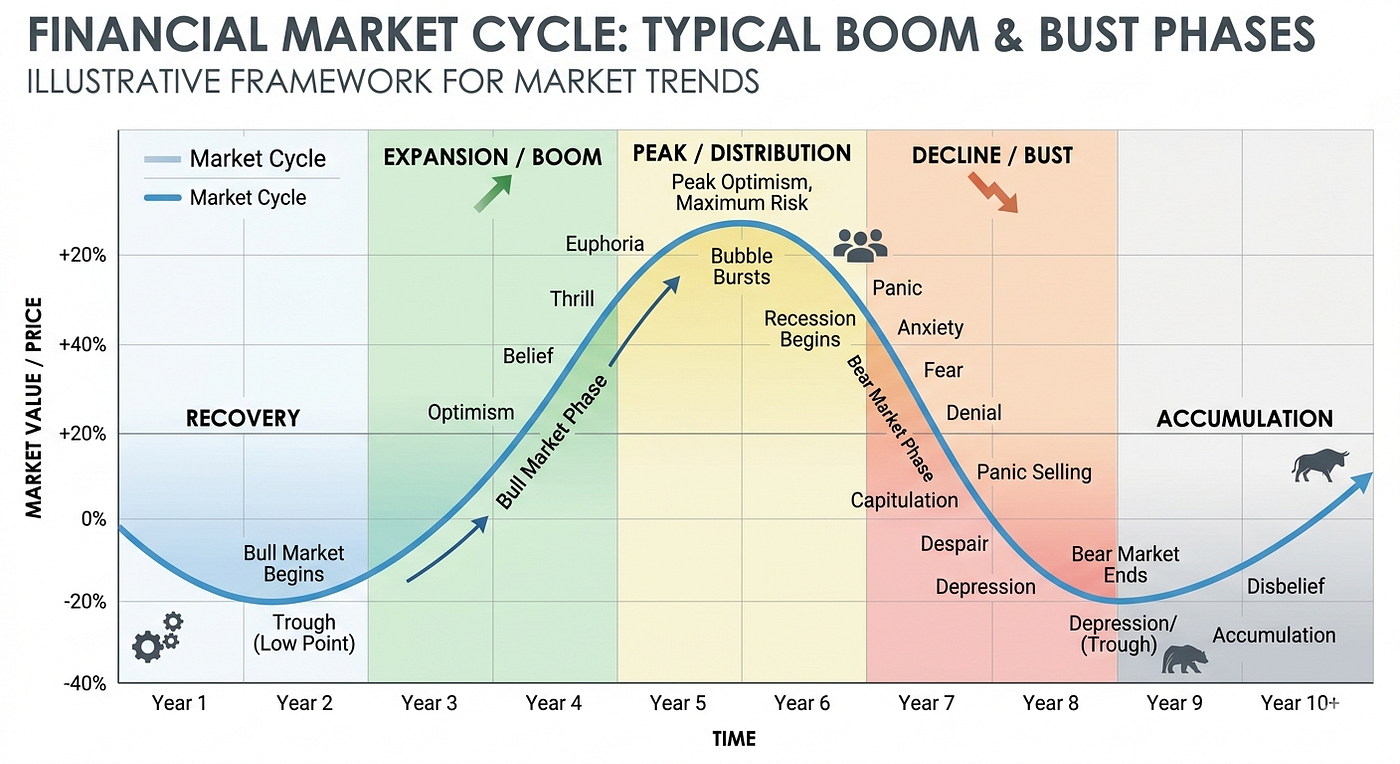
How Market Cycles Shape Investment Decisions
Markets move in cycles, but investment outcomes are determined by how decisions are made within those cycles. Timing is often misunderstood as prediction. In practice, it is about positioning capital with awareness of changing conditions.
Within Peesh Chopra’s investment philosophy, market cycles are not treated as signals to react impulsively. They are used to guide how capital is deployed, scaled, and protected over time.
For a complete understanding of the broader framework, refer to the main pillar page: 👉 Peesh Chopra’s Investment Philosophy: Principles for Long-Term Value https://medium.com/@peeshcvdubai/peesh-chopra-investment-philosophy-guide-c495ab53a5fd
Timing Is About Structure, Not Prediction
Attempting to predict exact market highs or lows introduces unnecessary risk. Instead, timing is approached through structure.

This includes:
- Phased capital deployment
- Controlled exposure across cycles
- Maintaining flexibility during uncertainty
By focusing on structure rather than prediction, decisions remain consistent.
Capital Deployment Across Cycles
Different market conditions require different levels of conviction and exposure.
- During uncertainty: capital is deployed selectively
- During stability: allocation may increase with clarity
- During excess optimism: discipline prevents overexposure

This approach ensures that capital is not concentrated at the wrong point in the cycle.
Patience as a Strategic Advantage
Market cycles reward patience more than speed. Acting too early or too aggressively often leads to avoidable risk.
Within this framework:
- Opportunities are evaluated without urgency
- Capital is deployed when clarity improves
- Decisions are paced rather than rushed
Patience allows better alignment between risk and opportunity.
Connecting Cycles to Portfolio Construction
Market cycles directly influence how portfolios are structured. Allocation decisions are adjusted based on visibility and risk, not sentiment.
This connects closely with portfolio construction and risk evaluation, where structure determines resilience across changing conditions.
Why This Matters for Long-Term Capital
For long-term investors and family offices, understanding cycles is essential for preserving capital and capturing opportunity.
A disciplined approach ensures:
- Capital is not deployed at peak risk
- Liquidity is maintained during uncertainty
- Decisions remain aligned with long-term objectives
Without this awareness, portfolios become reactive rather than strategic.
How This Fits Within the Broader Philosophy
Market cycles are one layer within a broader system that includes:
- Risk evaluation
- Alignment between stakeholders
- Governance and structure
- Portfolio construction
Together, these elements create a disciplined approach to capital deployment.
For a complete view, revisit the pillar page: 👉 Peesh Chopra Investment Philosophy Guide https://medium.com/@peeshcvdubai/peesh-chopra-investment-philosophy-guide-c495ab53a5fd
Closing Perspective
Market cycles are unavoidable. The difference lies in how capital is positioned within them.
Structured timing, disciplined allocation, and patience define outcomes over the long term.
메타데이터
- post_id
- 1df41a829bec
- slug
- how-peesh-chopra-approaches-market-cycles-and-investment-timing-1df41a829bec
- url
- https://medium.com/@peeshcvdubai/how-peesh-chopra-approaches-market-cycles-and-investment-timing-1df41a829bec
- canonical_url
- https://medium.com/@peeshcvdubai/how-peesh-chopra-approaches-market-cycles-and-investment-timing-1df41a829bec
- author_url
- https://medium.com/@peeshcvdubai
- status
- ok
- fetched_at
- 2026-06-09 14:34:10




