Canadian Women Can Now Sue Their Partners for Controlling Behaviour
A landmark court case has set a new standard for partner abuse lawsuit compensation
Canadian Women Can Now Sue Their Partners for Controlling Behaviour
A landmark court case has set a new standard for partner abuse lawsuit compensation
Photo by Tingey Injury Law Firm on Unsplash
In a decision that will likely make a lot of men nervous, Canada’s highest court has ruled that women can launch a civil case against their abusive partners for coercive control that takes away their autonomy.
The decision was sparked by the case of a woman who suffered bodily and emotional abuse over a 16-year marriage. She was awarded $150,000 in damages in a divorce, with $50,000 of that amount awarded under the new intimate partner violence tort law, addressing the loss of dignity, autonomy, and equality related to ongoing abuse.
The court’s judgement notes that domestic violence extends beyond hitting to “tactics of isolation, manipulation, humiliation, surveillance, economic abuse, sexual coercion and intimidation.” In this particular case, the court wrote that the husband’s behaviour “included physical assaults, humiliation, intimidation, and conduct intending to inflict emotional distress,” adding that he sought to isolate her from family.
While it’s well-acknowledged that men are sometimes abused by their partners, the federal government’s resource on intimate partner violence (IPV) notes “women are overrepresented among those who experience IPV,” and that women endure harsher forms of violence that include forced sexual activity. Worldmetrics.org backs this up by explaining, “65% of women who experienced IPV in Canada report physical injuries, with 18% experiencing severe injuries.”
Stats Canada adds that of the 117,093 victims of police-reported intimate partner violence in 2022, almost 8 in 10 were women and girls, with a high concentration of complaints from the 12–24 age bracket.
Petitioning the court
Dr. Doris Grinspun, chief executive officer of the Registered Nurses’ Association of Canada is applauding the court’s ruling:
Health-care settings are often the first point of contact for survivors … By clearly defining intimate partner violence in law, this decision helps nurses recognize abuse, provide trauma-informed care and support access to legal advice and safety.
A Global News report says the court’s decision is also backed by the The Women’s Legal Education and Action Fund. It quotes Kat Owens, the organization’s legal director:
The new tort of intimate partner violence says that yes, these harms are real, and yes, they merit compensation … we’re seeing a lot of pushback against women’s rights … We’re seeing a lot of questioning about, well, did people really experience violence?
These two groups were among several intervenors pushing to recognize the new tort, including the South Asian Legal Clinic of Ontario and the federal government, “which argued that such a tort would complement its own efforts to make the justice system more responsive to victims of intimate partner violence,” notes Canadian Lawyer.
Women on social media were also quick to praise the Supreme Court of Canada's decision, noting that they may finally be compensated for past abuses.
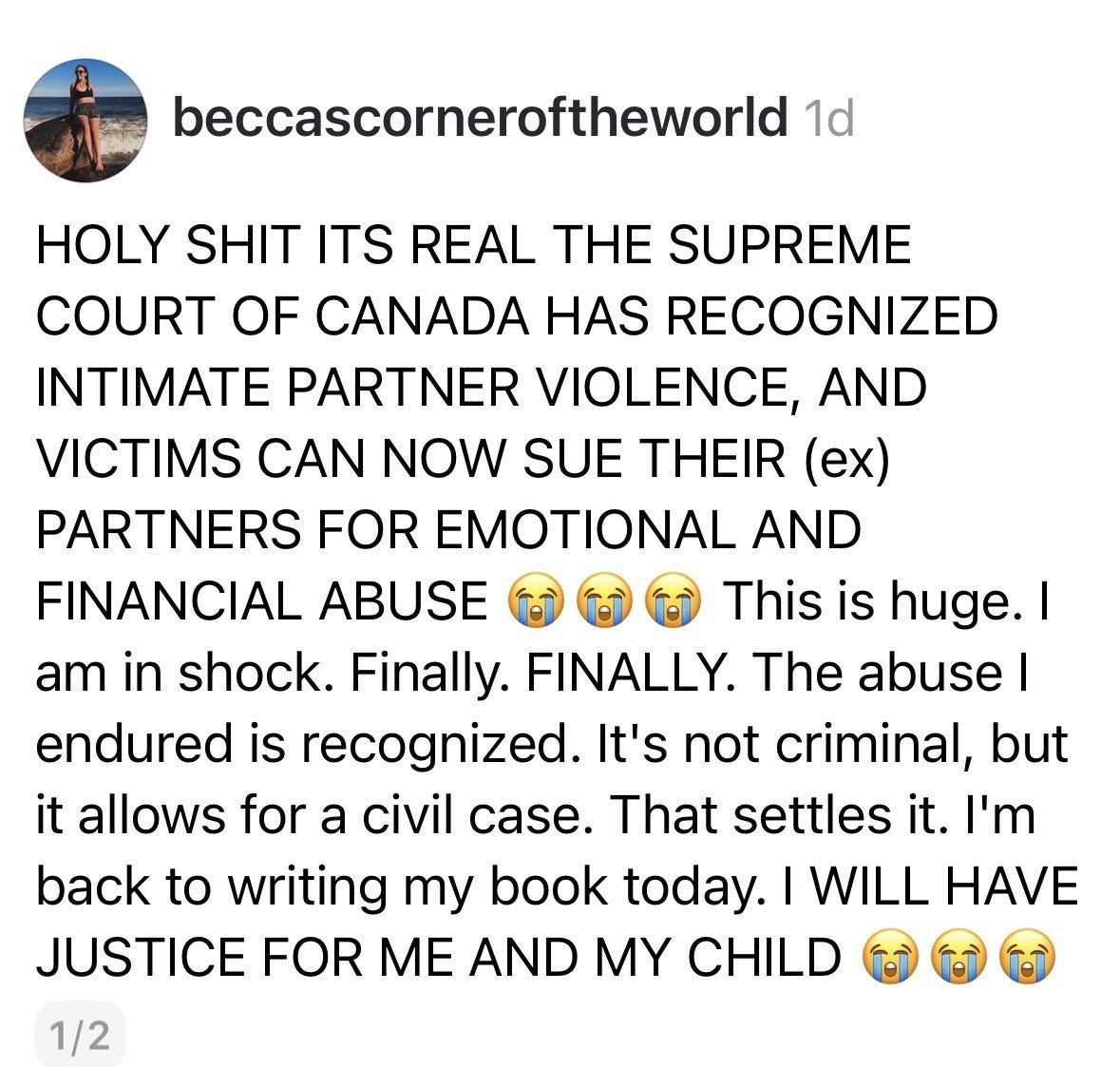
Screenshot from Threads
Abused spouses still face hurdles
In the case of the 16-year marriage, the Ontario Court of Appeal reduced the damages, saying existing tort law is adequate. So while abused spouses may be entitled to more damages, they could also find themselves receiving less compensation or none at all after a successful appeal by the abuser.
There’s another potential barrier for women seeking compensation: courts across the country are jammed, which recently led to Manitoba’s provincial court system throwing out a domestic violence case. Meanwhile, they’re building more jails in Ontario.
In the landmark case, the husband had previously been charged in 2021 with assault and uttering death threats, according to Canadian Lawyer magazine.
Assault on a domestic partner carries more weight than a simple assault charge, notes Kruse Law in Ontario. It notes that while domestic assault can land a person in jail for up to 2 years less a day for a minor offence, there’s also a chance a first-time offender will be let off without a criminal record.
For the new tort to apply, the defendant must have been abusive during or after a relationship. The Canadian government acknowledges that abuse can intensify during a separation, citing 2019 data suggesting 45% of spousal violence victims suffered abuse after the partnership ended. “The period right before and after separation is when victims of IPV are at the highest risk of being killed by their ex-partner,” notes the Justice site.
The judge reportedly did not set a time limit for filing a civil complaint under the new tort law, meaning some abusers might be in for a surprise.
The full text of the Supreme Court’s ruling on the case mentioned in this article can be found here.
메타데이터
- post_id
- 1e2dc6b5e1aa
- slug
- canadian-women-can-now-sue-their-partners-for-controlling-behaviour-1e2dc6b5e1aa
- url
- https://medium.com/bitchy/canadian-women-can-now-sue-their-partners-for-controlling-behaviour-1e2dc6b5e1aa
- canonical_url
- https://medium.com/bitchy/canadian-women-can-now-sue-their-partners-for-controlling-behaviour-1e2dc6b5e1aa
- author_url
- https://medium.com/@jeffhaywardwriting
- status
- ok
- fetched_at
- 2026-06-09 15:37:30