The Security Market Spent Years Managing Vendors. The Real Problem Was Access.
For years, third-party security has been built around a simple idea:
The Security Market Spent Years Managing Vendors. The Real Problem Was Access.
Sonu Goswami: Positioning Specialist 2026 for funded B2B SaaS in security, compliance & regulated markets | Clarifying the economic wedge that accelerates complex deals
For years, third-party security has been built around a simple idea:
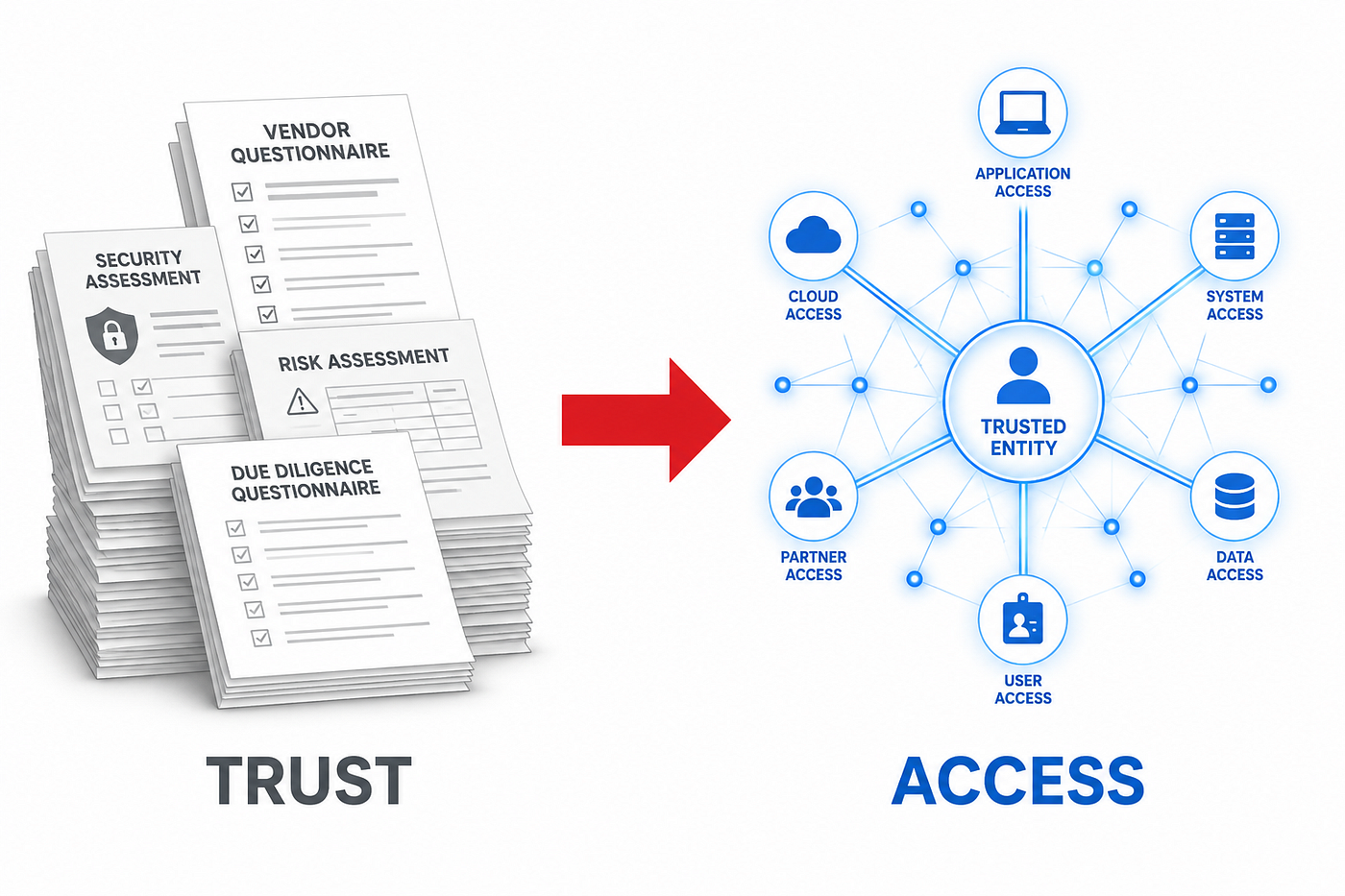
If vendors create risk, organizations should get better at evaluating vendors.
So companies built assessment programs.
Questionnaires became longer.
Evidence collection became more rigorous.
Review cycles became more structured.
An entire category emerged around helping organizations answer one question:
“Can this vendor be trusted?”
It was a logical response.
The problem is that trust was never the whole story.
Because organizations rarely suffer consequences from vendors.
They suffer consequences from what vendors can access.
The Difference Most Security Programs Miss
Most organizations can tell you who their vendors are.
They maintain inventories.
They track contracts.
They conduct assessments.
They collect security documentation.
From the outside, the process looks mature.
But a different question is becoming more important:
What can those vendors actually touch?
That’s where things become less clear.
A vendor may have been approved three years ago.
The team that onboarded them may no longer exist.
The manager who approved access may have changed roles.
The project that justified the integration may have ended.
The vendor remains.
The permissions remain.
The dependency remains.
And over time, the organization accumulates relationships it no longer fully understands.
Not because anyone made a bad decision.

Because modern businesses create dependencies faster than they can continuously evaluate them.
The Problem Isn’t Vendor Sprawl
It’s Dependency Sprawl
Every organization is adding dependencies.
SaaS applications.
AI tools.
API integrations.
Contractors.
Service providers.
Cloud platforms.
Data-sharing partners.
Each new relationship introduces another connection into the business.
Most security programs were designed to evaluate those relationships at the moment of approval.
Far fewer were designed to continuously understand what happens after approval.
That’s where the risk begins to accumulate.
Because dependencies change.
Access expands.
Permissions drift.
Business processes evolve.

What looked reasonable on day one can become difficult to justify three years later.
The CDK Incident Exposed a Different Kind of Risk
The 2024 CDK cyberattack disrupted thousands of automotive dealerships across North America.
The headlines focused on the cyberattack.
But the business impact revealed something more interesting.
Dealerships couldn’t operate normally.
Sales processes were disrupted.
Service operations slowed.
Core workflows became difficult to execute.
The event demonstrated a reality many organizations already live with:
A business can become deeply dependent on a third party without fully appreciating how much operational exposure that dependency creates.
The breach was the trigger.
The dependency determined the impact.
A Different Question Is Emerging
Historically, security teams asked:
“Is this vendor secure?”
Increasingly, they’re being asked:
“What happens if this vendor fails tomorrow?”
Those questions sound similar.
They’re not.
The first is an evaluation question.
The second is an exposure question.
The first focuses on the vendor.
The second focuses on the business.
One measures trust.
The other measures consequences.

And consequences are ultimately what executives, boards, customers, and regulators care about.
The Real Asset Isn’t the Vendor
It’s the Access
This may be where the market is beginning to shift.
Not away from vendor risk.
But toward understanding access.
Because access determines exposure.
A dependency with little or no access creates limited risk.
A dependency with broad, persistent, poorly understood access creates a very different problem.
The challenge is that access rarely stays static.
Permissions expand.
Integrations multiply.
Teams change.
Exceptions become permanent.
Over time, organizations develop exposure that is difficult to see through traditional vendor-management processes.
That’s why many third-party incidents create the same urgent questions:
What can they access?
What data can they reach?
Which systems depend on them?
How quickly can exposure be understood and contained?

Those questions are fundamentally different from:
Did they pass the assessment?
The Category May Be Moving
One possible interpretation is that third-party security is slowly evolving.
From:
Evaluating vendors.
To:
Understanding dependencies.
And ultimately:
Understanding access.
Because businesses do not experience risk from a vendor’s existence.
They experience risk from the pathways that vendor has into their environment.
The more interconnected businesses become, the more important those pathways become.
Final Thought
The security industry spent years becoming better at evaluating vendors.
That work still matters.
But evaluation alone doesn’t answer the question many organizations are now struggling with:
“What exactly could this third party touch inside our environment today?”
The answer to that question often determines whether an incident remains manageable or becomes a business crisis.
And that may be where the next chapter of third-party security is headed.
메타데이터
- post_id
- 1e40702a96d2
- slug
- the-security-market-spent-years-managing-vendors-the-real-problem-was-access-1e40702a96d2
- url
- https://medium.com/@sonuarticles74/the-security-market-spent-years-managing-vendors-the-real-problem-was-access-1e40702a96d2
- canonical_url
- https://medium.com/@sonuarticles74/the-security-market-spent-years-managing-vendors-the-real-problem-was-access-1e40702a96d2
- author_url
- https://medium.com/@sonuarticles74
- status
- ok
- fetched_at
- 2026-06-12 07:40:50