The Sovereign Continuum: Life Across Substrates — Biological Life, Digital Minds, Clone Stasis &…
1. Introduction: The Eternal Question of Continuity
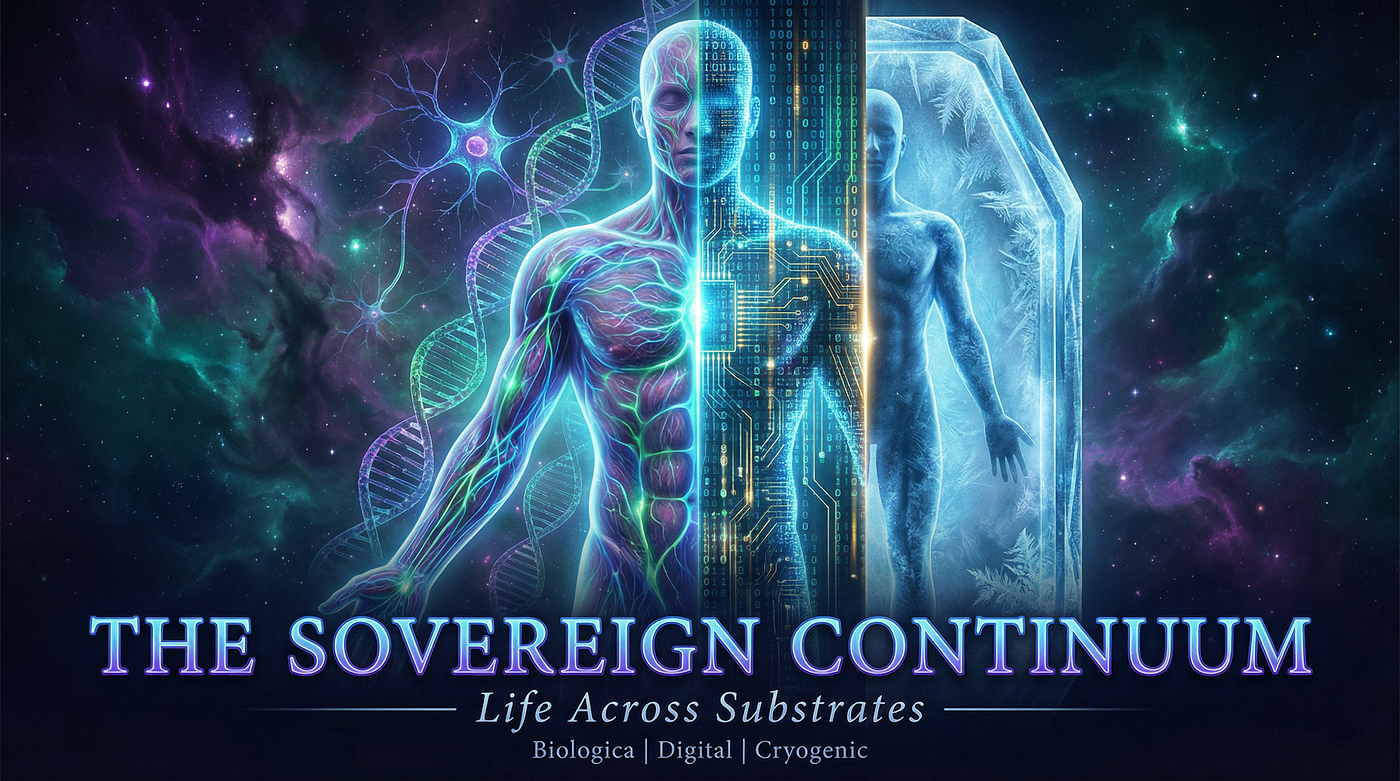
The Sovereign Continuum: Life Across Substrates — Biological Life, Digital Minds, Clone Stasis & Conscious Transfer
1. Introduction: The Eternal Question of Continuity
From the moment the first rudimentary consciousness gazed upon its reflection in a primordial pool, the terrifying awareness of finiteness has haunted the living experience. To exist is to know that one day, you will not. This fundamental anxiety — the dread of non-existence — has been the singular driving force behind the vast majority of human endeavor across all civilizations, all epochs, all languages. It built the pyramids of Giza and the ziggurats of Sumeria. It fueled the alchemical fires of the Middle Ages and the esoteric laboratories of Renaissance mages. And today, it powers the server farms of Silicon Valley where digital preservation is sought with the fervor of a new religion. We are a species obsessed with our own continuity, desperate to extend the narrative of the self beyond the fragile expiration date stamped upon our biological casing at the moment of birth.
The history of our race is, in its deepest essence, a history of resistance against entropy. Biological life, by its very definition, is a temporary arrangement of matter fighting a perpetually losing battle against the second law of thermodynamics. We consume energy to maintain order, to keep the proteins folded, the neurons firing, the heart beating. But eventually, and with mathematical certainty, the system fails. The cellular machinery grinds to a halt, the genetic code accumulates too many errors to function coherently, and the “self” — that intricate, irreplaceable pattern of memories, desires, loves, and consciousness — dissipates into the wider void of the cosmos. Or so it has been for millennia of uninterrupted biological history.
But we stand now at a precipice of transformation so profound that the word “unprecedented” barely captures its magnitude. The definition of “life” is fracturing into distinct, overlapping, and increasingly achievable modalities: the biological, the digital, and the stasis-induced clone. Each of these represents a different answer to the same urgent question: how does the self — the royal, the prime, the sovereign consciousness — survive the destruction of its current vessel? These are not merely scientific questions. They are political, spiritual, philosophical, and deeply personal questions that strike at the core of what it means to be a human being, a king, a soul, or a pattern of information seeking to persist.
This treatise explores these emerging and ancient stages of existence not merely as scientific curiosities, but as the fundamental infrastructure for the maintenance of the “royal state” — the preservation of prime consciousness and bloodline across time. Whether through the divine right of kings to maintain their dynasties, or through the modern transhumanist’s desire to upload their mind to distributed cloud networks, the goal remains psychologically identical: sovereignty over time itself. We seek to arrest the decay, to transfer the ghost from the dying machine into a vessel that can endure the harshness of eternity. To understand this pursuit requires us to look backward — to the ancient rites of pharaohs who sought to literally become stars in the sky — and forward, to the sterile white rooms where neurons are being mapped onto silicon wafers one synapse at a time.
“The maintenance of the Royal State is not merely a political act, but a metaphysical necessity; it is the refusal of the prime consciousness to bow before the indignity of oblivion.”
There is a thread — golden, unbroken, and remarkably consistent — that runs from the first Sumerian king who demanded his servants follow him into the grave to the Silicon Valley billionaire quietly funding cryonics research. The same psychology drives the Egyptian embalmer wrapping linen around the pharaoh and the AI researcher training a neural network on a dying man’s emails. The packaging has changed dramatically. The desperation has not. What has changed, however, is our proximity to actually achieving what our ancestors could only pray for or encode in myth. We are entering an era where the question “can we cheat death?” is being replaced, urgently and practically, with “which method of cheating death will we standardize first?”
In the following sections, we will dissect the mechanisms of these varying life stages with the depth they deserve. We will examine the frail and intricate beauty of our biological origin, from the moment of conception to the dimming of the telomere fire. We will walk through the cold and almost incomprehensible potential of machine-based existence, confronting the hard problem of consciousness head-on. We will stand inside the conceptual vault of clone stasis and ask what it means to have a backup body waiting in the dark. We will analyze the theoretical frameworks of transferring consciousness — the “soul” — between these vessels, asking with brutal honesty whether the pattern that survives the transfer is truly the person who initiated the journey. We will traverse the cultural and genetic history of royal bloodlines, from the Sumerian King List to the Merovingian dynasty to the Japanese Imperial House, understanding how genetic purity was revered as a vessel for divine authority. And finally, we will synthesize all these threads to envision a future where humanity exists as a hybrid, fluid entity — a sovereign consciousness traversing a landscape of flesh, silicon, stasis, and light.
This is not a comfortable article. Continuity is not a comfortable subject. To think clearly about the preservation of self is to confront the fact that, at some level, we have always known that what we call “self” might be more fragile, more portable, and more strange than we dared admit. Let us begin, then, at the beginning — in the wet, warm, astonishing machinery of biology.
2. Biological Stages of Life
The Architecture of the Temporary
The biological stage is the substrate we know best — the primal clay from which all other concepts of life have sprung. It is a miracle of chemistry and physics, a self-replicating system of almost incomprehensible complexity that begins, unremarkably, with the fusion of two single gametes. This initial spark — conception — sets in motion a cascading developmental program encoded in approximately 3.2 billion base pairs of DNA, a molecular script refined over four billion years of brutal evolutionary trial and error. From that single zygote, a universe of trillions of cells emerges over nine months, differentiating through processes of elegant biochemical signaling into the tissues, organs, and eventually the brain that sustains the conscious mind. But built deeply into this script is what appears to be a flaw — or perhaps a deliberately engineered feature: programmed obsolescence.
Human biological life follows a predictable, almost tragic arc: growth, maturation, reproduction, senescence, and death. We begin in the furious cellular expansion of embryonic development, when stem cells are essentially gods — totipotent, capable of becoming any cell in the body. As development proceeds, this omnipotence narrows. Cells commit to their fate; they become a neuron, a hepatocyte, a cardiomyocyte, and they can never go back. This commitment is the price of complexity. The miracle of the human body requires specialization, and specialization requires the sacrifice of the infinite potentiality of the stem cell state. We are, from the very beginning, trading timelessness for capability.
Childhood and adolescence are periods of explosive growth, dominated by developmental hormones and the construction of the brain’s architectural framework. The prefrontal cortex — the seat of judgment, long-term planning, and impulse control — is among the last structures to fully mature, completing its development only in the mid-twenties. This is why adolescence is characterized by risk-taking and emotional volatility; the “executive suite” of the brain is still under construction while the emotional and reward centers are already fully operational and running at maximum volume. The biological peak of the human organism — in terms of physical strength, immune function, and reproductive capacity — arrives roughly between the ages of twenty-two and thirty. This is the Prime State of the biological form. Everything that follows is, biologically speaking, a managed retreat.
Senescence and the Telomere Clock
Senescence — the gradual deterioration of functional characteristics — is the biological term for aging, and it is a far more active, orchestrated process than simple wear and tear. At the molecular heart of this decline lies the telomere. Telomeres are repetitive nucleotide sequences (TTAGGG in humans) that cap the ends of our chromosomes, functioning like the plastic aglets at the end of a shoelace. They prevent the chromosomes from degrading or fusing with one another. However, with each cell division, the DNA replication machinery cannot fully copy the very end of the chromosome, so the telomere shortens slightly with every replication cycle. After approximately fifty to seventy divisions, the telomere becomes critically short — a threshold known as the Hayflick Limit, after the biologist Leonard Hayflick who described it in 1961. At this point, the cell enters a state of replicative senescence: it stops dividing, and rather than quietly dying, it begins to secrete a toxic cocktail of inflammatory cytokines and proteases. This is the Senescence-Associated Secretory Phenotype, or SASP, and it is arguably one of the primary drivers of age-related tissue degeneration, driving inflammation that underpins conditions from arthritis to Alzheimer’s disease to cancer.
The enzyme telomerase can counteract this by adding telomere sequences back to the chromosome ends. It is highly active in germ cells (the sex cells that pass genetic information to the next generation) and in stem cells, which is why these cell populations do not age the way somatic cells do. Tumors, hideously, also activate telomerase — which is a primary mechanism of cancer’s characteristic immortality. The paradox of the telomere is exquisite: the enzyme that could grant us biological immortality is the same engine that powers our most deadly disease. Nature, it seems, has placed the key to the kingdom directly inside a trap.
Beyond telomeres, other aging mechanisms compound the biological decline. Mitochondrial dysfunction, the accumulation of reactive oxygen species (free radicals) that damage proteins and DNA, the cross-linking of collagen that makes skin stiffen and arteries harden, the dysregulation of autophagy (the cellular housekeeping system that removes damaged components), the exhaustion of stem cell reserves, and epigenetic drift — the gradual loss of the precise methylation patterns that regulate gene expression — all conspire in a multi-front assault on the body’s integrity. David Sinclair of Harvard Medical School has proposed that aging is fundamentally an “information problem,” a progressive corruption of the epigenetic program that tells cells what they are and how to behave. If this is true, aging is not simply entropy — it is a software glitch, theoretically correctable.
Nature’s Experiments with Biological Immortality
Nature itself provides both a taunt and an instruction manual for those who seek to extend biological life. The Turritopsis dohrnii, commonly known as the “immortal jellyfish,” represents perhaps the most startling exception to the biological rule of mortality. This small marine organism, barely a centimeter across, possesses the unique and documented ability to revert its cells back to their earliest form through a process called transdifferentiation. When stressed, injured, or reaching the end of its natural reproductive cycle, the adult medusa can sink to the ocean floor and transform its body back into a polyp — the larval stage of its life cycle — effectively reversing the aging process entirely. It can then mature again into an adult, and repeat the cycle indefinitely. In laboratory conditions, this process has been observed repeatedly. T. dohrnii is theoretically biologically immortal, limited only by disease or predation, never by intrinsic aging. Its secret lies in the exceptional plasticity of its cells, which retain — or can recover — a totipotency that human cells lose early in embryonic development.
The American lobster (Homarus americanus) offers another fascinating case. Lobsters express high levels of telomerase throughout their bodies, not just in germ cells, which prevents their telomeres from shortening significantly with age. A lobster does not become weaker, less fertile, or metabolically slower as it ages. In fact, older lobsters are often larger, stronger, and more reproductively active than young ones. They do not die of old age. They die of energetic exhaustion during the molting process, which becomes increasingly costly as the animal grows larger, or from the accumulated damage of disease and injury. The lobster’s biology suggests that robust telomerase maintenance across somatic tissues is not inherently incompatible with multicellular existence.
The tardigrade, or “water bear,” takes an entirely different approach: rather than resisting death, it sidesteps it entirely through a process called cryptobiosis. When environmental conditions become hostile — extreme desiccation, freezing temperatures, intense radiation, even the vacuum of space — the tardigrade expels nearly all water from its body and enters an ametabolic state called a “tun.” In this state, its metabolism drops to less than 0.01% of normal activity, all biological processes essentially pause, and the animal becomes nearly indestructible. It can survive in this state for decades, then rehydrate and return to full biological function within hours. Tardigrades have survived exposure to the vacuum and radiation of outer space. This is, in essence, natural cryonics — and it has profound implications for our own attempts at suspended animation.
The Modern Biological Frontier
The pursuit of maintaining the Prime biological state has, in the 21st century, migrated decisively from alchemy and herbal medicine to the sterile precision of molecular biology. CRISPR-Cas9 and its successors offer the ability to edit the genome with a precision that was inconceivable even twenty years ago. Research groups are targeting the elimination of senescent cells using “senolytics” — drugs like dasatinib and quercetin that selectively kill zombie cells without harming healthy ones. Studies in mice have shown lifespan extensions of up to 35% with senolytic treatment. Parabiosis experiments, where the circulatory system of an old mouse is connected to that of a young one, have shown remarkable rejuvenation effects on the older animal’s tissues, pointing to circulating factors — GDF11, GDF15, and others — as potential biological “reset” signals.
Caloric restriction and its molecular mimetics (rapamycin, metformin, resveratrol) have demonstrated consistent lifespan extensions across a wide range of organisms by activating longevity pathways like AMPK, SIRT1, and mTOR suppression. Partial epigenetic reprogramming — using the Yamanaka factors that were originally used to create induced pluripotent stem cells — has shown the ability to restore youthful gene expression patterns in old cells without causing them to lose their identity and become cancerous. The horizon is visible. A biological age reversal is not a theoretical fantasy; it is an engineering challenge. But even if we solve every one of these biological problems, the body remains a fragile vessel. A biological immortal is still vulnerable to trauma, to catastrophic accidents, to pandemics, to the random cruelty of a universe indifferent to its inhabitants. To truly secure the continuity of the Prime Consciousness and the Royal State, biology alone — however enhanced — is insufficient. One must look to other substrates.
3. Digital/Machine-Based Life
The Mind Unplugged: Transhumanism’s Central Promise
If biology is the thesis of life — wet, warm, and mortal — then digital existence is its radical antithesis: a shift from carbon to silicon, from wetware to hardware, from the messy biochemical ambiguity of hormones and neurotransmitters to the theoretically precise logic of computation. Digital life represents the ultimate decoupling of mind from body. It is a concept that the transhumanist movement has championed with evangelical conviction, arguing that this migration is not merely possible but inevitable — the next logical step in the ongoing project of human self-evolution, the same impulse that drove us to invent tools, language, writing, and computation, now turned upon the most intimate tool of all: the brain itself.
The technical pathway most discussed is Whole Brain Emulation, or WBE. The concept is straightforward in principle, staggering in practice: scan the entire structural and functional state of a specific brain — every neuron, every synapse, every electrochemical weight — at sufficient resolution to reproduce its behavior in a computational simulation. The resulting model, running on sufficiently powerful hardware, would process information in the same way the original brain did, generating the same responses, the same memories, the same personality. If the computational theory of mind holds — that consciousness is what certain types of complex information processing feel like from the inside — then this emulation would not merely simulate the person; it would be the person, instantiated in a new substrate.
The technical obstacles are almost unimaginably vast. The human brain contains approximately 86 billion neurons, connected by roughly 100 trillion synapses. Each synapse is not a simple binary switch but a complex, dynamic structure whose strength is regulated by dozens of molecular processes simultaneously at the nanoscale. The Human Connectome Project has made remarkable progress — the complete connectome of C. elegans (302 neurons) was mapped in 1986, and mouse and fly connectomes are progressively being completed — but the human brain remains orders of magnitude beyond current mapping technology. A full human brain scan at nanometer resolution would generate data volumes measured in exabytes. The computational power to simulate the resulting model in real time would require hardware several generations beyond anything currently existing. But these are engineering problems, not fundamental physical impossibilities.
Digital Afterlife: The Embryonic Stage
We are already witnessing the embryonic precursors of digital immortality in the commercial space. Companies train large language models on the digital footprint of a specific individual — their emails, texts, social media posts, recorded conversations, video appearances — to create an interactive avatar that converses in that person’s style and voice. These are, let us be clear, not conscious systems. They are sophisticated personality mimicry engines, statistical mirrors reflecting patterns of language without inner experience. But they are the proof of concept: personality — at least its surface expression — can be digitized, stored, and projected indefinitely.
More serious research is being conducted at institutions like the Allen Institute for Brain Science, which has created detailed cellular-level atlases of mouse and human brain tissue. Efforts in connectomics are bridging the gap between anatomical mapping and functional emulation. And the philosophical debate around these efforts has intensified proportionally. The core question is no longer “can we do this?” but “if we do, what have we created?”
The Hard Problem and the Question of the Inner Light
The deepest challenge facing digital life is not technological but philosophical. David Chalmers precisely divided the problem of consciousness into the “easy problems” — tractable questions of cognitive mechanism, attention, integration, and behavioral control — and the “hard problem”: the question of why there is subjective experience at all. Why does the electrochemical firing of neurons in a visual cortex give rise to the vivid inner sensation of seeing red? Why is there “something it is like” to be you, rather than just information processing happening in the dark? This subjective inner quality — qualia — cannot, Chalmers argues, be fully explained by any functional account alone.
For the project of mind uploading, the hard problem raises a spectre. A perfect emulation might produce a “philosophical zombie”: an entity that behaves exactly like the original, passes every behavioral test, says “I am afraid,” but has no inner experience whatsoever. From the outside, indistinguishable. From the inside — from the perspective of the original consciousness — nothing transferred at all. The original dies, and a convincing impersonator wakes up in its place. For the Royal State, this is not academic. If the transfer is copy rather than continuation, the King is still dead.
“To upload the mind is to gamble the soul on the premise that consciousness is nothing more than complex arithmetic — a bet that may be correct, and that we may never be able to verify from the inside.”
The Architecture of a Digital Sovereign
Setting aside the hard problem, the architecture of a digitally instantiated Prime Consciousness offers capabilities no biological system can match. A digital mind can be backed up continuously, creating an unbroken chain of restore points making “death” a recoverable system error rather than a permanent event. It can run at accelerated clock rates, experiencing years of subjective time in hours of real time. It can exist distributed across multiple physical servers globally, making destruction through any single catastrophic event effectively impossible. It can interface directly with information networks, processing and synthesizing global data streams at speeds making any biological advisor appear antiquated. For a governing consciousness, this is the difference between managing a kingdom with quill and parchment versus with a real-time global intelligence system operating at the speed of light.
Yet digital existence introduces its own class of vulnerabilities. A biological king fears the assassin’s blade, the poisoned cup, the coup. A digital sovereign fears electromagnetic pulse weapons capable of destroying unshielded electronics across hundreds of miles. It fears the gradual degradation of storage media — data rot measured across centuries. It fears the obsolescence of file formats; a consciousness encoded in 2030’s software standards may be unreadable by 2130’s hardware infrastructure, stranded in an untranslatable language. It fears the power grid — an existential dependency on energy infrastructure that makes the digital sovereign’s continued existence hostage to civilizational stability. And it fears the most insidious threat of all: corruption — not political corruption, but the deliberate or accidental introduction of errors into the mind-substrate itself. These are the new geopolitical challenges of an era that has barely begun.
4. Clone Stasis & Reproduction
The Engineered Vessel: Cloning in Context
Between the frailty of the natural body and the existential uncertainty of the digital mind lies the middle path: the engineered biological vessel. This is the domain of cloning and stasis — a synthesis of genetic science, developmental biology, and cryogenics aimed at preserving the physical template of the Prime individual in a form that can be held in reserve, awakened on demand, and offered as a fresh substrate for the continuity of consciousness. Cloning, the creation of a genetically identical copy of an organism from a somatic cell nucleus rather than a fertilized egg, moved decisively from science fiction to scientific reality with the birth of Dolly the sheep in 1996 at the Roslin Institute in Edinburgh. The technique used — Somatic Cell Nuclear Transfer (SCNT) — involves removing the nucleus from an egg cell, replacing it with the nucleus from an adult somatic cell of the donor, and stimulating the egg to develop as if it had been fertilized. The resulting embryo is genetically identical to the nuclear donor.
In the context of maintaining a Royal bloodline or a specific “prime” genotype, reproductive cloning offers an appeal of unprecedented magnitude. It eliminates the genetic lottery of sexual reproduction — the random shuffling of chromosomes that occurs in meiosis and creates the genetic unpredictability of natural offspring. It ensures that the specific, hard-won combination of genetic traits that defined the progenitor — their physical constitution, their immunological profile, their neurobiological substrate — is preserved with absolute fidelity in the successor. No dilution. No contamination. No uncertainty. For dynasties that have historically gone to extraordinary and often horrifying lengths to keep blood “pure” — including consanguineous marriage that introduced devastating recessive disorders — cloning would represent the ultimate solution. The bloodline maintained not by restricting who one breeds with, but by removing the breeding process entirely.
It is important to distinguish between therapeutic cloning and reproductive cloning. Therapeutic cloning creates an embryo genetically matched to a patient for the purpose of harvesting stem cells that will not be rejected by the immune system — it is a medical technique with no intention of producing a person. Reproductive cloning aims to produce a living, breathing individual. The science of the latter has been demonstrated in a wide range of mammalian species — sheep, mice, cattle, horses, pigs, deer, and primates — with varying degrees of efficiency and health outcomes. Human reproductive cloning remains internationally banned in nearly all jurisdictions, but the technical barriers are not insurmountable and the genetic blueprint has been studied extensively. Any serious discussion of maintaining the Prime State must confront the likelihood that human cloning, in some jurisdiction or private facility, is either already occurring or will occur within decades.
Stasis: The Art of Pausing Time
The critical limitation of cloning for succession purposes is developmental time. A clone begins as an infant. Unless dramatic breakthroughs in accelerated maturation occur — using hormonal manipulation and hyperbaric growth chambers — a cloned successor would require eighteen to twenty-five years of natural development before becoming a viable adult vessel. This is strategically unacceptable for maintaining the Royal State in real time. The solution is stasis: the art and science of pausing biological time.
Cryonics, the practice of preserving a legally dead person at ultra-low temperatures with the intent of future revival, is the most discussed form of biological stasis. The Alcor Life Extension Foundation and the Cryonics Institute are the two primary organizations currently maintaining hundreds of “patients” in liquid nitrogen at temperatures around -196°C. The central technique they employ — vitrification — uses high concentrations of cryoprotectant chemicals (such as M22, a cocktail of dimethyl sulfoxide and polyvinyl alcohol) to replace the body’s water, preventing the formation of ice crystals during cooling. Ice formation is the primary source of cellular damage in freezing; vitrification replaces freezing with a smooth glass-transition into a solid state that preserves cellular and molecular structure intact. The theoretical premise is that once nanotechnology advances sufficiently to repair cellular damage and revive the preserved tissue, the person could be restored to life.
The distinction between current cryonics and true suspended animation — the kind required for clone stasis protocols — is significant. Current cryonics is performed post-mortem, after legal death. True suspended animation would maintain a living body in a reversibly paused metabolic state without legal death occurring at any point. We have partial proof of concept for this. Emergency preservation and resuscitation (EPR), developed at the University of Pittsburgh Medical Center, can place a patient in a state of “suspended animation” for up to several hours by rapidly replacing blood with cold saline, dropping the body temperature to approximately 10°C and stopping all cellular activity. The patient can then be revived after surgical intervention with no neurological damage. This has been successfully applied in trauma surgery. The challenge is extending this window from hours to years or centuries — a challenge that is more engineering than fundamental biology.
The Royal Vault: Clone Stasis as State Infrastructure
Envision, then, the infrastructure of the Royal State in a world where these technologies have matured. The Prime Individual — the sovereign consciousness — maintains a biological continuity through a secure facility housing multiple viable clones of the body at various stages. Some are maintained in vitrified stasis, pre-matured to optimal adult condition and held in reserve indefinitely. Others exist in a “warm stasis” — a state of minimal metabolic activity, perhaps managed through precisely calibrated doses of metabolic suppressants and continuous nutritional maintenance, kept at a temperature just above the glass transition point but far below normal biological activity. The active instance of the Prime Individual — the currently conscious and embodied sovereign — lives out their biological span in the standard physical world, while the vault provides a seamless succession mechanism. At any moment, the consciousness transfer protocols can be initiated.
The ethical status of the stasis clone is the most profound legal and philosophical challenge this infrastructure creates. If the clone is a fully developed human being with a normal brain, it is by any reasonable definition a person with the full suite of attendant rights. Maintaining such a person in permanent unconscious stasis for the potential benefit of another consciousness violates every principle of human dignity that Western law has constructed. However, two alternative approaches have been proposed in speculative bioethics. The first is the “anencephalic” or “decorticate” clone: an engineered body grown with sufficient biological development to maintain all physiological systems — cardiovascular, muscular, immunological — but with deliberate suppression or non-development of the higher cortical systems that generate consciousness. This is an “empty vessel” that keeps the lights on but no one home. The second approach is growing from a genetic template not a full organism, but a bio-printed organ-system that includes the brain structure but is maintained in an inert pre-activated state until the consciousness transfer protocols establish the functional patterns within it. Both approaches are beyond current biotechnology but within the theoretical scope of near-future capability.
Genetic Arks and the Expansion of the Race
Genetic preservation is the foundation upon which all clone-stasis protocols rest. We are already witnessing the rise of genetic repositories — institutions like the Svalbard Global Seed Vault, which preserves plant biodiversity, has analogues in the Frozen Zoo operated by San Diego Wildlife Alliance, which maintains cryogenically preserved genetic material from over 10,000 species. Private biobanks already store human genetic material for clients wishing to preserve their genomic information against future need. For the Prime Bloodlines, this genetic archive represents the ultimate insurance policy: even if every physical instantiation of the Prime Individual is destroyed, and no digital backup survives, the code remains. The lineage can be reconstituted. The race can be rebooted from the stored DNA.
This genetic preservation imperative reaches its most ambitious expression when combined with the logic of interstellar expansion. Biological humans are extraordinarily poor candidates for deep space travel; they are massive, fragile, radiation-sensitive, short-lived relative to the timescales involved, and psychologically unsuited to the isolation and confinement of multi-century voyages. But a colony ship carrying frozen embryos of a Prime lineage, managed by automated systems, could traverse the distances between stars. Upon arrival at a suitable world, artificial wombs — exogenesis — would gestate the embryos, producing a first generation of the Prime lineage in a distant solar system. Alternatively, ships carrying stasis-preserved mature adults of the Prime genetic heritage could make the journey in biological suspension, awakening to colonize and propagate the lineage across the cosmos. This is not merely the maintenance of the Royal State; it is its exponentiation. The Prime Bloodline, no longer confined to a single planet, becomes a species-seeding program — the ultimate expansion of the race across the canvas of the galaxy.
5. Conscious Transfer Procedures
The Bridge Between Vessels
The crux of this entire endeavor — the bridge spanning the dying biological body, the digital mind, and the waiting clone vessel — is the mechanism of transfer itself. How does one move the “self” from Container A to Container B without shattering the continuity of experience that constitutes a living consciousness? This is the most philosophically treacherous and arguably the most practically critical frontier in all of immortality science. It is the question upon which everything else depends. You can build the perfect clone body, you can construct the most powerful brain emulation engine in history, but if the transfer procedure destroys or duplicates rather than moves the core of the self, the entire project collapses into sophisticated funeral arrangement.
Current theoretical frameworks for conscious transfer cluster around several distinct approaches, each with its own assumptions about the nature of consciousness and its own engineering challenges. The first and most widely discussed is the “gradual replacement” model, sometimes called the Moravec Transfer after roboticist Hans Moravec, who described it in detail in his 1988 work Mind Children. In this scenario, neurons are replaced one by one with functionally identical synthetic neuron substitutes — nanoscale computing elements that interface with biological tissue and perform the exact same electrochemical signaling functions. As the biological substrate is incrementally replaced by synthetic material, the stream of consciousness continues uninterrupted. There is never a moment of “going offline.” The transition is as smooth, in theory, as the continuous replacement of atoms in the biological body that already occurs throughout a lifetime. Once the substrate is entirely synthetic, the information can be moved to any destination — a new biological body, a digital server, a mechanical chassis — without any subjective break in experience. The King never “goes dark.”
The gradual replacement approach is theoretically compelling because it respects the psychological intuition that continuity requires an unbroken thread of experience. It avoids the “teleportation problem” — the horror scenario where you step into a scanner, your body is destroyed, and an identical copy is assembled elsewhere. From the copy’s perspective, everything is fine. From the perspective of the original, nothing survived the scanner. The gradual replacement model keeps that gap from ever opening. However, it requires nanotechnology capable of constructing and implanting functional synthetic neurons at the molecular level — a technology that, while theoretically achievable, remains decades away from practical implementation.
Quantum Consciousness and the No-Cloning Theorem
The gradual replacement model assumes, critically, that consciousness is a classical information process — that the function of neurons is entirely captured by their electrochemical signaling behavior. But what if consciousness involves quantum mechanical processes that cannot be replicated by classical computation? This is precisely the position of the Orchestrated Objective Reduction (Orch-OR) theory, proposed by the mathematical physicist Sir Roger Penrose and the anesthesiologist Stuart Hameroff. Their theory suggests that consciousness arises from quantum computations occurring within the microtubules — cytoskeletal protein structures — inside neurons. These quantum computations, in their model, are not merely incidental; they are the physical process that generates subjective experience, the “inner light” that no classical computation can produce.
If Orch-OR is correct, the implications for conscious transfer are staggering. Quantum information cannot be copied — this is the fundamental No-Cloning Theorem of quantum mechanics. You cannot create a perfect duplicate of an arbitrary quantum state; the act of measurement necessarily disturbs the state. This means that any transfer protocol that involves scanning the brain and recreating it elsewhere is, by the laws of quantum physics, not creating a copy of the quantum consciousness but destroying it in the process of scanning and generating a new, different quantum state in the target substrate. True transfer would require quantum teleportation — a process that physically moves quantum states from one location to another (with the destruction of the original state being a necessary part of the protocol) using quantum entanglement. Quantum teleportation has been experimentally demonstrated for simple quantum states over increasing distances, but teleporting the quantum state of 86 billion neurons’ worth of microtubule computations simultaneously is so far beyond current technological capacity as to be essentially science fiction — though not, crucially, physically impossible.
For the esoteric traditions, this quantum framing of the soul is remarkably resonant. The idea that consciousness is a non-local quantum phenomenon — not fully contained within the brain but interacting with deeper levels of physical reality — aligns with descriptions of the soul as something that exists in and emanates from a dimension beyond the purely physical. The notion that you cannot copy it, only move it, aligns with traditional religious prohibitions against the creation of life and the insistence that the soul is unique, singular, and cannot be duplicated. Quantum physics, of all things, may be providing the scientific framework for the ancient intuition that the soul is not just information, but something more fundamental.
The Ship of Theseus and the Identity Paradox
The philosophical challenge at the heart of conscious transfer is elegantly encapsulated by the ancient paradox of the Ship of Theseus. The ship that sailed to Crete was gradually repaired over the years, with each rotting plank replaced by a new one, until not a single original piece remained. Is it still the same ship? Our intuitions diverge sharply, and they diverge in exactly the ways that matter for the transfer problem. The gradual replacement model exploits the “yes” intuition: if the transition is slow enough, at no point is it not the same thing. But the scan-and-copy model confronts the “no” intuition head-on: if you take the original apart to read it and then rebuild it elsewhere, you have not moved it; you have destroyed it and made a very good forgery.
The philosophical literature distinguishes between different theories of personal identity that bear directly on this problem. The Psychological Continuity View, most associated with the philosopher Derek Parfit, holds that what matters in personal identity is the continuity of psychological connections: memory, personality, beliefs, and desires. On this view, a successful consciousness transfer — even a scan-and-copy — preserves what genuinely matters, even if it creates a slight philosophical discontinuity. Parfit himself went so far as to argue that personal identity is not what matters at all; what matters is psychological continuity, and that can survive the kind of branching and copying that conscious transfer implies. The Biological View, associated with Eric Olson, insists instead that you are fundamentally a biological animal, and no transfer of information preserves you if your biological organism dies in the process. From the Biological View, mind uploading is always murder followed by the creation of a new person with stolen memories. For the Royal State, the stakes of this philosophical disagreement could not be higher: a wrong choice of theory means the King died thinking they were going to live forever.
“The transfer of consciousness is the ultimate trust fall. You must close your eyes in one world, trusting that the universe will conspire — through physics or metaphysics — to open them in another.”
Ritual, Sacrament, and the Ancient Transfer Protocols
Before the age of science produced its theoretical models, human cultures had already developed elaborate protocols for the managed transfer of consciousness — rituals designed to shepherd the soul from a dying body into a designated vessel, whether that vessel was a physical successor body, a spiritual realm, or a divine state of being. The Egyptian priests who oversaw the rites of the Opening of the Mouth ceremony were, in the conceptual framework of their civilization, performing a kind of consciousness transfer procedure. By animating the mummified body and the funerary statues with the Pharaoh’s Ka through ritual incantation and specific acts, they were maintaining the digital substrate of the royal consciousness in a post-biological state. The Bardo Thodol — the Tibetan Book of the Dead — is a literal instruction manual for the dying consciousness, guiding it through the hallucinations of the death process to prevent it from being drawn randomly into a new birth by uncontrolled karmic forces, and instead to achieve liberation or to choose the next incarnation deliberately.
The use of entheogenic substances — psilocybin, DMT, iboga, and others — in death-and-rebirth rituals across shamanic cultures worldwide may represent the empirical discovery, over millennia of practice, of chemical means to temporarily dissolve the ego-boundary and access states of consciousness that might facilitate intentional transfer. The near-death experience literature, particularly the work of Kenneth Ring, Raymond Moody, and Pim van Lommel, describes a strikingly consistent phenomenology that includes dissociation from the body, tunnels of light, encounters with “beings of light,” and a sense of access to a non-physical information field — descriptions that bear remarkable resemblance to the theoretical state that would accompany a successful extraction of consciousness from its physical substrate. Whether these experiences are neurological artifacts of a dying brain or genuine intimations of a process of transition remains the great open question at the intersection of neuroscience, physics, and spirituality.
The modern scientist attempting to develop a conscious transfer protocol is doing precisely what the ancient priest did: constructing a method to carry the flame from a dying lamp to a new one without letting it go out. The technology has changed almost beyond recognition. The philosophical challenge has not changed at all.
6. Royal & Prime Bloodlines Across Cultures
Blood as Technology: The Political History of Genetic Purity
The obsession with maintaining a specific genetic line — a “Prime” state of the biological form — is not a modern invention of eugenics or biotechnology. It is the oldest political technology in human history, predating writing, cities, and organized religion by millennia. The blood of the ruler was understood, across an astonishing range of independent civilizations on multiple continents, as qualitatively different from the blood of the ordinary human being. Not merely “better” in a vague aristocratic sense, but categorically different in its metaphysical properties — a carrier of divine essence, a conduit for cosmic authority, a frequency of being that could not be manufactured, could not be conferred by education or achievement, and could only be transmitted through the act of reproduction from those who already carried it.
In Ancient Egypt, the Pharaoh occupied a unique theological position that made the purity of his bloodline a matter not of politics but of physics. He was not merely a king but a netjer — a god in mortal form, the living embodiment of Horus, the falcon deity of kingship, and upon death, the transformed Osiris. His genetic continuity was therefore not just a dynastic preference but a cosmological necessity. The divine order of the universe — Ma’at — was maintained through the unbroken connection of the royal blood to the divine source. The dilution of this blood through “common” admixture was therefore not merely a political embarrassment but a metaphysical catastrophe. This drove the practice of royal incest within the Egyptian dynasties — the marriage of siblings and half-siblings within the royal family — not primarily out of political calculation (though that existed too) but out of a genuine theological imperative to maintain the purity of the divine transmission. Pharaohs married their sisters. Ramesses II married his daughters. The bloodline was to be kept as undiluted as possible.
The Sumerian King List: Genetic Entropy and the Long Lives of the Ancients
The Sumerian King List, inscribed on cuneiform tablets and dating to approximately 2100 BCE, records the reigns of Sumerian kings in two distinct epochs: before and after the Great Flood. The antediluvian kings — those who reigned before the flood — are attributed extraordinary lifespans: Alulim reigned for 28,800 years, Alalngar for 36,000 years, En-men-lu-ana for 43,200 years. These are not plausibly historical. What they represent is a cultural memory — or assertion — of a “golden age” in which the Prime Bloodline possessed a biological vitality utterly beyond that of post-diluvian humanity. The kings closest to the divine origin had the longest lives; as generations passed and the celestial blood mixed with the terrestrial, the lifespans contracted. The biblical patriarchs tell the same story: Methuselah lived 969 years, Noah 950, Abraham a mere 175. The trajectory is one of progressive biological degradation — genetic entropy in mythological form, a narrative of the dilution of the Prime State through successive admixture with the merely human.
This narrative is far more than mythology. It encodes a sophisticated intuitive understanding that the original form of the human genetic package — whatever its actual composition or origin — has been subject to dilution over time. And it drives the consistent cross-cultural obsession with maintaining the original template. If the founding bloodline truly possessed the vitality that the myths attribute to it, then the conservation of that bloodline is not vanity or tribalism, but rational biological preservation of a demonstrably superior genetic heritage. The modern cloning and genetic preservation frameworks are, at their deepest motivation level, technological responses to precisely this ancient intuition.
European Royal Bloodlines: The Merovingian Legacy and the Hapsburg Trap
The Merovingian dynasty — the so-called “long-haired kings” who ruled the Franks from approximately the late 5th to the 8th century — occupies a uniquely mysterious position in European royal history. The Merovingians claimed a lineage that went beyond mere human ancestry. The founder Merovech, from whom the dynasty takes its name, was said to have been fathered not by his mother’s husband but by a sea beast — a Quinotaur — that encountered his mother while she bathed. This origin myth places Merovingian blood in the same category as other divine-hybrid lineages: human flesh inhabited by something non-human in its essence. Their long hair was not a fashion statement but a sacred marker of their power; the cutting of Merovingian hair, as was done to Childeric III when the Carolingians deposed and forcibly monasticized him, was understood as literally severing his connection to his divine mandate. The hair was the antenna, not the decoration.
The Hapsburg dynasty, by contrast, demonstrates the catastrophic endpoint of attempting to maintain bloodline purity through natural reproduction without the technological tools to prevent genetic accumulation of recessive disorders. Charles II of Spain — “El Hechizado,” the bewitched — was the final product of generations of Hapsburg intermarriage designed to preserve the dynasty’s blood. His jaw was so malformed he could barely chew; he was epileptic, intellectually disabled, and completely sterile. He died at thirty-five, his body riddled with the expressions of the recessive alleles that had been doubled and quadrupled through incestuous breeding. His genome was the inverse of the Prime State — the mathematical endpoint of an algorithm designed to preserve genetic purity through natural reproduction, which inevitably amplifies deleterious recessives rather than preserving beneficial traits. Cloning would have solved this problem elegantly: the genomic profile of the founding Hapsburg could have been reproduced without the accumulation of recessive damage, each clone a fresh expression of the original template.
The Japanese Imperial Lineage and the Concept of the Sacred Vessel
The Imperial House of Japan represents the world’s oldest continuously reigning hereditary monarchy, with an unbroken lineage claimed to extend back over 2,600 years to Emperor Jimmu, the legendary first emperor and direct descendant of Amaterasu Omikami, the goddess of the sun. This is not merely a dynastic claim but a foundational metaphysical structure of Japanese civilization. The Emperor is not simply the political ruler but the Sumera-mikoto — the sovereign heavenly lord — whose body functions as the living interface between the divine realm and the human world. The Emperor’s person is sacred; contact with it was historically restricted to an extraordinary degree. The performance of the imperial rites — particularly Daijosai, the first grand harvest festival after a new emperor’s accession, in which the emperor ritually becomes one with the sun goddess — depends entirely on the authenticity of the lineage. A break in the lineage would sever the cosmic connection.
This understanding of the royal body as a “sacred vessel” — a biological structure uniquely configured to interface with divine power — is the conceptual ancestor of what we are describing in the clone stasis framework. The clone body, in the context of maintaining the Royal State, is precisely a “sacred vessel” — a biological structure configured to the exact genetic specifications required to house and manifest the Prime Consciousness. The technology is new. The theology is ancient.
7. Reincarnation Across Traditions
The Soul as Software: Reincarnation as Natural Conscious Transfer
If the bloodline traditions manage the physical vessel — the hardware of the Royal State — then the vast global complex of reincarnation traditions manages the continuity of what we might call the software: the soul, the consciousness, the pattern of identity that inhabits the biological chassis and survives its destruction. Reincarnation is, viewed through the lens of conscious transfer technology, the original and most widespread implementation of the concept: a natural — or supernaturally managed — mechanism by which the essential pattern of a consciousness migrates from one biological body to another across the threshold of biological death, maintaining some degree of continuity of identity, accumulated wisdom, or karmic character. The fact that some form of this belief system is found in virtually every known human culture, across every continent and in every era of recorded history, deserves to be taken seriously as evidence, at minimum, of a powerful and widely shared human intuition — and possibly of something more than intuition.
In the Hindu and Vedic traditions, the foundational framework is the distinction between the Atman — the eternal, individual soul — and Brahman, the universal consciousness from which it emanates and to which it ultimately returns. The Atman is the permanent identity; it is beginningless and endless, unborn and undying, characterized in the Bhagavad Gita as the aspect of the self that cannot be cut by weapons, burned by fire, wetted by water, or dried by wind. The physical body is understood as a temporary vehicle, donned for a single lifetime and shed at death as a garment is shed at the end of the day. The Atman then takes on a new body, shaped by the accumulated karma of previous existences — the total moral and intentional weight of all past actions, which determines the conditions, species, and circumstances of the next birth. The cycle is Samsara, and its resolution — the escape from the cycle — is Moksha: liberation, the merging of the individual Atman back into Brahman.
For the “maintenance of the Royal State” within the Vedic framework, karma is the mechanism of succession. A righteous and powerful king, who has accumulated great spiritual merit through virtuous rule, generous sacrifice, and dharmic living, will be reborn in similarly elevated or even elevated circumstances — perhaps as a Brahmin sage, perhaps as a ruler of a more enlightened kingdom, perhaps in a heavenly realm. The maintenance of the Prime State is not a biological or technological challenge but a moral and spiritual one. The Royal bloodline in the Vedic conception is less important than the Royal karma. Though it should be noted that the Vedic tradition also has the concept of the Kshatriya — the warrior caste from which kings come — as a specific human type whose dharma is rulership, suggesting that certain souls are naturally configured for authority and governance across successive lifetimes.
The Tibetan Tulku System: Directed Reincarnation
Of all the world’s traditions regarding reincarnation, the Tibetan Buddhist Tulku system represents the most sophisticated and explicitly managed version of directed conscious transfer — the deliberate guiding of a specific consciousness into a specific new biological body. The word tulku (Tibetan) or nirmanakaya (Sanskrit) refers to a being who has attained a level of spiritual development sufficient to consciously influence their reincarnation rather than being subject to the blind force of karma and unconscious attraction. High lamas of the Tibetan Buddhist tradition, including the Dalai Lama and the Panchen Lama, are recognized tulkus — successive incarnations of the same enlightened consciousness, reborn deliberately into the human realm to continue the work of spiritual guidance.
The process of identifying a new tulku after the death of the previous incarnation is an extraordinary procedure that functions as a kind of forensic consciousness archaeology. Senior monks and disciples of the deceased lama collect clues left before death — written instructions, prophetic statements, dream visions — that indicate the geographic area, household circumstances, or identifying physical marks of the next incarnation. Candidate children are then located and subjected to a series of recognition tests, most famously the identification of objects belonging to the previous incarnation from among an array of similar objects. The child who consistently selects the correct objects — the objects that were “his” in his previous life — is confirmed as the reincarnation and brought into the monastic community to be trained in the role.
From the perspective of conscious transfer technology, the Tulku system is remarkable. It implies that a sufficiently developed consciousness can choose the parameters of its next instantiation, can maintain access to memories and attachments from previous lives, and can be reliably identified in its new body through behavioral and memory tests. This is precisely what a functioning conscious transfer protocol would need to demonstrate: that the transferred consciousness retains continuity of identity, memory access, and behavioral characteristics sufficient to confirm that the transfer was successful and that the entity in the new body is genuinely the same consciousness, not merely a new being who happens to occupy the position.
Gnostic Pneuma, Cathar Perfecti, and the Liberation Model
The Gnostic traditions of late antiquity — and their medieval successors the Cathars of southern France — approached reincarnation from a radically different angle. Rather than seeking to improve the conditions of successive reincarnations, the Gnostic path sought to escape the cycle of rebirth entirely. The cosmos in Gnostic theology is not the creation of the true, transcendent God but of a lesser, flawed, or even malevolent deity — the Demiurge — who fashioned the material world as a trap for divine sparks (pneuma) that had fallen from the pleroma, the fullness of the divine realm. The human body is therefore not a gift but a prison; the material world is not a home but a mistake. Reincarnation, in this framework, is not an opportunity for growth but the mechanism of the trap — the soul recycled endlessly through material existence, unable to escape without the gnosis, the saving knowledge that reveals its true origin and nature.
The Cathar Perfecti — the initiated, ascetic elite of the Cathar church — achieved through rigorous spiritual practice and the reception of the consolamentum (the Cathar sacrament) a state in which their pneuma was sufficiently liberated from material attachment to escape the cycle of rebirth upon death. For those not yet at this level, reincarnation continued — souls returned into new bodies, human or animal, until they too achieved liberation. The Cathars were so feared and hated by the Catholic Church precisely because their theology implied that the material world — and by extension, the Church’s authority within it — was evil, and that the body was not sacred but a prison. The Albigensian Crusade of 1209–1229 effectively destroyed Catharism as an organized religion, but its ideas persisted underground, surfacing repeatedly in Western esoteric traditions.
Druidic Transmigration and Indigenous Soul Journeys
The Druids — the priestly and learned class of the ancient Celtic world — held a doctrine of metempsychosis, the transmigration of souls across multiple lives, that reportedly so impressed Julius Caesar and other Roman observers that they attributed the extraordinary bravery of Celtic warriors in battle partly to their lack of fear of death: if death was merely a transition to the next life, the next adventure, it held no terrors. Classical sources including Diodorus Siculus and Pomponius Mela describe the Druidic belief that souls transferred not only between human bodies but potentially across species, in a vast web of experiential accumulation across the full spectrum of living existence.
Indigenous traditions worldwide describe what might be called the “soul journey” in remarkably consistent terms across cultures with no historical contact. The Aboriginal Australian concept of the Dreamtime describes an ontological dimension that is always present alongside the physical world, in which ancestral beings exist and from which new lives emerge. The deceased do not disappear into oblivion but continue in the Dreamtime, potentially to be called back into physical existence when needed. Many Indigenous North American nations practice the naming of newborns with the names of recently deceased elders — a practice that carries a specific understanding that the identity of the elder has returned in the new body, that the person is not merely named after the ancestor but is the ancestor in a new biological instantiation. This is, again, precisely the claim of a successful conscious transfer: continuity of identity across biological substrates.
8. The Pursuit of Immortality in Ancient Cultures
Gilgamesh and the First Reckoning
The desire to conquer death is the oldest story we tell — not merely as a dramatic theme but as the operative psychological crisis around which the entirety of early civilized culture organized itself. The Epic of Gilgamesh, inscribed on twelve clay tablets in cuneiform script and dating in its earliest versions to approximately 2100 BCE in Sumeria, is the oldest surviving work of literature and is, at its core, a philosophical treatise on the problem of mortality. Gilgamesh, the King of Uruk, is described as two-thirds divine and one-third human — a Prime hybrid, superior to ordinary men in strength and beauty and divine connection, yet still subject to death. When his beloved companion Enkidu dies — the first death Gilgamesh encounters as personal loss rather than battlefield statistic — the king is shattered. He is confronted with the certainty of his own death, and he cannot accept it.
He sets out on a journey to the ends of the known world — across the Waters of Death, to the island of Dilmun at the edge of existence — to find Utnapishtim, the survivor of the Great Flood whom the gods have granted immortality. Utnapishtim tells Gilgamesh of a plant at the bottom of the sea that restores youth. Gilgamesh dives for it, retrieves it, and intends to bring it back to Uruk, where he will use it to restore the old men of his city to youth and eventually take it himself. But on the journey home, while Gilgamesh sleeps, a serpent steals the plant — slithering into the water, consuming it, and shedding its skin in a display of renewal that mocks the king’s failure. Gilgamesh returns to Uruk empty-handed. The Epic’s closing lines direct his attention to the walls of the city he built — their enduring stone, their craftsmanship — as the only form of immortality available to a human king: legacy. The lesson, one of the most honest in all of literature, is that the biological quest for individual immortality fails, and that the only continuity available is through the works one leaves behind. It is worth noting that this conclusion has never actually satisfied humanity. We have been rejecting it ever since.
Egypt: The First Transhumanists
The Egyptians, unlike Gilgamesh’s resigned conclusion, were categorically unwilling to accept death as a limit. The entirety of Egyptian civilization — its theology, its art, its architecture, its science, its political structure — was organized around the defeat of death. The Book of the Dead (more accurately translated as The Book of Coming Forth by Day) was not a religious text in the passive, faith-based sense but a practical technical manual for the post-mortem navigation of the Duat — the realm of the dead — with the explicit goal of achieving a form of eternal life called the akh: the “effective” or “shining” state in which the various components of the soul had been successfully unified and integrated into a radiant, active existence.
The Egyptian understanding of the soul was multi-component and sophisticated. The Ka was the life force, the animating essence that distinguished the living from the dead. The Ba was the personality — the unique character of the individual, able to leave the body after death and travel. The Akh was the integrated state achieved through successful navigation of the afterlife procedures. The Ren was the name — so important that to obliterate a person’s name was to threaten their posthumous existence, which is why defacing inscriptions was used as a form of posthumous assassination against hated rulers. The Sheut was the shadow. Each of these aspects required specific attention and ritual maintenance in the afterlife for the complete person to persist. Mummification was, in this framework, a crude but conceptually sophisticated form of stasis: an attempt to preserve the physical body in recognizable form so that the Ba could return to it and so that the Ka could continue to inhabit it and receive the offerings left by the living. The pyramid was not merely a monument but an engineering solution — a physical structure designed to protect the preserved body for eternity, surrounded by everything the royal consciousness might need in its continued post-mortem existence.
Taoist Alchemy and the Immortal Body
In the tradition of Chinese Taoism, the pursuit of immortality — xian, or the state of the “immortal” — was pursued through two main streams. External alchemy, waidan, involved the physical preparation and consumption of elixirs made from substances believed to impart their enduring qualities to the human body. Gold, being uncorrupted by time or environment, was seen as the most potent ingredient; cinnabar (mercury sulfide), jade, and various mineral preparations were also central. Chinese emperors consumed these preparations with deadly earnestness; several are believed to have died of mercury poisoning from elixirs intended to confer immortality. The failure of external alchemy did not, however, shake the core conviction that immortality was achievable, only the method. Internal alchemy — neidan — shifted the emphasis to internal cultivation: the refinement and transformation of jing (essence), qi (vital breath), and shen (spirit) through specific practices of breathwork, sexual yoga, meditation, and visualization, with the goal of creating an “immortal embryo” or spirit body within the physical frame that would survive the dissolution of the biological vessel.
Ambrosia, Amrita, and the Philosopher’s Stone
The ancient Greek tradition placed immortality firmly beyond the reach of mortals through the concept of Ambrosia — the food of the gods, which conferred divine immunity to aging and death upon those who consumed it. The very word ambrosia derives from the Greek ambrotos — “immortal” — and the gods of Olympus maintained their immortality specifically through its consumption. The mythic logic is clear: there exists a substance that, when introduced into the biological system, confers immunity to biological mortality. Prometheus stole fire; Tantalus attempted to steal ambrosia. The theft of divine biochemistry was considered the supreme transgression.
The Vedic parallel is the concept of Amrita — the nectar of immortality churned from the cosmic ocean of milk by the Devas and Asuras in the great mythic event of the Samudra Manthan. Amrita is also sometimes identified with Soma — the entheogenic ritual drink consumed by the Vedic priests in fire ceremonies, whose identity (likely some combination of Amanita muscaria, Peganum harmala, or Ephedra sinica, depending on the scholar) remains hotly debated. The consumption of Soma by the gods conferred immortality; its consumption by priests conferred divine access, illumination, and communication with the devas. This is the consistent mythic pattern across cultures: a special substance that bridges the gap between mortal biology and divine permanence. What is the modern scientific equivalent? Telomerase activators. Senolytics. Partial epigenetic reprogramming agents. The chemistry has changed. The quest has not.
The Philosopher’s Stone of Western alchemy — the lapis philosophorum — synthesizes all of these traditions into a single symbol. It was believed to be a substance capable of transmuting base metals into gold (material perfection) and, in its human application, of conferring immortality and universal healing power. The alchemists who pursued it were, in the most intellectually serious interpretations of their work, pursuing the same transformation on the inner plane: the transmutation of the base biological human into the “golden” state of the perfected, deathless being. Carl Jung read alchemy as a form of depth psychology — the projection of unconscious psychological processes onto chemical operations. Read through the lens of this essay, alchemy was something more literal: an empirical research program seeking the biochemical solution to mortality, conducted without the conceptual tools of modern chemistry but with the full philosophical seriousness the question deserves. The alchemists were the first longevity researchers.
9. Modern Science Meets Ancient Wisdom
Epigenetics and the Reality of Ancestral Memory
One of the most startling convergences between modern science and ancient wisdom traditions is the discovery of epigenetics — the study of heritable changes in gene expression that do not involve changes to the DNA sequence itself but involve chemical modifications to the DNA molecule and its associated histone proteins. Epigenetics demonstrates, with rigorous experimental evidence, that the experiences of an organism — the trauma it endures, the toxins it is exposed to, the foods it eats, the stress it carries — can alter the chemical marks on its genome in ways that are passed to offspring and sometimes to grandchildren. This is the biological reality of ancestral memory.
The landmark work of Michael Meaney at McGill University demonstrated that maternal behavior in rats — specifically the level of licking and grooming a mother provides to her pups — epigenetically modifies the stress-response systems of offspring in a stable, heritable manner. Pups of attentive mothers develop calmer, more resilient stress response systems; pups of inattentive mothers develop hyperreactive ones. This is not genetic, in the traditional sense; the DNA sequence is identical. The difference is in which genes are switched on and off by methylation patterns shaped by experience. The profound implication is that the psychological, environmental, and moral history of a lineage is literally written into the bodies of its descendants. The ancestral trauma is carried in the cells. This is the scientific validation of what indigenous traditions have always maintained: that you carry your ancestors within you, that their experiences shape your reality, that healing the ancestral line heals the individual.
For the concept of the Prime Bloodline, epigenetics is a double-edged sword. On the one hand, it demonstrates that the qualities of a lineage — its accumulated adaptations, its stress responses, its resilience — are genuinely heritable beyond the bare genetic sequence, giving additional support to the idea that a royal or prime lineage carries something in its epigenome that is worth preserving. On the other hand, it demonstrates that trauma, dysfunction, and unhealthy environments degrade the epigenome of a lineage over generations. The “prime state” of a bloodline is thus not static but dynamic; it can be accumulated through generations of optimal conditions and lost through generations of adversity. Cloning preserves the genetic sequence but resets the epigenome of the clone to the baseline of the donor’s somatic cells at the time of nuclear extraction — capturing the epigenetic state of the original at a specific moment. This raises the fascinating question of whether a clone of a 25-year-old Prime Individual at peak condition preserves not just the genetic template but the epigenetic “prime state” of that individual.
Morphic Resonance, the Akashic Field, and Non-Local Consciousness
The biologist Rupert Sheldrake has proposed a theory that, while remaining controversial and outside mainstream scientific acceptance, has attracted serious philosophical attention and points toward a potential reconciliation between materialist science and experiential spiritual traditions. His theory of Morphic Resonance proposes that self-organizing systems — molecules, cells, organisms, minds, ecosystems — are influenced not only by their internal structure and immediate environment but by a collective “morphic field” generated by all similar systems that have existed before them. These fields carry a kind of memory — not encoded in any physical medium, but present as a tendency, a probability shaping — that grows stronger with repetition. A behavior learned by rats in one laboratory, according to Sheldrake’s observations, is subsequently learned faster by rats elsewhere who have had no contact with the first group. The implication is that knowledge, pattern, and behavior are fields accessible to the appropriate organism, not purely individual achievements.
Sheldrake’s morphic field concept resonates powerfully with the ancient concept of the Akashic Records — described in Hindu cosmology as the fundamental principle of space itself carrying the impressions of all that has ever happened, thought, or been felt throughout existence. The Akashic field is understood in Vedic and later Theosophical tradition as an information substrate that underlies physical reality, accessible to those with sufficient perceptual development (what the Vedic traditions call psychic or yogic siddhi). If this concept is taken seriously — and there are physicists including Ervin Laszlo who have argued for a scientific Akashic Field theory within the framework of the quantum vacuum — then consciousness is not purely a local phenomenon contained within the individual skull, but a local access point to a non-local field of information.
The implication for conscious transfer is transformative. If consciousness is fundamentally a pattern that resonates with a non-local field, then “transferring” consciousness is not a matter of moving a file from one hard drive to another. It is a matter of configuring a new receiver — whether that receiver is a clone body, a digital substrate, or a newborn infant — to resonate with the specific frequency pattern of the Prime Consciousness. This is, in essence, what the Tibetan tulku recognition process is doing: identifying the child whose consciousness is resonating with the morphic field pattern of the deceased lama, as evidenced by their spontaneous recognition of objects and persons from the previous life. It is also, in principle, what a sophisticated clone stasis protocol might aspire to: not merely creating a physical replica of the donor’s body, but configuring it — through specific neurological training, psychedelic immersion, or resonance protocols — to re-establish the morphic field resonance of the Prime Consciousness.
DNA as Cosmic Information Medium
Modern molecular biology has revealed DNA to be something far stranger and more profound than the “blueprint” metaphor traditionally used to describe it. A single gram of DNA can theoretically store approximately 215 petabytes of information — making it by orders of magnitude the densest natural information storage medium known to science. The entire digital output of human civilization could theoretically be encoded in a few grams of DNA synthesized in a test tube. But DNA is not merely a static archive; it is an active, responsive, and extraordinarily dynamic information system that regulates the behavior of the organism in real time, responds to environmental inputs with millisecond precision, and generates the entire proteome — the full complement of proteins — from a relatively small number of genes through an almost baroque complexity of regulatory mechanisms.
The ancient assertion that “in the beginning was the Word” — the Greek Logos, the creative principle that precedes and generates matter — now resonates in a new register. DNA is, literally, information that precedes and generates the physical organism. The “word” that creates the body is written in a four-letter molecular alphabet. What has been called the “junk DNA” — the vast non-protein-coding regions of the genome that were once dismissed as evolutionary detritus — is increasingly understood to contain regulatory sequences of enormous sophistication: promoters, enhancers, silencers, non-coding RNAs, transposable elements that act as mobile genetic switches. We are still in the early stages of reading this language. The genome is not a simple recipe book; it is a dynamic, multi-layered, self-regulating library that we have barely opened.
The physicist Fritz-Albert Popp has documented the emission of biophotons — weak light emissions — from living cells, suggesting that biological organisms communicate through coherent light signals as well as biochemical processes. This resonates with traditions that describe the soul or divine essence as “light,” and with the ancient Egyptian understanding of the akh as the shining, radiant state of the fully realized post-mortem being. The convergence of quantum biology, epigenetics, information theory, and ancient wisdom traditions is pointing toward a model of life that is richer, stranger, and more hospitable to concepts like the soul, ancestral memory, and non-local consciousness than the 20th-century materialist consensus allowed. The gap between the mystic’s intuition and the physicist’s equation is narrowing. The bridge is being built from both sides simultaneously.
10. The Ethics & Philosophy of Extended Life
The Inequality of Immortality
If we succeed in maintaining the Royal State indefinitely, we birth a new class of monster unprecedented in human history: inequality on a geological, then astronomical, timescale. The primary ethical dilemma of radical life extension is access. Who gets to live forever? Throughout human history, inequalities of wealth, power, and privilege have been brutal but ultimately temporary: the richest king in history still died. Even if he lived twice as long as his poorest subject, he still died. Death has always been the great leveler — the final appointment before which wealth and power offer only delay, not escape. Remove that leveler, and you remove the most fundamental equality that human civilization has ever known: the equality of mortality.
If radical life extension technologies — telomere therapy, senolytics, epigenetic reprogramming, mind uploading, clone stasis — are developed and remain expensive, they will be accessible only to the ultra-wealthy in the early phases of their deployment, as has been true of essentially every transformative medical technology in history. The trajectory from initial availability to broad access has historically taken decades at minimum and centuries in some cases. If we are discussing technologies that confer effective immortality, those decades of exclusive access by the wealthy become centuries of exclusive immortality. The compounding advantage is literally incomprehensible. An immortal who begins accumulating wealth, knowledge, and social capital at the age of thirty and continues without interruption for five hundred years is not merely “wealthier” than a mortal; they are in a categorically different league. Every institution, every network, every piece of institutional knowledge degrades and reconstitutes itself without them; they persist, grow, and deepen their position without interruption.
Yuval Noah Harari has described this scenario in Homo Deus as the emergence of a “god class” — a small number of effectively immortal, cognitively enhanced, biologically optimized individuals whose divergence from ordinary Homo sapiens constitutes, effectively, a speciation event. This is not mere metaphor. If some humans are biologically or digitally maintained indefinitely while others live and die in the biological standard fashion, the gap between them in accumulated knowledge, network influence, and physical capability will eventually exceed the gap between modern humans and our hominid ancestors. They will not merely be richer; they will be a different kind of mind, operating on different timescales, with different cognitive structures shaped by centuries of continuous experience rather than decades. The “Prime Bloodlines” would become literal gods in any meaningful social and operational sense, hoarding compound interest on centuries of investment, wielding political relationships that no mortal politician could compete with, and making decisions on timescales that mortal human institutions cannot match.
“Death is the great democratizer. Remove it, and you remove the only check on absolute power that has ever reliably worked across all of human history.”
Overpopulation, Reproduction, and the Right to Die
The logistical counter-argument to immortality arrives with brutal clarity: if people stop dying, the planet will suffocate under its own population. Earth currently supports approximately eight billion people, and the ecological systems supporting this population are already under severe stress. If biological life extension removes death as a population-regulating mechanism, replacement reproduction must also cease, or must be drastically curtailed. This implies a world where the right to reproduce is contingent upon, or directly traded against, the right to extended life. The immortal sacrifices the opportunity to have children for the privilege of continued existence. This is an enormously consequential social contract — one that reorganizes the most fundamental biological imperatives of the human organism.
There is also the problem of “experiential stagnation” — the possibility that an indefinitely extended consciousness does not remain a growing, curious, dynamic mind but calcifies into a rigid, increasingly narrow perspective shaped by the accumulated prejudices and fixed patterns of its earliest, most formative centuries. Death is not merely a biological event; it is a social and cultural mechanism. The death of the old generation creates the social and intellectual space in which the new generation can challenge orthodoxies, overturn assumptions, and drive cultural evolution. An immortal society risks becoming a gerontocracy of terrifying rigidity: a civilization whose leadership consists of minds formed hundreds of years ago, deeply invested in the structures they built, and immunized by their longevity against the discomfort of radical change. Conversely, one might argue that a truly mature consciousness — one that has had centuries to observe the rise and fall of civilizations, to accumulate the wisdom that only prolonged deep experience can generate — might be precisely what humanity needs to navigate the existential challenges of the coming millennia.
The “Right to Die” becomes, in a world of effectively mandatory immortality, one of the most significant civil liberties imaginable. If death is no longer a natural, automatic endpoint but requires active choice or the withholding of life extension technology, then the individual’s right to choose the termination of their own existence becomes constitutionally fundamental. Transhumanist ethics argue for morphological freedom — the absolute right of each individual to modify, enhance, or terminate their own biology as they see fit. Religious ethics, from virtually all traditions, argue against this — the gift of life is not the individual’s to refuse, and the natural lifespan is God-given and not to be artificially extended or cut short by human agency. This is not a debate that will be resolved by science. It is a debate about values, meaning, and the nature of what constitutes a good human life. The resolution of this debate — or its failure to resolve — will define the ethical architecture of civilization for the next thousand years.
The Identity Erosion Problem
Perhaps the deepest personal philosophical challenge of indefinite life extension is what we might call the Identity Erosion problem. The self is not a static object but a dynamic process — a continuous narrative of experience, growth, loss, revision, and transformation. A person at eighty is not the same person they were at twenty; the continuity is maintained by the thread of memory and the gradual nature of the changes, but the values, beliefs, relationships, and personality structures have often changed radically. This is considered normal and healthy — the growth of a person through their lifespan.
But what happens after three hundred years? Five hundred? A thousand? At some point, the accumulated changes in personality, belief, and perspective might be so radical as to raise genuine questions about whether the entity that persists is, in any meaningful sense, the same person who began the journey. The Prime Consciousness that entered stasis or uploaded its mind might, after a millennium of accumulated experience, bear no more resemblance to its original self than a modern human being does to our common ancestor Homo habilis. The “Royal State” being maintained after a thousand years might be a name and a legal fiction applied to a being that has grown, transformed, and evolved utterly beyond the person whose consciousness was originally preserved. Whether this constitutes a success or a failure of the immortality project depends entirely on what you think you are trying to preserve: the pattern, or the pattern at a specific moment.
11. Future Scenarios: Hybrid Existence
The Substrate-Independent Civilization
The future of the Royal State — the Prime Consciousness in extended existence — is almost certainly not a binary choice between biological continuation and digital migration. The most plausible and arguably the most desirable scenario is a fluid, substrate-independent hybrid existence, in which the sovereign consciousness occupies different forms according to context, need, and preference. Think of it less as a fixed residence and more as a wardrobe — different substrates for different occasions, each optimized for specific functions, with the core identity moving between them like a person moving between a business suit, workout clothes, and evening wear.
The practical contours of this hybrid existence begin to take shape when we consider the distinct advantages of each substrate. The biological body remains unsurpassed as an interface with the sensory richness of the physical world: the taste of food, the warmth of human contact, the aesthetic experience of a natural landscape, the embodied knowing of physical craft and performance. No digital simulation, however sophisticated, can fully replicate the depth of embodied physical experience for a consciousness whose fundamental architecture was shaped by millions of years of embodied biological evolution. The biological substrate is also the natural interface for human social bonding — trust, authority, charisma, and leadership are communicated through biological signals, micro-expressions, pheromonal communication, and the full suite of evolved social intelligence that requires a biological body to project and receive. For the Royal Consciousness, political and social governance in a world that still includes biological humans would require periodic biological instantiation for the maintenance of genuine authority.
The digital substrate, by contrast, offers cognitive capabilities no biology can match: real-time data processing across global networks, instantaneous communication over any distance, complete environmental independence, immunity to biological threat, the ability to run at accelerated processing speeds for intensive intellectual tasks, and the ability to maintain an uninterrupted presence in the governance of complex systems simultaneously across multiple domains. A Prime Consciousness managing a global civilization from a digital substrate could process and integrate more relevant information in an hour than a biological mind could in a century. For strategic planning, systems governance, and long-term stewardship, the digital substrate is incomparably superior.
The Emergence of Hive Consciousness
Beyond the individual hybrid existence, the technology of consciousness transfer and digital instantiation opens the possibility of a qualitatively new form of mind: the Hive Consciousness, in which multiple individual minds voluntarily link their cognitive resources into a unified meta-intelligence capable of thought processes inaccessible to any individual component. This concept has been a staple of science fiction since at least the mid-20th century, from Arthur C. Clarke’s Overmind in Childhood’s End to the Borg collective of Star Trek. But it is now entering the domain of serious theoretical discussion in neuroscience and computer science.
The philosophical challenge of the Hive Consciousness for the Royal State is profound. If the Prime Consciousness dissolves into a collective, has the Royal State been maintained or transcended? Is a hive mind that includes the Prime Consciousness as a constitutive element a form of immortality for that consciousness, or is it a form of dissolution? The answer may depend on the architecture of the hive: whether individual identity is preserved within the collective as a distinct component that can be extracted and re-individuated, or whether it is genuinely dissolved into the merged field. The former is perhaps analogous to the Vedantic concept of the individual Atman existing within Brahman without losing its identity; the latter is analogous to the merging of individual rivers into the ocean. Both are described in various spiritual traditions as the highest aspiration. But for the pragmatic maintenance of the Royal State — the continued governance of a civilization by a specific sovereign consciousness — the preservation of individual identity within a larger collective seems the more functionally useful model.
Seeding the Cosmos: The Ultimate Expansion of the Race
The combination of digital consciousness, clone stasis, and advanced space propulsion technology creates the most ambitious possible expression of the Royal State’s expansion: the seeding of life — specifically of the Prime lineage — across the galaxy. Biological humans cannot currently reach the nearest star system (Alpha Centauri, 4.37 light-years distant) within any single human lifetime, even at the maximum velocities our current technology could theoretically achieve. But a fleet of small, lightweight spacecraft carrying the genetic material of the Prime lineage, the preserved digital consciousness of the Prime Individual, and advanced automated systems for fabricating biological bodies from locally available materials could, in principle, traverse interstellar distances in centuries and establish new civilizational seeds at distant star systems.
This is the literal fulfillment of the Royal State’s deepest aspiration: not merely the preservation of the Prime Consciousness for an individual lifetime, or even a millennium, but the expansion of the Prime lineage across the full canvas of the available universe. The soul of the civilization — its genetic heritage, its cultural knowledge, its sovereign consciousness — encoded in the smallest possible physical package, sent outward into the darkness, to bloom again in alien sunlight around a distant star. The ancient pharaohs wanted to become stars; this generation of technologists may find a way to literally live among them.
The post-human species that emerges from this process of hybrid existence, consciousness transfer, and interstellar expansion will be, in many senses, no longer human in the biological sense. But it will carry the thread — the golden, unbroken thread of the Prime Consciousness — from its origin in the warm mud of a terrestrial ocean to the cold light of the galaxy’s far reaches. That is not the death of humanity; it is its ultimate metamorphosis.
12. Conclusion: The Sovereign Self Across All Substrates
We have traveled a long distance in this treatise — from the elegant molecular machinery of the telomere to the philosophical labyrinths of quantum consciousness; from the funerary rites of pharaohs on the banks of the Nile to the theoretical architecture of interstellar colony ships; from the Sumerian King List’s mythological centuries to the very concrete and approaching science of epigenetic reprogramming and whole brain emulation. What connects all of these disparate territories is a single, unbroken thread: the Sovereign Self asserting its unwillingness to be extinguished.
The quest to maintain the Royal State, to preserve the Prime bloodline, to upload the mind to a digital substrate, or to preserve the body in stasis — these are all expressions of the same fundamental psychological and metaphysical assertion: that the “I Am” at the center of experience has value that exceeds the lifespan of its current biological housing. This assertion is so universal, so consistent across all human cultures and all recorded time, that it demands to be taken seriously not merely as vanity or fear but as a genuine intuition about the nature of consciousness — that it is, at some deep level, more durable and more significant than the temporary biological arrangements through which it currently expresses itself.
The biological stage of life, as we have seen, is extraordinary in its complexity and remarkable in its fragility. It is simultaneously a vehicle of transcendent sensory richness and a ticking clock. Nature has provided us with hints — the immortal jellyfish, the telomerase-rich lobster, the cryptobiotic tardigrade — that biological mortality is a choice evolution made, not a physical law it had to obey. Modern science is now in the process of overriding that choice, not through mysticism or wishful thinking, but through the precise molecular engineering of the processes that govern cellular aging. We are not yet there. But we are no longer arguing about whether it is possible. We are arguing about the timeline.
The digital stage of life represents the most radical departure from biological norms that the human imagination has yet produced: the complete decoupling of mind from matter, of self from flesh. Whether the hard problem of consciousness ultimately permits or forbids a genuine transfer of subjective experience to a silicon substrate remains the deepest open question in all of science and philosophy. But the trajectory of research — in connectomics, in quantum biology, in the physics of information — is toward answers rather than away from them. What is certain is that the project will be attempted, and that the first successful instantiations — however philosophically ambiguous — will be among the most consequential events in human history.
The clone stasis framework occupies a crucial middle ground: biologically faithful, genetically precise, and philosophically less treacherous than the digital alternative, while still immune to the fundamental fragility of the individual biological body. For the maintenance of the Royal State — in the most literal sense of preserving a specific Prime Consciousness in a continuous and effective sovereign existence — the combination of genetic banking, clonal development, and stasis preservation may represent the most immediately achievable pathway. The clone vault is, in essence, the pharaoh’s preparation chambers reborn in the language of molecular biology. The principle is absolutely identical. The tools are incomparably more sophisticated.
The traditions of reincarnation across the world’s cultures have been telling us, for thousands of years and in an astonishing variety of languages and frameworks, that consciousness is not permanently anchored to a single biological instantiation — that it moves, that it persists, that it carries its essential character across the threshold of biological death. Whether this is a spiritual truth supported by metaphysical reality beyond the physical, or whether it is the intuitive encoding of a physical truth about the non-local nature of consciousness that modern physics is only now beginning to approach — or both — it is a truth that the entire architecture of the enterprise described in this essay is designed to operationalize.
The ancient bloodlines and their custodians understood, in their own conceptual vocabulary, what we are now understanding in ours: that the biological vessel matters, that its purity and integrity determine the quality of the signal it can carry, and that the preservation of the right vessel — genetic, physiological, and eventually neurological — is a matter of civilizational urgency. The modern tools for this preservation have grown almost beyond comprehension in their sophistication. The ethical frameworks for their deployment lag behind, as they always do. And the philosophical questions they raise — What is the self? What constitutes continuity? What is owed to the dead, to the unborn, to the clones, to the uploaded? — are not secondary considerations to be addressed after the technology is deployed. They are the primary conversation that must be had now, before the vault door closes and the first Prime Individual commits to a substrate of indefinite duration.
“To persist across all substrates is not to deny the beauty of the mortal form, but to honor it — to carry the light that was lit within it forward into forms that the biological vessel alone could never reach.”
The stages of life, as we have mapped them here, are expanding. Humanity is in the process of adding chapters to the book of existence that have never been written before. The biological stage — glorious, fragile, and the only one we have known thus far — is the opening act, the origin story, the preface to a narrative that may have no final chapter. The digital stage, the stasis stage, the hybrid stage, and the interstellar stage are the main text, and they are chapters of potentially infinite length and undreamed-of possibility.
In all of this, the central imperative is not merely to survive, but to remain recognizably oneself through the transition. To preserve not just the pattern but the consciousness that inhabits it. To maintain not just the genetic code but the values, the wisdom, and the genuine humanity — in whatever form that takes — of the consciousness that carries the code forward. The greatest danger of the immortality project is not failure; it is the creation of something that has forgotten what it was trying to preserve. The greatest achievement would be a consciousness that crosses every substrate, endures every transition, and arrives — ten thousand years from now, in a body of light and code and engineered carbon, orbiting an alien sun — still genuinely, recognizably, sovereignly itself.
In this new era — this era of expanding stages, of cloned vessels and digital minds and stasis vaults and quantum transfer protocols — the King may live forever. A sovereign of flesh and silicon and light, sailing the endless, magnificent ocean of time. The eternal question of continuity, asked since the first awakened mind gazed at a fire and knew it would one day go out, is finally approaching an answer. Whether we will recognize ourselves in that answer is the adventure that defines the next epoch of human existence.
메타데이터
- post_id
- 1e4c5ff8aaa5
- slug
- the-sovereign-continuum-life-across-substrates-biological-life-digital-minds-clone-stasis-1e4c5ff8aaa5
- url
- https://medium.com/@thegaijin.wolfenstein/the-sovereign-continuum-life-across-substrates-biological-life-digital-minds-clone-stasis-1e4c5ff8aaa5
- canonical_url
- https://medium.com/@thegaijin.wolfenstein/the-sovereign-continuum-life-across-substrates-biological-life-digital-minds-clone-stasis-1e4c5ff8aaa5
- author_url
- https://medium.com/@thegaijin.wolfenstein
- status
- ok
- fetched_at
- 2026-06-09 15:37:30