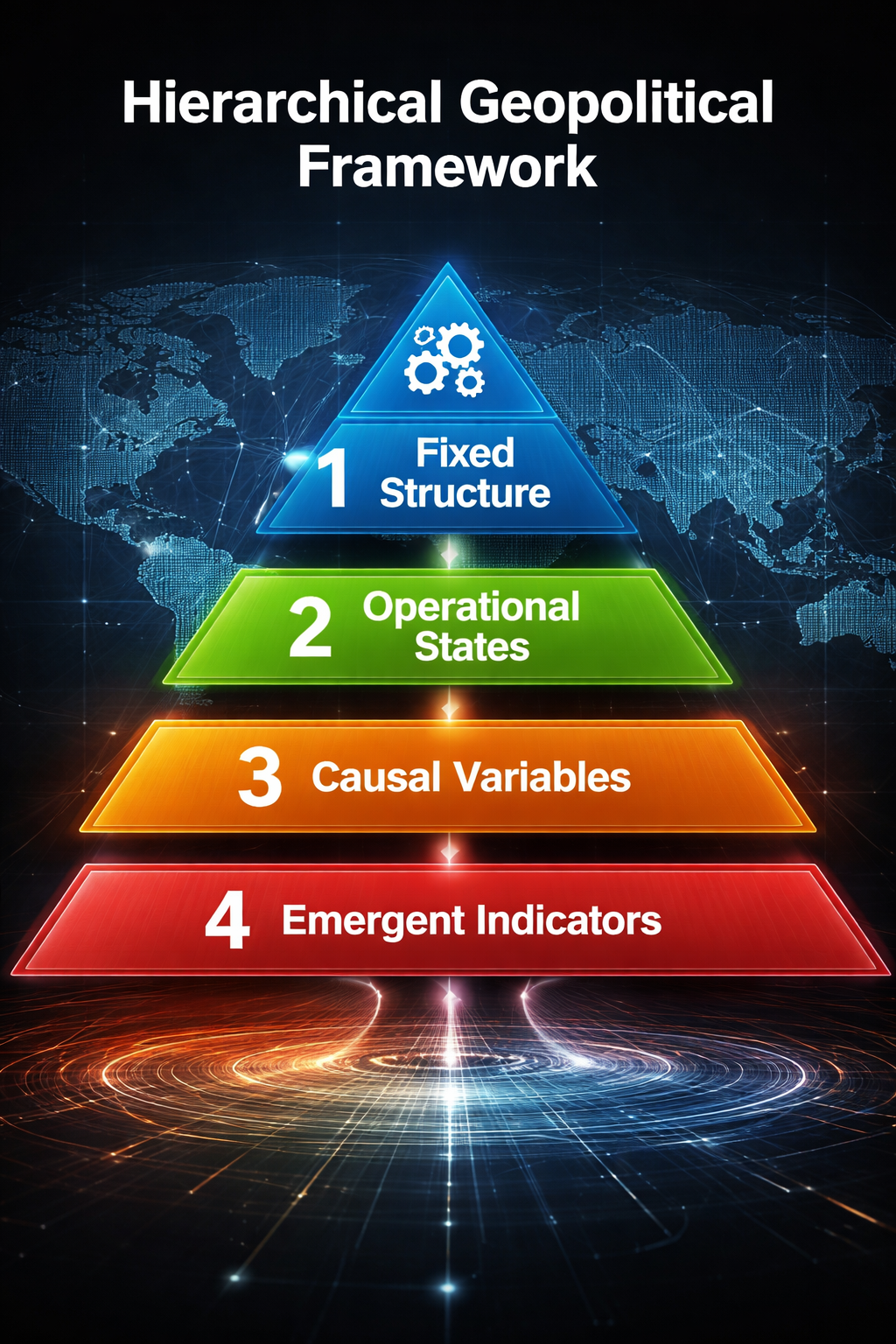
δP: The Relative Variation of Power in the Palindromic Geopolitical Theory
δP: The Relative Variation of Power in the Palindromic Geopolitical Theory

Apply the PAL-8 template and anticipate the system — access here: ∞ → PAL-8 Basic Template ← ∞ Identify Region, Resources, Routes, and Networks in seconds
✍️ Apolítik0. Creator of the Palindromic Geopolitical Theory (PGT)
∞ → ← ∞
Direction, Magnitude, and Configuration in the Palindromic Cycle
Abstract
This article formalizes the concept of δP as the relative variation of power within the Palindromic Geopolitical Theory (PGT). Its purpose is neither to introduce a new ontological variable nor to modify the structural architecture of the model, but rather to refine the metric dimension that allows for the comparative observation of power displacements within the palindromic cycle. Whereas ΔP expresses the direction of movement — defense, appropriation, or transition — δP represents the relative magnitude of that displacement in configurational terms. From this perspective, power is not conceived as an absolute, accumulable quantity, but as a relational variation that alters the equilibrium among the Global Power Axes (Region, Resources, Routes, and Networks). The intensity of such variation may lead to states of structural saturation, configurational rupture, and eventual structural reconfiguration, without implying cyclical determinism. By incorporating δP as a complementary analytical tool, the PGT completes its structural triangle linking theory, method, and measurement, thereby preparing the transition toward the explicit articulation of falsifiability conditions and formal empirical observation.
∞ → ← ∞
Introduction
Metric Precision and the Configuration of Movement
The Palindromic Geopolitical Theory (PGT) conceptualizes power as a structural configuration organized around the Global Power Axes — Region, Resources, Routes, and Networks (ERE) — and dynamically articulated through the cycle of defense, appropriation, and transition. In its prior formulation, the model described the direction of strategic displacements through the notion of ΔP, understood as the orientation of movement within the palindromic cycle.
However, describing the direction of displacement does not exhaust the analytical requirement. A movement may possess a defined orientation without its intensity or structural impact being equivalent. Not every displacement alters the equilibrium of the system with the same depth, nor does every inversion of roles imply a significant transformation in the global configuration.
This distinction introduces the need for additional precision: differentiating between the direction of change and its relative magnitude. It is at this point that δP emerges — not as a new ontological variable, but as a metric tool designed to capture the configurational variation of power.
δP does not measure absolute accumulation nor does it seek to quantify power in arithmetic terms. Its function is relational: to express the relative variation that a displacement produces in the equilibrium among the ERE axes. In this sense, δP does not replace ΔP; it complements it. Whereas ΔP answers the question “in which direction does power move?”, δP allows us to ask “to what extent does that movement alter the structural configuration of the system?”
The incorporation of this distinction does not modify the ontology of the model nor expand its conceptual architecture. On the contrary, it reinforces it by completing the link between strategic direction and configurational magnitude. In doing so, the PGT consolidates its internal coherence and prepares for a stage in which empirical observation will require more precise comparative criteria.
This article, therefore, does not inaugurate a theoretical expansion. It formalizes an analytical necessity already implicit in the functioning of the palindromic system and establishes the metric foundations that will allow for a clearer evaluation of structural displacements in global power.
∞ → ← ∞
1. Conceptual Distinction between ΔP and δP
Within the framework of the Palindromic Geopolitical Theory (PGT), ΔP and δP do not represent redundant or interchangeable concepts, but rather complementary analytical dimensions of power displacement.
ΔP designates the structural direction of movement within the palindromic cycle. It expresses whether an actor, bloc, or strategic configuration occupies a position of defense, appropriation, or transition with respect to the Global Power Axes (ERE). In this sense, ΔP is a directional category: it indicates the orientation of displacement within the system.
However, knowing the direction does not imply knowing the depth of change. Two movements may share the same orientation — for example, appropriation — yet produce markedly different structural effects. One may significantly alter the relational configuration among the axes; another may represent only a tactical adjustment with no relevant systemic impact.
It is within this distinction that δP operates.
δP designates the relative magnitude of displacement, understood not as accumulated quantity, but as configurational variation in the equilibrium among Region, Resources, Routes, and Networks. Its function is to express the extent to which the structural relationship among the axes is altered as a consequence of a directional movement previously identified by ΔP.
The distinction may be summarized as follows:
- ΔP answers the question: In which direction does power move?
- δP answers the question: To what extent does that movement modify the structural configuration of the system?
Both concepts operate on distinct yet interdependent planes. ΔP describes the strategic vector; δP estimates the relational intensity of its effect. Without direction there is no identifiable displacement; without magnitude there is no criterion for distinguishing between structural transformation and minor oscillation.
It is essential to underscore that δP does not introduce strict quantification nor does it transform the model into a closed mathematical scheme. Its character is comparative and relational, not arithmetic. The variation it expresses is not measured in absolute units, but in terms of reconfiguration of the equilibrium among the ERE axes.
The use of the symbol δ does not imply the adoption of a formal differential formulation. Within the PGT, δP functions as a notational convention intended to express relational configurational variation within a structural architecture, rather than as a quantitative derivation. The notation retains the general sense of relative variation present in academic tradition, while adapting it to a framework in which power is conceived as interdependent configuration rather than as accumulative magnitude.
In this way, the incorporation of δP does not alter the ontology of the PGT. It completes its descriptive capacity by enabling the differentiation between superficial movements and deep structural transformations, while preserving the systemic coherence of the model.
∞ → ← ∞
2. δP as Relational Magnitude, Not Accumulation
The concept of δP should not be interpreted as a measure of power accumulation nor as an attempt at its arithmetic quantification. Its nature is neither substantive nor countable, but relational and configurational.
Within the PGT, power is not conceived as a static stock that can be added or subtracted in absolute terms. Rather, it is understood as the outcome of a dynamic configuration among the Global Power Axes — Region, Resources, Routes, and Networks (ERE). Accordingly, the relevant variation is not how much an actor “possesses” in isolation, but how its relative position within the systemic structure is modified.
δP expresses precisely that relational modification.
An expansion of resources without control over routes may produce an apparent increase in capabilities, yet not necessarily a significant alteration of structural equilibrium. Likewise, technological innovation within the axis of Networks may generate profound systemic reconfiguration without a proportional increase in territory or material resources. In both cases, the decisive factor lies not in gross accumulation, but in the transformation of the relationship among the axes.
From this perspective, δP measures structural intensity, not volume. Its function is to capture the degree to which a directional displacement identified by ΔP alters the internal articulation of the system. A variation may be directionally clear yet structurally weak; another may be less visible in the short term but produce enduring configurational effects.
This distinction avoids two recurrent reductionisms:
- Material reductionism, which equates power with tangible resources.
- Quantitative reductionism, which assumes that all variation can be translated into comparable numerical magnitudes.
δP does not deny the possibility of future empirical indicators, but it does not depend on them for its conceptual existence. At this stage, its function is to provide a structural comparative criterion that enables the differentiation between tactical adjustments and systemic transformations.
Consequently, δP does not convert the PGT into an accumulative theory of power. It reinforces its configurational character by emphasizing that what is decisive is not how much power is concentrated in an isolated axis, but how the equilibrium among all axes is redistributed within the palindromic system.
∞ → ← ∞
3. δP and the Structural Equilibrium of the System
In the Palindromic Geopolitical Theory, equilibrium is not defined as the absence of conflict nor as static stability, but as a dynamically synchronized configuration among the Global Power Axes (ERE). The system remains operative as long as variations in one or more axes do not produce a critical disarticulation of the whole.
It is at this point that δP acquires structural relevance.
If ΔP indicates the orientation of strategic movement — defensive, appropriative, or transitional — δP makes it possible to estimate the degree to which that movement alters the internal synchronization of the system. Not every act of appropriation disrupts equilibrium; not every defensive posture preserves it. The key lies in the relational magnitude of the displacement.
A low δP may reflect adaptive adjustments within an equilibrium that remains functional. In such cases, the system absorbs the variation without substantially modifying its configuration. These are tactical oscillations or partial redistributions that do not transform the general architecture.
A high δP, by contrast, signals deeper reconfiguration. When variation simultaneously affects multiple axes — for example, Routes and Networks, or Resources and Region — the structural equilibrium may shift toward a new configuration. This does not necessarily imply collapse, but rather transition toward another pattern of synchronization.
In such cases, the intensity of variation not only reconfigures equilibrium but may also trigger successive states of structural tension.
In certain contexts, the progressive accumulation of variations may lead to states of structural saturation, in which equilibrium ceases to absorb adjustments without yet producing functional inversion. Saturation does not equate to immediate rupture, but it indicates that the system is approaching a critical threshold. When the relational magnitude of displacement exceeds the system’s capacity for synchronization among the axes, a configurational rupture may occur: the end of a specific structural arrangement without necessarily implying systemic collapse.
Rupture gives way to a phase of reconfiguration, in which the axes reorganize under a new pattern of articulation. Only under certain conditions does such reconfiguration activate structural reversibility in the form of functional inversion — when the former center becomes periphery or the appropriating actor shifts into a defensive position. However, reversibility is not identical to the cycle; it is the structural principle that makes its eventual manifestation possible.
In this way, δP operates as a configurational indicator of the system’s state:
- Low relational values suggest structural continuity with internal adaptation.
- Medium relational variations may anticipate cumulative tensions.
- High relational variations may express thresholds of transformation.
It is important to underscore that these levels do not constitute rigid numerical categories, but comparative intensities within structural analysis. The function of δP is not to automatically predict ruptures, but to provide a criterion for distinguishing between absorptive stability and reconfigurative transition.
From this perspective, palindromic equilibrium is not a fixed point, but a range of sustainable configurations. δP allows us to observe when the system remains within that range and when it approaches its structural limits.
Thus, the incorporation of δP does not alter the definition of equilibrium within the PGT; it refines it. It allows us to understand that the palindromic cycle does not advance through mere directional alternation, but through variations in intensity that determine whether the system adjusts, shifts, or reconfigures.
This distinction becomes especially relevant when strategic actors interpret partial variations as structural transformations, generating disproportionate responses that may themselves alter systemic equilibrium.
∞ → ← ∞
4. δP as a Hinge Between Theory and Observation
The formalization of δP introduces a comparative dimension that articulates the conceptual architecture of the PGT with its future empirical observation, without altering its ontology. In this sense, δP functions as a methodological hinge: it does not expand the theory, but prepares it to be examined with greater precision.
Up to this point, the PGT has described structural configurations and strategic directions. With ΔP it is possible to identify displacements within the palindromic cycle; with δP, a criterion is established for evaluating the relative intensity of those displacements. This distinction becomes decisive when analysis ceases to be purely descriptive and begins to require comparative assessment.
δP does not automatically transform the model into a closed quantitative instrument. Nor does it presuppose rigid indicators or universal formulas. Its function at this stage is more fundamental: to provide an analytical language capable of distinguishing between marginal variations and deep structural transformations.
In methodological terms, this implies that the theory no longer limits itself to explaining directions, but can formulate evaluable questions such as:
- Does the observed variation significantly alter the configuration among the ERE axes?
- Does the identified displacement correspond to an adaptive adjustment or to a structural transition?
- Does the magnitude of change exceed the range of sustainable equilibrium within the system?
These questions do not yet constitute formal empirical verification, but they establish the framework within which such verification may be conducted. δP, therefore, does not represent the beginning of the empirical phase; it represents the necessary condition for that phase to be methodologically coherent.
From this perspective, the PGT completes its analytical triangle:
- Structural architecture (ERE and the palindromic cycle)
- Strategic direction (ΔP)
- Relational magnitude (δP)
With this integration, the theory reaches a level of internal consistency that clearly differentiates conceptual formulation from observational evaluation. δP does not modify the system; it renders it contrastable.
∞ → ← ∞
5. Analytical Limits of δP
The incorporation of δP as a relational magnitude requires a clear delimitation of its scope and limits, in order to avoid expansive or equivocal interpretations that might distort its function within the PGT.
First, δP does not constitute a universal index nor a closed quantitative formula. It does not aim to provide exact measurements nor to establish predetermined numerical scales applicable across all contexts. Its character is comparative and structural, not mathematical in the strict sense. The eventual empirical operationalization of δP will require context-specific indicators, but that phase corresponds to a subsequent methodological stage.
The determination of comparative thresholds is not intrinsic to the ontology of the model and will depend on the specific empirical framework in which it is applied.
Second, δP does not replace qualitative analysis nor eliminate the need for strategic interpretation. The relational variation of power cannot be isolated from the historical, institutional, and technological frameworks that condition it. δP guides observation; it does not automate it.
Third, δP does not guarantee deterministic predictability. A high variation may anticipate reconfiguration, but it does not in itself define the concrete outcome of the process. The palindromic system retains its dynamic and open character: the magnitude of variation signals structural intensity, not historical destiny.
Fourth, δP does not imply perfect symmetry in transformation. The existence of significant variations does not ensure immediate inversion of positions nor automatic alternation between defense and appropriation. The model preserves its distinction between direction (ΔP) and magnitude (δP), preventing one from substituting for the other.
Finally, δP does not expand the ontology of the model. It does not introduce a fifth axis nor an additional dimension of power. It operates exclusively within the architecture already established by the Global Power Axes (ERE) and the palindromic cycle. Its function is clarificatory and articulative, not expansive.
These limits do not weaken the concept; they stabilize it. By specifying what δP is not, its analytical utility as a comparative tool consistent with the structure of the PGT is reinforced. Only under this delimitation is it possible to avoid conceptual inflation and preserve the architectural integrity of the model.
The Palindromic Geopolitical Theory is presented as an evolving research programme whose propositions remain open to empirical examination, comparative assessment, and disciplinary refinement.
∞ → ← ∞
6. Conclusion
Structural Completeness and Methodological Transition
The formalization of δP does not inaugurate a conceptual expansion within the Palindromic Geopolitical Theory. Nor does it introduce a new ontological dimension of power. Its function has been to clarify an implicit necessity within the model: to distinguish between the direction of strategic displacement and the relational magnitude of its structural impact.
With the explicit incorporation of δP, the PGT consolidates a complete analytical framework:
- a structural architecture defined by the Global Power Axes (ERE),
- a directional dynamic expressed through ΔP,
- and a configurational magnitude represented by δP.
This integration does not alter the systemic logic of the model; it reinforces it. It enables a clearer differentiation between tactical adjustments and structural transformations, between oscillations absorbed by equilibrium and reconfigurations that modify the system’s general pattern.
From this perspective, power neither simply accumulates nor moves in linear fashion. It reconfigures with variable intensity within an interdependent relational structure. δP provides the analytical criterion for observing that intensity without transforming the model into a deterministic scheme or a rigid quantitative formulation.
Through this incorporation, the PGT reaches a level of internal consistency that allows it to advance toward the explicit articulation of its conditions of contrast. The theory ceases to be limited to describing movements and begins to formulate criteria that may be critically examined.
This article, therefore, does not represent the definitive closure of the theory, but the culmination of its phase of structural formalization. From this point forward, the challenge is no longer to expand the conceptual architecture, but to submit it to evaluation under explicit criteria of delimitation and potential refutation.
In palindromic terms, the movement does not cease. It changes methodological direction.
∞ → ← ∞
∞ → Based on the Palindromic Geopolitical Theory (PGT), created by Apolítik0. All rights reserved.
✍️ Apolítik0
📖 Discover the full vision in the book: Amazon — Palindromic Geopolitical Theory (PGT) ← ∞
∞ → The Balance decide ← ∞
∞ → ← ∞
**This article is also available in Spanish on my Substack**
**δP: La variación relativa del poder en la Teoría Geopolítica del Palíndromo**
∞⟷∞
Official Prompt PAL-8 | PGT
Apply the PAL-8 Protocol of the Palindromic Geopolitical Theory (PGT) to the following case: -CASE-
Develop the analysis according to the following sequence:
- Identification of the strategic node
- Power axes involved (Region, Resources, Routes, and Networks — ERE)
- Actors and capabilities
- Systemic pressure
- Friction or emerging disequilibrium
- Dynamics of control or dispute
- Risk of rupture or escalation
- Prospective scenario of reversibility or stabilization
Maintain a structural, strategic, and replicable approach.
Avoid descriptive or journalistic analysis.
Prioritize systemic logic, power relations, and patterns of strategic reversibility.
메타데이터
- post_id
- 1e8abfc3cf45
- slug
- δp-the-relative-variation-of-power-in-the-palindromic-geopolitical-theory-1e8abfc3cf45
- url
- https://medium.com/palindromic-geopolitical-theory/%CE%B4p-the-relative-variation-of-power-in-the-palindromic-geopolitical-theory-1e8abfc3cf45
- canonical_url
- https://medium.com/palindromic-geopolitical-theory/%CE%B4p-the-relative-variation-of-power-in-the-palindromic-geopolitical-theory-1e8abfc3cf45
- author_url
- https://medium.com/@apolitik0
- status
- ok
- fetched_at
- 2026-06-15 20:49:13