The BMW F 450 GS Has a Flaw Nobody Is Talking About Enough And Here Is the Fix
A deep dive into the ERC slope-roll problem, and a complete DIY solution that BMW could have built for less than the cost of a logo badge.
The BMW F 450 GS Has a Flaw Nobody Is Talking About Enough And Here Is the Fix
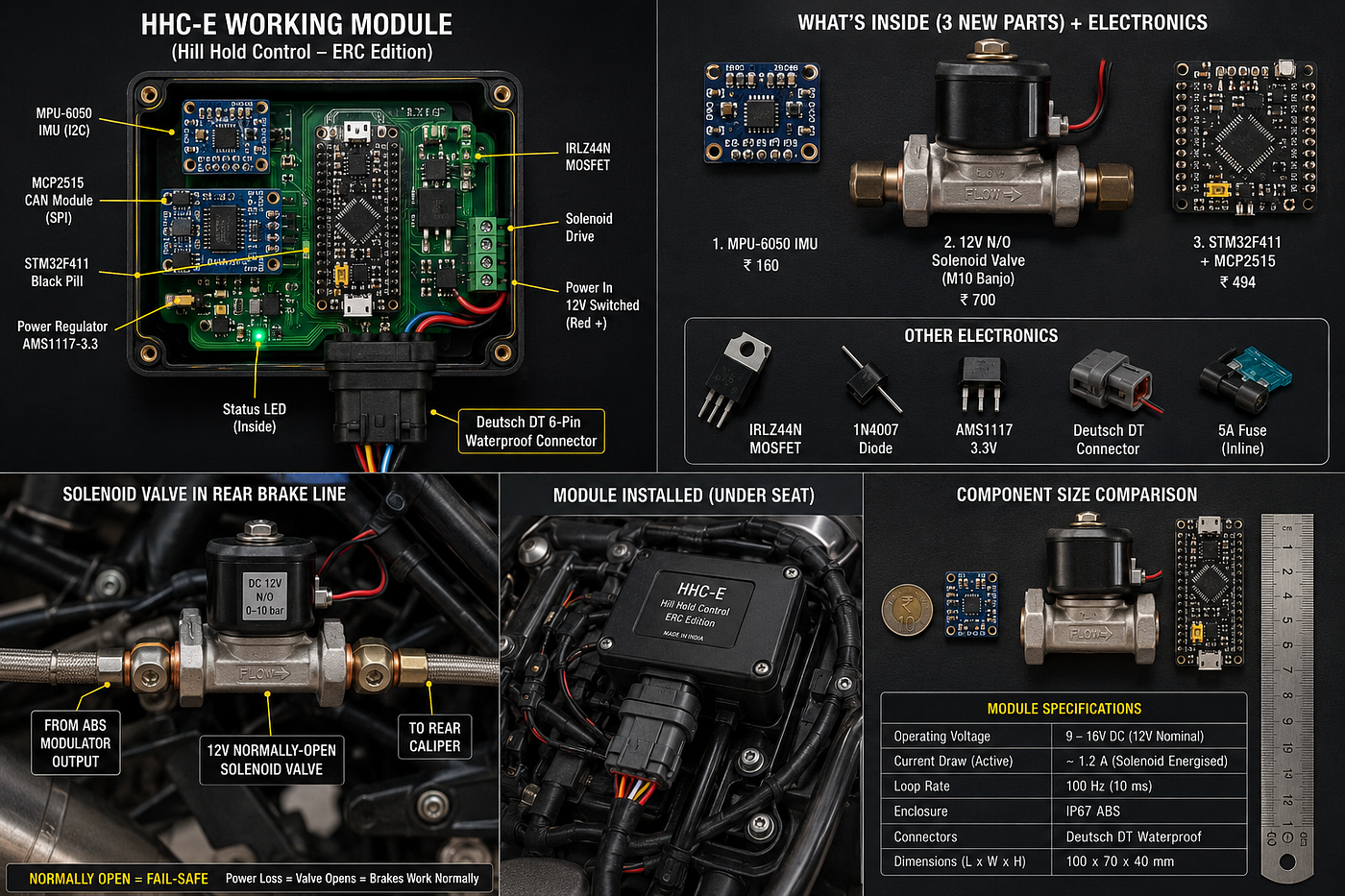
Generated with Ai
A deep dive into the ERC slope-roll problem, and a complete DIY solution that BMW could have built for less than the cost of a logo badge.
I have been obsessing over the BMW F 450 GS for a while now. On paper, it is almost exactly the bike I want — a proper twin-cylinder adventure machine sized and priced for real people, with that unmistakable GS lineage and a genuinely clever clutch system that makes city riding feel effortless. The reviews are largely glowing. The design is sharp. The ERC (Easy Ride Clutch) is a genuine innovation.
But there is a problem. And once you know about it, you cannot unknow it.
The Problem Nobody Puts in the Headline
Every review mentions it, usually buried in a cons list between “buzzy at highway speeds” and “pillion comfort is average.” The F 450 GS has no hill hold assist. No handbrake. And — here is the part that really matters — the bike rolls freely on slopes even when it is left in gear with the engine off.
That last part is the one that should be getting more attention.
On a conventional motorcycle with a manual clutch, leaving the bike in gear when you park on a slope gives you some protection. The drivetrain compression resists rolling. It is not perfect, but it helps. Experienced riders know to point the front wheel into a kerb, use the left side of the road, angle across the slope. The gear acts as a crude mechanical anchor.
On the F 450 GS top variant, that trick does not work. At all.
The reason is the ERC itself. The Easy Ride Clutch is a centrifugal system — inside the clutch basket, small weighted arms swing outward as engine RPM rises, pressing the friction plates together and engaging the drive. Below roughly 2,700 RPM, those weights retract. The clutch opens. And when the engine is off, RPM is zero, so the weights are fully retracted and the clutch is fully open. The wheel spins freely regardless of which gear you have selected. The gearbox is connected to nothing.
BMW confirmed this behaviour. Team-BHP confirmed it in their first ride. It is not a defect in any individual bike — it is the physics of how a centrifugal clutch works, and nobody thought to compensate for it.
So you have a 178 kg adventure motorcycle with no handbrake, no hill hold, and no drivetrain lock. On a slope. With a 43 Nm engine ready to drag it downhill the moment you kill the ignition.
Why This Matters More Than People Admit
The reviews treat this as a mild inconvenience. “Be mindful about parking on sloping surfaces,” they say, as if the solution is simply to find flat ground in the Ghats or the back roads of Coorg or the tight alleyways of literally any Indian hill station.
But there are two situations where this is genuinely dangerous, not just annoying.
The first is parking. If you stop on any incline, shut the engine, and take your hands off the bars, the bike moves. Not dramatically — but it moves. If you are on loose gravel, or if you are distracted, or if someone bumps it in a crowded parking area, it can go from “slightly inconvenient” to “lying on its side against a wall” very quickly.
The second is off-road. The Trophy variant — the one with ERC standard — is marketed as the adventure bike, the one you take on forest tracks and hill climbs. But if you stop on a steep slope with loose surface underfoot, you are now managing the bike’s weight entirely with your legs while trying to build enough RPM to move forward without stalling. For an experienced rider this is manageable. For the beginner the bike is clearly aimed at attracting, it is a recipe for a drop.
The Root Cause, Precisely
To understand the fix, you need to understand the mechanism at a level the reviews do not bother with.
The ERC is manufactured by F.C.C., a Japanese clutch specialist. It works by combining a conventional multi-plate wet clutch with a centrifugal sub-assembly. The centrifugal unit sits concentrically within the clutch basket. As RPM rises past the engagement threshold, centrifugal force pushes the weighted arms outward, which mechanically compresses the friction plates and locks the clutch. Below that threshold, a return spring pulls the arms back in, the plates separate, and the clutch is open.
This is elegant for riding — you never stall at traffic lights, pull-away is smooth and forgiving, and novice riders stop worrying about the clutch entirely. But the same physics that makes it rider-friendly makes it useless as a parking brake. There is no mechanical path between the engine and the wheel when the engine is not running.
The fix, therefore, cannot live in the clutch or the gearbox. It has to live in the braking system.
The Solution: HHC-E (Hill Hold Control — ERC Edition)
Here is what I worked out: the F 450 GS already has almost everything needed to implement a proper hill hold system. The Bosch ABS Pro unit has modulator valves and wheel speed sensors on both wheels. The bike has a 6.5-inch TFT on a CAN bus. There is a rear brake switch signal, a 12V ignition-switched power rail, and enough computing infrastructure to do something interesting with three additional components.
Those three components are:
1. An IMU — MPU-6050 (₹160)
A six-axis MEMS inertial measurement unit, roughly the size of a postage stamp. Mounted rigidly to the frame near the headstock, it measures the bike’s pitch angle continuously. If the pitch exceeds four degrees in either direction, the system knows the bike is on a slope.
2. A normally-open solenoid isolation valve (₹700)
This is the mechanical heart of the system. It gets spliced into the rear brake hydraulic line between the ABS modulator output and the rear brake caliper, using standard M10 banjo fittings. When the valve is not energised — its default state — brake fluid flows normally and brakes behave exactly as stock. When the valve is energised, it closes, trapping whatever brake fluid pressure exists in the caliper side of the line. The wheel is held. This is the same principle used in production hill hold systems on larger motorcycles.
The critical design choice is “normally open.” If the system loses power for any reason — blown fuse, dead battery, wiring failure — the valve springs open and the brakes return to completely normal operation. The fail-safe is baked into the physics of the valve.
3. A STM32F411 microcontroller with MCP2515 CAN module (₹494 combined)
A small ARM Cortex-M4 running at 96 MHz, about the size of a USB stick. It reads the IMU over I2C, monitors the bike’s CAN bus via SPI, drives the solenoid through a MOSFET gate, and sends status messages back to the existing TFT display so the rider can see when the system is active.
Total bill of materials: ₹2,969 (roughly $37 USD).
How the Logic Works
The system runs a five-state machine at 100 Hz — a hundred decisions per second, each one taking about ten milliseconds.
Idle: Everything is normal. The solenoid is open, brakes work as stock, the IMU is reading but not acting.
Slope detected: The bike has stopped (wheel speed equals zero), the rider has applied the brake (brake switch active), and the IMU confirms the pitch is beyond four degrees. The system waits.
Active: The rider releases the brake pedal or lever. At this point, on a conventional bike, the brake pressure drops and the bike would start to roll. With HHC-E, the solenoid fires the instant the brake is released on a slope, trapping the existing hydraulic pressure inside the rear caliper. The wheel is locked. The TFT shows a hold icon. A timer starts.
Releasing: The rider opens the throttle and the ERC begins to engage (above roughly 2,400 RPM on the approach to the 2,700 RPM engagement point). The system detects this via the CAN bus and begins ramping the solenoid open over 600 milliseconds — a smooth, gradual pressure release that prevents the classic lurch of a sudden brake release on a hill start.
Timeout: If eight seconds pass and the rider has not moved, the solenoid opens gradually with a warning on the TFT. Eight seconds prevents brake fade from prolonged caliper pressure.
The pitch detection uses a complementary filter — 96% gyroscope data (fast, smooth, but drifts over time) combined with 4% accelerometer data (slow, noisy, but drift-free). The result is a stable angle reading that is resistant to engine vibration without being sluggish to actual changes in slope.
What BMW Would Have Paid at the Factory
The IMU hardware — the MPU-6050 or a similar MEMS device — costs BMW less in volume than the copper crush washers that seal the brake line fittings. The solenoid valve, in automotive production quantities, is a commodity component. The logic can run entirely in software on the existing ECU with a firmware update.
BMW already ships a hill hold system on the F 900 GS and the R 1300 GS. The sensor hardware exists in their portfolio. The software logic is proven. The only reason the F 450 GS does not have it is a cost-cutting decision for the A2 price bracket — a decision that saved BMW perhaps ₹800 per unit at the factory level while leaving buyers with a genuine limitation on a bike explicitly marketed for hill and off-road use.
They offered an Akrapovic exhaust option. They skipped the hill hold sensor.
The Build in Practice
If you want to build this yourself, the process breaks into four phases over a weekend.
Phase 1 — Electronics: Wire the STM32 development board, IMU, and CAN module on a prototype board. Test the solenoid on a bench supply before touching anything on the bike. Confirm the IMU reads pitch correctly by tilting it by hand.
Phase 2 — Mechanical: Mount the IMU rigidly to the frame with an aluminium bracket. Splice the solenoid valve into the rear brake line using M10 banjo fittings and fresh copper crush washers. Bleed the rear brake system completely with fresh DOT 4 fluid. Check every fitting at full pedal pressure for thirty seconds.
Phase 3 — Software: Flash the firmware using a ₹350 ST-Link V2 programmer. Run the one-time IMU calibration with the bike on flat ground. Tap the CAN bus and use SavvyCAN on a laptop to identify the frame IDs for engine RPM and throttle position — this is the most technically involved step, but it takes about an hour of sniffing while someone revs the engine.
Phase 4 — Testing: Bench test first (solenoid fires, IMU reads), then hydraulic leak test at 100 psi, then on-bike static test on a slope, then fail-safe verification by pulling the fuse while the system is active. Every test has a clear pass/fail criterion. Do not skip the fail-safe test.
The entire system fits inside a 100×70×40mm IP67-rated ABS enclosure mounted under the seat, connected through Deutsch DT waterproof connectors — the same connector family BMW uses on the bike itself.
A Note on Risk and Responsibility
This is a brake system modification. I want to be direct about that.
The solenoid valve sits between the ABS modulator and the rear caliper. The ABS system still operates upstream of the valve, so ABS function is not compromised during normal braking — the ABS modulates pressure before it reaches the solenoid. The normally-open design means the valve defaults to safe-open on any power failure. The system only activates when the bike is stationary.
But you are cutting into a hydraulic brake line. If you do not know how to bleed brakes properly, if you do not have a torque wrench, if you are not comfortable with the hydraulic leak test — stop and find someone who is. Brake work done badly is not a recoverable situation. Do this right or do not do it.
If You Already Own One
Try this if you can. The component cost is under ₹3,000, the tools needed are basic, and the result is a system that brings the F 450 GS up to the standard that BMW’s own larger bikes already meet. Share your experience — the F 450 GS community is young and growing, and there is real value in a verified, tested build log from someone who has actually done this on their own bike.
For everyone else who is considering the bike: this limitation is real, it is documented, and it is solvable. It should not be a dealbreaker — the F 450 GS is a genuinely compelling machine in every other respect. But go in with your eyes open, especially if you plan to use it in the hills.
As for me — I have been building this in theory for a while now. The schematic is done, the firmware is written, the parts list is priced to the rupee.
I am planning to buy the F 450 GS next year. The day it arrives, the solenoid valve goes in.
I will write about how it actually goes.
This is not financial or professional engineering advice — if you modify your brakes, you accept full responsibility for the outcome.
메타데이터
- post_id
- 1e918fb1c5dd
- slug
- the-bmw-f-450-gs-has-a-flaw-nobody-is-talking-about-enough-and-here-is-the-fix-1e918fb1c5dd
- url
- https://medium.com/@arivazhagan0220/the-bmw-f-450-gs-has-a-flaw-nobody-is-talking-about-enough-and-here-is-the-fix-1e918fb1c5dd
- canonical_url
- https://medium.com/@arivazhagan0220/the-bmw-f-450-gs-has-a-flaw-nobody-is-talking-about-enough-and-here-is-the-fix-1e918fb1c5dd
- author_url
- https://medium.com/@arivazhagan0220
- status
- ok
- fetched_at
- 2026-06-10 13:10:15