Shanghai’s $14.7M Quantum Hub Changes Everything
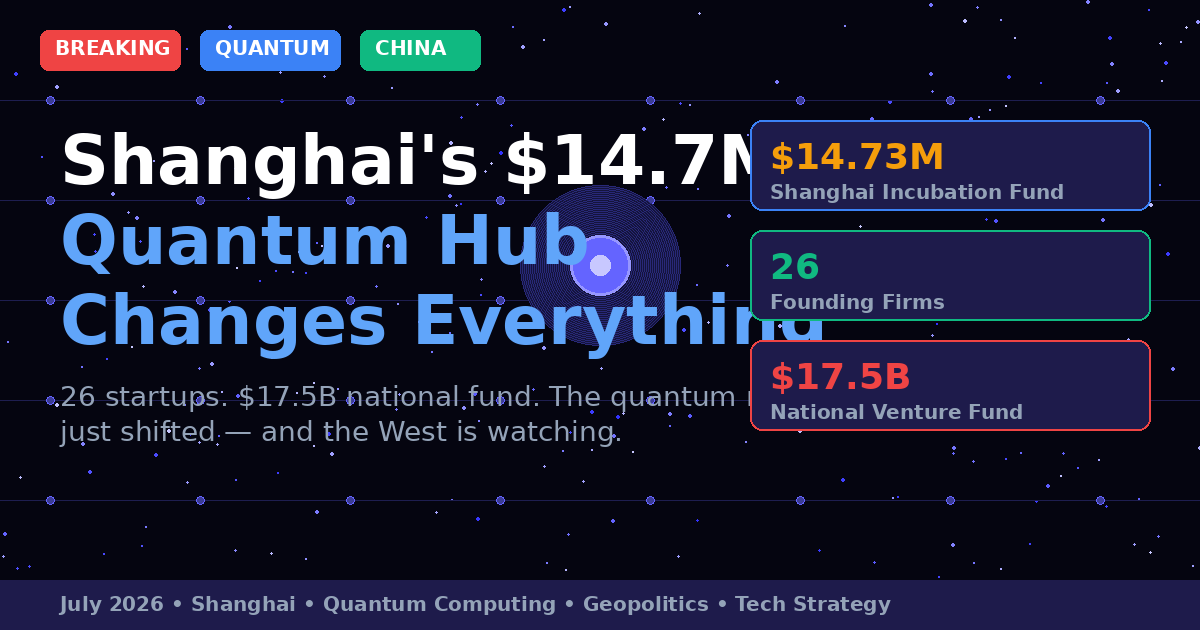
Shanghai launched a $14.73M quantum computing incubation hub with 26 firms. Here’s why China’s quantum push threatens Western tech…
Shanghai’s $14.7M Quantum Hub Changes Everything
Shanghai launched a $14.73M quantum computing incubation hub with 26 firms. Here’s why China’s quantum push threatens Western tech dominance — and what it means for you.
The Announcement That Shook the Quantum World
July 2026. Shanghai unveiled a quantum computing incubation hub backed by 100 million yuan ($14.73 million USD) in foundational research funding. 26 founding firms. Subsidies. Infrastructure. One clear mission: industrialize quantum technology before anyone else.
This isn’t just another tech park. It’s a signal.
China’s 15th Five-Year Plan — adopted March 2026 — named quantum technology as the #1 “future industry” above AI, semiconductors, and 6G. Above everything. And Shanghai just became ground zero for that ambition.
Here’s what happened, why it matters, and why every tech worker, investor, and policymaker should be paying attention.
What Shanghai Actually Built
The incubation zone isn’t a theoretical research lab. It’s a commercialization engine.
The package:
- $14.73 million in direct funding for foundational research and technology development
- 26 founding companies spanning quantum computing hardware, software, and applications
- Subsidized infrastructure — lab space, fabrication access, cooling systems
- Talent pipelines connecting Fudan University, Shanghai Jiao Tong University, and CAS institutes directly to startups
This isn’t Hefei (China’s existing quantum research capital). This is Shanghai — China’s financial and commercial hub. The message: China isn’t just researching quantum. It’s selling quantum.
The $17.5 Billion Elephant in the Room
Shanghai’s hub is one node in a much bigger machine.
China’s National Venture Guidance Fund allocated RMB 121.8 billion ($17.5 billion) across three regional quantum investment vehicles:
- Beijing-Tianjin-Hebei: Quantum computing + sensing
- Yangtze River Delta (Shanghai): Quantum communications + industrial applications
- Greater Bay Area (Shenzhen/Guangzhou): Commercial products
That’s not research grants. That’s venture capital structured for returns. The 15th Five-Year Plan explicitly calls for “innovative regulation, expanded venture investment, and stronger mechanisms for risk sharing” in quantum — language that means Beijing wants quantum unicorns, not just quantum papers.
China’s total government investment in quantum technology is widely cited at ~$15 billion — including the Hefei National Laboratory campus ($10 billion alone), the 12,000km Beijing-Shanghai quantum backbone, and the Micius satellite program.
The funding gap between China and the West? It’s widening, not closing.
The Startups Getting Funded Right Now
June 2026 was China’s quantum “big month.” The numbers are staggering:
Origin Quantum closed a Pre-IPO round of nearly RMB 3 billion (~$415M) with a post-money valuation approaching RMB 24 billion (~$3.3B). That single round nearly matched the entire sector’s Q1 2026 fundraising total.
SpinQ Technology raised $145M total across Series C rounds for superconducting quantum computers.
QBoson closed a $145M Series B for photonic quantum computing.
Fuxi Quantum — founded just two months ago — secured seed funding led by CATL, the world’s largest battery manufacturer.
Taiyi Liangsheng — less than six months old — closed an oversubscribed RMB 300M Pre-A round after receiving over RMB 2 billion in investment commitments within 8 days.
This isn’t slow-burn research funding. This is venture capital velocity. And it’s accelerating.
Why This Is Different From Western Quantum Efforts
Three structural differences make China’s approach uniquely threatening:
1. State-Directed Capital at Scale
In the U.S., quantum funding flows through NIST, NSF, and DARPA — research-focused, slow, academic. In China, the National Venture Guidance Fund deploys $17.5 billion through commercially-oriented vehicles with return expectations. The line between “public” and “private” capital is deliberately blurred.
2. From Lab to Factory Floor
The 15th Five-Year Plan marks a pivot from university research grants to commercial procurement and manufacturing subsidies. Origin Quantum now exports its own SL400 dilution refrigerator — a capability that didn’t exist three years ago. U.S. export controls on QuantumCTek and CAS institutes backfired: they triggered a crash program in domestic supply chains.
3. Integrated Space-Earth Networks
China already operates the world’s only dedicated quantum communications satellite (Micius). The 15th Plan calls for an integrated space-earth quantum communication network building on the 10,000km+ Beijing-Shanghai trunk line. No Western country has equivalent infrastructure.
What This Means for You (Yes, You)
If You’re a Developer
Quantum computing won’t replace classical computing. It’ll solve problems classical computers can’t touch — optimization, cryptography, materials simulation. Start learning quantum programming frameworks now. Qiskit (IBM), Cirq (Google), and Origin Quantum’s own SDK are freely available.
The developers who understand hybrid classical-quantum workflows will be the highest-paid engineers of the 2030s.
If You’re an Investor
China’s quantum sector is preparing for public listings. Origin Quantum’s Pre-IPO round signals an IPO is coming. For Western investors, direct exposure is limited by export controls and entity lists. But quantum-adjacent plays — cryogenics, photonics, quantum-safe cryptography — are accessible and growing.
If You’re in Cybersecurity
“Store now, decrypt later” is real. Adversaries are harvesting encrypted data today to decrypt when quantum computers break RSA. Post-quantum cryptography (PQC) migration isn’t optional — NIST’s PQC standards are already published. If your organization hasn’t started the transition, you’re already behind.
If You’re a Policymaker
The quantum race isn’t about who builds the first fault-tolerant computer. It’s about who industrializes quantum first — who builds the supply chains, trains the workforce, and captures the commercial applications. China’s incubation hub model is replicable. The question is whether the West will replicate it fast enough.
The 5 Developments to Watch Next
- Origin Quantum’s IPO timeline — China’s first quantum public listing will set the valuation benchmark for the entire sector.
- U.S. export control expansion — Will the Commerce Department add more Chinese quantum firms to the entity list? And will it matter if domestic supply chains are already built?
- Quantum + AI convergence — CATL’s investment in Fuxi Quantum signals battery/energy companies see quantum optimization as critical. Expect more cross-sector deals.
- Taiyi Quantum’s hardware — Founded in 2026 by former Microsoft chief quantum architect Liu Hongbin, building ytterbium-atom quantum computers. If they hit milestones, China’s neutral-atom path becomes credible.
- The “quantum winter” question — With this much capital flooding in, are we building real companies or inflating a bubble? The next 18 months will tell.
The Bottom Line
Shanghai’s $14.73 million incubation hub isn’t the story. It’s the symptom.
The story is a $15+ billion national commitment. It’s 26 startups getting subsidized lab space in China’s financial capital. It’s a Five-Year Plan that ranks quantum above AI and semiconductors. It’s a country that decided quantum technology is as strategically important as the atom bomb — and is funding it accordingly.
The West isn’t losing the quantum race because of a lack of talent or ideas. It’s losing because of a lack of coordinated industrial will.
Shanghai just reminded everyone what that looks like.
Before you go
Thousands of developers share what they’re building, learning, and discovering across our publications every month. One account connects you to our entire network of publications and communities.
메타데이터
- post_id
- 1ea89bc5bdd0
- slug
- shanghais-14-7m-quantum-hub-changes-everything-1ea89bc5bdd0
- url
- https://blog.cubed.run/shanghais-14-7m-quantum-hub-changes-everything-1ea89bc5bdd0
- canonical_url
- https://blog.cubed.run/shanghais-14-7m-quantum-hub-changes-everything-1ea89bc5bdd0
- author_url
- https://medium.com/@muruganantham52524
- status
- ok
- fetched_at
- 2026-07-08 20:12:56