Why I want my future electric car to roar like a diesel
I am a citizen deeply concerned with the state of our environment. I’d talk about climate change with anyone who will listen. So naturally…
Why I want my future electric car to roar like a diesel
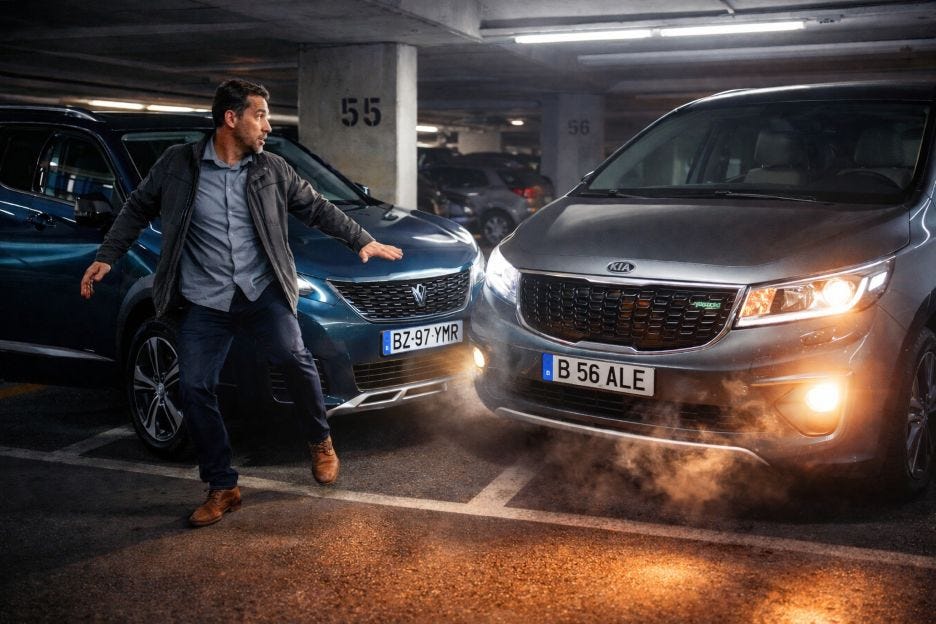
Generated with AI, which did not follow mt instructions exactly.
I am a citizen deeply concerned with the state of our environment. I’d talk about climate change with anyone who will listen. So naturally, I’m a huge fan of electric mobility. My wife and I agree that the next car we eventually buy will be at least a hybrid — but hopefully fully electric.
However, a rather unpleasant personal experience last week gave me a serious thought about EVs. My neighbor Alex owns a hybrid minivan, which at night is parked in front of my diesel-powered SUV. His parking place is #56, mine is #55. We have different schedules and rarely meet in the parking area.
A few days ago, he barely missed me while slowly driving in as I was stepping away from my car. I didn’t see him coming and nearly walked in front of the vehicle.

I do have a habit of looking left and right before crossing the parking area or a street, but sometimes I am too distracted to properly perform this safety ritual. Luckily, I stopped in time, although Alex was genuinely scared. After apologizing to one another, I continued my way home, analyzing the incident. Obviously, it was my fault.
I caught myself thinking that I had not heard the noise of an approaching car. And I immediately remembered that Alex’s vehicle is a hybrid.
The next day, I started searching for information about safety concerns related to EVs. And I discovered something unsettling: the very technology I’m championing might have an unintended consequence I can’t ignore.

The dilemma
Electric mobility promises cleaner air, quieter cities, and a lower carbon footprint. For urban environments especially, replacing internal combustion engines with electric motors is widely considered one of the most effective ways to reduce pollution and greenhouse gas emissions.
Electric and hybrid cars are not just cleaner — they are quieter than traditional vehicles. That’s great for reducing noise pollution. But it also means that pedestrians — especially children, the elderly, and visually impaired people — literally can’t hear them coming.

For various reasons, some people — especially children — stop right in the middle of the street.
But while electric vehicles bring clear environmental benefits, emerging research suggests they may also introduce an unexpected safety challenge for pedestrians.
Given people’s habit of scrolling on their phones while walking, the risk of being struck by a vehicle is real; being struck by a nearly silent one is even more likely.
And the reason is surprisingly simple: they are too quiet.
So, here’s a dilemma: how do I reconcile my enthusiasm for hybrid and electric vehicles with emerging research suggesting they may pose a greater risk to pedestrians?

What does science say on this issue?
This isn’t just academic curiosity. Back in 2009, the U.S. National Highway Traffic Safety Administration found that hybrids were about 1.2 times more likely to be involved in pedestrian crashes at low speeds.
The evidence was strong enough that regulators worldwide took action. The U.S. passed the Pedestrian Safety Enhancement Act in 2010. Europe, Japan, and — as of November 2025 — Australia now require Acoustic Vehicle Alerting Systems — artificial sounds — on all quiet vehicles traveling under 19 mph / 30 kmh. An electric car literally has to “sing” to be safe.

https://medium.com/@sensmedia.srl/why-chaos-gives-us-purpose-c29686c9cc54
A major study, published recently in Nature Communications , analyzed a decade of road data in the United Kingdom. The researchers analyzed enormous datasets, noting that in noisy urban environments, pedestrians were nearly three times as likely to be hit by an electric or hybrid vehicle:
- roughly 32 billion miles driven by electric and hybrid vehicles
- nearly 3 trillion miles driven by petrol and diesel cars
- more than 96,000 pedestrian collisions
Overall, the rate of pedestrian casualties per 100 million miles traveled was as follows:
- 5.16 for electric and hybrid vehicles
- 2.40 for petrol and diesel vehicles
In urban environments, the difference was even larger.

https://medium.com/reflections-and-realities/why-are-some-people-rich-and-others-poor-aeb9b46fdc75
The researchers discovered that hybrid vehicles, in particular, had a pedestrian casualty rate twice as high on average than for conventional cars. They suspect this isn’t about quietness alone, but about how hybrids are used: often as taxis and ride-share vehicles, clocking endless miles in crowded city centers where pedestrians are everywhere.
The researchers caution, however, that vehicle silence alone may not fully explain the difference in collision rates. Other possible contributing factors include driver demographics, as electric vehicles tend to be owned by younger drivers in some markets; rapid acceleration, since electric motors deliver torque instantly; or vehicle weight, as battery packs make EVs heavier than many comparable gasoline cars.
Still, the absence of engine noise remains one of the most widely discussed explanations. While regulations are increasingly requiring electric cars to emit sounds, it’s uncertain if pedestrians recognize these artificial noises as indicators of approaching traffic.
So where does this leave me — a climate advocate planning to buy an electric car? My thinking is that the problem — although real — isn’t unsolvable. But when I eventually buy an EV, I’ll order one that mimics the sound of conventional engine.
Not just for safety — perhaps a little for nostalgia as well.
Please notify me of broken links.
You may support my writing effort via BuyMeCoffee. Any amount is welcome.
메타데이터
- post_id
- 1eaf5072a2aa
- slug
- why-i-want-my-future-electric-car-to-roar-like-a-diesel-1eaf5072a2aa
- url
- https://medium.com/@sensmedia.srl/why-i-want-my-future-electric-car-to-roar-like-a-diesel-1eaf5072a2aa
- canonical_url
- https://medium.com/@sensmedia.srl/why-i-want-my-future-electric-car-to-roar-like-a-diesel-1eaf5072a2aa
- author_url
- https://medium.com/@sensmedia.srl
- status
- ok
- fetched_at
- 2026-07-31 22:40:12