I Kept Failing at Minimalism and Feeling Guilty About Clutter
Then I figured out I was trying to solve the wrong problem.
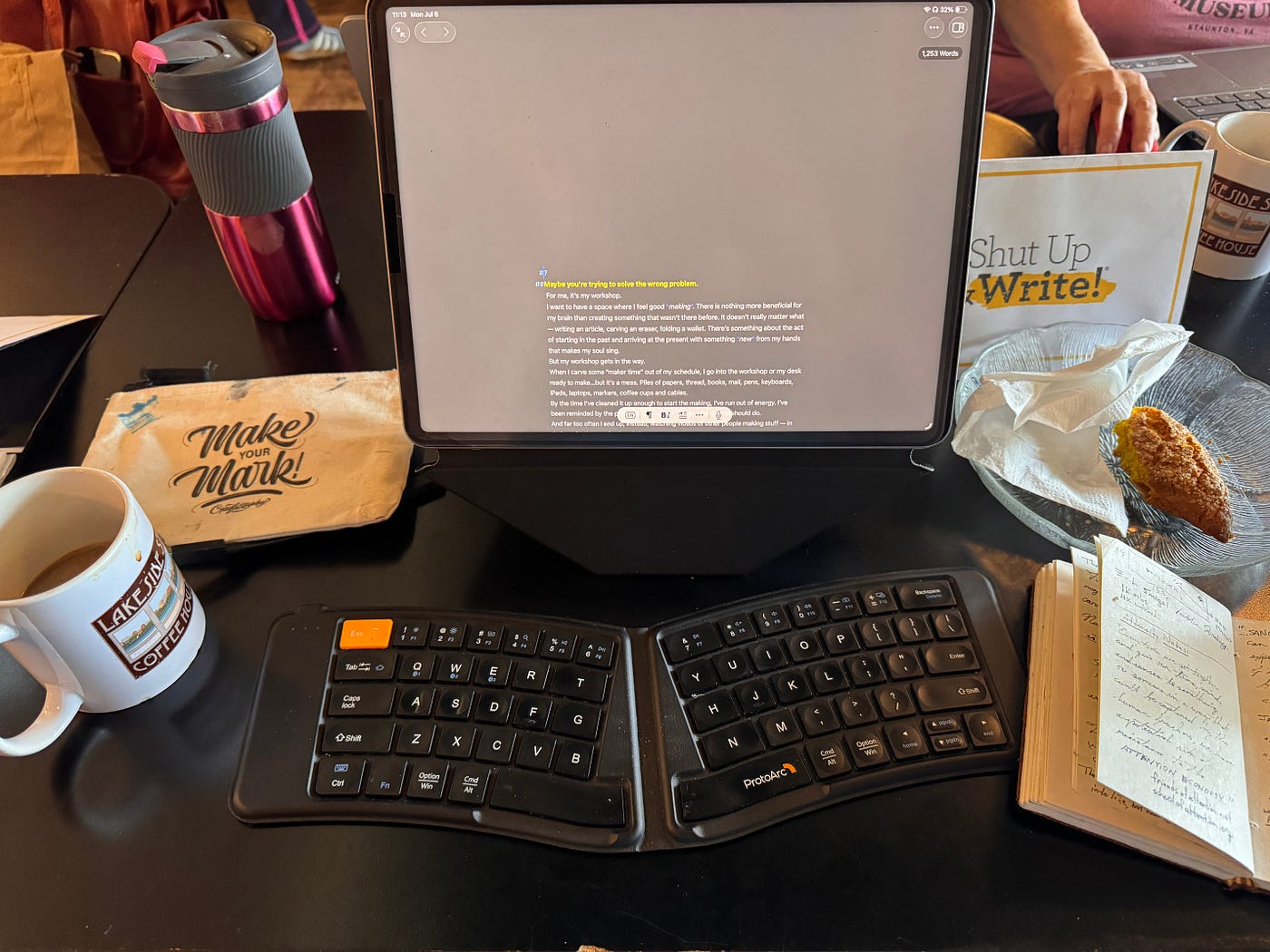
the oasis of attention that resulted in this article.
I Kept Failing at Minimalism and Feeling Guilty About Clutter
Then I figured out I was trying to solve the wrong problem.
For me, it’s my workshop.
I want to have a space where I feel good making. There is nothing more beneficial for my brain than creating something that wasn’t there before. It doesn’t really matter what — writing an article, carving an eraser, folding a wallet. There’s something about the act of starting in the past and arriving at the present with something new from my hands that makes my soul sing.
But my workshop gets in the way.
When I carve some “maker time” out of my schedule, I go into the workshop or my desk ready to make…but it’s a mess. Piles of papers, thread, books, mail, pens, keyboards, iPads, laptops, markers, coffee cups and cables.
By the time I’ve cleaned it up enough to start the making, I’ve run out of energy. I’ve been reminded by the piles of all the other things I need/want/should do.
And far too often I end up, instead, watching videos of other people making stuff — in their perfectly organized workshops.
Their workshop isn’t real, but the expectation is.
And by “real” I mean that almost all of them are heavily curated and presented in order to fit the video aesthetic of the maker. I understand that comparing my lived-in space to their specifically designed and edited one is unrealistic.
But surely there is a better way?
I’ve tried minimalism. I ended up getting very tired of going up and down stairs or reaching up high for shelves and containers where I’d hidden my art supplies out of view, to have the totally blank wall that would supposedly give me focus.
I’ve also tried the opposite, taking the doors off of the cabinets and putting the tools and materials out in the open on shelves, with walls full of pictures and drawings and whiteboards that would inspire my creativity!
Cue the overwhelm. And in both cases, disorganization, under the definition as “not knowing where things are. Whether it’s a random spot in a cluttered office or off in some zen-inspired bin that I forgot, it’s the same effect.
Not making.
If you consistently fail at achieving a goal, maybe it’s the wrong goal.
“Cleanliness is next to Godliness.” “Police your area and get it squared away.” “If you can lean, you can clean.“A place for everything, and everything in its place.” “Fix your mis en place!.”*Always be knolling**.”
Sound familiar? I’ve been conditioned from a very young age to equate “organized” with “clean” and both with “good.”
But “clean” doesn’t automatically mean good — take bacteria out of the soil, and nothing grows. For that matter, “organized” doesn’t necessarily mean good or clean — it might just mean “I don’t have to deal with this now, because it’s not out in the open.
“Good” is just an arbitrary value judgement rooted in colonialism, ableism, and that pesky old “Judeo-Christian” work ethic.
So if “clean” and “organized” aren’t working as the goals for my workshop, what goals will?
How about…joyful?
How aboutwelcoming? Not to other people — welcoming to me.
What about working towards a space that is like an old friend, the kind who says “Glad you’re back! What kind of mischief should we make today?”
Creating an Oasis of Attention
At a recent nonprofit gathering in Madison, Daniel Brown (a tribal leader for the Ho-Chunk nation) talked about need for sanctuaries — and acknowledged that like a lot of other DEI-associated words, that has become a charged word, almost the opposite of its actual meaning.
I can’t find a transcription of his speech, but a particular part really stuck in my mind. He suggested instead of “sanctuaries”, perhaps we should promote the model of the “oasis” — a place where people could find rest, resources, and news of the world after a long journey.
That idea took up space rent free in my mind and shows no sign of leaving. What different kinds of oases could I find? Or even create?
I came to the book *Attensity*** via a YouTuber talking about “reclaiming attention”. As person with ADHD, that’s pretty much the definition of the problem: I have a surplus of attention, it’s just not something I can easily claim or manage. The book — really a manifesto — is very inclusive in what it considers resistance to the forces that profit by splintering — “fracking” — our attention:
Every time we get together and give our time, mind, and senses to something or someone in a way that can’t be captured by the human frackers, we have a potential site of resistance to the Attention Economy…spaces, places where people can gather, care for each other, experiment with different kinds of attention and conceive brighter futures.
And this is even more clearly reiterated in the eighth of their Twelve Theses on Attention:
The exercise of a truer attention requires the carving out of spaces in the world where it can survive and thrive — new environments.
Not clean. Not minimalist.
As an example: at the moment I am at an oasis of attention, the coffee shop whereour local Shut Up & Write group meets.
I’m often the first one here, gathering a few tables together and taking care of office work before people begin to arrive one by one. Established authors, aspiring memoirists, illustrators and musicians, there’s no pre-requisites, gatekeeping, or expectations.
Before the session, I might be talking with my old friend Myrtle about the differences between polyamory and polygamy and the difficulty of bouzouki players who can’t play at dance tempo, or perhaps I’ll chat with my new friend Annette the historian about historical inaccuracies in the recent George Washington biopic.
Other conversations are going on around us — some more writing focused, as we have MFA candidates and people with agents and such. Some folks don’t talk, or only a little, but are no less a part of the group.
We are united by one simple understanding: at 10:15am, we will shut up and write for an hour.
It kind of freaks out the other coffee shop clientele — a table of loud, raucous conversation suddenly all laser-focused on screens, with an occasional friendly glare and “shhhhh!” at anyone breaking our literary sabbath.
That is what an oasis of attention looks like, for me. It’s not serene, it’s not challenging, it’s not particularly beautiful or even inspiring.
What makes it an oasis is how I feel when I’m there. It is a place where I feel comfortable being who I am, doing what I do.
It never lasts — there’s always meetings and emails and chores and errands afterwards. But you aren’t meant to stay at an oasis — you simply rest there for a bit. Chat with fellow travelers. And when you leave, it’s with the confidence you’ll find another when you need it.
It might not be clean, or minimalist, or high-tech. But you’ll know it when you find it, because it will welcome you.
- “…the opposite to the “Kondo-ing” practice of discarding and purging items, whereas knolling emphasizes keeping and organizing.” — wikipedia
* [Attensity: A Manifesto of the Attention Liberation Movement](https://bookshop.org/p/books/attensity-a-manifesto-of-the-attention-liberation-movement-the-friends-of-attention/fd52281dbcd359fc?aid=125314&ean=9798217086153&listref=as-mentioned-by-gray) (affiliate link)*
** Please tell me I’m not the only one who wants a George Thorogood film written to this phrase…*
If you enjoyed this kind of thing, you might want to come visit the Papermancy Guild. We create oases of attention online every two weeks at our Guild Hearth online, and nerd out about paper, books, craft, and cognition.
메타데이터
- post_id
- 1ebbb971a42a
- slug
- i-kept-failing-at-minimalism-and-feeling-guilty-about-clutter-1ebbb971a42a
- url
- https://medium.com/@graymiller/i-kept-failing-at-minimalism-and-feeling-guilty-about-clutter-1ebbb971a42a
- canonical_url
- https://medium.com/@graymiller/i-kept-failing-at-minimalism-and-feeling-guilty-about-clutter-1ebbb971a42a
- author_url
- https://medium.com/@graymiller
- status
- ok
- fetched_at
- 2026-07-10 04:31:59