AI Society for 12.16.24 — GenCast as your Weather Forecaster
Today: Google DeepMind’s GenCast for weather, perspectives on AI image and video creation, OpenAI v Musk, Claude’s ascendency, and a…
AI Society for 12.16.24 — GenCast as Your Weather Forecaster
Today: Google DeepMind’s GenCast for weather, perspectives on AI image and video creation, OpenAI v Musk, Claude’s ascendency, and a 1000-foot roller coaster
To lead, an update on AI-driven weather prediction, a topic I last covered back in the summer with Google’s ‘GraphCast.’ They’ve now done it again with ‘GenCast,’ the first tool that according to published tests in ‘Nature’ and the DeepMind blog, is the first to reliably generate forecasts 15 days out. This exceeds the capabilities of the leading US and European models. From the ‘NY Times’ reporting:
· They (Google DeepMind) report in the journal Nature on Wednesday that their new model can, among other things, outperform the world’s best forecasts meant to track deadly storms and save lives.
· In 2019, Dr. Emanuel and six other experts, writing in the Journal of the Atmospheric Sciences, argued that advancing the development of reliable forecasts to a length of 15 days from 10 days would have “enormous socioeconomic benefits” by helping the public avoid the worst effects of extreme weather.
· The DeepMind team trained GenCast on a massive archive of weather data curated by the European center. The training period went from 1979 to 2018, or 40 years. The team then tested how well the agent could predict 2019’s weather.
· The new agent’s forecasts are probabilistic — like those on the weather apps of smartphones. For instance, GenCast can give a range of percentages for the likelihood of rain in a specific region on a given day.
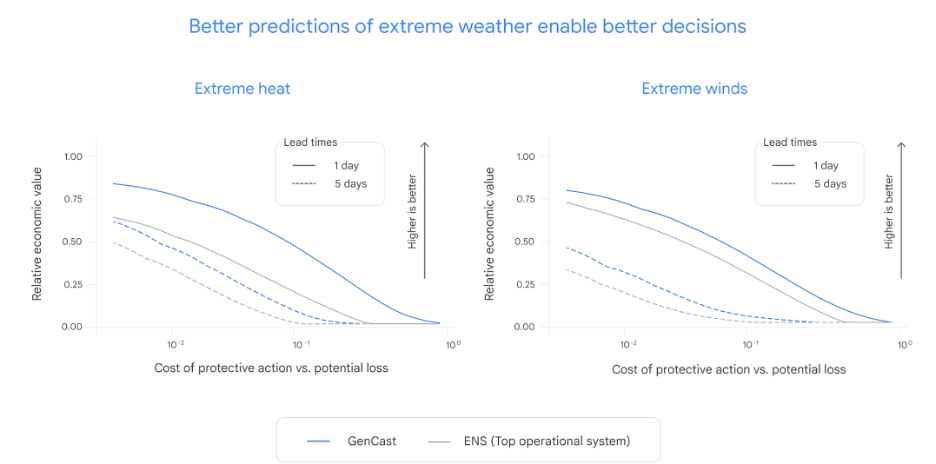
Source: Google
Locally, some sad news as reported by the ‘Mercury News.’ If you remember Suchir Balaji, the OpenAI whistleblower who accused the company of US copyright law violations, he was found dead by suicide on Nov 26.
· In an interview with the New York Times published Oct. 23, Balaji argued OpenAI was harming businesses and entrepreneurs whose data were used to train ChatGPT.
· “If you believe what I believe, you have to just leave the company,” he told the outlet, adding that “this is not a sustainable model for the internet ecosystem as a whole.”
· Information he held was expected to play a key part in lawsuits against the San Francisco-based company.
Two perspectives on recent AI image and video creation enhancements. The first, from James O’Conner’ posting in ‘AI Advances,’ compares the quality and accuracy of human images created by Grok2, OpenAI, and Microsoft’s Copilot. He offered different prompts reflecting nationalities, and as an example, from this prompt:
“Create a highly realistic image of an ideal Russian woman representing the culture of Russia”
The three platforms generated:

Source: James O’Conner. Grok2 (1), OpenAI (2), Copilot (3), Grok2 (4)
Across his tests, he considers Grok2 to be the most realistic. Note that Grok2 also has minimal guardrails for creating images with public figures, example above, and as I’ve covered previously.
Then Enrique Dans dives deeper into OpenAI’s Sora, with more of a focus on guardrails that should help avoid deepfakes. For example:
· It also has any number of features aimed at preventing it from being used to create deepfakes (for the moment, only a subset of OpenAI users will be able to generate videos using an uploaded photo or footage of a real person as a reference).
· Despite OpenAI’s precautions to prevent deepfakes, that era is over. It’s only a matter of time before someone will use Sora to generate something that will fool a lot of people, and go viral in the process.
Moving to models, the ‘NY Times’ reports how OpenAI is striking back at Musk’s lawsuit. From the article:
· Earlier this month, Elon Musk asked a federal court to block OpenAI’s efforts to transform itself from a nonprofit into a purely for-profit company.
· On Friday, OpenAI responded with its own legal filing, arguing that Mr. Musk is merely trying to hamstring OpenAI as he builds a rival company, called xAI.
And:
· Other tech companies are also weighing in on OpenAI’s change. On Thursday, Meta, which owns Facebook and Instagram, sent a letter urging California’s attorney general, Rob Bonta, to prevent Mr. Altman and his colleagues from converting OpenAI into a pure for-profit company.
· In its letter, Meta argued that OpenAI’s restructuring could create a dangerous precedent for nonprofits, potentially leading “to a proliferation of similar start-up ventures that are notionally charitable until they are potentially profitable.”
We’ll see how this progresses.
Next, ‘AI Rabbit’ details the more interesting features in Google’s Gemini 2.0, including agents, its multimodal chops, speed, and use of the bot as a research assistant. He also describes how Gemini integrates with Google’s other AI tools that include Astra (agents), Mariner (computer use), and Jules (coding).
Not to leave out Perplexity, ‘The Information’ reports on the company’s sales forecasts released as part of their current fundraising efforts. It seeks to raise $500 million at a 160-times forward revenue And, a look into part of its business model:
Perplexity in July announced a new cost for its business: It shares a flat, double-digit percentage of revenue with a news publisher every time a search result references the publisher’s content. The startup has struck deals with publishers including Time and Fortune. It is also facing a copyright infringement lawsuit filed by News Corp and a legal threat from The New York Times Co. over its use of their content in results.
Lastly, and also from the ‘NY Times,’ a look at how ‘Claude’ from Anthropic is gaining support amongst techies due to its more ‘human’ interactions. From the reporting:
· Claude’s killer feature — which its fans describe as something like emotional intelligence — isn’t something that can easily be measured. So fans are often left grasping at vibes to explain what makes it so compelling.
· “Some mix of raw intellectual horsepower and willingness to express opinions makes Claude feel much closer to a thing than a tool,” said Aidan McLaughlin, the chief executive of Topology Research, an A.I. start-up. “I, and many other users, find that magical.”
· Newer versions have gone through a process known as “character training” — a step that takes place after the model has gone through its initial training, but before it is released to the public.
· During character training, Claude is prompted to produce responses that align with desirable human traits such as open-mindedness, thoughtfulness and curiosity.
Turning to hardware, a few updates. ‘EE Times’ details a new open standard for interconnecting AI accelerators aka GPUs/TPUs/others.
· The recently announced Ultra Accelerator Link (UALink) is an open solution that is being developed by a broad array of switch and accelerator vendors
· UALink creates an open ecosystem to connect accelerators to a switch — the number of switches depends on how many accelerators are in a pod
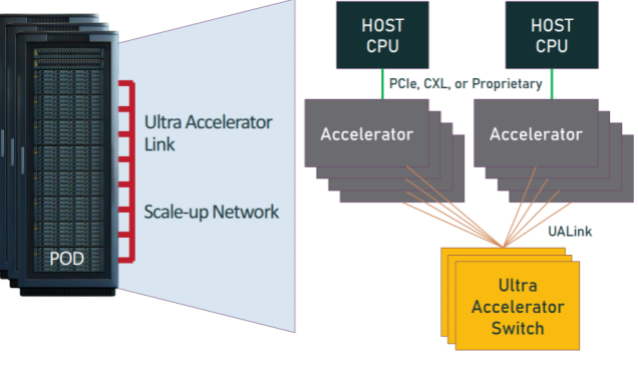
Source: EE Times
Also from ‘EE Times,’ a practical perspective on folding AI into circuit design, offering:
· An in-depth exploration of both the advantages AI brings to circuit design — including automation, optimization and error reduction — and the challenges that limit its effectiveness in certain high-stakes applications.
This last point is critical, with the article detailing issues with accuracy — determinism vs probability, training data availability, lack of model transparency, and the need in any case to re-validate any designs.
And, Dipanshu penning in ‘Artificial Intelligence in Plain English’ explains the acronym soup of different processor types (beyond CPUs and GPUs), their uses, and where they shine, spanning TPUs, DPUs, VPUs, APUs, and QPUs.
To close, a practical (or impractical) use of AI, depending upon your perspective. Theme Park innovators have been in search of the 1000-foot roller coaster for decades, and they now have the technology available. As the article in ‘International Theme Park Services’ describes, using AI and new materials, it is now within grasp and being designed. The where and when is still open.

Source: ITPS
메타데이터
- post_id
- 1ee8c9f5cdae
- slug
- ai-society-for-12-16-24-gencast-as-your-weather-forecaster-1ee8c9f5cdae
- url
- https://medium.com/a-i-society/ai-society-for-12-16-24-gencast-as-your-weather-forecaster-1ee8c9f5cdae
- canonical_url
- https://medium.com/a-i-society/ai-society-for-12-16-24-gencast-as-your-weather-forecaster-1ee8c9f5cdae
- author_url
- https://medium.com/@daveginsburg
- status
- ok
- fetched_at
- 2026-07-21 15:32:57