When One Edge Case Eats the Park: A Software Tester’s Guide to Jurassic Park
“Who Tested This?” — Edge Cases in Film & TV
When One Edge Case Eats the Park: A Software Tester’s Guide to Jurassic Park
“Who Tested This?” — Edge Cases in Film & TV
This is the first entry in a series exploring how edge cases quietly drive some of the most memorable failures in film and television. Because in every system — fictional or real — the edge cases are always waiting.
There are two types of people watching Jurassic Park:
- People who see dinosaurs escaping and think, terrifying
- People who see a system failure and think, “Who tested this?”
Or worse:
“This wasn’t in scope.”
Beneath the roaring T-Rex and clever girl moments lies something far more unsettling:
A production system that clearly never met a tester with a healthy distrust of the phrase:
“No one would do that in real life.”
So let’s step into the control room — not as visitors, but as testers — and see exactly where this system begins to fall apart.
The Real Villain of This Story: Untested Assumptions
The dinosaurs didn’t break the park. The system did.
The park is effectively one giant integrated platform:
- Security systems
- Electric fences
- Vehicle control
- Access management
- Monitoring dashboards
All tied together. All centrally controlled. And all — apparently — happy to fall over together.
From a QA perspective, this isn’t a park. It’s a single point of failure with branding.
So let’s analyse the testing gaps.
Did Nedry Intentionally Take Down the Entire Park?
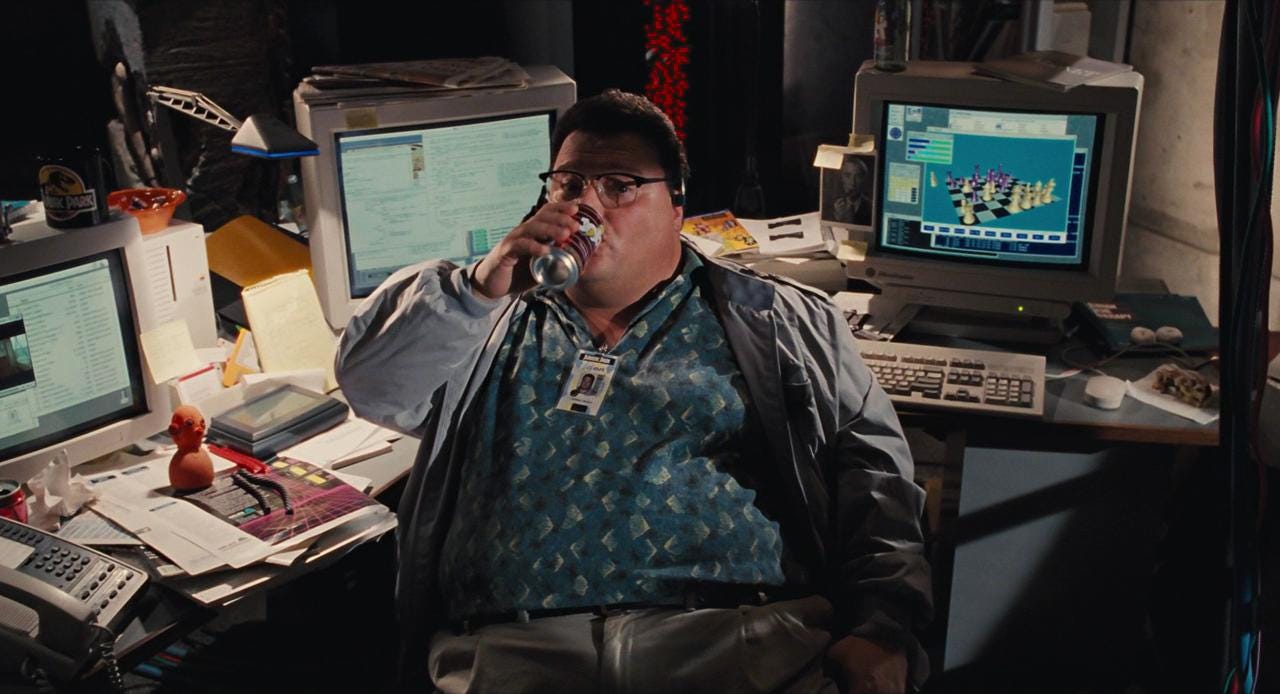
Let’s talk about Dennis Nedry — the world’s most underpaid developer (his words, not mine).
Short answer: No… but also, yes (accidentally, and that’s worse).
What he intended:
- Temporarily disable security to steal embryos
- Cover his tracks by erasing logs
- Restore the systems after he was on the boat off the island
- Get paid and disappear
What he actually did:
- Disabled everything
- Locked out other users
- Created a recovery process that required manual intervention
- Introduced a time delay during a tropical storm (bold choice)
There’s no clear indication he meant to bring the entire park down permanently.
But here’s the problem:
If your system allows one person to accidentally take down the entire platform… that’s not sabotage. That’s design.
Was It Just the Script… or a Perfect Storm?
If this were a bug report, the root cause would not be “Nedry”.
It would be:
Combination of unhandled conditions leading to catastrophic failure
Because several things collide at once:
1. The Script
Nedry’s script disables critical systems and introduces a delay.
2. The Storm
A tropical storm hits the island, reducing visibility, increasing risk, and limiting response time.
3. Human Factors
- Nedry leaves the system unattended
- Poor (or non-existent) documentation
- Knowledge siloing means no one else can restore the system quickly
4. System Design
- No redundancy
- No graceful degradation
- No isolation between critical components
Individually? Manageable.
Together?
You’ve got yourself a textbook edge case cluster.
Monolith or Cascade Failure?
Here’s the debate every tester would have in the control room:
Option A: A Monolithic System
Everything is tightly coupled.
- One switch affects everything
- One script impacts all subsystems
- One failure = total failure
Option B: Cascade Failure
Systems are somewhat independent, but:
- A critical dependency fails (e.g. power/security)
- Other systems rely on it
- Failures ripple outward
Honestly?
It’s likely a bit of both — a monolith wearing a microservices costume.
Which is arguably worse.
Because it gives the illusion of safety without any of the actual protection.
A Little Easter Egg Real-World Edge Case Detail

The system Nedry and Lex Murphy interact with isn’t pure fiction.
It’s inspired by real Unix systems used in the early 90s — specifically environments like IRIX developed by Silicon Graphics.
These systems were powerful, complex, and — crucially — often operated by a small number of highly specialised users.
From a testing perspective, that introduces familiar risks:
- High privilege concentration (few people with a lot of control)
- Limited operational knowledge sharing
- Interfaces optimised for experts, not resilience
- Recovery dependent on specific individuals
Sound familiar?
Because that’s not just a film problem. That’s a very real category of production risk.
These systems were powerful — but often relied on a small number of experts to operate and recover them. Which means the real edge case wasn’t the dinosaurs… it was dependency on one person.
Was QA Involved… At All?
Now for the uncomfortable question.
Was this:
- A system in QA?
- A system that passed QA?
- Or a system that never met QA?
Evidence QA might have existed:
- The park is in a preview phase
- Scaffolding shows that some elements were still in progress
- External experts are invited to review it
- There’s a discussion about safety and approval
This feels suspiciously like:
User Acceptance Testing (UAT)… but with dinosaurs
Evidence QA was… limited:
- No apparent fail-safes for critical systems
- No role-based access controls
- No recovery automation
- No protection against insider threats
- No visible monitoring alerts during failure
And most importantly:
No one asks, “What happens if someone turns it off?”
Which is either unrealistic… Or the most realistic thing about the whole film.
The Edge Case That Ate Everyone
Here’s the uncomfortable truth:
Nothing that happens in Jurassic Park is surprising from a testing perspective.
- Insider misuse? Common.
- Systems failing during bad weather? Expected.
- Recovery processes failing under pressure? Classic.
- Over-reliance on automation? Seen it.
The real issue is that these scenarios were likely labelled as:
“Low probability. Not worth testing.”
If this were a real project, this is the part where someone says,
“We’ll improve that in Phase 2.”
And that’s the trap. Because in complex systems:
Edge cases don’t stay on the edges for long.
The Tester’s Field Notes
If you’re new to testing — or mentoring someone who is — this film is a perfect case study.
Here’s what to take away:
1. Always Question Assumptions
If someone says “no one would do that”, write a test for it.
2. Test for Misuse, Not Just Use
Happy paths don’t break systems. People do.
3. Look for Single Points of Failure
If one action can break everything, it eventually will.
4. Think in Combinations
Bugs rarely happen in isolation. Test how things fail together.
5. Ask “What If Recovery Fails?”
Failure is inevitable. Recovery is what matters.
Example Test Case (Because We Can’t Not)
Test Case: JP-SEC-001 — Insider Threat
Precondition: User has high-level system access
Action: Executes an unauthorised script affecting system controls
Expected Result:
- Critical systems remain operational
- Alerts are triggered
- Access is restricted or revoked
- System rollback is available
Actual Result:
- Dinosaurs
This Was Always Going to Happen
Jurassic Park isn’t a story about dinosaurs escaping. It’s a story about a system encountering its first real edge case. And failing spectacularly. Because the most dangerous words in software development aren’t:
“We have a bug.”
They’re:
“No one would ever do that.”
What other tests do you think were missed at Jurassic Park? What would you have included in your test plan?
메타데이터
- post_id
- 1ef95c773842
- slug
- when-one-edge-case-eats-the-park-a-software-testers-guide-to-jurassic-park-1ef95c773842
- url
- https://medium.com/@kaylenstuart/when-one-edge-case-eats-the-park-a-software-testers-guide-to-jurassic-park-1ef95c773842
- canonical_url
- https://medium.com/@kaylenstuart/when-one-edge-case-eats-the-park-a-software-testers-guide-to-jurassic-park-1ef95c773842
- author_url
- https://medium.com/@kaylenstuart
- status
- ok
- fetched_at
- 2026-06-24 11:06:28