New Video Drop: What Is the Grain? The Most Important Data Modeling Question.
A table can have the right columns, the right types, and the right joins — and still be completely wrong.
New Video Drop: What Is the Grain? The Most Important Data Modeling Question.
A table can have the right columns, the right types, and the right joins — and still be completely wrong.
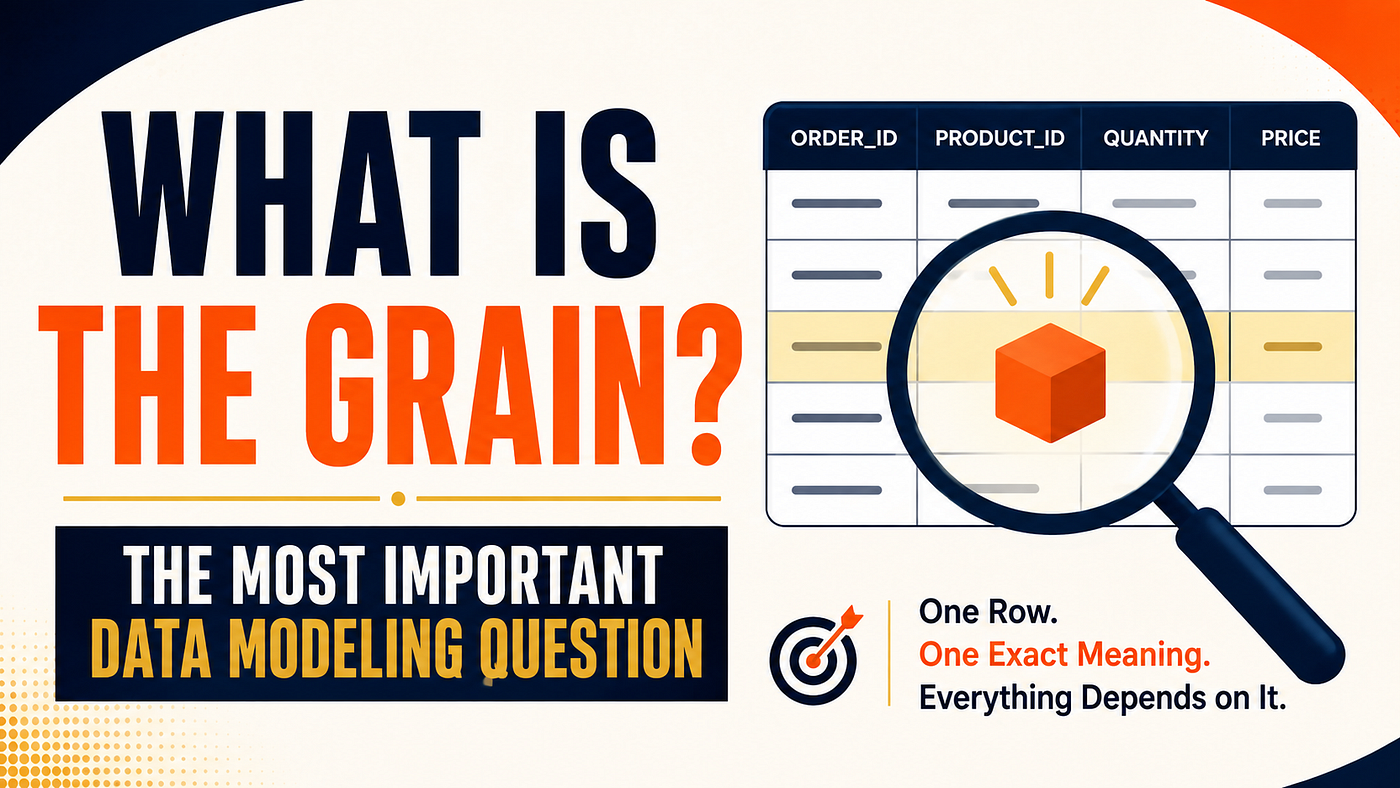
What if one unanswered question was quietly inflating your revenue numbers, doubling your customer counts, and breaking dashboards nobody can explain?
That question is: what does one row in this table represent?
This is the grain — the exact meaning of a single row — and it is the first decision to make before designing any table. It sounds small, but it decides four things everything else depends on:
- The primary key
- Which columns belong in the table
- How the table joins to others
- Which metrics can be safely calculated
Here is how the grain silently breaks a number. Take one order with three products. At the order level, that order is one row worth $100. At the order-item level, the same order is three rows, one per product. Now join an order-level payment table to those item rows and sum the payment amount. The $100 order becomes $300. The data was never missing. The join ran successfully. The grain was simply misunderstood — and this is why so many “SQL bugs” are really grain bugs.
The fix starts with a precise grain statement. Not “this table contains sales data,” but “one row represents one completed order item, for one customer, at one store, at the time of purchase.” That single sentence forces the real design questions into the open: can the same product appear twice in an order, do we need a line number, are cancelled items included, should price reflect purchase time or the current value, what happens when an order is updated.
Three mistakes cause most grain problems: mixing multiple grains in one table, changing the grain during transformation without documenting it, and assuming a key is unique instead of testing it. The defense is boring and reliable — count the rows, check duplicates, inspect samples, and confirm the business meaning with the data owner.
For data engineers, the lesson is simple. Before you choose columns, partitions, storage formats, or fact and dimension tables, define what one row means. If the grain is unclear, every calculation built on the table is at risk. If it is clear, keys, joins, metrics, and history all become easier to design.
The most important data modeling question is not “what columns do we need?” It is “what does one row represent?” Start there.
The full video walks through the tables visually, the three mistakes, and a five-step framework you can use on your next model:
[embed]
The best data modelers aren’t the ones who write the cleverest SQL. They’re the ones who ask the simplest question before anyone else thinks to: what does one row mean?
Answer that first, and every join, metric, and dashboard you build stands on solid ground. Skip it, and you’re just decorating a crack in the foundation.
메타데이터
- post_id
- 1f28987e73bf
- slug
- new-video-drop-what-is-the-grain-the-most-important-data-modeling-question-1f28987e73bf
- url
- https://medium.com/@Bricksnotes/new-video-drop-what-is-the-grain-the-most-important-data-modeling-question-1f28987e73bf
- canonical_url
- https://medium.com/@Bricksnotes/new-video-drop-what-is-the-grain-the-most-important-data-modeling-question-1f28987e73bf
- author_url
- https://medium.com/@Bricksnotes
- status
- ok
- fetched_at
- 2026-08-18 11:40:50