Why Encryption Doesn’t Protect Your Privacy (And a New Way to Fix It)
Md. Sakib Ahmed
Privacy-Preserving Traffic Transformation via Orthogonal Manifold Rotation
Md. Sakib Ahmed
Independent Researcher · April 2026
⸻
Abstract
End-to-end encryption has largely solved content confidentiality – but not privacy. Observable traffic metadata such as packet size, timing, and flow structure remains exposed and highly exploitable. Modern machine learning systems can infer user behavior and communication intent with over 90% accuracy from encrypted traffic.
This paper introduces Privacy-Preserving Traffic Transformation (PPTT), a fundamentally different approach. Instead of adding noise or masking metadata, PPTT applies continuous orthogonal transformations to the feature space itself. This renders observable traffic statistically uninformative to external classifiers.
The transformation is exactly invertible for legitimate receivers and introduces minimal overhead. Simulation results show classification accuracy dropping from 92 – 97% to as low as 6 – 8%.
PPTT reframes metadata privacy as a geometric control problem rather than a statistical obfuscation problem.
⸻
- Introduction
Encryption protects what you say – but not how you behave.
Even fully encrypted traffic still reveals patterns:
• Packet sizes
• Timing between packets
• Direction of communication
• Session structure
These patterns allow systems to infer applications, behaviors, and even identities.
This is the metadata privacy gap.
⸻
2. Why Existing Defenses Fail
Most defenses try to “hide” patterns:
• Padding changes packet size
• Timing obfuscation adds delay
• Dummy traffic adds noise
But all of them stay inside the same feature space.
That’s the problem.
If the attacker understands the space, they can relearn the patterns.
⸻
3. The Core Idea
Instead of modifying the data, PPTT changes the space itself.
Think of it like this:
Instead of hiding a signal, you rotate it into a dimension the observer doesn’t understand.
Mathematically:
M_obs(t) = R(t) · M(t)
Where:
• M(t) is original metadata
• R(t) is a rotation matrix
Key property:
The receiver can perfectly recover the original data.
The attacker cannot interpret it.
⸻
4. Why Rotation Works
Noise-based methods:
They distort the signal – but keep it in the same coordinate system.
PPTT:
It changes the coordinate system entirely.
So the classifier isn’t just confused – it becomes fundamentally misaligned.
⸻
5. Continuous Transformation
The rotation changes over time.
This creates:
• A moving target
• A non-stationary data distribution
• Resistance to retraining
Even if the attacker adapts, the system keeps shifting.
⸻
6. Architecture
Two layers:
Fast Layer:
• Applies transformations per packet
• Ensures low latency
Slow Layer:
• Updates transformation strategy
• Detects adaptation
• Adjusts rotation dynamics
⸻
7. Results
Baseline accuracy:
• Random Forest: 94%
• Neural Network: 96%
With PPTT:
• Drops to 6 – 8% initially
• Recovers only to ~20% after retraining
• Random baseline is 33%
This means:
The classifier performs worse than random guessing.

⸻
8. Overhead
• Bandwidth: ~2 – 3%
• Latency: ~1 – 2 ms
• Synchronization errors: minimal
So the system is practical.
⸻
9. Key Insight
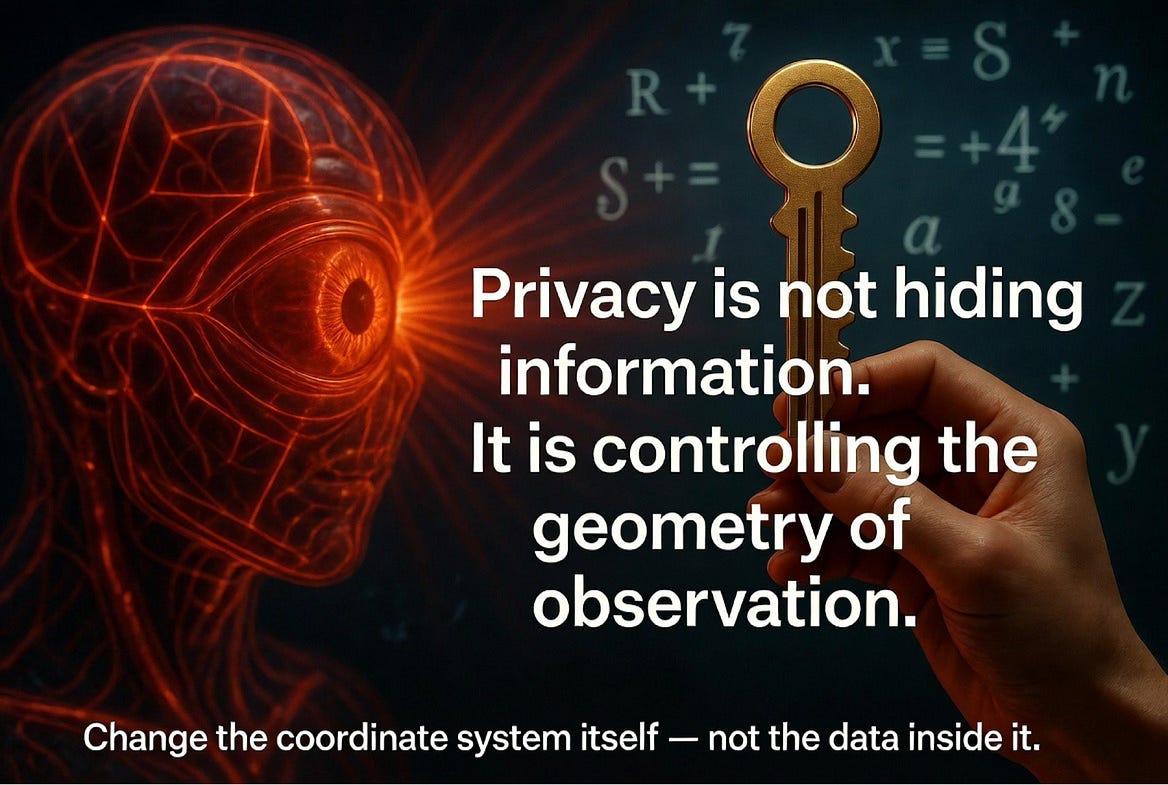
Privacy is not about hiding data.
It’s about controlling how the data can be interpreted.
PPTT achieves this by changing the geometry of observation.
⸻
10. Conclusion
Metadata privacy is still an unsolved problem.
PPTT shows that:
• You don’t need to destroy information
• You don’t need heavy noise
• You can preserve utility completely
You just need to change the space in which observation happens.
Keywords
Metadata Privacy · Traffic Analysis · Orthogonal Transformation · Manifold Rotation · Network Security · Geometric Signal Processing · Adversarial Resistance
⸻
Author Note
This work is part of an ongoing independent research direction exploring geometric control of information systems, including Adaptive Vector Orthogonality and manifold-based privacy frameworks.
⸻
Data & Code
Prototype implementation will be released upon formal submission.
⸻
License
CC-BY 4.0

메타데이터
- post_id
- 1f44c8d16e2c
- slug
- why-encryption-doesnt-protect-your-privacy-and-a-new-way-to-fix-it-1f44c8d16e2c
- url
- https://medium.com/@amdsakib/why-encryption-doesnt-protect-your-privacy-and-a-new-way-to-fix-it-1f44c8d16e2c
- canonical_url
- https://medium.com/@amdsakib/why-encryption-doesnt-protect-your-privacy-and-a-new-way-to-fix-it-1f44c8d16e2c
- author_url
- https://medium.com/@amdsakib
- status
- ok
- fetched_at
- 2026-06-17 08:20:12