Why Doesn’t the Village Next to a Tourist Hotspot Ever Take Off?
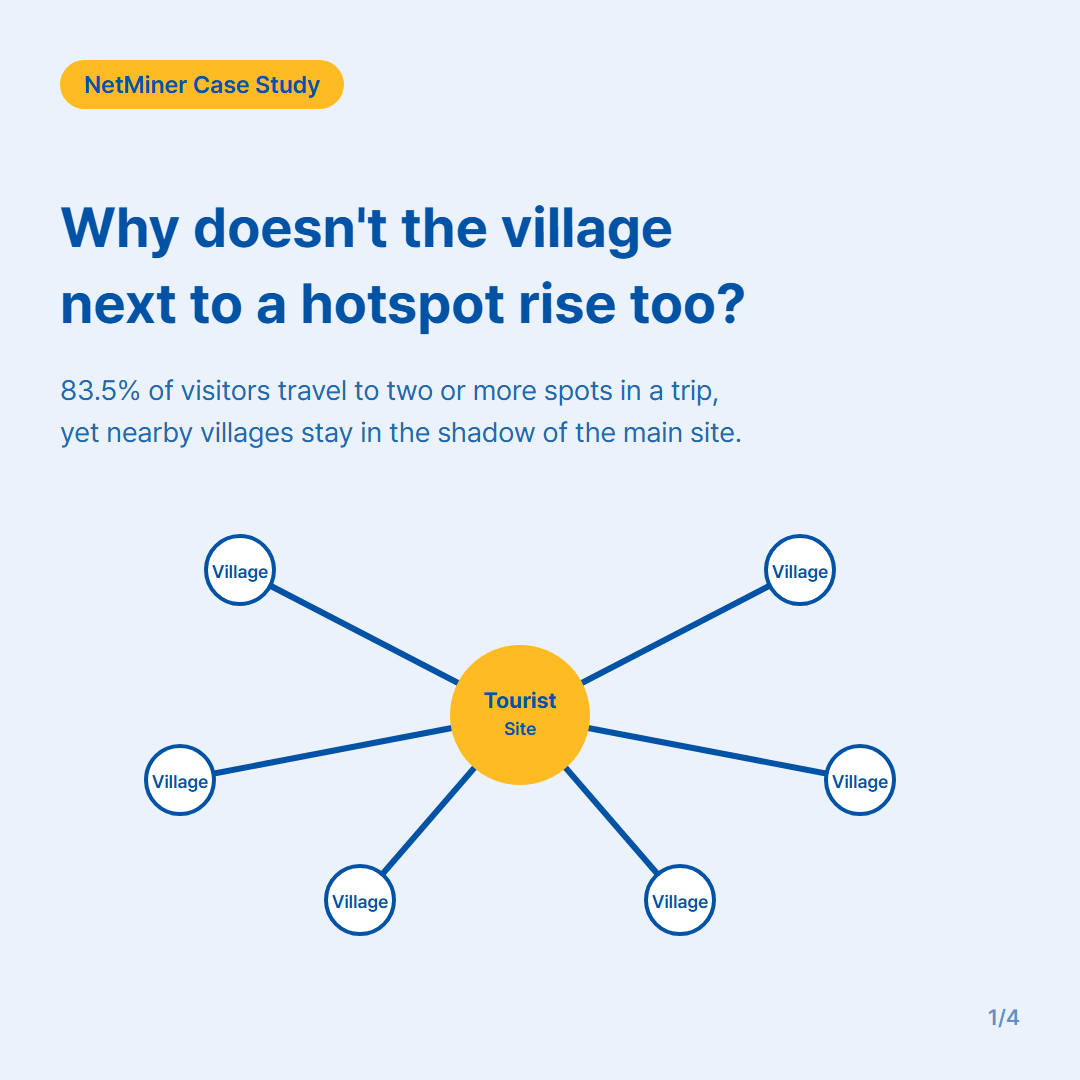
On a single trip, 83.5 percent of visitors stop at two or more destinations. So why does the village right next door always stay in the…
Why Doesn’t the Village Next to a Tourist Hotspot Ever Take Off?
On a single trip, 83.5 percent of visitors stop at two or more destinations. So why does the village right next door always stay in the shadow of the main attraction?
Track 2.4 million social media posts, and the answer starts to take shape. This post introduces a study that used social network analysis (SNA) to map the co-visitation relationships between tourist attractions and peri-urban villages in the Dapeng Peninsula, Shenzhen, China. (Zhou et al., 2020)
Background
Looking at a single attraction hides the village’s role
The Dapeng Peninsula sits on the outskirts of Shenzhen, under mounting pressure from rapid urban expansion and development. Alongside its well-known natural and cultural attractions, the area is dotted with small villages that rarely draw visitors on their own but provide essential backstage services: lodging, meals, parking.
Most prior research analyzed the visitation patterns of individual attractions in isolation. But real trips rarely end at a single stop. Visitors move between multiple destinations in a single day, and in that process, attractions and villages form one interconnected ecosystem. The problem was that quantitative data showing these connections, which places tend to be visited together, was almost nonexistent at the village level. Villages simply don’t get mentioned often enough on social media.
Key Idea
Look at co-visitation relationships, not isolated visits
The core idea of this study is to trace where a single person traveled over the course of a day, rather than counting visits to each location separately, and use that to map a co-visitation network between attractions and villages. In this network, each location becomes a node, and the more often two places are visited together on the same trip, the stronger the link between them.
The catch is that social media data alone tends to underrepresent or entirely miss low-visibility locations like villages. To address this, the researchers combined social media big data with offline survey data in a hybrid approach. They then calculated how many other locations each node connects to (degree centrality) and how often it bridges different clusters within the network (betweenness centrality) to reveal the role each location plays.
Solution
To quantify the co-visitation relationships between attractions and villages, the researchers applied social network analysis (SNA).
Step 1. Collecting and cleaning social media data
From 2.4 million posts collected on Sina Weibo, the researchers used Chinese semantic analysis and geotag filtering to narrow the dataset down to 8,029 posts related to the Dapeng Peninsula. Based on the chronological movement patterns of the same users, they extracted 1,202 reliable co-visitation records.
Step 2. Filling data gaps with a survey
To offset the underrepresentation of small villages with low online visibility, the researchers surveyed Weibo users (700 distributed, 382 returned) to collect additional travel route information.
Step 3. Calculating co-visitation linkage strength
For location pairs with high social media visibility, the researchers used co-exposure frequency from the big data. For pairs involving low-visibility villages, they applied a corrected formula incorporating spillover visitation ratios from the survey data. This produced quantified linkage strengths across 74 locations in total: 26 natural attractions, 6 cultural attractions, and 42 peri-urban villages.
Step 4. Analyzing network structure
Using NetMiner, the researchers applied the Kamada-Kawai algorithm to cluster locations with high co-visitation intensity, dividing the Dapeng Peninsula into two distinct groups: a smaller cluster centered on the northwest coast and a larger cluster centered on the southeast.
Step 5. Identifying each location’s role through centrality analysis
By calculating degree centrality and betweenness centrality, the researchers determined which locations formed the backbone of the network and which ones served as bridges connecting different clusters.
Conclusion
Attractions form the backbone; villages remain dependent supporters
The locations with the highest degree centrality were Yangmeikeng Valley (0.753), Xichong Beach (0.644), and Dapeng Fortress (0.616), in that order. These major attractions formed the backbone of the entire network, while peri-urban villages showed consistently low centrality overall. The same locations also ranked highest in betweenness centrality, functioning as bridges that connected the flow of visitors between different clusters.
A closer look at the relationship between attractions and villages reveals a dependent structure: villages generate almost no visitor draw of their own and rely on spillover from nearby attractions. Yet the study also found real mutual benefit at play. Where environmental protection restricts facility expansion at major attractions, villages step in to provide essential services such as lodging, meals, and parking.
On the other hand, co-visitation links between villages surrounding the same attraction were extremely rare, suggesting that these villages compete for visitors and duplicate investments rather than collaborate.
This study matters because it frames the value of peri-urban villages not as a simple hinterland, but as an interdependent part of the tourism ecosystem’s broader structure.
NetMiner | CYRAM Network Science · Social Network Analysis · Graph Analytics https://www.netminer.com
From two-mode network analysis to degree centrality and hierarchical cluster analysis, you can run it all directly in NetMiner. **☞ Try for Free ☞ NetMiner Help Center**
References
- Zhou, Y., et al. (2020). Co-visitation network in tourism-driven peri-urban area based on social media analytics: A case study in Shenzhen, China. Landscape and Urban Planning.
메타데이터
- post_id
- 1f7d7a5bc8b7
- slug
- why-doesnt-the-village-next-to-a-tourist-hotspot-ever-take-off-1f7d7a5bc8b7
- url
- https://medium.com/@netminer/why-doesnt-the-village-next-to-a-tourist-hotspot-ever-take-off-1f7d7a5bc8b7
- canonical_url
- https://medium.com/@netminer/why-doesnt-the-village-next-to-a-tourist-hotspot-ever-take-off-1f7d7a5bc8b7
- author_url
- https://medium.com/@netminer
- status
- ok
- fetched_at
- 2026-08-11 11:41:10