Your dashboards are lying to you
Why I think the modern BI stack is quietly broken — Part 1 of 2
Your dashboards are lying to you
Why I think the modern BI stack is quietly broken — Part 1 of 2
Every company I’ve worked with calls itself “data-driven.” Dashboards on every screen. KPIs blinking in real time. BI tools humming in the background.
And yet, when I ask a frontline manager a simple question — why did high-value churn spike last week? — I watch the same thing happen every time. A slack to the analytics team. A ticket gets filed. Days pass. By the time the answer arrives, the moment has already moved on.
This is the quiet failure of the modern data stack. We’ve spent a decade building infrastructure to collect, store, and visualize data — and somehow ended up with business users who still can’t get answers when they need them.
I want to be honest about what’s broken. In Part 2, I’ll get into what I think comes next.
The four cracks I see in every BI deployment
If you’ve worked in data, you’ve named these problems out loud. They show up in every retrospective, every roadmap. Let’s look at them honestly.
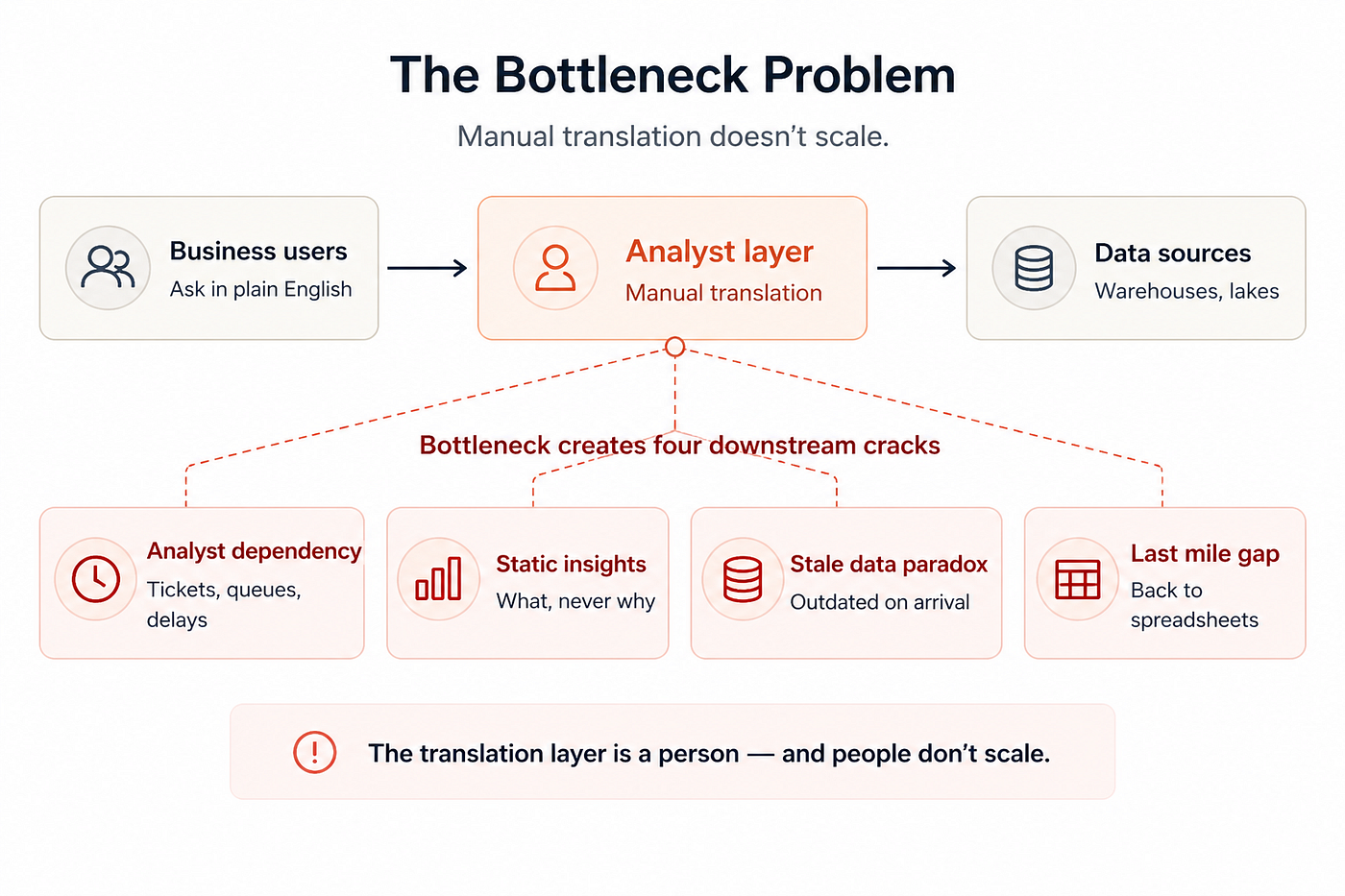
Analyst dependency. Every ad-hoc question becomes a ticket. Every ticket becomes a queue. The result is an IT backlog where urgent decisions wait days, sometimes weeks, behind report requests that may not even matter by the time they’re answered. Your analysts aren’t the bottleneck — the workflow is.
Static insights. Dashboards are great at telling me what happened. They’re terrible at explaining why, and worse at suggesting what to do next. Every meaningful interpretation requires human effort: an analyst to dig in, a manager to contextualize, a meeting to align. The dashboard reports the symptom, never the diagnosis.
The stale data paradox. Here’s the irony — the more careful you are about building “the right” custom report, the more outdated the data is when it finally lands. By the time a decision-maker reads it, conditions have shifted. You’ve optimized for accuracy and lost relevance.
The last mile gap. Beautiful visualizations sit one layer above the operational detail people actually need. So what does everyone do? Export to Excel. The most expensive analytics stack in the world ends up feeding a manual spreadsheet because that’s where the real work happens.
These aren’t tooling problems. They’re architectural ones.
Why this happens
The pattern underneath all four cracks is the same: there’s a translation layer missing between the human asking the question and the system holding the answer.
Today, that translation layer is a person. Sometimes a team of people. They take ambiguous business questions (“why is churn up?”), turn them into precise technical queries (joins, filters, time windows), run them, interpret the result, and hand it back. They’re good at this. But they don’t scale, they don’t work nights, and they have other things to do than be a human SQL compiler.
Every problem above is downstream of this missing layer. Tickets pile up because translation is manual. Insights are static because no one wants to re-translate every time the question shifts. Data goes stale because translation takes time. The last mile fails because translation doesn’t make it all the way to the operational level.
If you fix the translation layer, the four cracks close.
What that fix looks like
I think the fix is a conversational intelligence layer — a system that handles the translation between business intent and technical execution automatically, in real time, with guardrails that make it safe enough to trust.
Not a chatbot bolted onto your dashboard. Not “ask AI” as a side feature. An actual architectural layer that sits between users and data and makes the translation problem disappear.
In Part 2, I’ll walk through how that layer works under the hood — the pipeline from natural language to verified answer, the semantic intelligence that prevents hallucinations, and the guardrails that make this deployable in an enterprise context.
For now, the takeaway is simpler: if your team is still routing every data question through a human, you’re not data-driven. You’re analyst-driven. There’s a difference, and it’s costing you more than you think.
Part 2 drops next. If this resonated, hit follow — I’ll be writing about the architecture of the conversational intelligence layer, semantic grounding, and the guardrails that make it enterprise-ready.
메타데이터
- post_id
- 1fa3adf9058b
- slug
- your-dashboards-are-lying-to-you-1fa3adf9058b
- url
- https://medium.com/@arorasmail/your-dashboards-are-lying-to-you-1fa3adf9058b
- canonical_url
- https://medium.com/@arorasmail/your-dashboards-are-lying-to-you-1fa3adf9058b
- author_url
- https://medium.com/@arorasmail
- status
- ok
- fetched_at
- 2026-07-15 01:33:30




