What if Hermione killed Voldemort?
A reimagining of J.K. Rowling’s finale — and why changing the hero might have changed everything.
What if Hermione killed Voldemort?
A reimagining of J.K. Rowling’s finale — and why changing the hero might have changed everything.
Picture it: the Great Hall in ruins, the air thick with ash and grief. Voldemort stands triumphant over what appears to be Harry Potter’s lifeless body—carried in the arms of Hagrid like a broken doll. The Death Eaters crow. Neville Longbottom makes his stand. And then, from the far end of the hall, through the smoke and rubble, comes Hermione Granger.
Not as a supporting character. Not as someone who arrives just in time to help. But as the character who ends it.
This is the story J.K. Rowling never wrote. But what if she had?
The version we got
Let’s be honest about the ending we received. In Harry Potter and the Deathly Hallows, Voldemort’s defeat is ultimately a question of wand mechanics. Harry wins not by being more powerful or by outwitting his enemy in any traditional sense, but because of a wandlore technicality: he disarmed Draco Malfoy in a moment of mercy weeks earlier, which made him the true master of the Elder Wand, which meant Voldemort’s killing curse rebounded, which meant evil died not with a bang but with a kind of bureaucratic twist of fate.
Rowling has defended this choice—and rightly so in many ways. The theme of the series was always that love, sacrifice, and mercy are more powerful than violence. Harry’s greatest weapon was never a spell. It was his willingness to die for others. The ending is internally consistent, beautifully thematic, and rewards close reading across all seven books.
But it also leaves Hermione standing on the sidelines.
“She was the brightest witch of her age. She solved every puzzle, broke every enchantment, kept Harry alive through sheer intellectual ferocity. And in the final moment, she watched.”
What Hermione was, and what she deserved
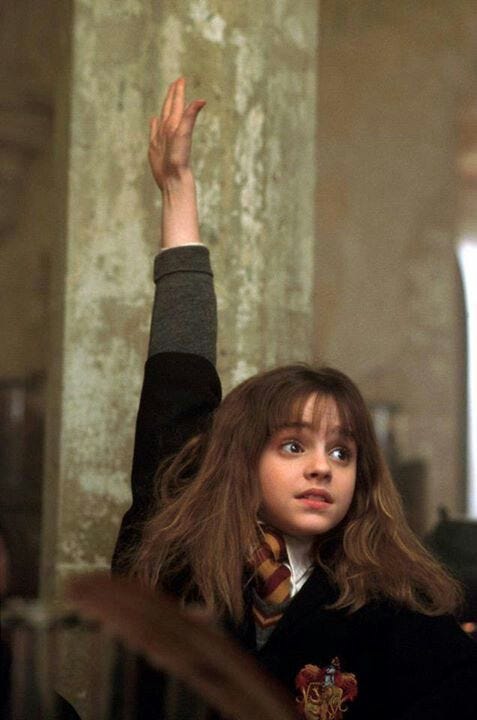
Hermione Granger is, by any reasonable measure, the most competent character in the Harry Potter series. She mastered spells years ahead of her classmates. She brewed the Polyjuice Potion at twelve. She manipulated time itself to save innocent lives. She spent the better part of Deathly Hallows holding their mission together—organizing the tent, managing the horcrux hunt, and healing Ron’s splinching—while Harry spiraled into depression and Ron occasionally wandered off.
The Hermione of the books is not a sidekick. She is, functionally, the operational brain of the entire operation. Rowling herself has said in interviews that Hermione is in many ways the character she identified with most. And yet, in the climactic scene of a seven-book series, she is essentially a bystander.
“Hermione was the one who had read every book, memorized every counter-curse, and anticipated every trap. She deserved to be standing in that moment—not watching it.”
Imagine a rewrite. Imagine Rowling had restructured the final confrontation so that Harry’s sacrifice—his willingness to die—did exactly what it does in the original: it neutralized Voldemort’s power over him, it protected the survivors, and it fulfilled the ancient magic. But what if his survival, and the final blow, required Hermione?
How it might have worked
This is not a simple swap. You cannot just replace “Harry” with “Hermione” and call it a day. The emotional architecture of the ending depends on whose story is being completed. A Hermione-centric finale would require rethinking not just chapter thirty-six but also the thematic spine of the final book—possibly the final two.
But here is one version that could work.
Harry, having walked into the forest and died—or nearly died—returns, but in a diminished state. The Horcrux inside him is destroyed. He is himself again, fully human, no longer a vessel. But in this version, that makes him less capable of defeating Voldemort, not more. His sacrifice has purged him of the dark tether. He is free. But he is also, in some magical sense, spent.
Voldemort, sensing this, moves in for the kill.
And it is Hermione—who has been researching, always researching, who found the loophole in the horcrux magic, who understood the Elder Wand’s history better than anyone—who steps forward with knowledge that Harry, in his exhausted, traumatized state, could not have accessed. Not power. Not strength. Knowledge deployed at the exact right moment, in the exact right form.

She does not overpower Voldemort. She out-thinks him. She sees the flaw in his arrogance — the same flaw she has been pointing out for six years, to anyone who would listen — and she exploits it.
· · ·
What does this change thematically
The original ending argues that love conquers all. Harry’s capacity for love — his mother’s sacrifice, his own willingness to lay down his life — is the magic that Voldemort cannot understand or counter. It is an ending that rewards emotional intelligence and selflessness.
A Hermione ending would not contradict this. But it would add a second argument: that knowledge and preparation and relentless effort matter too. That the girl who was told she was “insufferable” for reading too much, who was mocked for knowing the answers, who was underestimated by nearly every villain in the series — she was the one who actually ended it.
There is something genuinely radical about that. Not radical in a forced, agenda-driven way, but radical in the way great literature occasionally is: quietly, inevitably, and, in retrospect, obviously.
Rowling spent seven books telling us Hermione was the smartest person in the room. An alternate ending would simply have taken her at her word.
The question of Harry
None of this erases Harry. In this version, his sacrifice remains the turning point. The series is still, fundamentally, his story — his loss, his love, his lightning bolt scar. He is the boy who lived. He walked into death willingly. That is not diminished.
What changes is the final act. In theater, there is a useful distinction between the protagonist — whose internal journey drives the story — and the hero — who performs the climactic action. In most great stories, these are the same person. But they do not have to be.
Harry could remain the protagonist of seven books while Hermione delivers the final blow. His arc — from orphan to sacrifice — completes exactly as written. Her arc — from eager student to the woman who saved the wizarding world — completes with something closer to the weight it deserves.
Why didn’t Rowling write it?
Rowling is not an arbitrary writer. Every structural choice in the series was made for a reason. Harry kills Voldemort because the series is Harry’s story. After all, the prophecy named him, and the narrative logic demanded it.
But prophecies are interesting things in fiction. They tend to create the very outcomes they predict, because the characters believe in them. Voldemort chose Harry because of the prophecy. Dumbledore shaped Harry’s entire life around the prophecy. The wizarding world’s understanding of the war was filtered through it.
And yet — prophecies in Rowling’s world are notoriously ambiguous. Dumbledore himself admits this. “It is our choices, Harry, far more than our abilities, that show what we truly are.”
What if the choice, in the end, had been Hermione’s?
“The prophecy said ‘neither can live while the other survives.’ It said nothing about who would be standing there when Voldemort fell.”
A different series, same magic
There is, in the end, no perfect version of this story. The one Rowling wrote is the one she wrote, and it is extraordinary. Seven books of accumulating mythology, complex morality, and genuine emotional weight. The ending she chose serves the themes she spent years building.
But the exercise of imagining otherwise is not ingratitude. It is the deepest form of engagement a reader can offer a book: to love it enough to wonder what else it might have been.
Hermione Granger, the brightest witch of her age, who once said, “I hope
메타데이터
- post_id
- 1fa9e00e98ce
- slug
- what-if-hermione-killed-voldemort-1fa9e00e98ce
- url
- https://medium.com/@mahaalshamari2004/what-if-hermione-killed-voldemort-1fa9e00e98ce
- canonical_url
- https://medium.com/@mahaalshamari2004/what-if-hermione-killed-voldemort-1fa9e00e98ce
- author_url
- https://medium.com/@mahaalshamari2004
- status
- ok
- fetched_at
- 2026-06-09 14:34:10