Ghostly Green Travelers: Why Some Comets Glow Like Space Kryptonite
Green comets are not common. Comets in bluish white colours are much more seen. Usually, when a comet decides to drop by our neck of the…
Ghostly Green Travelers: Why Some Comets Glow Like Space Kryptonite
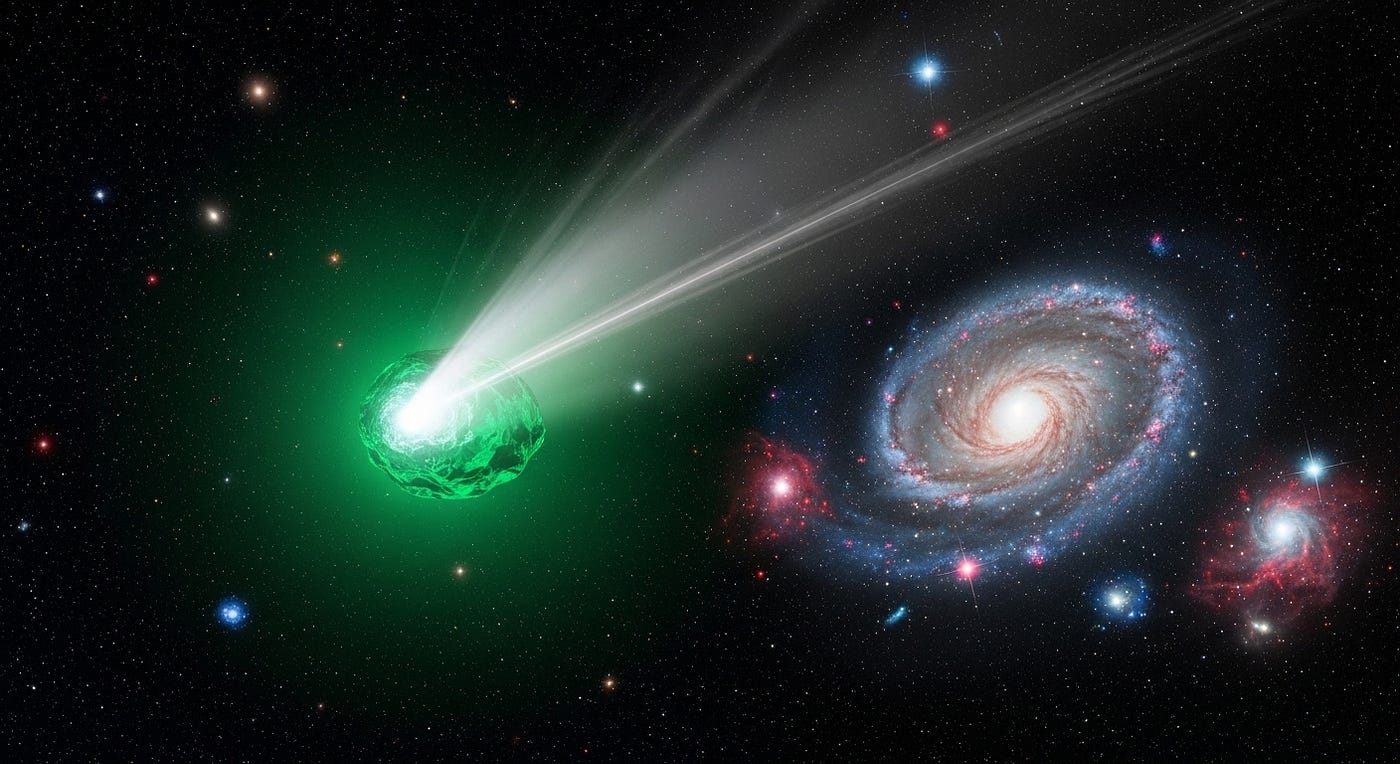
Digital artist’s impression of a Green Comet Travelling In outer space
Green comets are not common. Comets in bluish white colours are much more seen. Usually, when a comet decides to drop by our neck of the woods, it looks like a fuzzy white smudge or a streaky blue ghost. But every once in a while, a comet shows up looking like it’s ready for a St. Patrick’s Day parade or a starring role in a sci-fi flick.
So, why the sudden wardrobe change? Why does a “dirty snowball” suddenly start glowing like a radioactive lime?
The Secret Sauce: Diatomic Carbon
The culprit behind this cosmic glow-up is a molecule called diatomic carbon (or C2 if you want to get fancy). It’s basically two carbon atoms stuck together, and it’s a total rebel. On Earth, you won’t find it hanging out in your backyard because it’s way too unstable. But in the cold, lonely vacuum of space? It’s thriving.
Here’s how the magic happens:
- The Big Melt: As a comet gets cozy with the Sun, its icy nucleus starts to sizzle and vaporize.
- The Breakup: Sunlight hits the organic “gloop” coming off the comet and smashes it into smaller pieces. One of those pieces is our friend, C2.
- The Glow: When UV rays hit C2, the molecule gets “excited” (literally, its electrons jump to a higher energy level). When it settles back down, it spits out that energy as bright green light.
“Live Fast, Die Young”
You might notice something weird in photos of famous green comets, like the “Great Green Comet” (C/2022 E3 ZTF): the “head” (the coma) is a brilliant emerald, but the tail is usually a boring white or faint blue.
Why doesn’t the green color stretch out into a long, majestic ribbon?
Since C2 is essentially the “rock star” of molecules — it lives fast and dies young. The same sunlight that creates C2 is also trying to kill it. Within about two days of being born, the UV radiation from the Sun rips the two carbon atoms apart. This process, called photodissociation, happens so fast that the green molecules never actually make it out into the tail. They vanish before they can finish the trip!
The Verdict?
What you get is a comet that looks like a glowing green eyeball screaming through the void, trailing a white dusty cape behind it. It’s a temporary, beautiful chemical reaction that reminds us space isn’t just a big empty room — it’s a giant, chaotic laboratory.
The next time you hear about a “Green Comet” passing by, grab some binoculars. You’re literally watching the Sun tear apart space-carbon in real-time. Pretty metal, right?
Thanks for reading. If you like this type of articles, please consider supporting the writer through Medium membership subscription. Thanks.
메타데이터
- post_id
- 1fae4d74175a
- slug
- ghostly-green-travelers-why-some-comets-glow-like-space-kryptonite-1fae4d74175a
- url
- https://medium.com/@tuas8787/ghostly-green-travelers-why-some-comets-glow-like-space-kryptonite-1fae4d74175a
- canonical_url
- https://medium.com/@tuas8787/ghostly-green-travelers-why-some-comets-glow-like-space-kryptonite-1fae4d74175a
- author_url
- https://medium.com/@tuas8787
- status
- ok
- fetched_at
- 2026-07-13 06:23:13