The Right Argument About AI and the Environment
A consultant’s case for the honest middle, with the numbers checked.
The Right Argument About AI and the Environment
A consultant’s case for the honest middle, with the numbers checked.
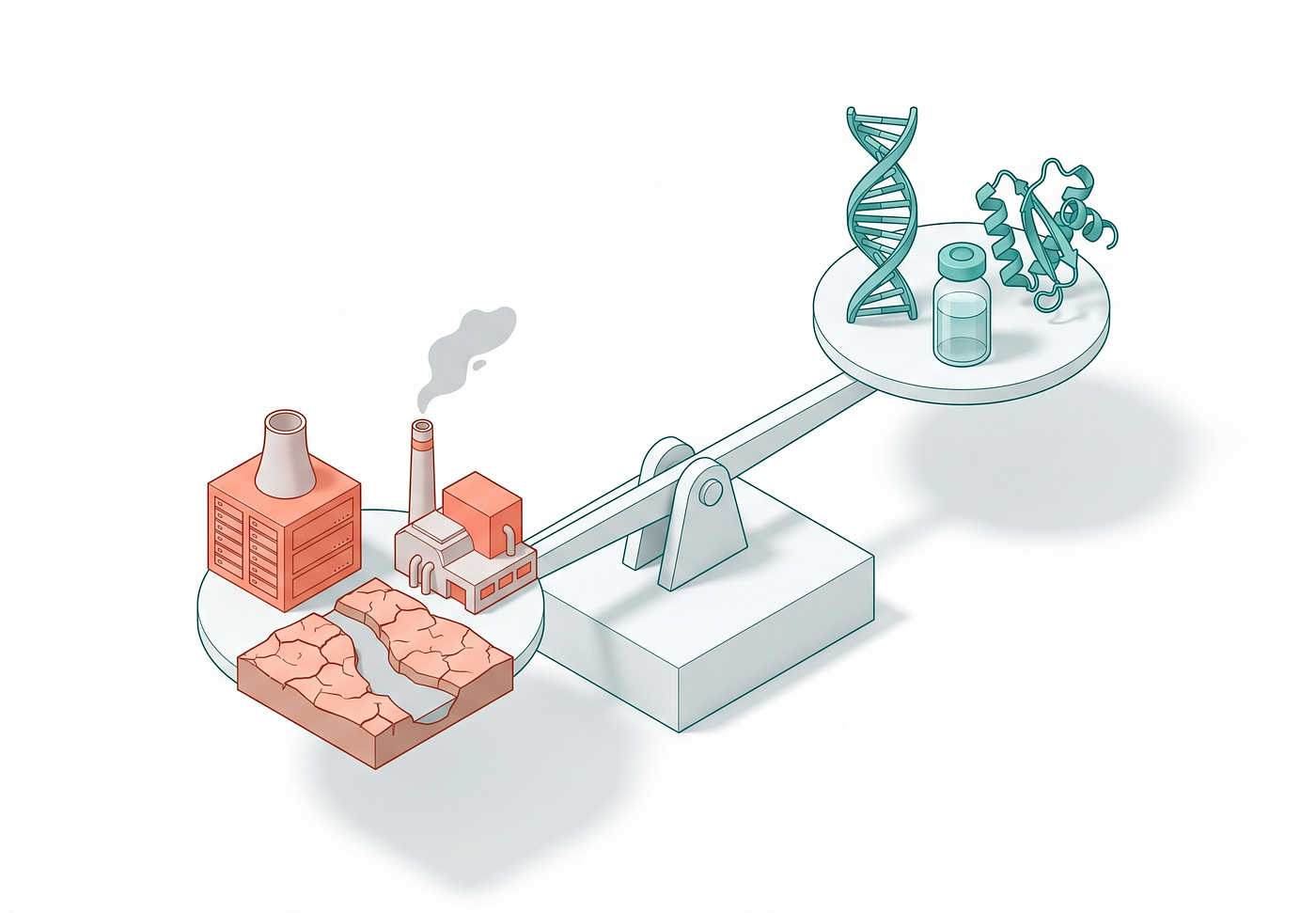
The water panic is mostly the wrong fight. The energy concern is real but regional and partly phantom. The genuinely hard problem is the fossil lock-in being built for speed. And the benefits are real, Nobel-validated, and concentrating in fewer hands every quarter. A consultant’s case for the honest middle, with the numbers checked.
https://www.youtube.com/watch?v=JzlPbEGJ4F0
I sit in the middle of this. I help organizations actually deploy AI, which makes me a middleman between the technology and the people who use it, and middlemen have a specific obligation: to carry the right argument in both directions. Not to defend AI, not to apologize for it, but to be precise about what is true.
The environmental backlash against AI is coming, and in many places it has already arrived. Over the next year or two it will get louder, and the people in it deserve real numbers instead of viral ones. The trouble is that the loudest version of the argument is usually wrong, and the wrongness cuts both ways. “The town next to the data center has no water” is the wrong frame for a real concern. “It is just a teaspoon of water per query, relax” is the wrong dismissal of a real cost. Both are lazy, and both make the actual problem harder to fix.
So this is the honest version, sorted into three buckets that I will come back to the whole way through:
- Inherent to compute. Electricity demand, and the water consumed generating that electricity. Real, large, and unavoidable in the aggregate.
- An engineering or siting choice. Evaporative cooling in a desert, gas turbines bolted on to dodge a permit, building in a water-stressed basin. Avoidable, and fixable with known techniques.
- A pre-existing utility or policy failure that AI amplified. Broken grid-connection queues, opaque rate design, groundwater that was already overdrawn. AI is pouring new demand into systems that were failing before it showed up.
Almost everything that makes people angry sits in buckets two and three. Keep that in mind and the whole picture reorganizes.
Three things to take away:
- The water panic is mostly the wrong fight. It is nationally negligible, locally acute, and almost always a siting and transparency failure rather than a property of computing. The water you protest at the cooling tower is the smaller share; the larger share is the power plant. And the same workload can use thousands of times more or less water depending on where and how you build it, which means “thirsty AI” is a decision, not physics.
- The real, hard, irreversible problem is the fossil infrastructure being committed for speed. A gas-turbine order book booked out to 2030, coal retirements being stalled, gas plants built on multi-decade lifespans, much of it underwritten by ordinary ratepayers against demand the utilities themselves admit may be partly fictional. Most of it is avoidable, which is exactly what makes it a policy failure being poured into concrete.
- The benefits are real and underdiscussed, and they are concentrating. Nobel-validated science, a screening trial that caught more cancers, the first AI-designed drug through a positive mid-stage trial, AI weather forecasts running at a national agency. The uplift is genuine. It is also being captured by a few firms, a few countries, and the already-skilled, and that gap is widening.
The water argument is mostly the wrong argument
Start with water, because it is where the discourse is worst and the correction is cleanest.
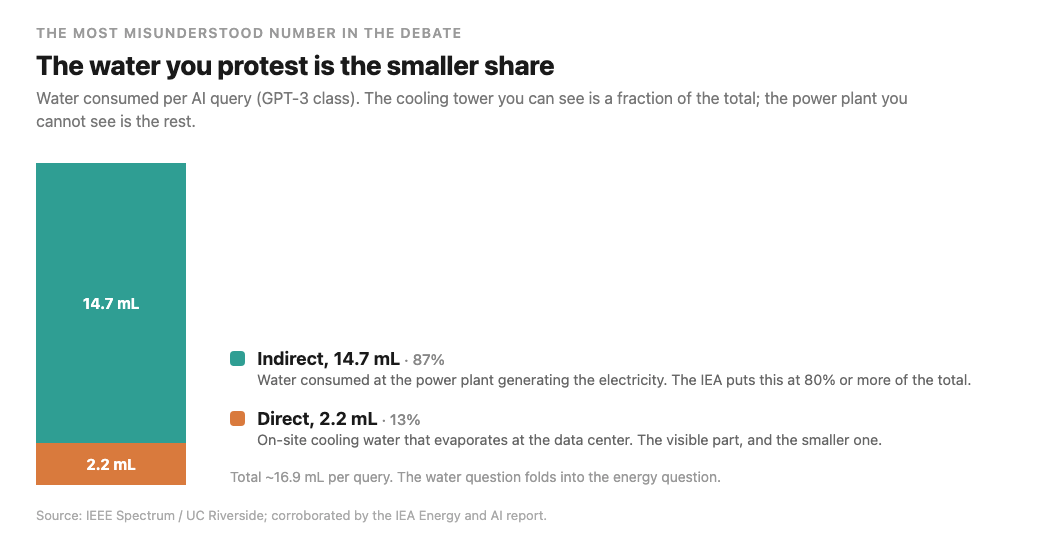
The number almost everyone gets wrong is the split between direct and indirect water. When a data center cools its servers, some water evaporates on site. But the electricity it draws was generated somewhere else, and thermal power plants consume water too. For a single GPT-3-class query, researchers estimate roughly 2.2 millilitres of on-site cooling water and about 14.7 millilitres consumed generating the power, so the indirect share is 80 percent or more of the total. The cooling tower you can see and protest is the smaller part. The bigger part is the grid, which folds the water question back into the energy question.
The intensity varies so much by design that it cannot be inherent. Peer-reviewed work from Lawrence Berkeley National Laboratory found water intensity ranging across roughly four orders of magnitude depending on the facility. Inside a single company, Microsoft’s self-reported water-use effectiveness runs from 1.52 litres per kilowatt-hour in Arizona to 0.02 in Singapore, and an air-cooled design uses no cooling water at all. In December 2024 Microsoft announced a closed-loop design that targets zero water for cooling. If the same computation can use thousands of times more or less water depending on where and how you build it, then thirst is a siting and engineering choice. That belongs in bucket two.
At national scale the volume is small. At local scale it can be acute. US data centers consumed roughly 17 billion gallons of water directly in 2023, about 0.3 percent of public water supply. The IEA puts global data-center water consumption at around 560 billion litres in 2023, rising toward 1,200 billion litres by 2030. Those aggregate figures kill the idea that AI is draining a country’s water. The real argument lives in specific places, so let me go to the specific places.
The one town that genuinely ran on data-center water is The Dalles, Oregon. Google’s water use there rose to about 355 million gallons in 2021, roughly 29 percent of the city’s total consumption, a figure that only became public after The Oregonian sued and the city settled. This is the strongest “town ran dry” case there is, and notice what it actually is: a siting choice (evaporative cooling in a place where water is contested) compounded by a transparency failure (the secrecy is what fueled the backlash). It is a real cautionary tale. It is still not evidence that computing is inherently thirsty.
The flashpoint cases that went viral are mostly the data center as lightning rod, not cause. In Maricopa County, Arizona, data centers used about 905 million gallons in 2025, which is 0.12 percent of the county’s daily water, while golf courses use roughly thirty times more. The crisis there is Colorado River decline, agriculture, and groundwater overdraft, all of which predate AI. In Uruguay in 2023, Google’s original design would have drawn about 7.6 million litres a day of potable water during the worst drought in 74 years, and the protests (“no es sequía, es saqueo,” it is not drought, it is plunder) led to an approved redesign that switched to air cooling, which again proves the demand was a choice. In Chile, the most dramatic viral number turned out to be a roughly 1,000-fold unit error, confirmed and publicly corrected by the journalist who first reported it; the real figure is material but not apocalyptic, and Google again redesigned to air cooling. In Spain, Meta’s Talavera project plans around 504 million litres a year, roughly 8 percent of the town’s consumption, drawn mostly from the stressed Tagus basin, under the banner “tu nube seca mi río,” your cloud dries my river.
In every one of those cases, agriculture and ordinary municipal use dwarf the data center. The data center is new and visible, so it becomes the target. The legitimate concern, siting a thirsty design in a stressed basin, is real and gets buried under a causal story that is wrong.
The one systemic water finding that holds is about siting, and it is self-inflicted. Bloomberg’s analysis found that about two-thirds of US data centers built or in development since 2022 sit in high-water-stress areas, with five states holding 72 percent of them. That is the strongest water indictment available, and it is an indictment of where the industry chooses to build, not of computing itself. It is fixable with closed-loop and air cooling, reclaimed water, and better siting. Bucket two, again.
A note on the numbers you should not repeat. Sam Altman’s widely shared 0.32 millilitres per query is self-reported, unaudited, and counts only direct cooling, so quote it as a company claim and never as a verified fact. The “bottle of water per email” figures usually trace to a Washington Post collaboration with UC Riverside describing an oversized 100-word request, not a typical query. And xAI’s Memphis site draws roughly 3 million gallons a day currently, not the 13 million that gets cited, which is the campus peak design capacity. Precision matters most exactly where the topic is hottest.
Energy is where “inherent to AI” bites
Water mostly reorganizes into energy, so this is the bucket-one core of the whole story, and it deserves the same discipline.
The doubling is real. “AI is eating the grid” is not. Data centers used about 415 terawatt-hours in 2024, roughly 1.5 percent of global electricity, projected to reach about 945 terawatt-hours by 2030, roughly 3 percent. The number that should reset the apocalyptic framing: data-center growth is less than 10 percent of global electricity demand growth to 2030. Electric vehicles, air conditioning, and industrial electrification lead. Globally, AI is a secondary driver. The crisis is regional, not planetary.
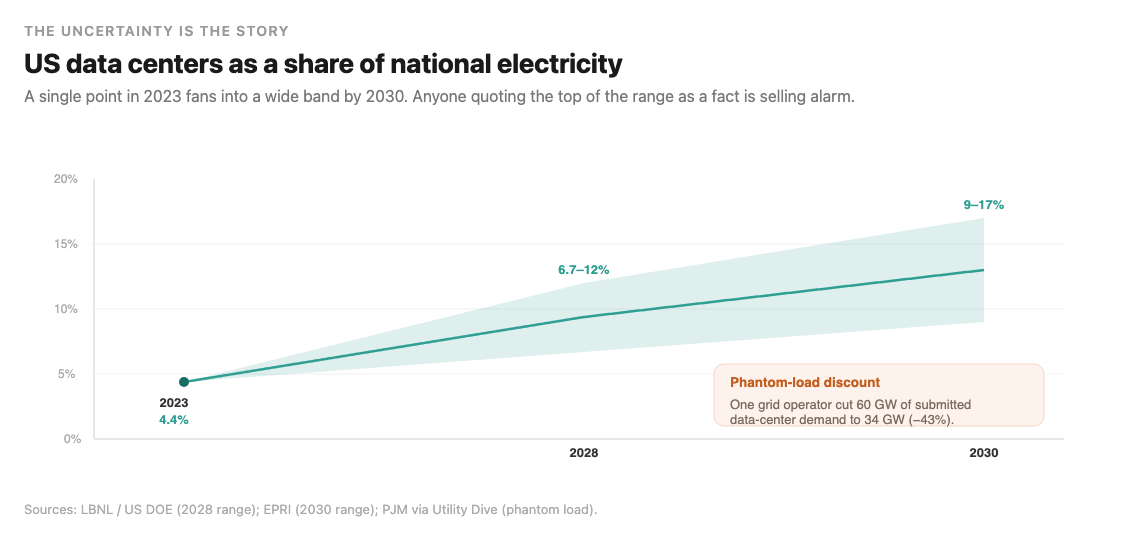
The US is the hotspot, and the honest signal is the range. US data centers were 4.4 percent of national electricity in 2023. Lawrence Berkeley projects 6.7 to 12 percent by 2028. EPRI’s 2026 update puts data centers at 9 to 17 percent of US generation by 2030, a low-to-high scenario range that also covers streaming and crypto, not AI alone. That two-fold spread is the finding. Anyone quoting the top of the range as a fact is selling alarm; the uncertainty is the honest story.
The scariest demand numbers are partly phantom. When developers shop a data center, they file interconnection requests with multiple utilities at once, so the raw totals double-count. PJM, the largest US grid operator, accepted only 34 of about 60 gigawatts of 2030 data-center submissions, a 43 percent cut. Utilities report that more than 70 percent of interconnection applications are eventually withdrawn. Texas’s grid operator saw its large-load queue balloon past 400 gigawatts, the vast majority data centers, and says itself that the figure is inflated by speculative requests. This cuts two ways at once. It undercuts the headline that AI will break the grid. And it is precisely why building thirty-year power plants against this demand is a trap.
The decisions made for speed that cannot be unmade
Here is the strongest, most defensible version of the environmental concern, and it is not the one on the placards. It is not that AI is thirsty. It is that irreversible fossil commitments are being made for speed, underwritten by ordinary people, against demand the utilities admit may be partly fictional.
Gas is winning the margin, and gas is a multi-decade commitment. The IEA expects natural gas and coal together to meet more than 40 percent of the additional data-center demand to 2030, with renewables roughly half. Named projects give it physical form: Meta’s Hyperion in Louisiana, a Microsoft and Chevron plant in West Texas, a Google and Crusoe site in North Texas. A gas plant needs a thirty-to-forty-year operating life to pay off. That is the lock-in mechanism made of steel.
The turbine backlog is committed capital through the end of the decade. GE Vernova’s gas-turbine backlog hit 100 gigawatts in early 2026, with about a fifth tied to data centers, and new orders do not deliver until late 2028 at the earliest, with slots projected sold out through 2030. A booked backlog at that scale is itself a form of locked-in capital. This is the hardest evidence that the fossil commitment is already made.
Coal retirements are slowing, partly to serve this demand. Only 2.6 gigawatts of US coal retired in 2025, the least since 2010, and the US Department of Energy has issued emergency orders stalling several gigawatts of planned retirements. This is the clearest “speed locks in fossil for decades” signal, with an honest caveat: the orders are a political choice layered on real demand, not a technical necessity of AI.
The worst single case is an outlier, and you have to say so. xAI’s Memphis site ran up to 35 gas turbines while permitted for 15, emitting an estimated 1,200 to 2,000 tons of nitrogen oxides a year, in a way that bypasses both the grid queue and emissions permitting. That is irreversibility and permitting failure in one place. But Microsoft and Google are not doing this. Treating xAI as representative would be the same error as “the town ran dry because of AI.” Name it as the exception it is.
The lock-in number, stated honestly, has an off-ramp. Cornell modeling estimates the behind-the-meter gas build-out could add 24 to 44 million metric tons of carbon dioxide a year by 2030, with up to roughly 73 percent of it avoidable through smarter siting and grid decarbonization. Even the lock-in is mostly avoidable, which means it is a policy and siting failure being made permanent by speed, not an inherent cost of compute.
And much of the gas may not be needed at all. Duke University modeling found that with modest flexibility, around two hours of curtailment, the existing US grid could absorb up to roughly 100 gigawatts of new load without building new generation. Treat that as a model rather than an observation, but the implication is decisive: if flexible-load rules could avoid a large share of new firm capacity, then much of the gas build-out is a self-inflicted market-design failure, not a physical necessity. Bucket three, writ large.
Who pays the bill
The harm that is already landing is not ecological, it is financial, and it falls on people who are not in the room.
The bill is real, and the cause is rate design. PJM’s capacity auctions, which pay generators to be available, cleared at record prices, jumping roughly nine-fold from about $28.92 to $269.92 per megawatt-day. PJM’s own independent market monitor attributes 63 percent of that capacity-price increase, around $9.3 billion, to data centers. In Virginia, Dominion has projected residential bills could climb substantially by the mid-2030s absent reform. Value is being privatized and cost socialized, and the mechanism is entirely reversible through rate design.
The counter-evidence belongs in the piece too. A study for Virginia’s legislature found no evidence of a historical cost shift from data centers to residential customers, while noting future upward pressure is likely. The widely cited advocacy figures of $100 billion or more in added costs are forward projections that assume price caps expire and nothing gets reformed. The honest framing is not “you are already subsidizing Big Tech,” it is “the rules currently allow that cost shift and oversight is weak,” and several states are already moving to fix it, including Virginia’s dedicated data-center rate class.
The asymmetry is the sharp edge. If the demand fails to materialize, and the phantom-load numbers suggest a chunk of it will, ratepayers can be left paying for grid upgrades and capacity committed under take-or-pay terms. The value goes to a few balance sheets; the risk sits with households. That is a contract and regulation problem, not a property of AI, which is exactly why it is fixable and exactly why it is worth fighting about precisely.
The other side of the ledger
To stay honest, the piece cannot only catalogue harm, because the same demand is also the largest force pulling clean energy forward.
AI and data centers drove a record 68 gigawatts of corporate clean-energy contracts in 2024, up 29 percent year over year, with data centers more than 17 gigawatts of that and roughly 60 percent of US corporate deals. AI is also reviving nuclear: Constellation is restarting Three Mile Island Unit 1, 835 megawatts, on a 20-year deal with Microsoft, targeted for 2027.
Both things are true at once, and the caveats are load-bearing. The Three Mile Island restart returns existing clean supply to the grid rather than adding new capacity, so the net climate gain is smaller than “new nuclear” implies. Small modular reactors deliver in the 2030s and do nothing for the 2026 to 2030 gap that gas is filling right now. AI is accelerating clean energy and locking in near-term gas. A serious account holds both.
The benefits are real, and they are underdiscussed
The environmental cost only means something weighed against what the compute actually buys, and the honest answer is that it buys more than pictures of Han Solo fighting gremlins. These survived fact-checking. The overhyped ones did not, and I dropped them.
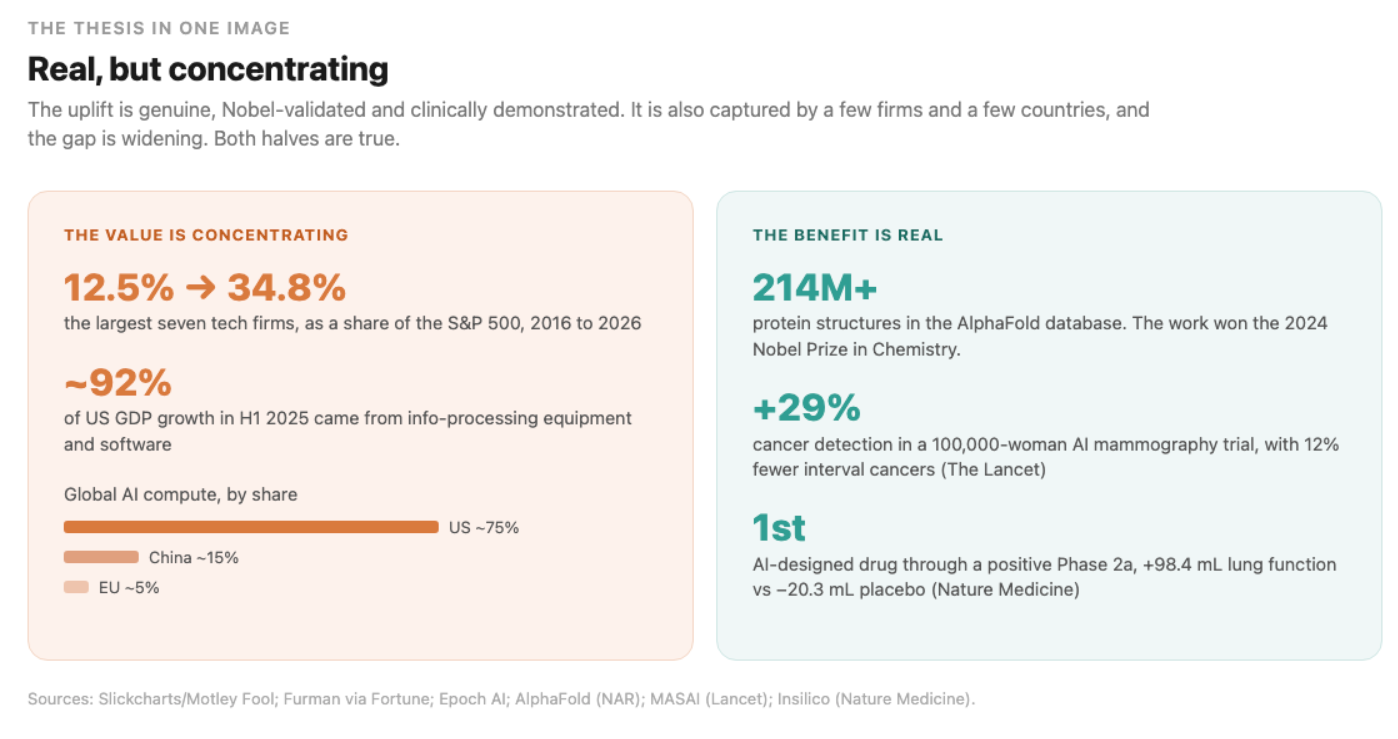
Protein structure is the most substantiated AI-for-science result. AlphaFold’s database now covers more than 214 million predicted protein structures, and the work won the 2024 Nobel Prize in Chemistry. Adoption runs to over a million researchers, including in low- and middle-income countries. The honest caveat: predictions are computational hypotheses, weaker for disordered regions and genuinely novel folds, not finished biology.
A screening trial actually changed patient outcomes. The MASAI randomized trial of around 100,000 women found that AI-supported mammography raised cancer detection by 29 percent with no rise in false positives, cut radiologist reading workload by 44 percent, and reduced interval cancers by 12 percent, with final results published in The Lancet in early 2026. That interval-cancer reduction, fewer cancers missed between screens, is the outcome that matters, and it comes from a prospective trial with patient endpoints, not an accuracy benchmark.
The first AI-designed drug posted a positive mid-stage trial. Rentosertib, whose target and molecule were both AI-generated, showed a 98.4 millilitre improvement in lung function against a 20.3 millilitre decline for placebo over 12 weeks in 71 patients with idiopathic pulmonary fibrosis, published in Nature Medicine. It is a genuine first-of-kind peer-reviewed readout. The caveats are equally real: small, short, single-country, Phase 2a, with Phase 3 still years out, and as of late 2025 zero AI-designed drugs are approved. Discovery acceleration is proven; clinical validation is not yet.
AI weather forecasting already left the lab. The European Centre for Medium-Range Weather Forecasts put its AI forecasting system into operational service in 2025, with gains of up to 20 percent on measures like cyclone tracks. A national meteorological agency now runs AI forecasts around the clock, which is the strongest “this is real and deployed” signal in the whole catalogue, with direct public benefit in extreme-weather warning.
One discipline note, because it is the same discipline as the water section. The MIT study claiming a 44 percent jump in materials discovery was withdrawn after the institution disavowed it. The “millions of new materials” headline for GNoME is better described as predicted stable structures, since independent chemists found little evidence the predictions meet tests of novelty and usefulness. And the impressive 97.2 percent figure for one AI weather model is a win rate across many targets, not “97 percent more accurate.” The benefits are strong enough that they do not need the inflated versions, and using the inflated versions is how you lose the argument.
Real, but concentrating, and the gap is widening
Here is the part I am most worried about, because it is the one the benefits section can be used to paper over. The uplift is genuine. It is also being captured narrowly, and both halves of that sentence carry weight.
The growth is riding on one narrow sector owned by a handful of firms. Information-processing equipment and software, about 4 percent of US GDP, accounted for roughly 92 percent of US GDP growth in the first half of 2025; strip that category out and growth would have been near 0.1 percent annualized. The largest seven tech companies reached 34.8 percent of the S&P 500 by mid-2026, up from 12.5 percent a decade earlier. Nvidia’s top four customers are about 61 percent of its revenue. The economic upside is concentrating into a few balance sheets, and that is not an interpretation, it is the arithmetic.
The uplift skews to the already-skilled and the already-strong. Productivity growth in AI-exposed industries rose from 7 percent to 27 percent over recent years, AI-skilled workers command a large wage premium, and heavy-adopting firms show higher employment and sales growth. These are correlational and partly industry-sourced, so the right reading is “the AI-skill gap is large and widening,” not “AI hands you a raise.” Within economies, large incumbents pull ahead of smaller firms, which mirrors the divide between countries.
The early-career squeeze is a real early signal. Stanford researchers found workers aged 22 to 25 in AI-exposed jobs saw a 13 percent relative employment decline since late 2022, around 20 percent for entry-level software, while older workers in the same roles grew. It is a relative decline in specific cohorts, not economy-wide job loss, and the causal leap to AI rather than the broader tech contraction is contestable. But it is exactly the kind of early signal that gets ignored until it is a movement.
The honest macro counterweight is sobering in a different direction. The economist Daron Acemoglu estimates aggregate productivity gains over ten years are unlikely to exceed about 0.66 percent in total, since only a fraction of tasks are exposed and only a fraction of those are profitably automatable now. That is the strongest case that the uplift may be concentrated precisely because it is modest and captured, not large and shared.
The global divide is the starkest axis. Only about 32 countries host AI data centers, and the US and China operate more than 90 percent of the specialized ones. By one independent measure the US controls roughly 75 percent of global AI-supercomputer compute, China about 15 percent, the EU about 5 percent. The UN Development Programme warns this could open a new era of divergence. Cloud rental softens the picture, since you do not need a domestic data center to use the models, but the gaps in sovereignty, cost, latency, and capacity are real, and Africa holds well under 1 percent of global AI compute.
The right argument
Put the buckets back together and the shape is clear.
The water panic is mostly the wrong fight: nationally negligible, locally acute, and almost always a siting and transparency failure rather than a property of computing. The Dalles is the one clean cautionary case. Chile is the one clean clickbait case.
The energy concern is real but regional, and the demand numbers themselves are partly phantom, which should lower the temperature and sharpen the aim at the same time.
The genuinely hard, genuinely irreversible problem is the fossil lock-in being built for speed: turbine backlogs booked through 2030, coal retirements stalled, gas plants on multi-decade lives, much of it underwritten by ratepayers against demand utilities admit may not arrive. Most of it is avoidable, which is what makes it a policy failure being poured into concrete rather than a law of physics.
And the benefits are real, Nobel-validated, clinically demonstrated, and operationally deployed, but they concentrate in a few firms, a few countries, and the already-skilled, and that gap is widening.
People are going to turn on AI harder, and soon. When they do, the job of anyone who sits in the middle of this, consultant or engineer or policymaker or reader, is to carry the right argument: not “AI is destroying the planet,” and not “it is just a teaspoon of water,” but a precise account of which costs are inherent, which are choices, and which are failures we already know how to fix. It is not all bad and it is not all good. That is what progress has always looked like up close. The rich, important work is in the middle, and the middle is where the arguments that actually change anything get made.
Marco Kotrotsos, specializing in practical AI implementation for organizations ready to close the gap between AI hype and AI value. With 30 years of IT experience now focused purely on AI deployment, he works hands-on with companies to turn AI potential into measurable business outcomes.
This article is published in Autocomplete, a Medium publication about real-world AI for practitioners and decision-makers. We’re always looking for writers. If you’re building with AI and have something worth sharing, reach out.
My free Substack newsletter, also called Autocomplete, can be found here: https://acdigest.substack.com.
My books on Amazon: Claude Code for Everyone Else and From Vibe to Production.
메타데이터
- post_id
- 1fd1bab0f23b
- slug
- the-right-argument-about-ai-and-the-environment-1fd1bab0f23b
- url
- https://medium.com/autocomplete-real-world-ai/the-right-argument-about-ai-and-the-environment-1fd1bab0f23b
- canonical_url
- https://medium.com/autocomplete-real-world-ai/the-right-argument-about-ai-and-the-environment-1fd1bab0f23b
- author_url
- https://medium.com/@kotrotsos
- status
- ok
- fetched_at
- 2026-06-15 20:49:13