The Foolish Gospel: Chapter 2: Eden Lost, Eden Restored
The Lord made Eden the most holy place at the center of His world — a sacred space where Adam and Eve could walk with God, share in His…
The Foolish Gospel: Chapter 2: Eden Lost, Eden Restored
[embed]ElevenLabs
The Lord made Eden the most holy place at the center of His world — a sacred space where Adam and Eve could walk with God, share in His life, and rule alongside Him in joyful relationship.
The opening chapters of Genesis show us a God who delights in order. When God creates order, creation thrives and flourishes as He intended. Eden stood at the center of that ordered world. And in the very center of Eden stood two trees that would shape everything that followed.
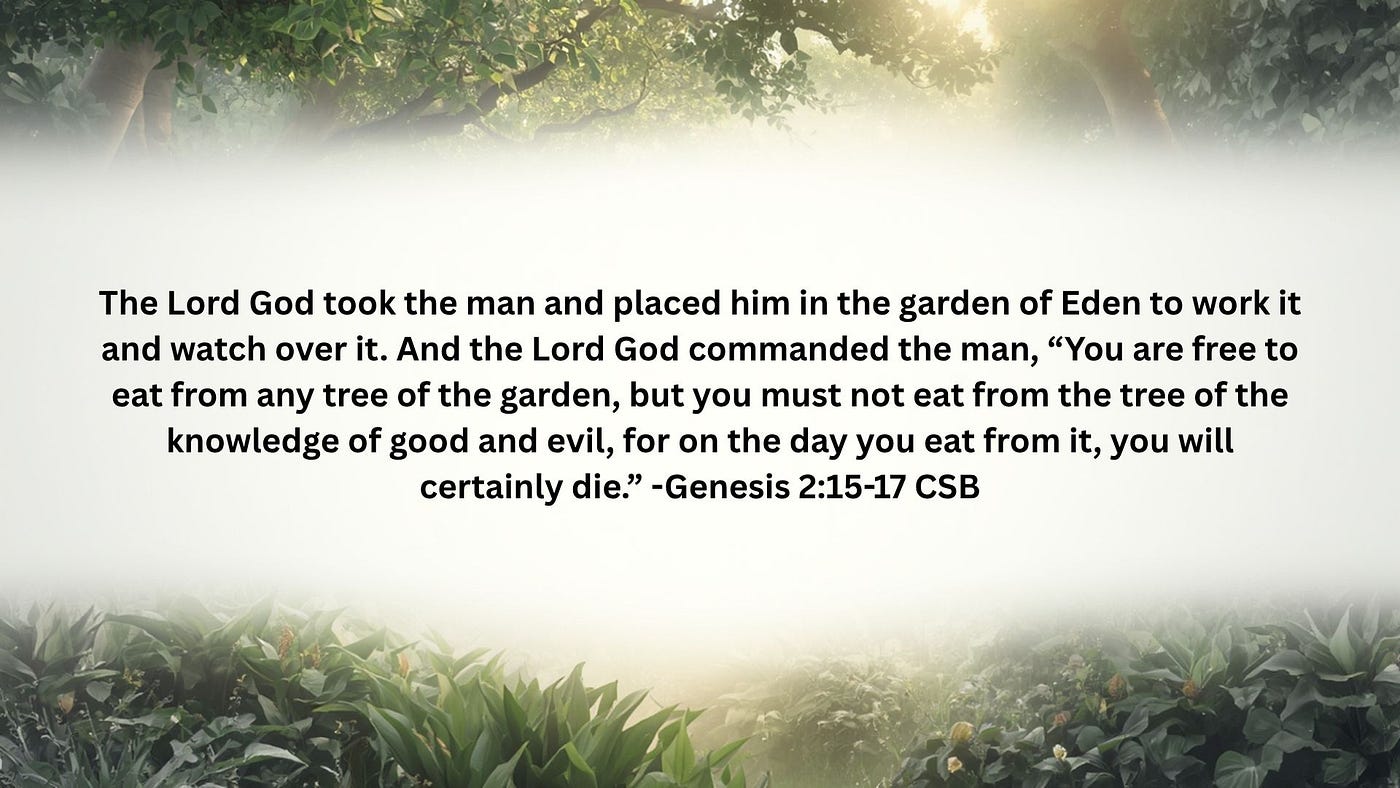
One was the tree of the knowledge of good and evil. The other was the tree of life. God gave humanity one simple command: they were not to eat from the tree of the knowledge of good and evil.
Genesis 3 opens with a chaos creature — a serpent — slithering into the garden. His first move is to undermine God’s word. He twists what God had said, plants seeds of doubt, and deceives Eve. She eats from the tree of the knowledge of good and evil, then gives some to Adam, and he eats as well.
In that single act of disobedience, everything changed. Their eyes opened, and they felt exposed and ashamed. They sewed fig leaves together and hid from God. When God comes looking for them and asks what they have done, the consequences unfold. God sent Adam and Eve out of the garden, away from the Tree of Life. He cursed the serpent to crawl on its belly and eat dust.
That was the quick version of what happened.
Canva
But there is much more going on here than a simple morality tale. Let’s slow down and process what just happened.
Eden was the place where humanity walked with God, talked with God, and shared in His life together. It was the spot where God made His home with us. Eden stands as the Bible’s first temple — the original holy place where heaven and earth overlapped in perfect communion.
Ancient Israel later gave this reality symbolic expression in the tabernacle and, centuries afterward, in the Temple. Cherubim guarded the entrance to the Most Holy Place, just as they guarded the way back to Eden. Inside stood the golden lampstand, its branches and almond blossoms echoing the Tree of Life. Yet these structures were only shadows. After Eden, humanity no longer walked in that same unhindered intimacy. Instead, people related to God through commands and covenants, always reaching toward a closeness they had lost.

Canva
Jesus brought Eden back to us.
The holy place of God is no longer a distant garden or a tent in the wilderness. Through His death and resurrection, the living God has made His home inside every believer. If you belong to Christ, the Holy Spirit lives in you. You are now Eden. (John 14:23; 2 Corinthians 6:16–18)
Even the name carries wonder. In Hebrew, “Eden” means pleasure or delight. When the early church translated the Old Testament into Greek, they often rendered “Eden” with the word paradise. That is no minor detail.
Paradise is within you.

Canva
The serpent in the garden was a chaos creature.
God creates order, and He created humanity to partner with Him in that ordering work. A chaos creature is anything that disrupts, twists, or brings disorder into God’s beautiful world. Behind this serpent stood a far darker intelligence. This was no casual conversation in the shade. The stakes were enormous.
Satan himself conceived the scheme of a talking snake deceiving the woman, and he carried it out. In deceiving Eve, he deceived the universe. Scripture calls that ancient serpent “the devil and Satan, who leads the entire world astray” (Revelation 12:9; see also 20:2).

Canva
Adam and Eve were two real individuals, but they also represent all of us. In them, we all fell. Their very names carry this truth. The name “Adam” means man or humanity. Translators translate the same Hebrew word as either “Adam” or “man” depending on the context. Adam named his wife “Eve,” which means life, because she would become “the mother of all living.”
Why were the stakes so high? On the surface, the tree of the knowledge of good and evil doesn’t seem that dangerous. After all, God later encourages His people to grow in wisdom and understanding (see Proverbs and Ecclesiastes). The real problem wasn’t knowledge itself. It was seeking knowledge apart from God.
The full name of the tree — “the tree of the knowledge of good and evil” — is long and clunky on purpose. It hints at something deeper: autonomy. The serpent captured it when he said, “You will be like God, knowing good and evil” (Genesis 3:5).
Notice the difference: “like God” is not the same as “with God.” One is independence (“I will figure this out on my own”). The other is intimate dependence.
As soon as they ate, their eyes were opened. They now had knowledge — but they had lost the with-God life.
God had forbidden them from eating from this tree. He warned them: the day they ate from the tree of the knowledge of good and evil, they would die.
For a long time, many Christians have understood this as when biological death entered the world for humans and animals. That may very well be true. However, there are a couple of important considerations that should give us pause.
First, plants were already experiencing biological death and decay long before this moment. Adam and Eve were eating fruit and other plants. Why single out biological death for humans and animals as the major consequence?
Second, when Christ came to restore eternal life (Romans 5:21), He did not restore endless biological life on this earth. We still die physically. The life He offers is something deeper.
Death, at its core, is separation. Biological death is the separation of the soul from the body. Biological life is the soul’s attachment to the body.
The death Adam and Eve experienced that day was not biological. It was a far deeper separation — they were cut off from the Tree of Life. That tree symbolized an ongoing relationship with God and the continual impartation of His own life and nature.
In Eden, real life was defined by attachment to God. It was only by remaining in that relationship that Adam and Eve could have grown into the God-like beings they were created to become.
Imagine a sixteen-year-old named Oscar who dreams of becoming a professional sprinter. He faces two choices.
Option A is a thick, comprehensive book filled with every detail about proper sprinting form, training methods, and the history of great runners.
Option B is a personal friendship and ongoing coaching relationship with Usain Bolt, the man who holds the world records in the 100m and 200m.
If Oscar chooses Option A, he will gain enormous knowledge about how to sprint. But he will be on his own to actually do it. This is like the tree of the knowledge of good and evil.
If Oscar chooses Option B, he gains a wise guide who has already walked the road. Bolt can encourage him on hard days, correct his form, help him choose the right training, and walk with him through the long process of becoming the best runner he can be. This is like the tree of life.
Of course, the analogy breaks down here because God is perfect. He never gives bad advice. He never mistreats his friends, and the stakes are higher than any Olympic record.
Both trees offered a path toward becoming more God-like — but they led in opposite directions.
The tree of the knowledge of good and evil gave Adam and Eve an immediate, dangerous god-likeness: the power to decide for themselves between good and evil. They became “like gods,” autonomous and independent.
The tree of life offered a different path — slower, relational, and far better. By partaking of it, they would have grown more and more like the one true Creator God, not by seizing control, but by deepening their attachment to Him.
God sent Adam and Eve out of the garden to live in the world on their own, now left to implement the knowledge they had seized.
He did not curse them. God cursed the serpent to crawl on its belly and eat dust. God also cursed the ground because of them, saying, “Cursed is the ground because of you” (Genesis 3:17).
This was a terrible consequence. To live in a world where God is no longer in direct charge, where humanity must now try to navigate life by its own knowledge and strength, is a heavy burden. Adam and Eve were on their own.
The woman would now face the risk and pain of childbearing in a dangerous, hostile world. During the most vulnerable season of her life, she would have to depend on the strength and protection of others — especially her husband — to keep her and the child safe.
This is what God meant when He said, “I will increase your pains in childbearing; with painful effort you will give birth to children. Your desire will be for your husband, and he will rule over you.”
Adam would now work the ground under constant stress and hardship. “By the sweat of your brow you will eat your food,” God told him.
Because Adam represents all of us, this curse falls on humanity. When we try to live by our own knowledge and strength — alienated from God — life becomes exhausting and futile. We cannot follow the rulebook on our own. The disorder we see in the world is a constant reminder of our failure. Creation itself groans under this weight. As Paul later wrote, “the creation was subjected to futility…” (Romans 8:20). Death now reigns where life with God was meant to flourish.
But that is not how the story ends!
The Fall shows us our desperate need. We need access to God’s life again, and thank God — we have it. His name is Jesus Christ.
Earlier, I compared the heart of a born-again believer to a new Garden of Eden. Now we can say the indwelling Holy Spirit is the new Tree of Life planted inside that heart. We have access once more, and can live attached to Christ. We can live in Him. (Romans 5:12–21)

Canva
The world — and even many religious institutions — continues to offer us the tree of the knowledge of good and evil. It comes in one of two forms: “Make your own rules and live as you please,” or “Here are the rules — follow them.” Both paths fail because both cut us off from God and lead to chaos.
The key to real life — the only life that matters — is attachment to God. In the light of eternity, attachment to our biological bodies for as long as possible is far less important than we think.
To listen to the Tree of Life inside requires a few conscious choices.
Slow down. Talk with God and sit in contemplative silence, paying attention to what He presses on your heart. Read the Scriptures with this same expectant mindset — not looking for rules to follow, but watching to see what God wants to show you.
Whatever you do, don’t turn this into another legalistic chore. That never works. It just becomes one more rule to keep.
Come to prayer and Scripture in a hungry state. Come with honesty:
“I am hungry for real life. I’ve tried the knowledge game on my own, and it doesn’t work. It’s time for the real thing. Help me know Christ.”
This may sound simple, but it works far better over time than just following rules.
Imagine an older couple who have enjoyed a long, joyful marriage. They know each other so well they can finish one another’s sentences. They think alike, rarely need to ask clarifying questions, and even when they disagree, they know how to handle each other with grace and understanding. Their closeness didn’t come from following a list of commands. It came from decades of relational attachment — living life together, day after day.
Now imagine the opposite: they share a house but rarely speak. Each posts a list of rules on the fridge for the other to obey. Do you think that kind of marriage would last? Of course not. It would either end in divorce or become a cold marriage of mere convenience.
It is like that with Jesus.
The relational attachment to God is available to you right now through the Holy Spirit. But the serpent is still calling out from the other tree. He whispers in his seductive way, “Come here… look at this… it’s tasty.”
He is loud in our world. So loud that our default setting is to rush through life like we’re being swept down a fast river current, grabbing whatever “fruit” we can reach from the branches as they fly past.
I want to encourage you to try something simple.
Put an oar in the water. Slow the pace down. Ask God to speak to you.
What does life look like for you right now? What partnership does God have in mind for you? Is life feeling chaotic and burdensome? Is there too much “sweat of the brow”?
Tell Him about it. Let Him adjust your perspective, or show you a better way — a life more fitted to how He made you.
It does not need to be a legalistic enterprise.
Let me tell you what I do — not to prescribe a new rule for you, but to show how accessible and doable this can be. My commute is about twenty-five minutes each way. On the drive to work, I try to ride in quiet, prayerful contemplation. On the way home, I often listen to my audio Bible. I don’t do it perfectly every day, but I’ve noticed that life works better when I do. So I end up choosing it more often than not because I like the fruit it produces.
The rest of my spiritual rhythm flows into studying and praying over things like these writings.
Over the years I’ve tried many “spiritual fixes” at conferences and special events. I learned helpful things from them, but none produced the lasting change in me — none made me say, “I am more like Jesus than I was before” — like these simple, daily habits of attachment have.
If you know me in person, you know I’m far from perfect. But thanks to Jesus, I am better than I once was — and by His grace, I will keep going.
Footnote: Here are a couple of books that were especially helpful to me while writing this chapter. I do not endorse or agree with everything in them, but I found them thoughtful and useful:
- The Ruthless Elimination of Hurry by John Mark Comer
- The Lost World of Adam and Eve by John H. Walton
메타데이터
- post_id
- 1fe4232aadb8
- slug
- the-foolish-gospel-chapter-2-eden-lost-eden-restored-1fe4232aadb8
- url
- https://medium.com/the-foolish-gospel/the-foolish-gospel-chapter-2-eden-lost-eden-restored-1fe4232aadb8
- canonical_url
- https://medium.com/the-foolish-gospel/the-foolish-gospel-chapter-2-eden-lost-eden-restored-1fe4232aadb8
- author_url
- https://medium.com/@lorenyoder
- status
- ok
- fetched_at
- 2026-08-01 04:39:42