The Lynching in My Hometown Wasn’t News, in 1983
40 years later, I heard about it as a “cold case.”
The Lynching in My Hometown Wasn’t News, in 1983
40 years later, I heard about it as a “cold case.”
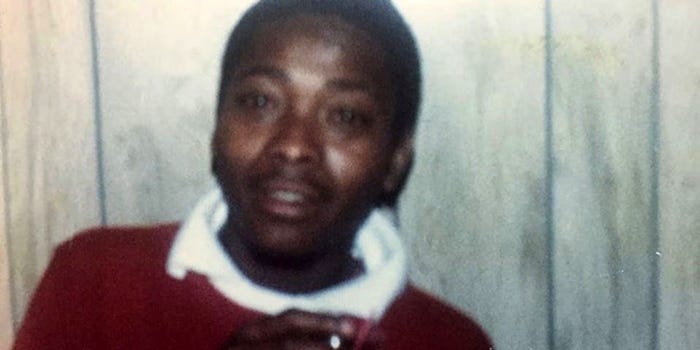
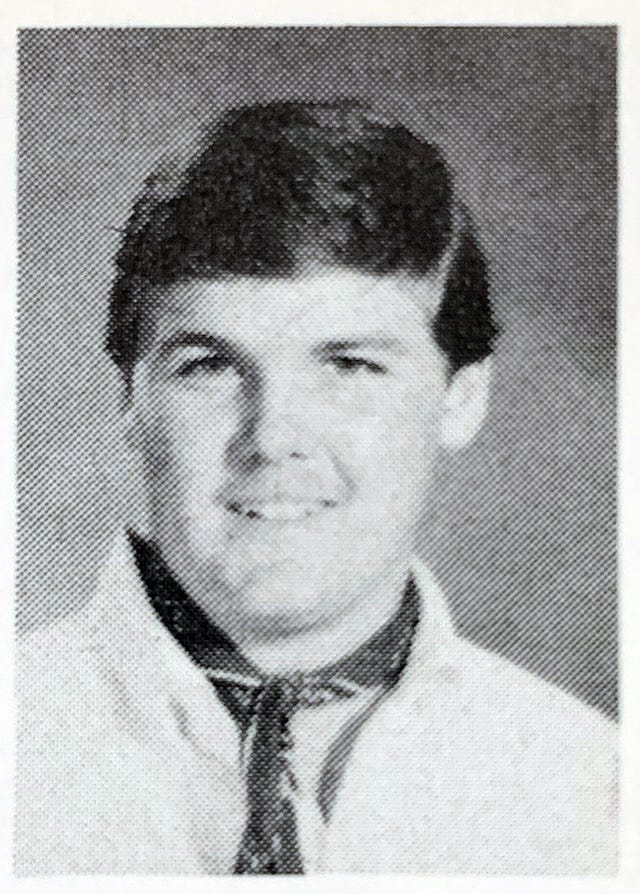
Tim, ca. 1983 (Spalding County Sheriff’s Office; Public Domain)
In my junior year of high school a story appeared in the local newspaper, at the bottom of an inside page, saying some squirrel hunters had found a young Black man dead in a field off a dirt road on the north side of town. A deputy said the fellow “had been worked over with a knife pretty well.” He’d struggled.
The headline called it a “mystery killing.” The Sheriff’s office speculated maybe he was a transient. Or maybe he was local, they didn’t know.
You might find it surprising that when the police showed photos of the body around Black neighborhoods, the deceased’s sister told them she didn’t know who it was. But back then, the Sheriff’s office was a haven for Klansmen. And sure enough, once Tim’s identity was confirmed, his family would be terrorized: a brick through the window wrapped in a piece of paper with “You’re next” scrawled on it; a blood-soaked shirt left on the seat of the schoolbus Tim’s stepfather drove; a headless dog dumped onto the floor of their house.
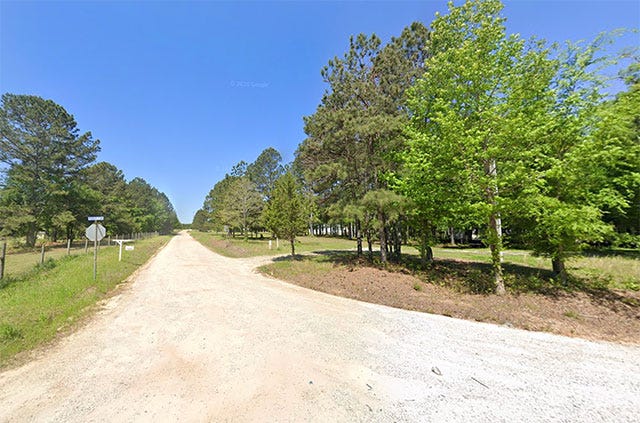
The field where Tim was lynched (right) is now a homesite.
It was no secret who’d done it, in certain circles anyway. You see, Tim had been hanging around a White woman. Was seen dancing with her. And the previous Friday night the White fellow she’d been seeing too, a sixth grade dropout and pulpwooder called Frankie, showed up at a Black club north of the tracks with a couple friends, went inside, and asked Tim to step out. Nobody witnessed Tim getting into the truck.
From town they drove further north, past the textile mills and the mill village, on by the agricultural station, and into some farmland where the White men pulled Tim out into an empty field. There, they hacked at him with a steak knife, carved St. Andrew’s crosses on his stomach and back, stabbed him through the lungs, then tied him to their pickup with a logging chain and dragged him for a while along the powerline cut before leaving him there to bleed out in the cold October night.
That done, they went home to the trailer park a mile down the road, and threw their bloody clothes and some of Tim’s into an old well that was used as a trash pit, together with the chain and the knife. Gravel and dirt went in on top of that.
Blood samples, hair samples, a cudgel, and pieces of Tim’s clothing were taken from the field, and tire tracks were photographed. But since there were “no known suspects and no known motives,” the sheriff’s office quickly moved on to other matters, such as a spree of mailbox vandalism which required their attention.
After the identity of the murder victim was reported, no further stories appeared in the paper. The local radio station never mentioned it again either. There were football scores to report, after all. Within a few weeks the case was orphaned. Somehow, over the following years, the evidence would become misplaced, never to be seen again.
Sometime in 2007, Chris — who’d been a boy in the hunting party that found the body — wrote a letter to the GBI saying that Frankie had been bragging for years about butchering Tim and tossing the knife down a well. Someone was sent to interview him, then life went on as it had before.
And that’s how things stood, through a half-dozen sheriffs’ administrations, until 2016 when a classmate of mine was elected sheriff. Darrell knew Tim’s case well and had been chewing on it because he also knew that some of the deputies assigned to it in ’83 were documented Klansmen.
It just so happened that, around that time, a cold case reviewer at GBI had run across Chris’s tip in the file. When he called Darrell to ask a few questions, he found a man on the other end of the line who wanted the whole bloody thing opened back up, and knew exactly who he wanted to talk to.
Darrell in our junior year of high school, 33 years before being elected sheriff
I give Darrell a lot of credit for what happened next. In Georgia the GBI handles murder cases like these, but if county sheriffs don’t want them handled they can make an investigation nigh on impossible. And with the original evidence long ago vanished into thin air, there’s little chance anyone from Atlanta could have cracked the case if the sheriff hadn’t handed them a prybar.
Darrell assigned a deputy to work with the GBI, and they sat down again with Chris. Frankie was tipped off by a cop (his sister’s son Lamar) who told him the sheriff was gunning for him and his brother-in-law Bill now, and let Frankie know who’d been talking.
But there was precious little Frankie could do about any of that at the time, seeing as how he was locked up on sexual assault charges. Darrell took a gamble and made a public announcement that the case had been reopened and they were closing in on the killers, hoping to loosen up some more tongues with Frankie in the can and Bill likely keeping a low profile and hoping the whole thing would blow over.
Together, the GBI and the sheriff’s office turned up a motley assemblage of felons, skinheads, child molesters, and meth-tweakers that Frankie and Bill knocked around with who were willing to describe how the pair had boasted about killing and mutilating “that n*****” for years, and used his murder as an example of what they might do to anyone who crossed them. Only their immediate families felt enough loyalty to the killers to continue defending them. Everybody else figured their lines had just played out.
The GBI tapped state prosecutor Marie Broder to handle the case, which was older than she was. When it came down to brass tacks, she informed them, all they had was two fellows bragging they’d committed a murder everybody knew about. Maybe they were just trying to look tough. With the evidence gone, and the well in Frankie’s yard (where he still lived when he wasn’t in jail) located too close to other people’s homes to excavate, they didn’t have a snowball’s chance in hell.
“We need to get in this damn well,” she told them.
The key to that puzzle came in the form of a hydrovac, a machine that blasts water into a well and kicks up whatever’s in there, then sucks it up with a giant vacuum. At first, all that arose was dirt and gravel. And then, along with old bottles and assorted garbage, what was left of the evidence was resurrected: the chain, the knife blade, and — preserved by the rocks and soil packed on top — torn and stained clothing, including Tim’s Adidas sneakers and a shirt with seven slashes matching the seven stab wounds in Tim’s back recorded in the autopsy. There was no recoverable DNA on anything.
Frankie and Bill were arrested for murder in October 2017, exactly 34 years after the lynching.
The family who’d once been terrorized to compel their silence had never even seen these men’s faces before nor heard their names. Which comes as no surprise to me because even in the 1980s Black and White did not mingle in that town. Hell, despite the Supreme Court’s ruling in the 1950s, county schools hadn’t integrated until the early 1970s. If you wanted integration you could find it on the football field, at the McDonald’s, on the mill floor or packing line, or in the prison. But the neighborhoods, bars, lunchrooms, and churches had yet to emerge from Jim Crow.
Racism in Spalding County wasn’t dosed out in microaggressions. Nobody was left to guess how things stood, and where everybody belonged. Very few families of color owned property, and White landlords got their rents in cash, and in person. I can still recall my stepfather’s mother, a tall cotton-haired widow in heels, pearls, and oversized sunglasses, excusing herself to “go collect the rent from my nigras,” which was how Negro was pronounced among polite Whites at that time and place.
It was the landlords who decided the elections. Their candidates were the incumbents or whoever they tapped to replace them, and if anyone tried to get a nose under the tent, they had a little spiel for their tenants: “Now I gotta tell you, ol’ So-and-so’s running for mayor. And if he gets in, he’s gonna hike up the property taxes, so I’ll have to raise your rent $25 a month. Just wanted y’all to know so it won’t come as a surprise. Y’all take care now, I’ll see you next month.”
A thousand dollars a year in today’s money might not seem like much to some people. But it pinches a lot harder when it’s coming straight out of your kids’ groceries.
Despite the multiple confessions and the evidence from the well, Tim’s family was reluctant to get their hopes up. “Ain’t nothing guaranteed,” his sister Telisa observed. “As a Black woman, a Black human being, living in a racist town, you never know what is going to happen.”
As it happened, Frankie was found guilty of murder and sentenced to life in prison plus 30 years. Bill copped a manslaughter plea and was sentenced to 20 years in prison and lifetime banishment from the county, should he live long enough to be released. It was not until they were behind bars that Tim’s family at last put a headstone on his grave, no longer afraid that the killers would desecrate it.
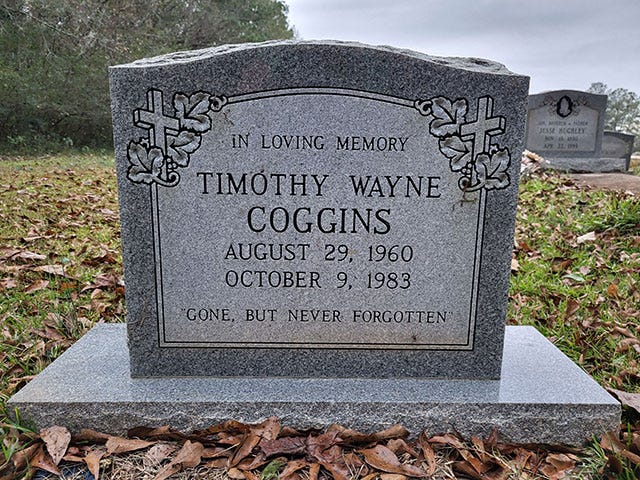
Image courtesy of Find a Grave
I didn’t find out about all this until I saw the whole sorry affair reported as a solved “cold case” a few years later. I wish I could tell you I was surprised by any of it. Still, I was a bit shaken by the fact that I hadn’t even remembered the lynching. I contacted some friends who’d also moved away after high school, and none of them recalled it either.
But looking back, why would we? It was just a little story tucked away in the corner beneath the second halves of front-page articles about a small plane crash, the opening of the annual county fair, and the resignation of Reagan’s Interior Secretary James Watt in the wake of a scandal following comments that affirmative action wasn’t needed in his department as he already had “a black, a woman, two Jews and a cripple.”
A young man just six years older than myself was lynched — stabbed, beaten, and dragged — and it wasn’t even as newsworthy as the county fair. And this in 1983.
I’m glad the family got some peace. I just wish his mother had lived another year so she could have seen it. Out of everything, what sticks with me most was what Tim’s niece Heather said to Bill at his sentencing hearing after relating to the court 35 years of collective pain, fear, and unassuaged grief:
“We forgive you. I hope that whoever you pray to, you ask for forgiveness and are forgiven. I also hope that you spend the rest of your natural life behind bars.”
Well, I’m optimistic about that last part. As for the first part, I suppose hope springs eternal. But I ain’t waiting up nights.
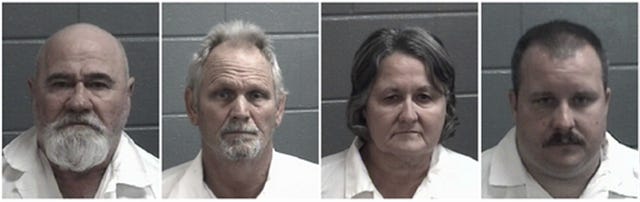
Left to right: Frankie, Bill, Frankie’s sister Sandra, and Sandra’s son Lamar (Spalding County Sheriff’s Office; Public Domain)
메타데이터
- post_id
- 1fe95e345ba2
- slug
- the-lynching-in-my-hometown-wasnt-news-in-1983-1fe95e345ba2
- url
- https://medium.com/thinkpiece-magazine/the-lynching-in-my-hometown-wasnt-news-in-1983-1fe95e345ba2
- canonical_url
- https://medium.com/thinkpiece-magazine/the-lynching-in-my-hometown-wasnt-news-in-1983-1fe95e345ba2
- author_url
- https://medium.com/@ptzenki
- status
- ok
- fetched_at
- 2026-06-14 11:28:49