The Audacity to Learn: From Southeast DC to the Ivy League
Reflections on a second master’s degree, global classrooms, and why literacy is our ultimate weapon for liberation.
The Audacity to Learn: From Southeast DC to the Ivy League
Reflections on a second master’s degree, global classrooms, and why literacy is our ultimate weapon for liberation.
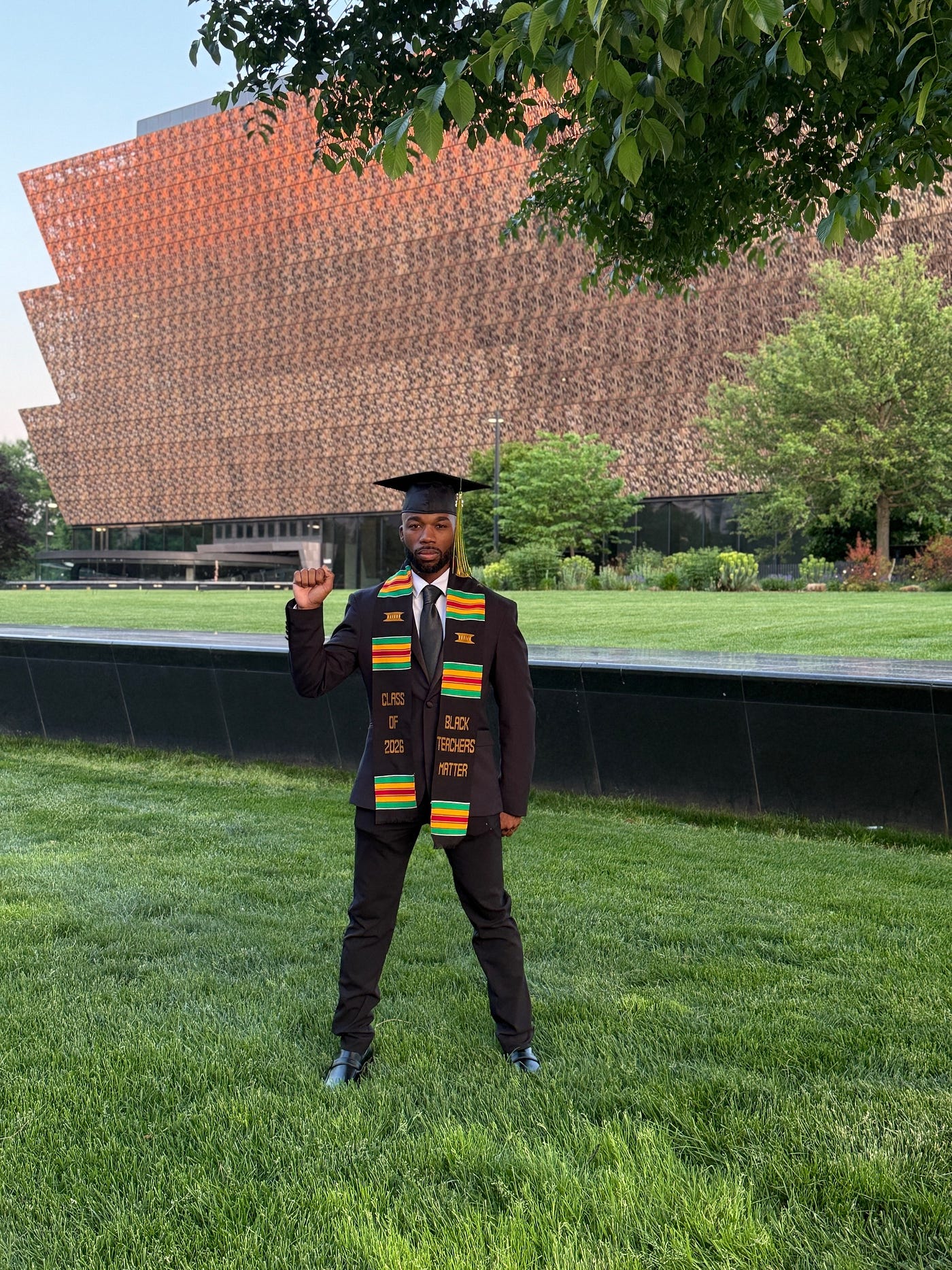
We often treat education as a ladder — a linear ascent from one credential to the next, each step elevating us further above the ground where we began. But for those of us who view the classroom not just as a workplace, but as a site of radical possibility, entering graduate study is less of a climb and more of a deliberate deepening. It is an intentional pausing of the immediate present to interrogate the structures that govern our language, our schools, and our minds.
As I stand on the precipice of a new and final academic chapter — entering the Doctor of Education (Ed.D.) program in the Teaching of English at Columbia University’s Teachers College this fall — I am forced to look back at the immediate past. I have completed my second master’s degree. To some, a second master’s might look like academic redundancy or an excess of credentials. But to me, it has been a necessary crucible. It represents the bridge between the visceral realities of teaching across continents and the structural frameworks required to dismantle the barriers embedded within contemporary education.
Escaping the Architecture of the Projects

To understand why this second master’s degree matters (University of San Francisco), one must understand the environment that shaped my earliest worldview. I grew up in Washington D.C., raised in the Washington Highland Dwellings projects — a neighborhood heavy with systemic constraints and narrow expectations of what a Black boy could become. In communities like mine, the negative male archetypes are vivid and immediate, while the pathways out are often obscured.
The physical environment of public housing can easily become a mental boundary if you let it. But early on, a profound counter-narrative was introduced into my life. My parents and my family made a conscious, radical decision to anchor my reality in books. They understood what the state often forgets: that education is defensive armor. They built a protective barrier around my mind, choosing literacy over the streets.
Later, during high school and college, the raw, unvarnished words of motivational speakers like Eric “ET” Thomas began to fill my headphones, shifting my internal dialogue. I realized that breaking cycles required an aggressive pursuit of personal excellence. I didn’t just want to survive my environment; I wanted to decode the very mechanics of how structural inequality operates. Education went from being a means of personal escape to my life’s primary weapon for collective advancement.
The Borderless Classroom: From D.C. to Southeast Asia
My understanding of education underwent a massive paradigm shift when a random conversation set off a spark, leading me to apply to the Overseas Education Group (OEG) and board a plane for Thailand. That decision turned into a five-year journey teaching across Southeast Asia, moving from the vibrant cultural landscapes of Thailand to the fast-paced, high-stakes academic environments of Vietnam.
Teaching abroad strips away your assumptions about language. In Bangkok and Hanoi, I quickly realized that English is not a static set of rules to be policed; it is a living currency of human connection. In those spaces, rigid grammar conventions faded in importance compared to the raw, immediate need for communicative agency. I learned to strip away the gatekeeping mechanisms of traditional Western instruction and focus entirely on empowering students to speak their truth.
While Thailand offered an incredible quality of life and a profound lesson in cultural adaptation, Vietnam sharpened my tools as an educator, presenting a rigorous academic standard that challenged me to elevate my instructional delivery. Throughout those five years, navigating foreign cities and unfamiliar cultural terrains, my faith in God served as my ultimate anchor. I learned that when you step outside your comfort zone with a clear “why,” the universe makes room for your purpose.
However, returning to the United States to teach 9th and 12th-grade English Language Arts brought a different set of revelations. Here, the classroom is often a microcosm of systemic inequalities. At home, language is frequently weaponized as a tool of assimilation. We tell students — implicitly and explicitly — that their home dialects, their cultural syntaxes, and their multimodal ways of understanding the world are deficient if they do not align with a rigid, Eurocentric standard.
It was this striking contrast between the borderless potential of language abroad and the restrictive, defensive posture of literacy instruction at home that drove me back to graduate school. I didn’t need another degree to learn “how*”to teach; I needed the space to investigate “why” we teach the way we do, and “who” our current methods are leaving behind.
Global Literacy as Liberation: A Thesis of Radical Hope
The theoretical heartbeat of this second master’s degree is my graduate thesis: “Global Literacy as Liberation.” This work is the direct intellectual synthesis of every lesson plan, every student essay, and every cross-cultural dialogue I have experienced over the past decade. The central thesis argues against the outdated notion that literacy is merely a functional skill — the mechanical ability to decode text and replicate standard prose. Instead, it posits that true literacy is an act of self-actualization and systemic critique.
Drawing heavily from critical pedagogy, my research explores how we can transform secondary English classrooms into spaces of global, multimodal communication. If our students are to navigate an increasingly interconnected world, their literacy instruction must evolve. It must encompass the ability to critique media, analyze digital narratives, use artificial intelligence ethically as a scaffold for thought, and view literature through a deeply global, empathetic lens.
Literacy becomes liberatory when it ceases to be a tool used to measure a student’s compliance with dominant structures, and instead becomes the means by which they decode the world around them, question authority, and articulate their own uncompromised truths. Writing this thesis was an exhausting, rigorous labor, but it solidified my identity as an instructional designer and a scholar-practitioner equipped to reshape curriculum.
The Architecture of Gratitude: Walking with Giants
An academic journey of this scale is often narrated as a solitary endeavor — late nights fueled by coffee, isolated reading, and independent writing. But that narrative is an illusion. No one arrives at the gates of an Ivy League doctoral program alone. We are carried there on the shoulders of those who believed in us when the vision was still blurred.
My foundations were laid by my mother and father, whose unwavering love rooted me in resilience long before I ever stepped foot in a graduate seminar. In the professional sphere, I owe an immense debt to the mentors and professors who pushed my thinking, challenged my biases, and held my work to the highest standards of intellectual rigor.
And then, there are the relationships that define our humanity along the way. Over the past seven years, my closest friend/cousin, Asia, has been an absolute anchor. In this life, it is rare to find someone who acts as both a family figure and a profound source of inspiration. Asia, our shared conversations, our mutual growth, and your unwavering belief in the vision have been a masterclass in what it means to pursue excellence in tandem. Thank you for constantly expanding my horizon of what is possible.
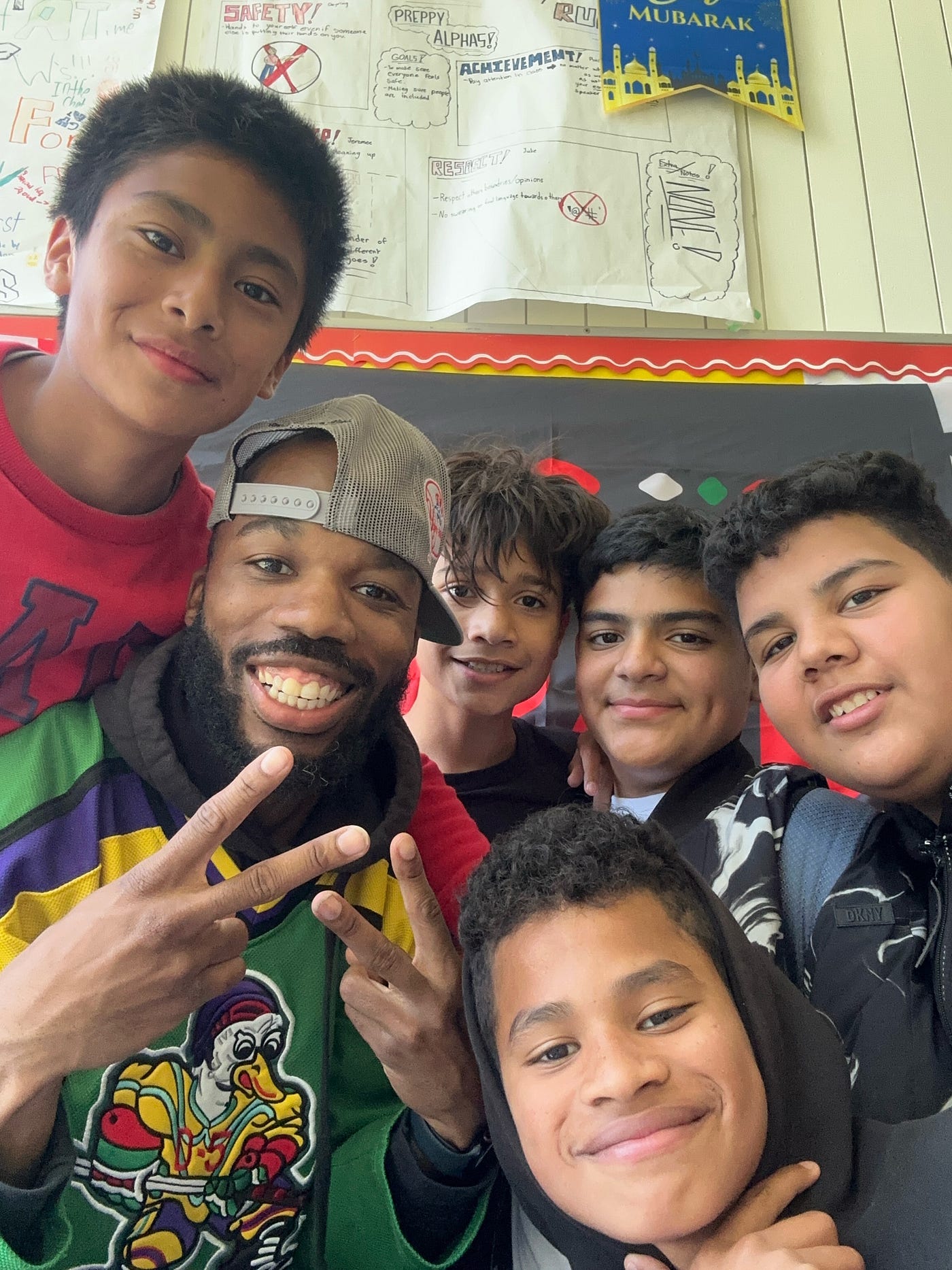
Finally, I am indebted to my students. The 9th and 12th graders who sit in my room every day are the ultimate curators of my research. Their curiosity, their skepticism, and their brilliance keep me honest. They remind me that theory without practice is empty, and practice without theory is blind.
The Next Horizon: Columbia University and Beyond
This fall, I will step onto the campus of Columbia University’s Teachers College to begin my Ed.D. in the Teaching of English. It is a moment of profound humility and immense responsibility.
To any Black man or anyone from an underestimated community looking at my trajectory, my message is simple: Strive for greatness! Do not let the zip code you were born into dictate the boundaries of your mind. Find mentors, understand your “why,” and recognize that your story — no matter how complex — is your greatest asset.
Entering a doctoral program is not the end of the road; it is the beginning of a larger obligation to the field of education. The questions I began asking in the Washington Highland Dwellings, in the classrooms of Thailand and Vietnam, and in my current school will now be examined under the highest levels of academic scrutiny. I am entering this space not to escape the classroom, but to gather the research backing and the institutional leverage necessary to return to public education and affect systemic change.
A second master’s degree was never about the credential. It was about developing the vocabulary to name the injustices I saw in education, and the framework to build something better. The true work is just beginning.
Strive4Greatness
메타데이터
- post_id
- 1ff864e930ef
- slug
- the-audacity-to-learn-from-southeast-dc-to-the-ivy-league-1ff864e930ef
- url
- https://medium.com/@teacherdee/the-audacity-to-learn-from-southeast-dc-to-the-ivy-league-1ff864e930ef
- canonical_url
- https://medium.com/@teacherdee/the-audacity-to-learn-from-southeast-dc-to-the-ivy-league-1ff864e930ef
- author_url
- https://medium.com/@teacherdee
- status
- ok
- fetched_at
- 2026-06-09 15:37:30




