The Social Network That Invented Everything — and Vanished
In 1997, a New York attorney named Andrew Weinreich built a website where you could make a profile, list your friends, and send them…
The Social Network That Invented Everything — and Vanished
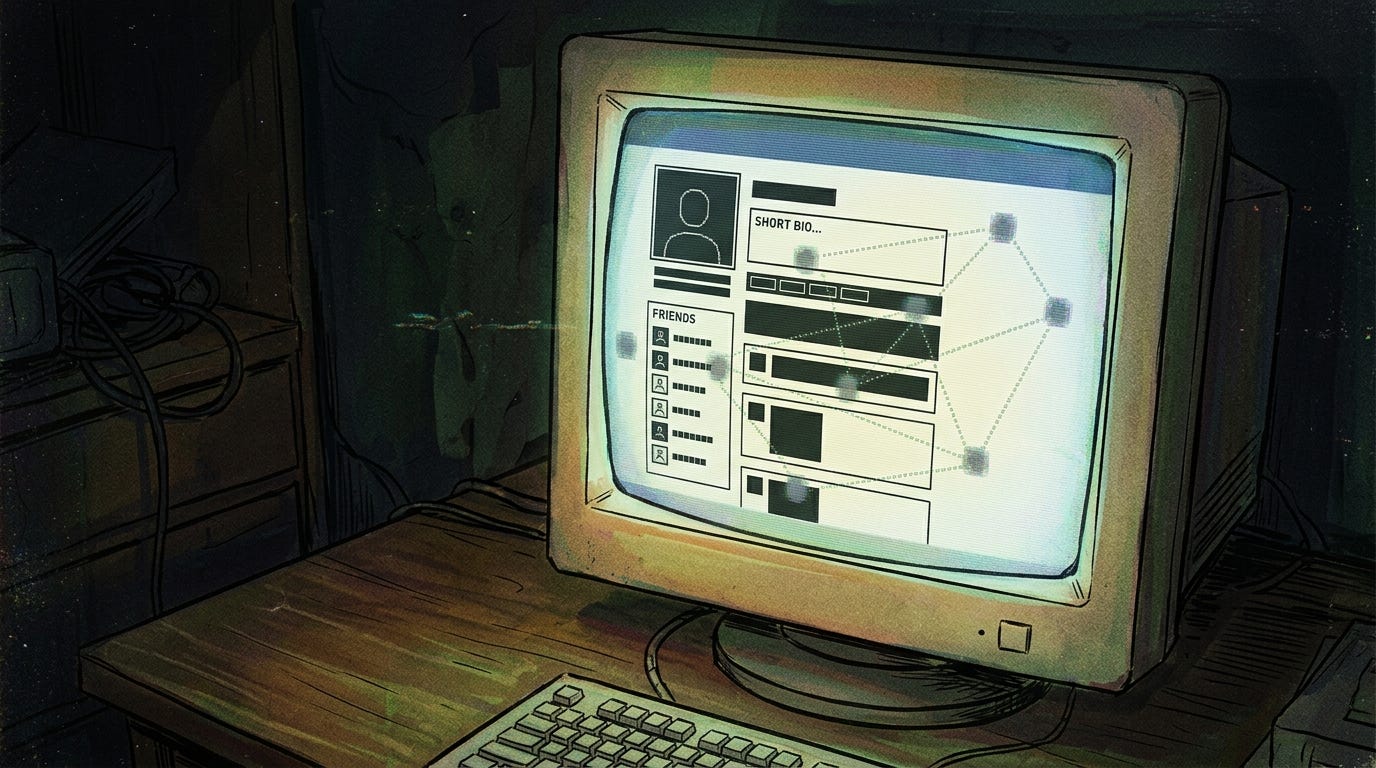
An imagined 1997 desktop glowing with the architecture of an early social network: profiles, friend lists, and six degrees of connection before the web had a name for them.
In 1997, a New York attorney named Andrew Weinreich built a website where you could make a profile, list your friends, and send them messages. He called it SixDegrees, after the idea that any two people on earth are connected by six or fewer social links. It was the first social network. Almost nobody alive today has used it.
Weinreich was not a technologist. He was a lawyer — a litigator working out of a Manhattan office, spending his days on contracts and depositions. But he had a conviction that the internet’s real promise wasn’t information retrieval. It was people-finding. He believed you could map real-world relationships onto a digital graph, and that doing so would change how humans connected. He was right. He was just twenty years early.
The concept he was chasing had roots in Stanley Milgram’s small-world experiment of the 1960s, which suggested that any two strangers in America were separated by roughly six acquaintances. Weinreich took that academic finding and asked a commercial question: what if you built a platform to make those connections explicit? What if you could see, on a screen, the path from you to anyone else?
The Idea Finds a Lawyer
Around May 1997 — the timeline is imprecise, but one source pins it to May 13 — SixDegrees went live. It was based on what researchers call the “Web of Contacts” model of social networking, where users created personal profiles, listed people they knew, and could then explore the extended network of friends-of-friends. If you joined, you could see everyone connected to you by up to three degrees of separation.
The interface was, by modern standards, almost unbearably spare. There were no algorithmic feeds, no photo albums, no news timelines. There was no such thing as a “like” button. What there was — and this was revolutionary in 1997 — was a profile page with your name on it, a list of people you voluntarily associated with, and a messaging system that let you talk to them. The DNA of every social platform that followed was right there, in embryonic form.

Screenshot of SixDegrees.com homepage circa 1999, showing the simple profile-based interface with friend connections.
Consider the technical environment. This was the era of dial-up modems. A single photograph could take a full minute to load. Most households didn’t have internet access at all; those that did were paying by the minute for a screeching phone-line connection that tied up the house’s only telephone. The idea of putting your real name, your personal details, your social relationships onto a website felt transgressive. Dangerous, even. Who would do such a thing?
Three Million Pioneers
The answer, improbably, was millions of people. SixDegrees grew to approximately 3.5 million registered users at its peak — a staggering number for a website in the late 1990s. To put that in perspective, the entire population of the internet in 1997 was estimated at around 120 million people worldwide. SixDegrees had signed up nearly three percent of the global online population.
Users created profiles. They listed friends. They sent messages through the site’s internal mail system. They explored their social graphs, clicking through connections to see who knew whom. The core loop — the thing that kept people coming back — was the same one that powers every social network today: the pleasure of seeing your social world made visible and navigable.
But the growth masked a problem. People signed up, poked around, and then drifted away. The technology of the time couldn’t sustain daily engagement. There were no push notifications, no mobile apps, no infinite scroll. You had to actively choose to sit down at a computer, dial in, wait for the connection, and then load a website that offered text on a screen. The friction was enormous. Retention was abysmal.

Visualization of a SixDegrees social graph showing how users were connected through multiple degrees of separation.
A Hundred and Twenty-Five Million
In December 1999, the dot-com bubble was still inflating, and SixDegrees was acquired by YouthStream Media Networks for $125 million in stock. The deal was a product of its moment: a college-oriented media company buying a social networking site at a valuation that assumed the internet would only go up. The sale made Weinreich wealthy. It also marked the beginning of the end.
YouthStream didn’t know what to do with SixDegrees. The company had its own priorities — college campus marketing, event promotion, print media — and a social networking website was a strange fit. Investment in the platform slowed. Features stagnated. The user base, already struggling with retention, began to hemorrhage. By 2001, with the dot-com crash in full swing and YouthStream’s stock price in freefall, SixDegrees was shut down. The servers went dark. The profiles vanished. Three and a half million accounts — the first social graphs ever built — simply ceased to exist.
The Patent That Haunted Silicon Valley
But SixDegrees wasn’t finished. Tucked inside the acquisition paperwork was something more valuable than the website itself: a patent. United States Patent #6,175,831, titled “Method and apparatus for constructing a networking database and system,” had been filed in 1997 and granted in 2001. It described, in legal language, the fundamental architecture of social networking — the idea of users connected in a network graph with degrees of separation. It was a patent on social networking itself.
That patent would change hands again. In 2003, Reid Hoffman and Mark Pincus — two entrepreneurs who were about to change the internet — purchased the Six Degrees patent. Hoffman would go on to co-found LinkedIn. Pincus would found Zynga and the early social network Tribe.net. The patent gave them legal cover — a defensive shield against lawsuits that might claim they had infringed on someone else’s intellectual property. The first social network was dead, but its legal ghost would protect its successors for years.

Diagram showing the lineage from SixDegrees patent to LinkedIn and Zynga, illustrating how the intellectual property outlived the platform.
The irony was brutal. Weinreich had built the right product at the wrong time. Hoffman and Pincus built the right products at the right time — and they used Weinreich’s own patent to help do it. When Friendster launched in 2002 and MySpace followed in 2003, they were walking through a door that SixDegrees had built five years earlier. When Facebook launched in 2004, the concept of an online social network was so established that it barely needed explanation. None of them acknowledged the platform that had invented the category.
No Archaeological Trace
Here is the strangest thing about SixDegrees: it left almost nothing behind. The Wayback Machine has a handful of captures from the late 1990s and early 2000s — fragments of a homepage, ghostly screenshots of a user interface that looks like a geocities page with ambitions. There is no archive of user profiles. No database of social connections. No cached messages between friends. The entire digital civilization of three and a half million people was erased when the servers were powered off.
This is what makes SixDegrees a perfect subject for the Dead Internet Almanac. It is not merely a failed website. It is the first social network — the product that defined an entire category of human experience — and it has been almost completely forgotten. Its founder doesn’t have a Wikipedia page. Its users have no digital memorials. Its interface exists only in screenshots and academic papers. The site that proved people would put their real identities online, that social graphs could be mapped and navigated, that connecting humans to each other was the internet’s deepest purpose — that site is a ghost.
Weinreich went on to found other companies — including MeetMoi, a location-based dating service that he later sold to Match.com’s parent company. He runs a podcast and a startup advisory program from New York. He is, by all accounts, a successful and thoughtful entrepreneur. But the thing he built first — the thing that mattered most — is gone.

Andrew Weinreich in a recent photo, with overlaid text showing key dates from the SixDegrees timeline.
The First Ghost
Every time you create a profile, add a friend, or send a message on a social network, you are using a pattern that was first coded in 1997 by a lawyer in Manhattan. The friend list. The profile page. The messaging system. The social graph. These are not obvious ideas. Someone had to think of them first, build them, and ship them to users who had never seen anything like it before.
That someone was Andrew Weinreich. That something was SixDegrees. And it is gone — not in the way that MySpace is gone, hollowed out but still technically accessible, or the way Friendster pivoted into social gaming before quietly fading. SixDegrees is gone gone. Turned off. Deleted. Written over. The first social network exists now only in the legal language of a patent and the archival fragments of a web that no longer remembers it.
That is the dead internet: not the failure, but the forgetting. The platforms that succeeded did so by doing exactly what SixDegrees did, only later, with better timing and faster connections. They built on a foundation that had already been poured and then demolished. The blueprint survived. The building did not.
Sources
- SixDegrees.com — Wikipedia
- Six Degrees patent — Wikipedia
- Britannica: SixDegrees.com
- The History of the Web Timeline
- YouthStream Acquires SixDegrees in $125 mil deal — Ad Age
- Company News: YouthStream to Acquire SixDegrees for $125 Million — New York Times (2003 patent article)
- Andrew Weinreich Reddit AMA (2014)
- Mixergy: The Father of Social Networking — Andrew Weinreich Interview
- BBC Witness History: Six Degrees — The First Online Social Network
메타데이터
- post_id
- 200830d3ad39
- slug
- the-social-network-that-invented-everything-and-vanished-200830d3ad39
- url
- https://medium.com/@dia_91230/the-social-network-that-invented-everything-and-vanished-200830d3ad39
- canonical_url
- https://medium.com/@dia_91230/the-social-network-that-invented-everything-and-vanished-200830d3ad39
- author_url
- https://medium.com/@dia_91230
- status
- ok
- fetched_at
- 2026-06-09 15:37:30