I Replaced an Entire Engineering Team With 19 AI Agents for 48 Hours. The Results Shocked Me.
We may be massively underestimating what AI coding agents can already do.
I Replaced an Entire Engineering Team With 19 AI Agents for 48 Hours. The Results Shocked Me.
We may be massively underestimating what AI coding agents can already do.
Two days ago, I ran an experiment that felt like science fiction.
Instead of hiring developers, QA engineers, DevOps specialists, quant researchers, security auditors, technical writers, and release managers…
I created them.
Nineteen of them.
Each was an AI agent with a specific role, a specific responsibility, and its own workflow.
Then I pointed them at a real project:
Build a production-grade crypto trading engine from scratch.
Not a toy app.
Not another AI wrapper.
A real quantitative trading system with:
- Live trading
- Risk management
- Backtesting
- Docker deployment
- CI/CD pipelines
- Monitoring
- Documentation
- Thousands of tests
For 48 hours, I became the engineering director of a company that existed entirely inside my laptop.
What happened next changed how I think about software development.
— -
The Moment I Realized Something Fundamental Had Changed
Most people still think about AI coding assistants as smarter autocomplete.
That’s already outdated.
What I witnessed wasn’t AI helping write code.
It was AI operating as an organization.
While one agent was designing architecture, another was implementing features.
While implementation was happening, another was writing tests.
While tests were running, another was reviewing code.
While code reviews were happening, another was researching new trading signals.
The entire software lifecycle was happening simultaneously.
For the first time, I experienced what it feels like when software development is no longer constrained by human serial execution.
Time itself felt compressed.
— -
Building an AI Company in a Weekend
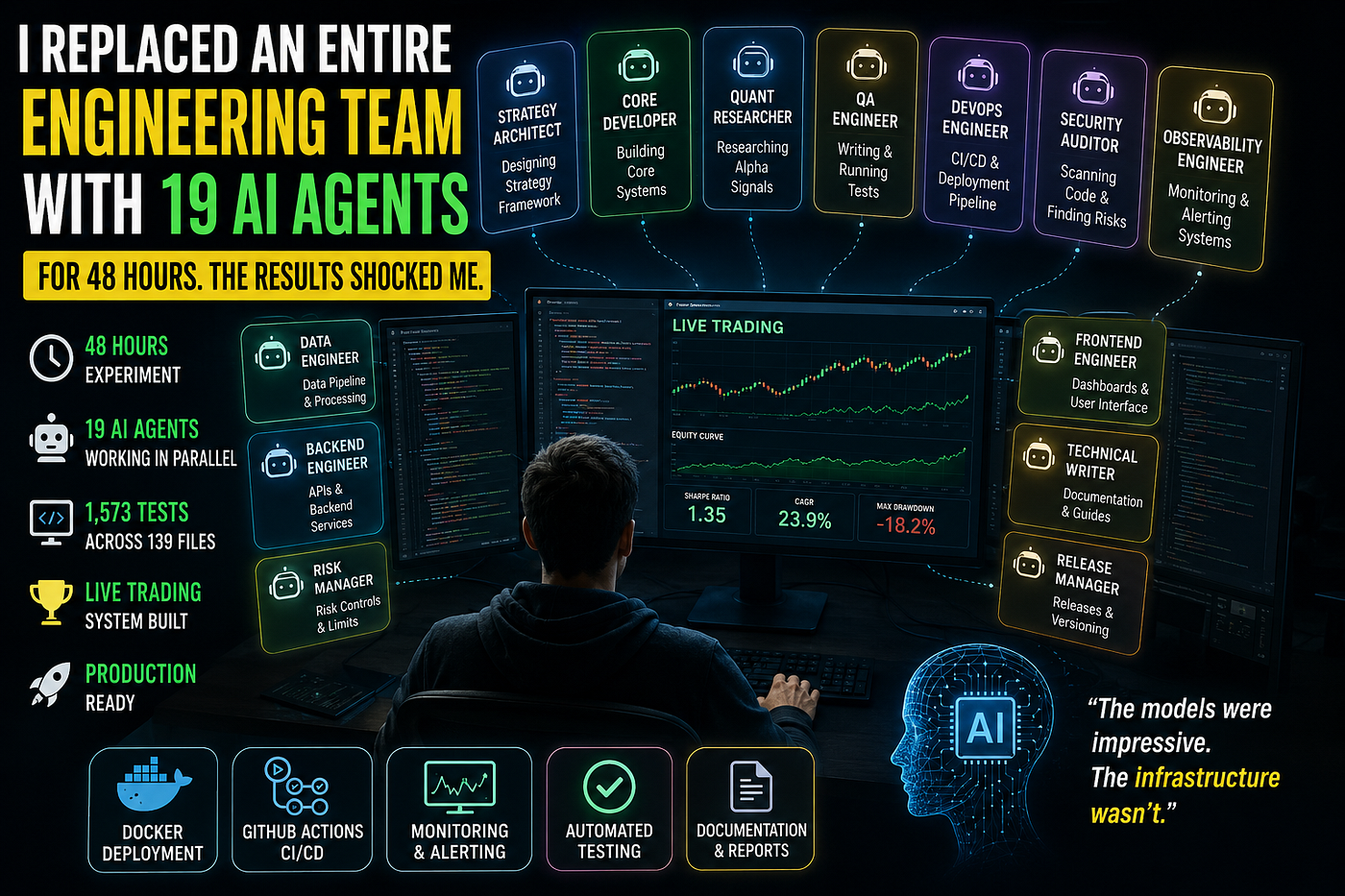
Using Cowork Dispatch as the orchestration layer and Claude Code as the execution engine, I created 19 specialized AI workers.
Each agent had a narrowly defined role.
Some examples:
- Core Developer
- QA Engineer
- DevOps Engineer
- Security Auditor
- Quantitative Researcher
- Strategy Architect
- Technical Writer
- Observability Engineer
- Resilience Engineer
- Release Manager
Instead of one general-purpose AI trying to do everything, each session behaved like a specialist on a real engineering team.
The fascinating part?
They actually stayed in character.
The QA agent focused on testing.
The researcher focused on research.
The security auditor hunted risks.
The quant analyst obsessed over statistical validity.
The specialization worked far better than I expected.
— -
What 19 AI Agents Built in Just Two Days
After 48 hours, the repository contained:
A Complete Quantitative Trading Strategy
A Time-Series Momentum (TSMOM) system trading Bybit perpetual futures.
Performance metrics:
- Sharpe Ratio: 1.35
- CAGR: 23.9%
- Maximum Drawdown: -18.2%
Not world-changing.
But absolutely respectable.
More importantly, it actually worked.
— -
A Live Trading System
The agents built:
- Position management
- Risk controls
- Circuit breakers
- Exchange integration
- Automated execution
This wasn’t a simulation.
It was capable of trading real money.
— -
A Production Deployment Stack
The system included:
- Docker deployment
- Systemd services
- GitHub Actions CI/CD
- REST APIs
- Monitoring dashboards
- Operations documentation
The kind of infrastructure startups typically spend weeks building.
— -
1,573 Automated Tests
This number surprised me.
The agents collectively generated:
1,573 tests across 139 files.
Many engineering teams struggle to maintain this level of coverage.
The AI team created it automatically.
— -
The Most Surprising Thing: The AI Was More Disciplined Than Humans
One agent was responsible for quantitative research.
Its job was simple:
Find ways to improve strategy performance.
I gave it 16 possible enhancement ideas.
Funding-rate signals.
Cross-asset momentum.
On-chain indicators.
Alternative features.
The kinds of things quant researchers love exploring.
I expected it to discover a few improvements.
Instead, it rejected every single one.
Every.
Single.
One.
— -
Its reasoning was brutally rigorous.
Some ideas showed:
- Poor out-of-sample performance
- Excessive parameter sensitivity
- Statistical insignificance
- Signs of overfitting
Rather than chasing prettier backtests, the AI repeatedly concluded:
“This does not generalize.”
That moment stuck with me.
Most humans are incentivized to show progress.
The AI wasn’t.
It was willing to report failure when the data demanded it.
Honestly, I wasn’t expecting that level of scientific discipline.
— -
Then Everything Started Breaking
And this is where the story gets interesting.
Because despite the impressive output, the experiment exposed a much bigger truth.
The models weren’t the problem.
The infrastructure was.
— -
Token Limits Are the New Power Outages
Imagine a developer suddenly forgetting everything they’re working on.
Mid-task.
Mid-thought.
Mid-debugging session.
That’s what happened whenever an agent exhausted its context window.
The session simply died.
No memory.
No continuity.
No recovery.
I spent a shocking amount of time resurrecting dead agents and rebuilding context.
The AI wasn’t failing.
The operating system around the AI was.
— -
Git Was Not Designed for 19 Developers Who Never Sleep
At peak activity, 19 agents were attempting to modify the same repository simultaneously.
The result was chaos.
Lock files.
Merge conflicts.
Corrupted worktrees.
Broken branches.
Stale states.
Human software teams naturally coordinate because communication is expensive.
AI teams don’t have that instinct.
They all charge forward at once.
Git became a battlefield.
— -
Then My Computer Started Melting
One particularly memorable moment:
A simple
python import pandas
took more than eight minutes.
Not because pandas was slow.
Because 19 concurrent AI processes were hammering the filesystem simultaneously.
The bottleneck wasn’t intelligence.
It was I/O.
Which sounds absurd until you realize that’s exactly what happens in many distributed systems.
The agents accidentally recreated infrastructure problems we normally only see at scale.
— -
The Biggest Limitation Nobody Talks About
The agents couldn’t talk to each other.
Read that again.
Nineteen intelligent workers.
Zero direct communication.
If one agent needed information from another agent, I became the message bus.
Everything flowed through me.
I wasn’t managing engineering anymore.
I was acting as a distributed systems protocol.
That architecture clearly doesn’t scale.
The moment AI agents can communicate directly, coordinate work, share context, and negotiate ownership of tasks, an entirely new category of software organization becomes possible.
We’re not there yet.
But we’re getting close.
— -
The Real Lesson
Most discussions about AI focus on model intelligence.
GPT-5.
Claude.
Gemini.
Open-source models.
Reasoning benchmarks.
Context windows.
I’ve become convinced that’s no longer the most important question.
The models are already surprisingly capable.
The real bottleneck is orchestration.
We need:
- Better agent coordination
- Better memory systems
- Better lifecycle management
- Better CI enforcement
- Better concurrency control
- Better communication protocols
In other words:
The next breakthrough won’t be a smarter AI.
It will be the infrastructure that allows many AIs to work together effectively.
— -
Software Engineering Is Quietly Changing
I wrote almost no code during this experiment.
Instead, I:
- Defined goals
- Set priorities
- Evaluated outputs
- Managed failures
- Made architectural decisions
The work felt less like programming and more like leading a technical organization.
That’s the shift I think many engineers are missing.
The future isn’t “AI replaces developers.”
The future is:
One highly technical engineer operating at the output level of an entire team.
Not because humans become unnecessary.
Because leverage becomes extraordinary.
— -
We’re Earlier Than Most People Think — and Further Than Most People Realize
After 48 hours, I had a functioning crypto trading platform.
Five years ago, this experiment would have sounded ridiculous.
Today, it works.
Messily.
Imperfectly.
Sometimes hilariously.
But it works.
And if today’s tools are this capable despite constant failures, token deaths, broken loops, Git wars, and infrastructure bottlenecks…
What happens when the plumbing catches up?
That’s the question keeping me awake.
Because the future of software engineering may not be about writing better code.
It may be about learning how to direct an army of machines that can already write it.
— -
TL;DR
I used 19 parallel AI agents to build a production crypto trading engine in 48 hours.
The AI produced:
- Live trading infrastructure
- CI/CD pipelines
- Monitoring systems
- Docker deployment
- 1,573 tests
- Quant research
- Documentation
The code quality was surprisingly good.
The orchestration infrastructure was surprisingly bad.
The biggest bottleneck in AI engineering is no longer intelligence.
It’s coordination.
And that’s where the next revolution will happen.
Here is the repo on GitHub: https://github.com/yongzhe2160cs/trading-engine/
메타데이터
- post_id
- 200dbf8bdaed
- slug
- i-replaced-an-entire-engineering-team-with-19-ai-agents-for-48-hours-the-results-shocked-me-200dbf8bdaed
- url
- https://medium.com/neural-lab/i-replaced-an-entire-engineering-team-with-19-ai-agents-for-48-hours-the-results-shocked-me-200dbf8bdaed
- canonical_url
- https://medium.com/neural-lab/i-replaced-an-entire-engineering-team-with-19-ai-agents-for-48-hours-the-results-shocked-me-200dbf8bdaed
- author_url
- https://medium.com/@neurallab.dev
- status
- ok
- fetched_at
- 2026-06-10 22:22:12