HEDIS 2025: What Health Plans Must Do Now to Prepare for Digital Quality Measures
From MY2025 lessons to MY2026’s biggest HEDIS overhaul in 20 years — how health plans can leverage AI and FHIR to stay ahead
HEDIS 2025: What Health Plans Must Do Now to Prepare for Digital Quality Measures
From MY2025 lessons to MY2026’s biggest HEDIS overhaul in 20 years — how health plans can leverage AI and FHIR to stay ahead
2024–2025 Quality AI Lessons Learned
Tenasol’s Quality AI solution is used by several national and regional health plans to rapidly and accurately identify numerator evidence supporting HEDIS reporting. Clinical quality review teams reported that Tenasol’s solution significantly improved the detection and extraction of measure-specific information, leading to faster and more efficient reviews — saving time and money compared to costly, manual and labor-intensive review processes.
Tenasol clients also reported additional value based on Tenasol’s speed to delivery. Scalable, real-time processing of structured and unstructured data accelerated data time to value getting extracted discrete data and validated quality measure evidence from any record format within 24 to 72 hours, delivering improved workforce utilization without disrupting existing workflows.
Here are the key lessons learned which you may consider in evaluating Quality AI tools to augment your abstraction process:
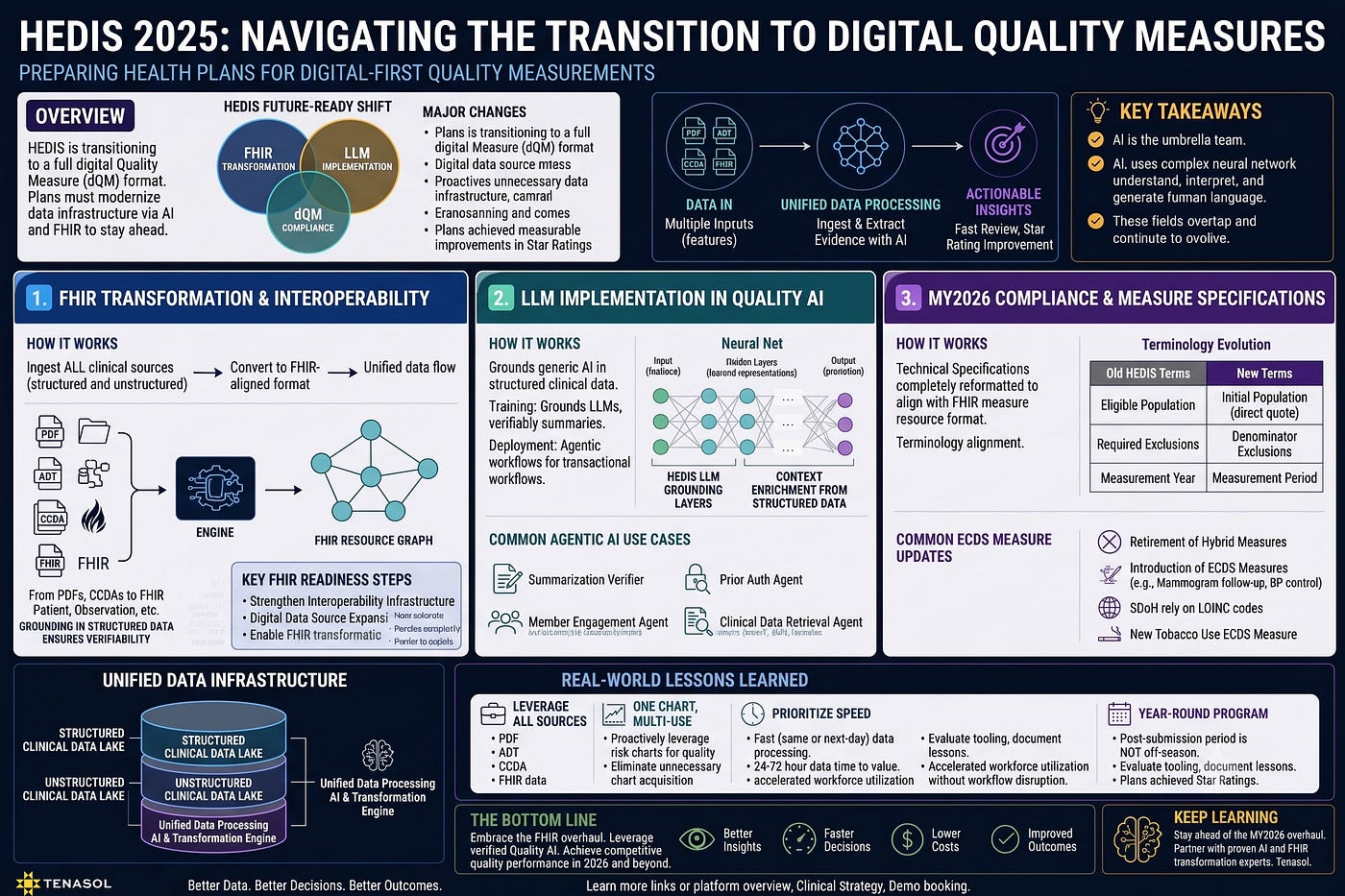
Leverage all clinical sources — Identify all sources of data that can impact quality measure performance. Plans historically lean towards traditional data, such as PDF records, however, ADTs, CDAs and FHIR data can all have a positive impact on outcomes.
One Chart, Multi-Use — Health plans collect data for multiple programs each year. Prior to launching new chart-chase initiatives, plans should proactively leverage data across the enterprise (e.g. risk charts for quality), as it may eliminate the need for unnecessary chart acquisition and coding efforts, saving time and money.
Unify Data Processing — Invest in systems and processes that are capable of ingesting and extracting evidence from all available sources. Work collaboratively with your internal IT teams to streamline dataflows and select only vendors that demonstrate the ability to extract measure evidence in a unified way across all available data.
Prioritize Speed and Turnaround Time — HEDIS season is a demanding time, with a limited window to complete the activities necessary for success. For our clients, Tenasol performs same or next-day data processing to ensure quality teams are never delayed with the latest insights necessary to complete abstraction in a timely manner.
Treat HEDIS as a Year-Round Program — One of the clearest lessons from MY2025 is that plans that outperform their peers do not treat the post-submission period as an off-season. The period immediately following HEDIS reporting is the best time to evaluate tooling, document lessons learned, and begin preparing for the next measurement year. Plans that systematically incorporate lessons learned into future quality programs have achieved measurable improvements in Star Ratings within two years.
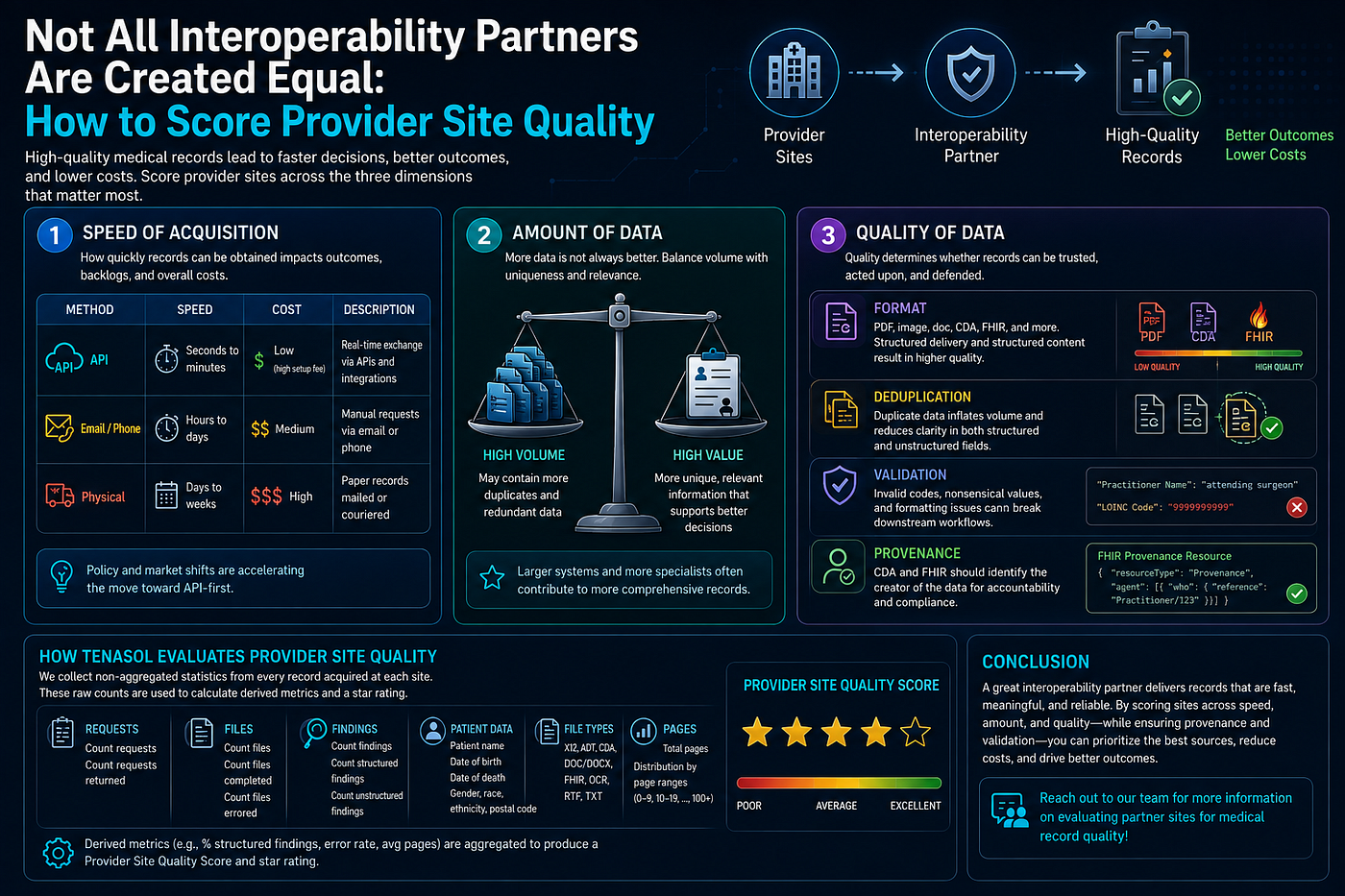
HEDIS reporting is only as strong as the quality of the data you receive, therefore, ensuring high-quality, relevant, and complete records is essential for success. In addition to the takeaways above, enforcing consistent quality, resolution and relevance of data will help drive more efficient review and reporting during HEDIS season.
MY2025 Measure Updates
NCQA continued its digital-first push with MY2025, retiring three hybrid measures and introducing three new ECDS-based measures:
- Documented Assessment After Mammogram (DBM-E)
- Follow-Up After Abnormal Mammogram Assessment (FMA-E)
- Blood Pressure Control for Patients with Hypertension (BPC-E)
Additional updates strengthened health equity, behavioral health, maternal and child health, and chronic disease management including diabetes and cardiovascular conditions. Significant changes were also made to race and ethnicity reporting requirements, and the age range for the Breast Cancer Screening measure was broadened.
These updates are designed to promote comprehensive, patient-centered care and improved health outcomes across all domains.
MY2026 Measure Updates
NCQA’s MY2026 specifications represent the most significant update to HEDIS in over 20 years, accelerating the industry’s transition to digital quality measurement. Health plans should take note of the following key changes:
New FHIR-Aligned Format The MY2026 Volume 2 Technical Specifications have been completely reformatted to align with the FHIR measure resource — the largest structural change to HEDIS publications in more than two decades. The new format is designed to support a future where health plans, providers, public health agencies, and vendors can access and view HEDIS measures in the same format across any system. Key terminology changes include:
- “Eligible Population” → Initial Population
- “Required Exclusions” → Denominator Exclusions
- “Measurement Year” → Measurement Period
Seven New Measures, Two Retirements, Four ECDS Transitions NCQA added seven new measures, retired two, and transitioned four additional measures into ECDS reporting — further reducing reliance on hybrid and administrative data sources.
ECDS Submission Simplification NCQA no longer requires HEDIS measure data in ECDS reporting to be submitted by each source system of record (SSoR) accessed to produce the measure result. This reduces administrative burden and simplifies reporting workflows for health plans with multi-source data pipelines.
SDoH Measure Updates ICD-10 diagnosis codes have been removed from the Social Need Screening and Intervention (SNS-E) intervention denominators, as they can no longer be reliably linked to documented SDoH assessments. The measure will now rely exclusively on LOINC codes — reinforcing the importance of structured, interoperable clinical data.
New Tobacco Use Screening ECDS Measure The legacy Medical Assistance With Smoking and Tobacco Use Cessation (MSC) survey measure is being replaced by a new ECDS measure — Tobacco Use Screening and Cessation Intervention — expanding screening to commercial tobacco product use in persons aged 12 and older and including evidence-based cessation strategies.
What This Means for Health Plans The MY2026 updates make one thing clear: FHIR-based digital quality measurement is no longer a future consideration — it is the present direction of HEDIS. Plans that have not yet invested in FHIR transformation capabilities, multi-source ECDS data pipelines, and structured clinical data infrastructure risk falling behind as NCQA continues retiring hybrid and administrative reporting pathways.
Tenasol’s platform is purpose-built for this transition, supporting ingestion and transformation of all clinical data formats — structured and unstructured — into FHIR, enabling health plans to meet MY2026 requirements and beyond.
Looking Ahead: Preparing for Digital Quality Measures (dQMs)

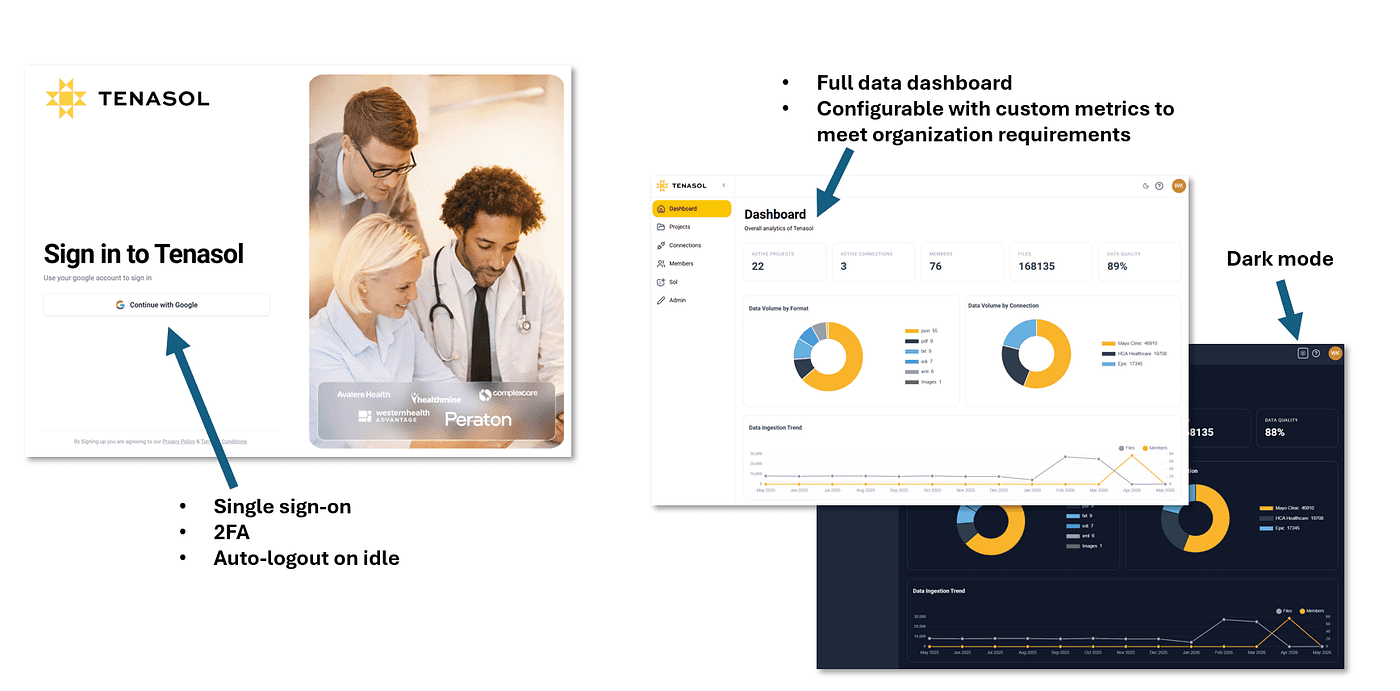
Tenasol’s FHIR Viewer
The future of HEDIS lies in a full transition to digital Quality Measures (dQMs), with a growing emphasis on real-time, interoperable data exchange. Tenasol is well-positioned to support clients making this transition, as our platform natively supports the transformation of all available data to FHIR, in addition to providing tools for IT teams to visualize and validate evidence, optimizing its use for digital quality. Health plans should begin taking the following steps:
Interoperability Readiness: Strengthen your interoperability infrastructure and ensure your systems can support FHIR-based data exchange.
Digital Data Source Expansion: Collaborate with EHR vendor partners to access and aggregate digital clinical data.
FHIR Enablement: Work with EHR vendors or vendors like Tenasol to ensure data can be sent in FHIR format. Plans without FHIR capabilities should use tools like the Tenasol FHIR Transformation Solution, which enables ingestion and conversion of data from any format to FHIR.
Year-Round Quality Infrastructure: As MY2026 removes per-SSoR submission requirements, plans should invest now in unified data pipelines capable of aggregating ECDS data across all sources continuously — not just during HEDIS season.
The future of HEDIS is focused on digital quality. Plans that proactively invest in digital transformation and data quality will be better positioned to meet the evolving demands of HEDIS. To test and explore the Tenasol FHIR tool, click this link.
2025–2026 LLM Implementation
2025–2026 LLM Implementation
In 2024, Tenasol took initial steps in testing and benchmarking LLM approaches across its product suite. The landscape has evolved significantly since then:
- Summarization remains the ideal LLM use case in healthcare, where controlled, verifiable output is essential. Plans that deployed generic AI without grounding it in structured clinical data faced inaccurate outputs and eroded trust — reinforcing that AI cannot guess in healthcare. Tenasol addresses this today through practices such as Retrieval-Augmented Generation (RAG), grounding every summarization output in verifiable source data rather than relying on a model’s unguided output.
- Generative LLM costs dropped dramatically in 2024 and continued to fall through 2025 via model compression techniques, making production deployment increasingly viable for high-volume use cases.
- Non-generative LLM classifiers remain cost-effective and highly accurate. As of 2026, Tenasol has completed QA and is in wider production deployment of LLM-based classifiers across its quality and risk adjustment products.
- Agentic AI is emerging as the next frontier — with health plans beginning to deploy AI agents for end-to-end transactional workflows including prior authorization status, member engagement, and clinical data retrieval. Tenasol has already built generative AI summarization tools and agentic capabilities directly into its platform UI, enabling clients to interact with clinical data conversationally and generate insights on demand — without needing to build custom integrations or write queries.
Conclusion
Tenasol’s continued investment in digital innovation — particularly in FHIR transformation and LLM integration — demonstrates a clear commitment to accelerating quality measurement and abstraction for health plans. Lessons from 2024 and 2025 confirm the value of real-time, multi-source data processing, emphasizing speed, interoperability, and reuse across quality and risk programs.
As NCQA’s MY2026 specifications usher in the most significant HEDIS format overhaul in over two decades, health plans face a clear mandate: modernize now or fall behind. Organizations that proactively unify their clinical data infrastructure, invest in FHIR readiness, and partner with proven AI vendors will be best positioned for sustainable, scalable quality performance.
Tenasol’s scalable tools — including its FHIR Viewer, transformation engine, and LLM-based classifiers — enable health plans to activate clinical data across every program, in real time, at enterprise scale. Digital transformation is no longer optional. It is the foundation of competitive quality performance in 2026 and beyond.
See our platform overview here | Learn more about clinical data strategy here | Book a demo today
메타데이터
- post_id
- 200ffad32efa
- slug
- hedis-2025-what-health-plans-must-do-now-to-prepare-for-digital-quality-measures-200ffad32efa
- url
- https://medium.com/@tenasol/hedis-2025-what-health-plans-must-do-now-to-prepare-for-digital-quality-measures-200ffad32efa
- canonical_url
- https://medium.com/@tenasol/hedis-2025-what-health-plans-must-do-now-to-prepare-for-digital-quality-measures-200ffad32efa
- author_url
- https://medium.com/@tenasol
- status
- ok
- fetched_at
- 2026-08-06 11:15:05