HOW GEOMETRY AND BASIC MATH REDUCE ELECTRICAL NOISE
Have you ever wondered how twisted-pair cables help reduce electrical noise without any shielding at all?
HOW GEOMETRY AND BASIC MATH REDUCE ELECTRICAL NOISE
Have you ever wondered how twisted-pair cables help reduce electrical noise without any shielding at all?
Let's dive in.
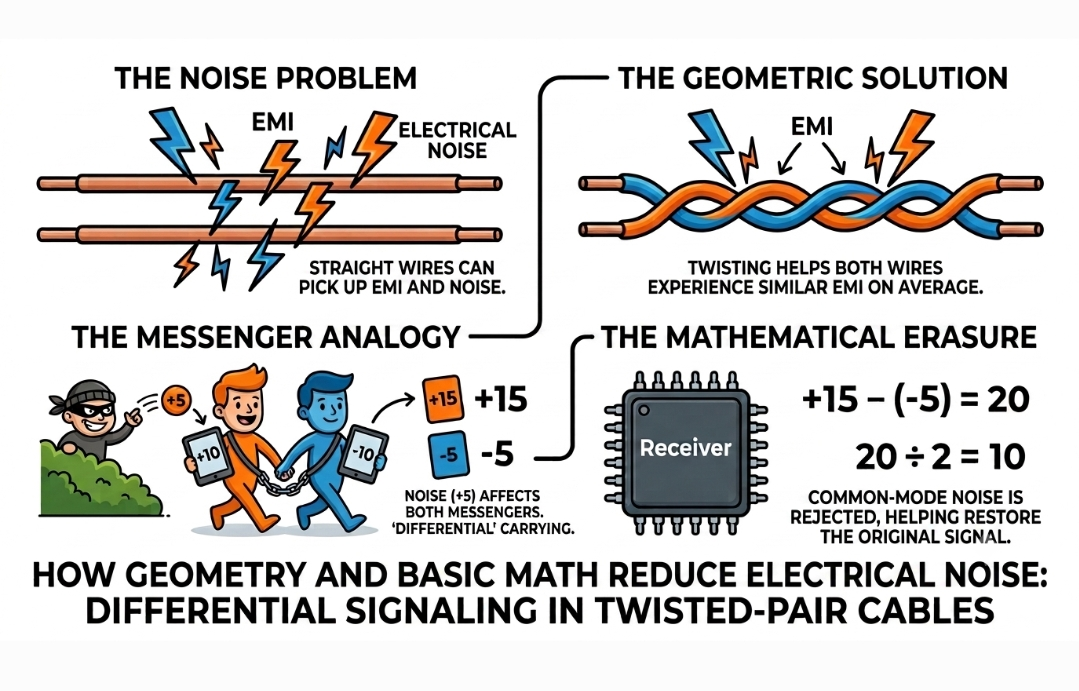
If you take two unshielded copper wires and lay them flat, they can pick up electromagnetic interference from nearby power lines, radios, motors, and other sources.
Now, if you twist those same wires around each other, the amount of noise picked up by the pair can be greatly reduced.
Twisted-pair cables carry enormous amounts of data across networks worldwide, often achieving high data rates without requiring heavy metallic shielding.
The secret involves two things working together: Twisting + Differential Signaling.
Differential signaling allows the receiver to reject noise that appears similarly on both conductors.
To visualize this, imagine two messengers, Kelvin and Augustine, tasked with delivering a critical value, let's say 10, across a chaotic valley where random bandits constantly throw fake numbers into passing messages.
If Kelvin goes alone carrying a 10, and a bandit throws a +5 at him, he arrives with 15 and the data gets corrupted.
Instead, the sender uses both messengers. Kelvin carries +10, while Augustine carries the mathematical opposite: −10.
Because they are walking closely together, the bandits affect both messengers in approximately the same way. Now, let's say a random +5 hits both of them.
Kelvin arrives with: +10 + 5 = +15 Augustine arrives with: −10 + 5 = −5 The receiver then subtracts Augustine's signal from Kelvin's: 15 − (−5) = 20 And divides by two: 20 ÷ 2 = 10 The original value is recovered.
The common interference has been rejected because it appeared on both signals in the same way. That's the basic idea behind common-mode rejection.
The receiver's ability to reject common-mode signals is quantified by something called Common-Mode Rejection Ratio (CMRR).
Now comes the physical part that makes the whole system work even better.
Assuming the two wires ran parallel to each other, a noise source closer to one conductor could couple more strongly into that conductor than the other. The resulting interference would no longer be perfectly equal, meaning some noise would remain after subtraction.
Twisting changes the geometry. As the pair travels along the cable, the two conductors continually swap physical positions. The conductor that is closer to the noise source in one section becomes farther away in another.
Over the length of the cable, this helps the two conductors experience much more similar interference. When the interference is similar on both conductors, the differential receiver can reject much of it.
So there are really two complementary ideas at work: Differential signaling gives us mathematical rejection. Twisting helps create the physical conditions that make that rejection effective.
메타데이터
- post_id
- 201d949b33af
- slug
- how-geometry-and-basic-math-reduce-electrical-noise-201d949b33af
- url
- https://medium.com/@alexanderachuga/how-geometry-and-basic-math-reduce-electrical-noise-201d949b33af
- canonical_url
- https://medium.com/@alexanderachuga/how-geometry-and-basic-math-reduce-electrical-noise-201d949b33af
- author_url
- https://medium.com/@alexanderachuga
- status
- ok
- fetched_at
- 2026-08-18 22:43:10