Your $800 Espresso Machine Might Be One Scale Buildup Away From a Replacement
The engineering decision hiding inside every all-in-one espresso machine — and why most buyers only discover it too late
Your $800 Espresso Machine Might Be One Scale Buildup Away From a Replacement
The engineering decision hiding inside every all-in-one espresso machine — and why most buyers only discover it too late

I once watched someone spend £750 on an all-in-one espresso machine, use it daily for two years, and then watch it die in a way that a repair shop described, without apparent irony, as “terminal.”
The cause wasn’t abuse. It was tap water.
Scale — dissolved calcium carbonate — had blocked a micro-channel inside the heating element. The channel was so narrow that descaling fluid couldn’t flow through to dissolve it. The element couldn’t be opened. The only fix was a new heater assembly, which cost more than made financial sense to pursue.
She bought a replacement. It was the same model.
This isn’t an edge case. It’s a structural consequence of a specific heating architecture that a significant portion of all-in-one espresso machines under $1,000 use. And it’s almost never mentioned in the marketing.
The thing the spec sheets don’t tell you
When you’re evaluating all-in-one espresso machines in the sub-$1,000 bracket, the comparison sites give you the same information: grind settings, boiler temperature, steam pressure, footprint dimensions. They compare what’s easy to measure.
What they rarely compare is what happens to those machines over time, and more specifically, how they fail.
There are two fundamentally different approaches to heating water in this category. The choice between them has more practical impact on long-term ownership than almost any other spec on the sheet.
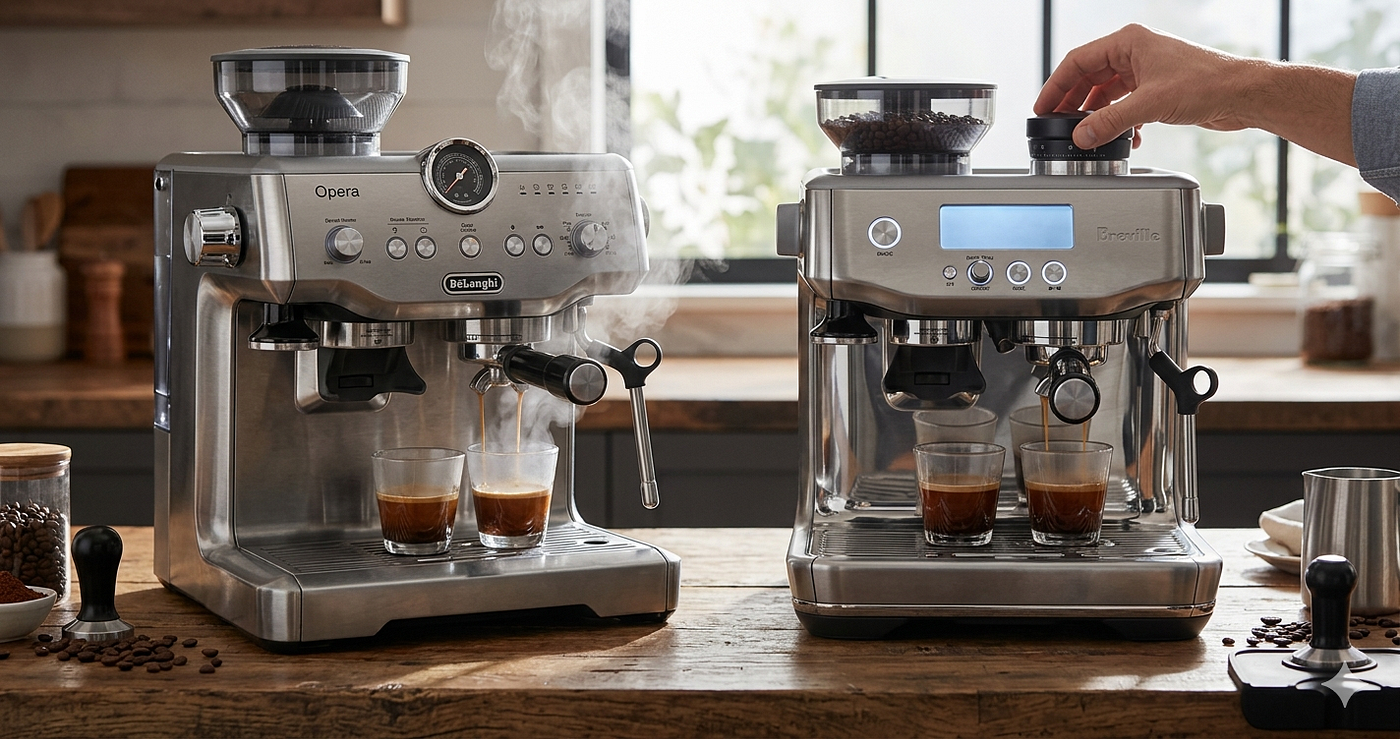
The first approach — used in machines like the Breville Barista Pro — is a rapid-heating element that pumps water through a narrow, stainless-steel-lined fluid path embedded in an aluminium block. Breville calls theirs the ThermoJet. It heats water in 3 seconds. No waiting, no ritual warm-up, no planning your morning around a ten-minute preheat cycle. For a lot of people, that immediacy is genuinely useful.
The second approach is a traditional boiler — a sealed chamber, typically brass, that holds a volume of hot water ready for extraction. The Lelit Anita uses a 250ml brass boiler. You heat it up for about ten minutes before you use it. In exchange, you get something the ThermoJet design fundamentally cannot offer: thermal mass.
Thermal mass is physics, not marketing. Brass is dense. It holds heat. When cold water enters the boiler during a shot, the temperature drop is gradual and small, because the mass of the metal absorbs and buffers the change. The shot extracts at a more consistent temperature. The flavour is more even.
With a ThermoJet, there’s no reservoir to buffer anything. The PID controller compensates electronically, adjusting the element’s output in real time. It’s impressive engineering. It’s also a permanent compromise.
The scale problem, explained plainly
Here’s what happens in hard water areas — which is most of the UK and a substantial part of the US.
When water is heated above roughly 60°C, dissolved calcium bicarbonate breaks down and precipitates as calcium carbonate. That’s limescale. It deposits on whatever surface it touches.
In a large brass boiler, scale accumulates on the interior walls and settles at the bottom. The chamber is spacious. Flow isn’t impeded by the early stages of buildup. You descale periodically — the chemical agent flows freely through the open chamber, dissolves the deposits, and the boiler works as normal.
In a narrow-channel heating element, scale deposits somewhere more difficult: inside a passage the diameter of which is measured in fractions of a millimetre. A small amount of buildup can restrict flow meaningfully. A moderate amount can block it entirely.
And here’s the part that matters: if a micro-channel becomes fully blocked, the descaling agent cannot reach the deposit. It can’t flow to where the problem is. You’re left with a blockage that chemical cleaning cannot solve, inside a sealed element that mechanical cleaning cannot reach.
The result is a heater that needs replacing. Not a descale cycle. A component replacement.
This isn’t speculation — it’s a failure mode documented in home espresso communities and noted by independent reviewers. It doesn’t happen to every machine. It’s more likely in hard water areas, with infrequent descaling, over longer ownership periods.
But the Lelit Anita’s brass boiler is architecturally immune to this specific failure. Scale settles in an open chamber. Descaling works. The machine stays functional.
The grinder gap nobody budgets for
There’s a second dimension to this category that gets less attention than it deserves.
Most integrated grinders under $1,000 use stepped adjustment mechanisms — physical click-stops that move the burrs to a fixed position. The Breville Barista Pro has 30 of them. The DeLonghi La Specialista Prestigio has 8.
Thirty steps sounds like a lot until you’re trying to dial in a light-roast Ethiopian natural that wants to extract somewhere between step 14 and step 15.
Specialty coffee is unforgiving at the margins. The difference between a shot that tastes sour and underdeveloped and one that tastes balanced can be a grind adjustment of 20 microns. Stepped grinders don’t work in microns. They work in clicks.
The Lelit Anita’s integrated grinder is stepless — the adjustment knob turns freely, without detents, allowing you to move the burrs any distance you want. It’s the same fundamental mechanism as standalone grinders that cost several hundred pounds on their own. In an integrated machine under $1,000, it’s unusual.
This matters more as your taste in coffee develops. If you start with supermarket beans and dark roasts, a 30-step grinder is entirely adequate. If you end up chasing single-origins and subscription roasters — which a lot of people do, once they start paying attention — you’ll eventually want more precision than a stepped mechanism can give you.
The apartment problem
A note for anyone buying in a shared building or living somewhere where sound carries.
Vibration pumps in espresso machines run at around 50–60 Hz and produce a characteristic whine that, when transmitted through a metal chassis without damping, becomes genuinely unpleasant to share a wall with.
The Solis Grind & Infuse Perfetta uses a belt-driven grinder — a mechanism where the motor and burr assembly are physically decoupled by a belt, rather than attached directly. The belt absorbs vibration. The chassis doesn’t resonate. Independent testing by Whole Latte Love measured it at 71–72 dB during grinding, which is meaningfully quieter than direct-drive alternatives.
If noise is your primary constraint — early mornings, thin walls, a partner who doesn’t share your enthusiasm for the hobby — the Solis is probably your machine. Its 54mm portafilter also fits within the much wider ecosystem of third-party accessories, unlike the Lelit Anita’s non-standard 57mm LELIT57 system.
What the specs actually mean in practice
The Breville Barista Pro is a good machine for someone who wants to start making decent espresso without a steep learning curve. Three-second heat-up, guided workflow, consistent results. The ThermoJet trade-offs matter more in hard water areas and over longer ownership periods — if you descale regularly and replace it in five years, the architecture probably won’t catch you.
The Lelit Anita is for someone who thinks about ownership differently. Ten-minute warm-up and a non-standard portafilter ecosystem are real inconveniences. But a brass boiler that’s been in commercial espresso machines for decades, a stepless grinder, and modular internal construction using standard industry parts — that’s a machine you can reasonably expect to maintain for ten years without specialist intervention. Lelit publishes spare parts diagrams. The pump is a standard Ulka unit available from dozens of distributors.
The Solis Perfetta sits between them in terms of ambition and trades some precision for quiet.
None of these machines is the wrong answer. They optimise for genuinely different things.
The question worth asking, before you buy, is which trade-offs you’re actually prepared to live with — and which ones you won’t discover until year three.
Technical specifications sourced from manufacturer product pages, specialist retailers including Whole Latte Love and iDrinkCoffee, and official instruction manuals. Find the full comparison and buying guide at BrewPrecision.com.
메타데이터
- post_id
- 203c12bbaf6b
- slug
- your-800-espresso-machine-might-be-one-scale-buildup-away-from-a-replacement-203c12bbaf6b
- url
- https://medium.com/@brewprecision/your-800-espresso-machine-might-be-one-scale-buildup-away-from-a-replacement-203c12bbaf6b
- canonical_url
- https://medium.com/@brewprecision/your-800-espresso-machine-might-be-one-scale-buildup-away-from-a-replacement-203c12bbaf6b
- author_url
- https://medium.com/@brewprecision
- status
- ok
- fetched_at
- 2026-07-15 02:14:29