週クラ | Shuukura – Silenced Desires: Consumption and Identity in Sendai and Miyagi
週クラ | Shuukura – Silenced Desires: Consumption and Identity in Sendai and Miyagi

Many young adults in Japan live in tiny apartments, yet continue to consume relentlessly. They are often described as “Happy Victims”, victims of luxury brands and large corporations. And yet, each purchase does bring them a fleeting sense of happiness.
In a highly homogenized society that places strong emphasis on outward presentation, identity and class imagination are compressed into visible, displayable symbols. Within such a structure, individual choice is often pre-conditioned long before it is consciously made.
Out of fear of disturbing or burdening others, people refrain from seeking help. Out of a greater desire to preserve the atmosphere rather than assert their own will, they find themselves unable to say what they truly want, unless it is mediated through spending money.
This is a place of deep repression, so repressive that it renders people voiceless. It becomes difficult to genuinely articulate one’s desires, and so people turn to money as a means of purchasing anything connected to longing or expression.
The more repressive the society, the more fragmented and specialized desire becomes.
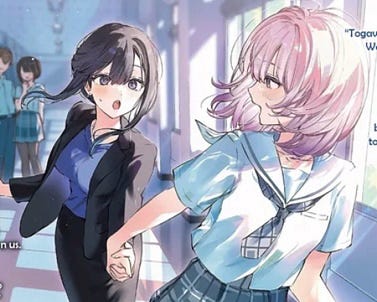
Sendai and Miyagi are no exception; in fact, they reflect these conditions in different ways. Sendai was raised in a superficial family, and after losing the conditional love of her parents, she leans even further into being a people pleaser. She is afraid to voice her true opinions, afraid of appearing “angry” and damaging her image. Miyagi describes her as a “normie,” which suggests that despite Sendai’s outstanding appearance, vibe, and style, she is ultimately a product of this highly homogenized, appearance-driven society. Her conformity is so deeply ingrained that she feels compelled to wear makeup to school and spend time, money, and effort curling her hair every day. When Miyagi visits her while she is sick, Sendai’s first thought is not relief, but anxiety – “She’s going to see me without makeup, with messy hair.” Yet Miyagi does not care. To her, this is the real Sendai: imperfect, vulnerable, and unguarded.
Miyagi, on the other hand, responds differently to the same social pressures. In a society so repressive that it silences authentic expression, she turns to other outlets. She reads a wide range of manga and even demands Sendai to read explicit material. For Miyagi, manga becomes a vehicle for escaping reality. It is a space where desire and expression can exist without constraint. In her view, without spending money, she cannot truly express what she wants or even understand what it is she wants to say. Sendai becomes the embodiment of Miyagi’s desires. That’s why at the beginning of the story, before the characters starts to get emotionally attached, Sendai was basically an outlet for one’s desires, she was objectified, like how she was also objectified in school. Thus, it’s natural for Miyagi to assume that “If I don’t pay Sendai, she won’t even want spend time with me”.
This analysis is inspired by a Douyin video analysis of Japanese’s porn industry:
메타데이터
- post_id
- 20570b7eeb06
- slug
- 週クラ-shuukura-silenced-desires-consumption-and-identity-in-sendai-and-miyagi-20570b7eeb06
- url
- https://medium.com/@manner0.006/%E9%80%B1%E3%82%AF%E3%83%A9-shuukura-silenced-desires-consumption-and-identity-in-sendai-and-miyagi-20570b7eeb06
- canonical_url
- https://medium.com/@manner0.006/%E9%80%B1%E3%82%AF%E3%83%A9-shuukura-silenced-desires-consumption-and-identity-in-sendai-and-miyagi-20570b7eeb06
- author_url
- https://medium.com/@manner0.006
- status
- ok
- fetched_at
- 2026-06-22 05:41:33