“Marxism, What Are You Doing in My Swamp?”
Think of your average animated family-friendly comedy, like Shark Tale, Madagascar, or Rio. Most of its contents are silly jokes for kids…
“Marxism, What Are You Doing in My Swamp?”
Source: Shrek 2
Think of your average animated family-friendly comedy, like Shark Tale, Madagascar, or Rio. Most of its contents are silly jokes for kids to giggle and parents to roll their eyes at, and the plot itself isn’t to be taken seriously. The same thing goes for Shrek 2. Shrek 2 is intended to be a funny, satirical comedy for the whole family to enjoy, and nothing more. However, Shrek has more mature themes than meets the eye. One could say… it has layers (pun intended). Surprisingly, Marxism is an identifiable theme in Shrek. Unlike your average family-friendly comedy, the film displays clever commentary on social classes. It uses Shrek as a model for demonstrating how the high, rich classes and the low, poor classes clash because of their differences. After falling in love despite their class differences, in Shrek 2, Shrek and Fiona get married and visit Fiona’s royal family in the kingdom of Far Far Away. Shrek is nervous to go because he knows he won’t fit in, but he goes anyway to make Fiona happy. Once he gets to the kingdom of Far Far Away, Shrek realizes just how much he doesn’t belong there, and while Shrek lives in a satirical fairy tale world, he finds himself in a society just like our own.
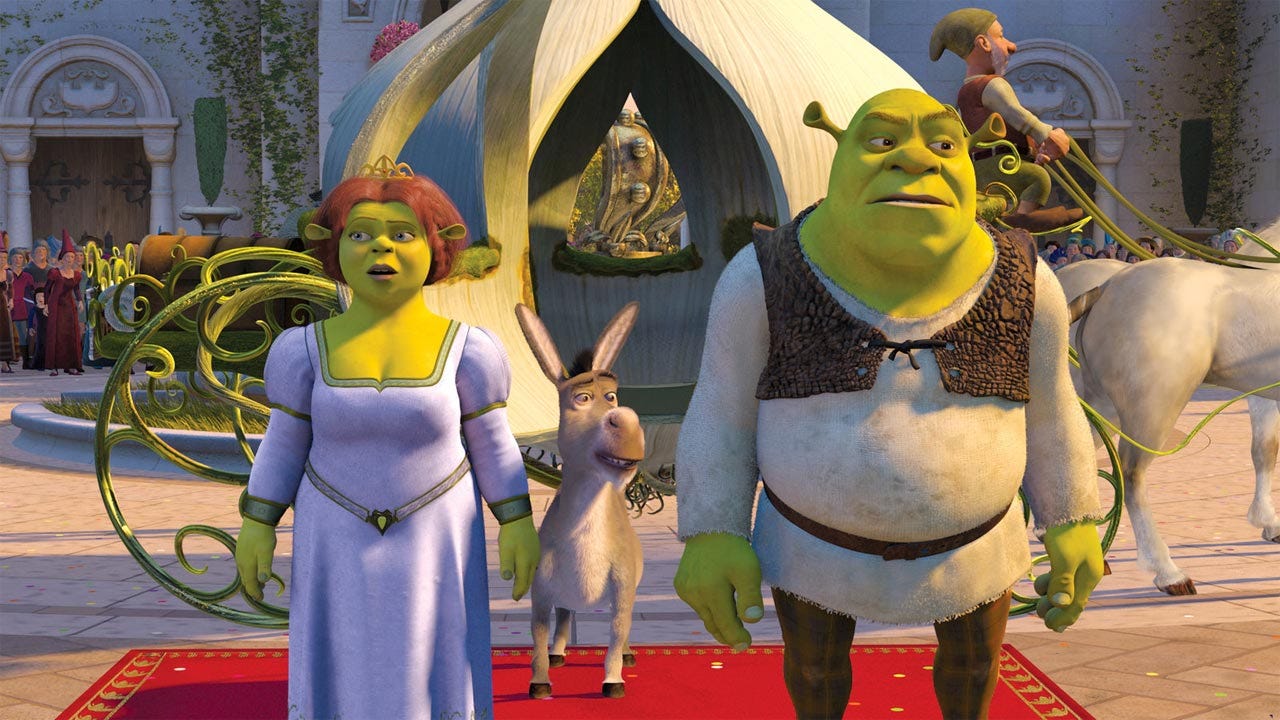
Shrek and Fiona arriving in Duloc in their low-class onion carriage. Source: Shrek 2
One reason why Shrek ultimately thinks the kingdom of Far Far Away isn’t a good place for him to go is the fact that he, like the rich high-class royalty, has stereotypes about the other end of the social hierarchy. As soon as Shrek and Fiona hear the news that Fiona’s parents want them to visit them in Duloc, Shrek immediately denies and is against the idea. He retorts: “Somehow I don’t think I’ll be welcome at the country club.” Fiona pleads with Shrek to try to get him to give her parents a chance. Shrek replies with “To do what? Sharpen their pitchforks?” Shrek, being a low-class ogre, assumes all high-class people are ogre-hunting, violent individuals who indulge themselves in rich people activities that he deems as meaningless, such as going to the country club. Similarly, King Harold has his doubts about welcoming Shrek into the family once he sees him arrive at the castle, overtly showing his disdain for Shrek’s ogre appearance. Later on in the film, King Harold exclaims: “Not while I’m king! I will not have this… this ogre ruining my daughter’s life!” By addressing Shrek simply by what he is dehumanizes Shrek and reduces him to what he is in a derogatory way.
The higher classes ultimately think that them and the lower class shouldn’t mix. This idea goes all the way back to the first Shrek movie. Fiona is locked in a tower for her own protection from her ogre curse and can only be awoken by true love’s kiss of a prince. Fiona’s happily ever after included a rich and royal husband, because she herself was rich and royal. But the sheer fact that in the end she ended up with someone of her true class deep down (ogre and ogre), shows that the pure high class and those who are a little different, therefore essentially lowering them a class, are never able to mix. When Prince Charming pretends to act like Shrek after Shrek turns himself into a human for Fiona’s family, it ultimately never ends up working out because Fiona loved the real Shrek. In a similar fashion, King Harold conspired with the Fairy Godmother because he didn’t want his daughter to be with someone of a low class such as Shrek’s and drag her down further than she already was. Then he tried to set them up because Prince Charming was everything that Shrek wasn’t. Similarly, Shrek also felt the need to change himself so that Fiona’s parents would like him, thus prompting him to drink a potion that would turn him into a human, which ultimately shows the struggle to make relationships work out between the high class and the low class.

Source: Shrek 2
Physically, the characters who are rich are dressed more kempt and elegant, wearing clothes crafted from rich fabrics and strutting all the trendy, coiffed hairdos for the hyper-consumerist, conforming high class. Meanwhile, Shrek and his band of fairytale outcasts are raggedy, wearing dirty or stained clothes, and not fitting any of the beauty standards of the high class whatsoever (thin, human, and fit). What was also interesting is that all the high-class individuals in the film speak with a posh British accent. Both Fiona’s parents are British despite Fiona not sounding British herself. Could this be a result of Fiona being locked away in a tower and somehow picking up an American accent? The chances of that are low, even for a satirical world such as Shrek 2’s. This was probably DreamWorks utilizing the stereotype that British people are more fancy than Americans, thus prompting them to use British accents for the high class and American (and in Shrek’s case, Scottish) accents for the lower class. Additionally, their mannerisms are depicted completely differently. While the rich enjoy things like the country club, royal balls swarmed with paparazzi, and groveling in their wealth overall, Shrek and his low class friends enjoy watching tournaments on the television, bathing in mud, laughing loudly and making inappropriate jokes, chewing sloppily, etc. Wealth directly has an impact on behavior in the film. As Fiona strays furhter away from her princess identity, she assimilates into ogre culture by bathing in the mud with Shrek and living in the Swamp. On the other hand, when Shrek is exposed to the lavish, royal lifestyle of the kingdom of Far Far Away, he is prompted to change himself to try to fit the standards of his surroundings, whereas if he was still in the humble swamp, he would be free to be himself.

Shrek and Fiona meeting King Harold and Queen Lillian. Source: Shrek 2
However, this is not to say that the high and lower classes don’t get along at all. At the end of the day, despite their differences, Shrek and Fiona’s Dad, as well as the lower classes and the higher classes in general, have a lot more in common than what the film depicts overall. When Shrek first arrives in Duloc and realizes they’re being judged, he whispers to Fiona: “Happy now? We came. We saw them. Now let’s go before they light the torches.” Meanwhile, Harold whispers to Fiona’s mom, Queen Lillian, “Good! Here’s our chance. Let’s go back inside and pretend we’re not home.” While both express their utter hatred for each other, they are united by feelings of hatred, a mutual feeling. This can physically be seen in their food fight when the King engages in “low class” behavior with Shrek and throws food across the table and angrily eats like a pig, because of his annoyance by Shrek. The high class and the low class also partake in high-consumerist culture that exists in the kingdom of Far Far Away. At the beginning of the film, many fast food and fashion chain parodies can be seen, such as Farbucks Coffee for Starbucks Coffee, Fiar’s Fat Boy for Burger King, Olde Knavery for Old Navy, etc. The peasants of the kingdom can be seen shopping at these places at the start of the film, but further into it, the Fairy Godmother and Prince Charming are seen ordering at the drive thru of Friar’s Fat Boy. Even though both social classes are separated by how much money they earn, they are unified by their love of fast food and consumerism as a whole.

Source: Shrek 2
Ultimately, Marxism is too strong a force to not inevitably end up in children’s films, as it’s all that consumes us on a daily basis, and writing a content-rich plot that would exclude it is virtually impossible. Shrek 2 overall does a great job in displaying the clash between social classes in clever ways, whether it be through parodies of popular culture or simply through little details like accents. What Shrek 2 also serves to preach is that when all is over and done with, true love trumps social class, which seems to be a prominent theme in a lot of family-friendly movies today. Shrek 2 spreads the message also that it does not agree with the social class dynamics that occured in the film by showing that Fiona and Shrek can have a happy ending despite the amount of money/privalege or lack thereof either of them may have.
메타데이터
- post_id
- 205aa661fdf3
- slug
- marxism-what-are-you-doing-in-my-swamp-205aa661fdf3
- url
- https://medium.com/@isabellasantucci/marxism-what-are-you-doing-in-my-swamp-205aa661fdf3
- canonical_url
- https://medium.com/@isabellasantucci/marxism-what-are-you-doing-in-my-swamp-205aa661fdf3
- author_url
- https://medium.com/@isabellasantucci
- status
- ok
- fetched_at
- 2026-08-21 12:39:01


