Twin-Delayed DDPG (TD3) for Intelligent Robot Agents Explained
Imagine a future in which robots run, jump, and navigate difficult terrain with the grace of a living creature. That scenario is no longer…
Twin-Delayed DDPG (TD3) for Intelligent Robot Agents Explained
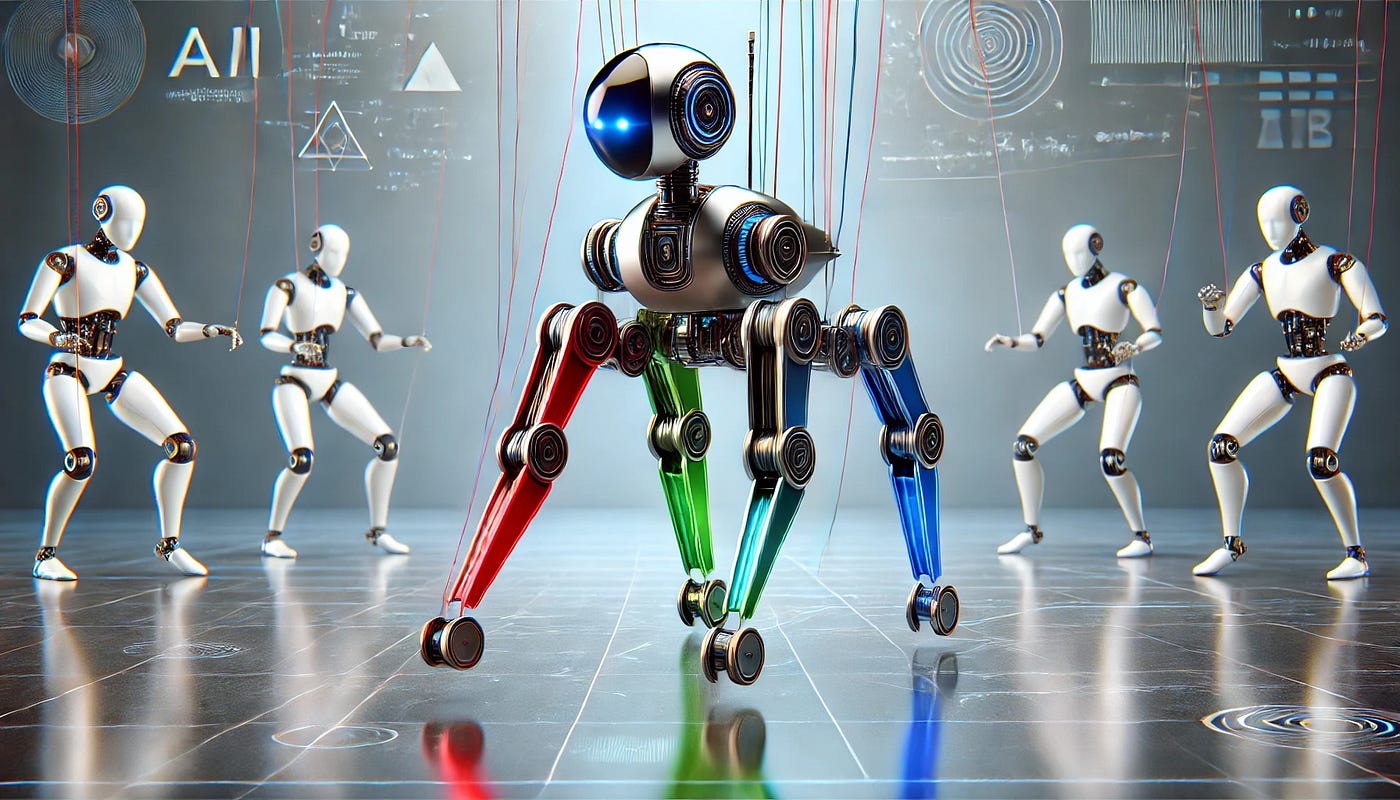
How can Twin-Delayed DDPG (TD3) learn to control complex robot motion. Image created by DALL-E.
Imagine a future in which robots run, jump, and navigate difficult terrain with the grace of a living creature. That scenario is no longer confined to science fiction. A fundamental algorithm of this trend is the Twin-Delayed Deep Deterministic Policy Gradient (TD3) algorithm, a powerful innovation in Artificial Intelligence that pushes the boundaries of how robots learn and move. By today “Addressing function approximation error in actor-critic methods” has attracted more than 6600 citations on Google Scholar since its publication on ICML 2018. We now live in an age where robots increasingly assist in manufacturing, healthcare, and exploration. With these rising demands, researchers constantly look for robust methods to make machines adapt quickly and operate autonomously. The work on TD3 stands out as highly relevant because it tackles the challenge of continuous control: Instead of robots making merely on/off decisions, they must fine-tune an infinite range of motions — like a human expertly balancing on one leg or gracefully sprinting forward.
What is the aim of TD3?
Deep Reinforcement Learning aims to produce an “intelligent agent” that can learn by trial and error, receiving rewards or penalties for its actions. Traditional methods, such as the original Deep Q-Network (DQN), excelled at problems with clearly defined, discrete moves, like playing Atari games. However, real-world tasks — controlling a robotic arm, flying a drone, teaching an AI-driven ant-like robot to walk — often require continuous, fine-grained adjustments in every joint or movement. That is where TD3 truly shines. It cleverly combines three key ideas: policy gradient (for guiding actions directly), actor-critic methods (where one network proposes actions while another scores them), and double Q-learning (to reduce overestimations that can derail training). This marriage of techniques better handles continuous, high-dimensional spaces. Put simply, it is ideally suited for tasks like robot locomotion.
What are the basic ingedients to build TD3?
In this remarkable study, researchers set out to demonstrate the prowess of TD3 by teaching a four-legged “ant-like” robot to run across a virtual field. Led by Stephen Dankwa and Wenfeng Zheng at the University of Electronic Science and Technology of China, the team built on earlier advances — like Deterministic Policy Gradient (DPG) and Deep Deterministic Policy Gradient (DDPG) — but sought to overcome some of those methods’ shortcomings. They designed a computer simulation (using the PyBullet physics engine and the OpenAI Gym interface) where the ant robot receives a reward for forward movement. The robot, however, is not pre-programmed with how to walk. Instead, it tries out different ways of moving its legs, learns from the results, and gradually improves, thanks to the feedback loops provided by the TD3 algorithm.
How TD3 Works Step by Step
- Initialize Networks and Memory: The algorithm begins by initializing two critic networks Qθ1 and Qθ2, an actor network πϕ, and their corresponding target networks with identical initial parameters. A replay buffer B is also set up to store past experiences.
- Gathering Experience: At each time step, the agent selects an action using the actor network with added exploration noise ϵ drawn from a normal distribution. The agent executes this action in the environment, observes the reward r and the new state s′, and stores this experience as a transition tuple (s,a,r,s′) in the replay buffer.
- Learning from Experience: A random batch of past experiences is sampled from the replay buffer. The next action a~ is generated using the target actor network, with added clipped noise to prevent overestimation. A target value y is computed using the minimum estimate from the two target critics to reduce bias.
- Updating the Critic Networks: The critic networks are updated by minimizing the mean squared error (MSE) loss between their predictions and the target value y.
- Updating the Actor Network (Periodically): Every d time steps, the actor network is updated using the deterministic policy gradient, which improves the policy by maximizing the expected value of the first critic’s estimate.
- Soft Update of Target Networks: The target networks are slowly updated towards the current networks using a soft update mechanism controlled by the parameter τ, ensuring gradual and stable learning.
- Repeat Until Completion: The process continues iteratively, allowing the agent to improve its policy and critics over time, leading to better decision-making in a continuous action space.
What did they do better than others?
Training a virtual robot to move might seem straightforward, but it requires astonishing computing power and careful coordination. The researchers implemented not one but four separate neural networks: two “critic” networks that evaluate the quality of the robot’s chosen actions, plus an “actor” network and its slowly updated “target” copy that propose which action to take next. During each training cycle, the “actor” improves at suggesting better leg movements, while the “critics” keep an eye on overall performance to guide the actor’s learning. To implement this multi-network system, the study authors used two-layer neural networks with up to 400 and 300 hidden nodes, employing Rectified Linear Units (ReLUs) as activation functions and a final tanh layer for the output. They also introduced carefully tuned noise to keep the robot exploring new actions instead of always repeating the same motions. All of this was orchestrated through thousands upon thousands of simulated attempts and updates.
Which Results Emerged?
TD3 was evaluated on a suite of MuJoCo continuous control tasks, including HalfCheetah, Hopper, Walker2d, Ant, Reacher, InvertedPendulum, and InvertedDoublePendulum, using OpenAI Gym. The results demonstrate that TD3 consistently outperforms or matches the performance of leading policy gradient methods. Compared to DDPG, both in its original and re-tuned versions, as well as other state-of-the-art approaches such as Proximal Policy Optimization (PPO), Trust Region Policy Optimization (TRPO), Soft Actor-Critic (SAC), and Actor-Critic using Kronecker-Factored Trust Region (ACKTR), TD3 exhibits superior stability and efficiency in learning optimal policies.
A closer examination reveals that TD3 achieves the highest maximum average return in nearly all tested environments. Particularly in more challenging tasks such as HalfCheetah, Hopper, Walker2d, and Ant, TD3 consistently surpasses DDPG and other baseline methods, highlighting its robustness and ability to handle complex control problems. In environments like Reacher and InvertedPendulum, where performance across different algorithms remains relatively stable, TD3 still matches the best-performing approaches, demonstrating its reliability across a diverse range of tasks.
Ablation studies further confirm the critical role of TD3’s key components. The removal of any of the three core elements — Clipped Double Q-learning, Delayed Policy Updates, or Target Policy Smoothing — results in a notable decline in performance, reinforcing their importance in achieving stability and efficiency. Additionally, TD3 consistently outperforms alternative actor-critic methods, such as Double Q-learning (DQ-AC) and Double DQN (DDQN-AC), by effectively mitigating overestimation bias. These findings underscore the strength of TD3’s design and its ability to refine and enhance reinforcement learning for continuous control applications.
What is possible with this technique?
The implications stretch far beyond robotic ants as the citation count shows. Think of improvements in robotic prosthetics, where a patient needs a device that adapts to uneven pavements and hills. Or advanced robotic arms that can pick delicate fruit without squashing it. Robots guided by TD3 can learn more naturally, require less manual tuning, and adapt to unseen challenges. In the long run, these methods could revolutionize warehouse automation, self-driving car navigation on unpredictable roads, and even exoskeleton suits for rehabilitation.
Is the Data Open for the World to See?
One of the most appealing aspects of this project is its openness. The authors relied on Python libraries (like PyBullet and Torch) that are widely available, and they have made it clear that the environment configurations and code are accessible for those wishing to replicate or extend their work. The open source implementation of TD3 is available on GitHub.
Conclusion: Catching the Next Wave of Intelligent Robotics
By tackling one of the toughest challenges in AI — continuous action in a high-dimensional environment — Twin-Delayed DDPG dramatically steps up a robot’s ability to learn and adapt. This research is more than a neat demonstration; it sets a new standard in how we build, train, and unleash virtual agents in the real world. The possibilities are immense, from manufacturing assistants that adjust instantly to new tasks to sophisticated medical robots that navigate complex environments. As we watch a simple ant-like robot learn to run, it is hard not to be amazed by the potential that lies ahead: a future in which machines learn from the ground up and reach levels of agility and intelligence we once thought impossible.
This post is based on this ICML 2018 Paper.
If you liked this blog post, I recommend having a look at our free deep learning resources or my YouTube Channel.
Text and images of this article are licensed under Creative Commons License 4.0 Attribution. Feel free to reuse and share any part of this work.
메타데이터
- post_id
- 20918449f2bd
- slug
- twin-delayed-ddpg-td3-for-intelligent-robot-agents-explained-20918449f2bd
- url
- https://medium.com/data-science-collective/twin-delayed-ddpg-td3-for-intelligent-robot-agents-explained-20918449f2bd
- canonical_url
- https://medium.com/data-science-collective/twin-delayed-ddpg-td3-for-intelligent-robot-agents-explained-20918449f2bd
- author_url
- https://medium.com/@akmaier
- status
- ok
- fetched_at
- 2026-06-26 12:24:55