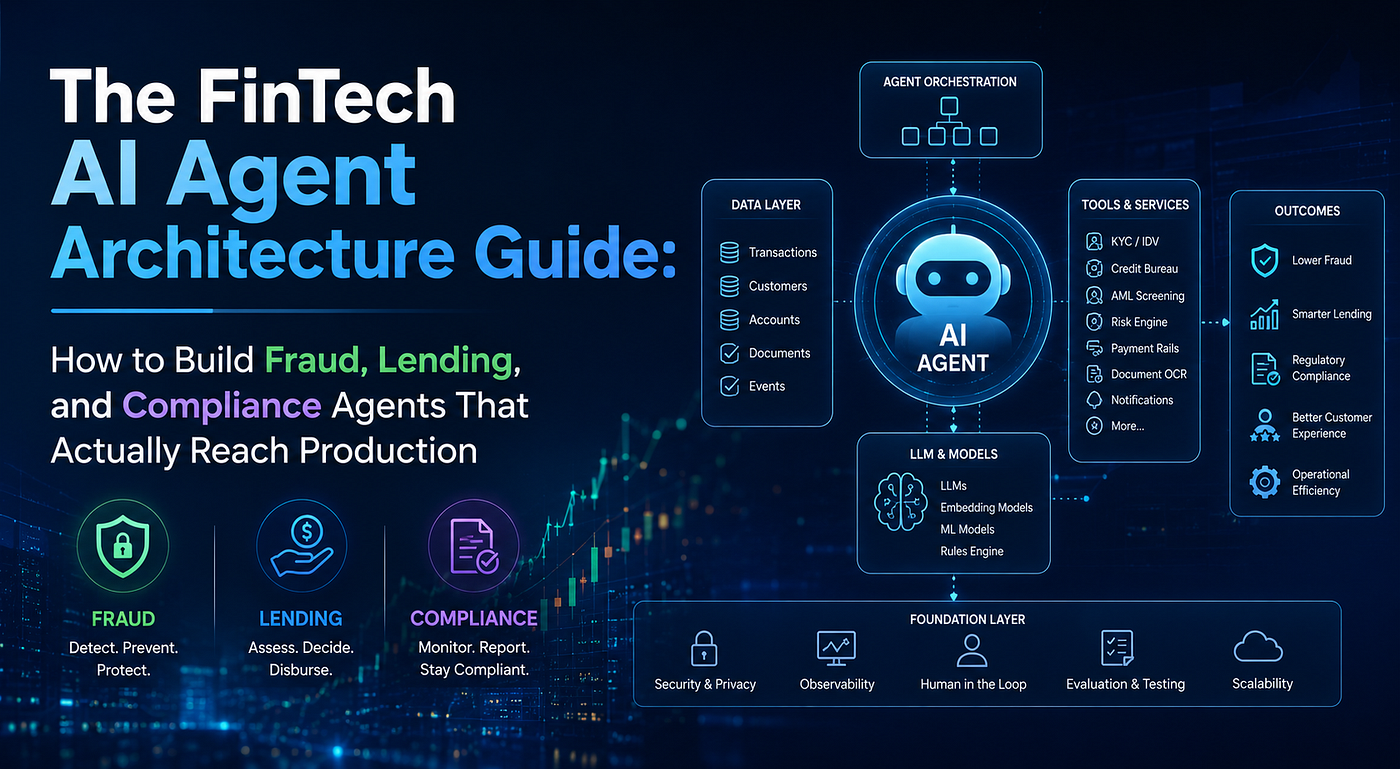
Why MCP Servers Are the Backbone of Modern FinTech AI Solutions
Imagine a scenario within a high-stakes financial institution: an AI model, brilliant and vast, has been trained on mountains of historical…
Why MCP Servers Are the Backbone of Modern FinTech AI Solutions

Imagine a scenario within a high-stakes financial institution: an AI model, brilliant and vast, has been trained on mountains of historical data. Yet, when a critical, real-time market event hits a sudden flash crash or a new regulatory mandate it freezes. Why? Because its knowledge is static and siloed, unable to securely access the live trading APIs, internal compliance databases, or up-to-the-second transaction feeds needed to act intelligently. The gap between what AI knows and what AI can do has been the industry’s biggest hurdle. This is where the Model Context Protocol (MCP) server steps in, acting as the universal “Rosetta Stone” for AI. It doesn’t just feed the AI more data; it gives the AI secure, real-time access to the tools and context necessary to move from a powerful predictor to a decisive, autonomous AI Agent. The MCP server is the indispensable backbone transforming these limited large language models (LLMs) into the powerful, actionable systems that make modern FinTech AI solutions truly feasible and scalable.
What is an MCP Server? Deciphering the Protocol
The core genius of the Model Context Protocol lies in its simplicity. It is an open standard designed to enable LLMs and other AI clients to interact with external enterprise resources in a standardized, secure, and predictable manner.
Defining MCP: The Universal Connector
An MCP Server is essentially an intermediary layer that wraps a FinTech organization’s proprietary systems like core banking platforms, risk engines, and market data feeds and exposes their functionality as a set of structured, machine-readable tools (or functions) to the AI.
The protocol ensures that when an Agentic AI wants to check a client’s credit score, execute a trade, or search an internal compliance document, it doesn’t need to learn a custom API for every single system. Instead, it speaks the standardized MCP language, and the MCP server handles the secure translation and execution. This bridging of the Knowledge Cutoff inherent in most LLMs is what makes contextual, real-time decision-making possible in finance.
The Backbone: 4 Critical Roles of MCP Servers in FinTech AI
The server component of the Model Context Protocol fulfills essential requirements that are non-negotiable in the highly regulated and complex financial sector.
A. Real-Time Contextual Intelligence and Hallucination Reduction
AI models are only as good as their input. In FinTech, outdated information can lead to millions in losses or critical compliance breaches.
- Necessity for Fresh Data: Market conditions, interest rates, and regulatory laws change by the second. An MCP server provides deterministic, verifiable data by querying live systems (e.g., market price feeds or transaction databases) and supplying the results directly to the LLM.
- Mitigating AI Hallucinations: By grounding the LLM’s output in verifiable, real-time facts drawn via the MCP, the risk of the model inventing data or procedures is drastically reduced. This verifiable Data Lineage is paramount for accuracy in financial reporting and operations.
B. Enhanced Security, Compliance, and Auditability
Perhaps the most critical function of the MCP server in FinTech is acting as the security gatekeeper and compliance layer.
- Granular Permission Models: An MCP server controls which AI agents can access which specific internal tools and data sources. This means a customer service chatbot agent can access basic account balances, but an automated fraud agent might be the only one permitted to lock a compromised account.
- Audit Trails: Every request an AI agent makes to an internal system through the MCP server is logged, authenticated, and time-stamped. This provides a detailed, immutable audit trail that is essential for satisfying regulators and proving AI compliance in case of disputes or errors.
C. Enabling Agentic AI and Complex Workflow Automation
The MCP server is the foundation for the next generation of AI: Agentic AI. These are models that don’t just answer questions but can autonomously execute complex, multi-step tasks.
- Autonomous Tasks: An MCP server allows an AI to string together multiple actions securely. For instance, a loan processing agent could: 1) Check a client’s credit score (via MCP tool 1), 2) Query internal risk assessment data (via MCP tool 2), 3) Generate a loan document (via its own generation ability), and 4) Apply the core banking system (via MCP tool 3).
- This transition dramatically accelerates time-to-market for financial services automation.
- N architecture that saves tremendous development time and reduces complexity.
D. Scalability and Interoperability (M x N vs. M + N)
Without MCP, every new AI model requires a custom, complex integration with every target financial system (an M x N problem, creating a messy web of APIs).
- By using a standardized protocol, the MCP server allows one AI model (M) to interact consistently with all financial systems (N), and all future AI models can use the same server creating a scalable M + N architecture that saves tremendous development time and reduces complexity.
Real-World Applications in Modern FinTech
MCP servers are rapidly becoming central to mission-critical applications:
- Automated Risk Management: AI agents use MCP to query real-time market risk data and instantly execute hedging strategies or alert human traders if exposure exceeds set limits.
- Advanced Fraud Detection: By connecting to multiple log and transaction databases, the AI can perform real-time semantic search to detect complex patterns of collusion or money laundering that rules-based systems miss.
- Personalized Financial Advice: Customer-facing AI assistants use MCP to pull a customer’s live portfolio, transaction history, and product eligibility criteria securely, offering highly relevant, compliant advice without human intervention.
Conclusion
The future of financial services is irrevocably tied to the capabilities of Agentic AI, and the Model Context Protocol (MCP) server is the critical infrastructure enabling this revolution. It moves AI beyond simple text generation to secure, autonomous action, addressing the two primary challenges in FinTech adoption: the need for real-time contextual intelligence and the mandate for unwavering security and compliance. By standardizing communication, providing granular access controls, and generating irrefutable audit trails, MCP servers ensure that every AI decision from fraud detection to automated trading is not just intelligent, but verifiable and compliant. FinTech institutions embracing this protocol are not just adopting AI; they are building a scalable, trustworthy foundation that future-proofs their operations, reduces the risk of AI hallucination, and ultimately unlocks the full, trillion-dollar potential of automated financial services.
메타데이터
- post_id
- 20930ecd6b4d
- slug
- why-mcp-servers-are-the-backbone-of-modern-fintech-ai-solutions-20930ecd6b4d
- url
- https://medium.com/@yash.p_60148/why-mcp-servers-are-the-backbone-of-modern-fintech-ai-solutions-20930ecd6b4d
- canonical_url
- https://medium.com/@yash.p_60148/why-mcp-servers-are-the-backbone-of-modern-fintech-ai-solutions-20930ecd6b4d
- author_url
- https://medium.com/@yash.p_60148
- status
- ok
- fetched_at
- 2026-06-09 15:37:30