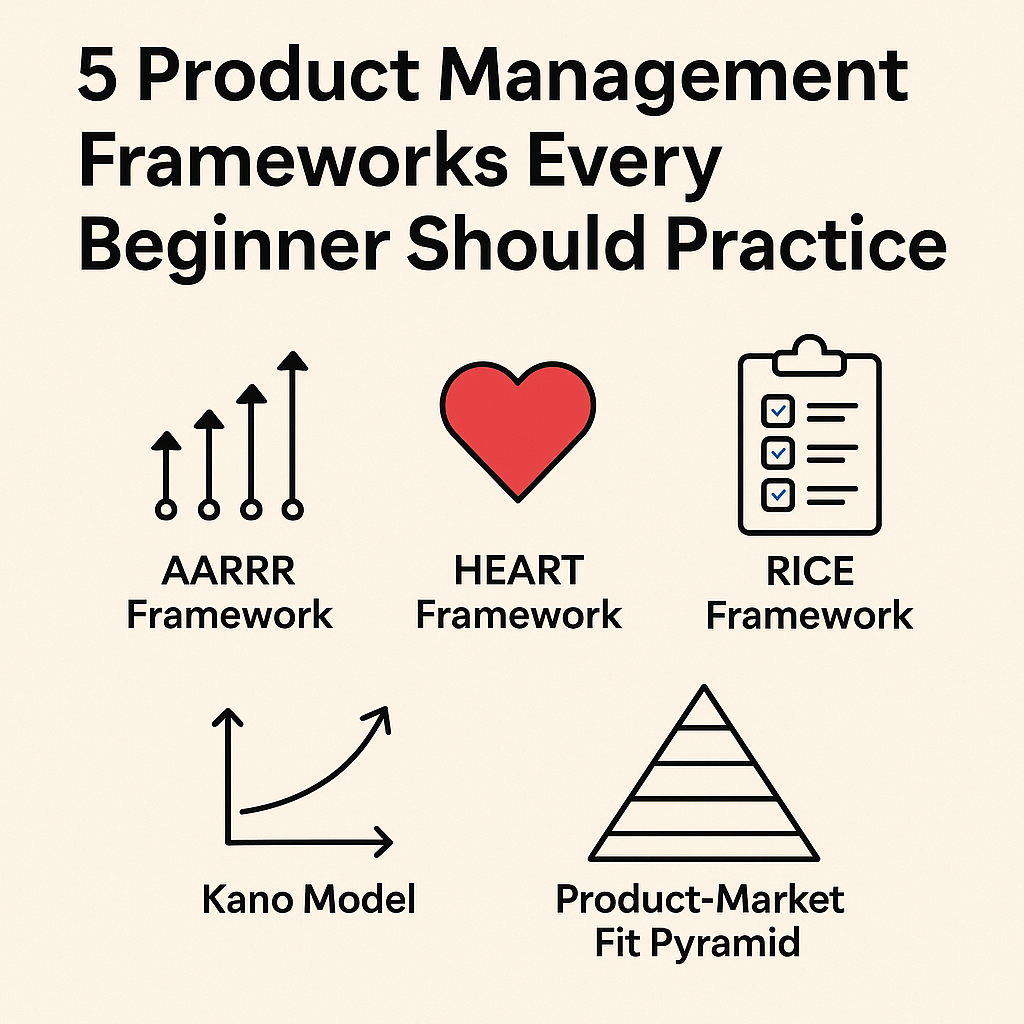
5 Product Management Frameworks Every Beginner Should Practice
When I first started learning about product management, I thought PMs just used frameworks. But the truth is — great PMs think in…
5 Product Management Frameworks Every Beginner Should Practice
When I first started learning about product management, I thought PMs just used frameworks. But the truth is — great PMs think in frameworks.
Frameworks aren’t just fancy diagrams from textbooks. They’re mental models that help you bring structure to chaos, make decisions faster, and communicate ideas clearly.
If you’re new to product management, here are five foundational frameworks you should not only learn — but actually practice.
1️⃣ The AARRR Framework (Pirate Metrics)
Let’s start with the classic. AARRR, also known as Pirate Metrics, helps you understand the full user journey — from discovery to retention.
AARRR stands for:
- Acquisition → How are users finding you?
- Activation → Are they getting value in their first experience?
- Retention → Are they coming back?
- Referral → Are they inviting others?
- Revenue → Are they paying or converting?
🧭 Why it matters: This framework reminds PMs to look beyond sign-ups. Growth isn’t just about more users — it’s about keeping and converting them.
💡 Try this: Pick your favorite app and map out its AARRR funnel. You’ll see its strengths and weak spots instantly.
2️⃣ The HEART Framework (For User Experience Metrics)
Created by Google, HEART is a powerful way to measure user happiness and engagement.
HEART stands for:
- Happiness → Are users satisfied?
- Engagement → How often do they interact?
- Adoption → Are new users joining?
- Retention → Are they sticking around?
- Task Success → Can users easily complete what they came for?
🧭 Why it matters: HEART helps PMs think empathetically while staying data-driven.
💡 Try this: Use the HEART framework to evaluate your own product — or even your favorite app. You’ll see how design and data intersect beautifully.
3️⃣ The RICE Framework (For Prioritization)
Every PM faces this question: Which feature should we build next?
The RICE framework brings objectivity to that decision.
RICE stands for:
- Reach → How many users will this impact?
- Impact → How much will it improve their experience?
- Confidence → How sure are we about our assumptions?
- Effort → How much time or resources will it take?
🧭 Why it matters: RICE helps avoid “HiPPO decisions” (Highest Paid Person’s Opinion 😅) and keeps the focus on what truly moves the needle.
💡 Try this: Next time you’re brainstorming features, score each one using RICE. You’ll be surprised how clearly priorities emerge.
4️⃣ The Kano Model (For Understanding User Delight)
The Kano Model helps you figure out which features users expect and which ones will delight them.
It divides features into 3 main types:
- Basic Needs: Users expect them (if missing → frustration).
- Performance Needs: More is better (like faster load times).
- Delighters: Unexpected extras that make users smile.
🧭 Why it matters: Not all features are created equal. Kano helps PMs allocate effort where it truly impacts user satisfaction.
💡 Try this: Next time you see a feature that made you go “wow!”, ask yourself — is it a delighter or a basic expectation?
5️⃣ The Product-Market Fit Pyramid (By Dan Olsen)
This one’s all about alignment. It breaks down product-market fit into layers:
- Target Customer
- Underserved Needs
- Value Proposition
- Feature Set
- User Experience
🧭 Why it matters: If any layer is off, your product won’t resonate. It’s a great framework for validating ideas and ensuring your product truly meets real user needs.
💡 Try this: Before launching a new idea, walk it through each layer. You’ll instantly spot weak links.
⚡ The Takeaway
Frameworks are not rules — they’re lenses. They help you think clearly, collaborate better, and make confident decisions.
So don’t just memorize them — practice them. Apply AARRR to analyze growth. Use RICE for prioritization. Map Kano to your roadmap.
Because the real skill of a product manager isn’t in knowing frameworks — ✨ It’s in knowing when to use which one.
메타데이터
- post_id
- 20d0c620d366
- slug
- 5-product-management-frameworks-every-beginner-should-practice-20d0c620d366
- url
- https://medium.com/@aishwarya.srmsbs/5-product-management-frameworks-every-beginner-should-practice-20d0c620d366
- canonical_url
- https://medium.com/@aishwarya.srmsbs/5-product-management-frameworks-every-beginner-should-practice-20d0c620d366
- author_url
- https://medium.com/@aishwarya.srmsbs
- status
- ok
- fetched_at
- 2026-07-26 12:40:45