Open-Source LLMs 2026: Choose, Evaluate & Deploy Self-Hosted Models
Learn how to pick open-source and open-weight LLMs, check licenses, evaluate benchmarks, and deploy privately with confidence for real…
Open-Source LLMs 2026: Choose, Evaluate & Deploy Self-Hosted Models

Closed, API-only language models made it ridiculously easy to prototype: paste an API key, send prompts, ship a demo. But convenience has a cost — vendor lock‑in, limited customization, pricing volatility, and persistent questions about what happens to your data once it leaves your systems.
That trade-off is why open-source (and “open-weight”) large language models have moved from hobbyist curiosity to a serious option for teams building real products. In fact, n8n points out that since early 2023, new open-source model releases have surged — nearly doubling compared to closed-source releases. And the BentoML team argues the motivation is straightforward: self-hosting gives you control — over privacy, fine-tuning, and performance optimization — rather than accepting whatever an external API decides to deliver.
This article is a practical, production-minded guide to the open-source LLM landscape: what “open” really means, why the ecosystem is moving so fast, how to evaluate models without getting misled by benchmarks, and what a sane deployment path looks like — whether you’re experimenting on a laptop or shipping to enterprise customers.
1) “Open-source” vs “open weights”: the single most important distinction
A lot of people use “open-source LLM” as a catch-all for anything you can download. But there’s a meaningful difference between:
- Open source (in the traditional sense): more of the full pipeline is shared (code, details, sometimes data where legally possible).
- Open weights: the model weights are downloadable, but training code and datasets may not be shared, and the license may restrict commercial use, redistribution, or other behaviors.
BentoML explains this explicitly: many models are “openly available,” but the licensing is often open weights, not OSI-style open source. Their article summarizes OSI’s framing: both may release weights, but open weights typically don’t fully disclose training code/data, while open source aims for fuller disclosure.
The Hugging Face piece echoes the same practical interpretation: “open weights” commonly means public weights under a more restrictive custom license, while “open source” typically implies weights + code under permissive licenses like Apache 2.0 or MIT.
Why this matters: If you’re building a product (not just a demo), you must treat licensing as a first-class engineering constraint — just like latency, cost, and accuracy.
2) Why open models are surging: it’s not just ideology
Open-source LLMs are often framed as “community vs Big Tech.” In practice, adoption is being pulled by business realities:
Control and privacy
DataCamp highlights one of the biggest drivers: with proprietary LLMs, companies worry about data leakage or unauthorized access; with open models, the company keeps control and responsibility for protecting data. BentoML makes the same point from a deployment angle: open models can run locally or inside private infrastructure, reducing exposure compared to sending prompts to a provider’s servers.
Cost predictability
Open models don’t magically become “free” — you still pay for compute — but you can replace a variable API bill with infrastructure you control. BentoML notes that with good inference optimization, open deployments can reach an attractive price‑performance ratio relative to commercial APIs. DataCamp similarly emphasizes reduced vendor dependency — while acknowledging inference still requires resources.
Customization becomes the differentiator
As open models close the quality gap, the advantage shifts away from “which model did you pick?” toward “how well did you adapt it?” BentoML argues you can fine-tune smaller open models on proprietary data to encode domain knowledge and brand voice — something that’s far harder when your only interface is a serverless API.
The gap is shrinking fast
BentoML cites Epoch AI’s estimate that open-weight models trail state-of-the-art proprietary models by about three months on average, emphasizing how quickly the frontier moves.
3) The honest drawbacks: what “open” doesn’t solve
Open-source models are powerful — but not magic. n8n lists practical disadvantages you should plan for:
- Quality can vary, especially compared to the largest closed models backed by enormous training budgets.
- Security risks exist: open environments can be more exposed to manipulation and attacks.
- Licenses vary widely: permissive, custom commercial terms, and non-commercial restrictions all exist in the wild.
DataCamp adds another real-world constraint: computational demands remain a barrier (running and updating models isn’t trivial without resources and skills).
So the right mindset isn’t “open is better.” It’s:
Open models move risk from the vendor’s black box into your engineering backlog — where you can manage it… if you’re prepared.
4) A field guide to the model landscape: think in “jobs,” not hype
Both BentoML and n8n are blunt about a key truth: there is no single “best” open-source LLM — it depends on your use case, compute budget, and priorities.
Instead of chasing the latest headline, start by sorting models into “jobs to be done.” Here’s a practical way to think about it — using examples repeatedly highlighted across the sources:
A) Reasoning and agentic workflows (multi-step tool use)
- DeepSeek-V3.2: BentoML describes it as a top choice for reasoning and agentic workloads, with design choices aimed at long-context and tool-use scenarios. But it’s also compute heavy — BentoML notes multi‑GPU setups can be required for efficient serving.
- Kimi-K2: Presented as an agent-focused MoE model with variants and long context (256K), designed for tool use and multi-turn workflows.
B) Coding assistants and “terminal agents”
- GLM‑4.7: BentoML positions this model as tuned for coding-agent workflows, tool use, and stability over long interactions — exactly the kinds of issues that break real agent systems in production.
- DeepSeek Coder V2: The Hugging Face guide calls out DeepSeek Coder V2 as a coding specialist with a simple “Ollama run” path.
- StarCoder2 (from n8n’s list): explicitly framed as focused on code completion and multi-language programming.
C) General chat + multilingual content + creative work
- Qwen models show up everywhere:
- BentoML highlights Qwen3’s large instruct model as strong for general chat and creative tasks.
- The Hugging Face article describes Qwen3’s flagship MoE model as strong for reasoning, code, and multilingual tasks, under Apache‑2.0.
- n8n includes Qwen2.5 in its “top 11” set, emphasizing multilingual tasks and structured data processing.
D) On-device and “small-but-capable” deployments
- Gemma 2 appears in both n8n’s list and Hugging Face’s guide as a model family intended to be efficient enough for more constrained hardware (with the trade-off of a smaller context window in some variants).
- Phi (3.x/4) appears in n8n’s list as a smaller family that targets on-device inference and reasoning.
E) Multimodal (text + image)
- BentoML notes Llama 4 as “natively multimodal” (text and images) and points to Scout vs Maverick depending on long-context and compute constraints.
The takeaway: Treat model families like tools in a workshop. You don’t pick a “best tool,” you pick the tool that fits the job, the budget, and your safety constraints.
5) How to choose the right model without getting fooled by leaderboards
Benchmarks are useful — but only if you read them like an engineer, not a sports fan.
Use multiple signals, not one score
The Hugging Face guide recommends combining leaderboards:
- Hugging Face Open LLM Leaderboard (standardized evaluation across multiple tests),
- LMSys Chatbot Arena (human preference via head-to-head votes),
- plus tools like Artificial Analysis for performance/cost comparisons.
Beware “benchmark contamination”
The same guide warns about models inadvertently trained on benchmark questions (“test leakage”), inflating results.
Include hallucination and factuality checks
It suggests looking for consensus across hallucination/factuality resources (e.g., TruthfulQA and others) and requiring RAG faithfulness checks before shipping RAG-heavy apps.
Don’t ignore tooling and availability
n8n’s article makes a practical selection choice: their “top 11” focuses on models that are widely used and available in Ollama, because accessibility matters when you’re trying to build real workflows quickly.
A good internal evaluation loop looks like this:
- Shortlist 3–5 models that match your job (coding, chat, long-context, tool use).
- Check licensing and commercial viability first (see next section).
- Run your own test set: real prompts, real documents, real tool-calls, real failure modes.
- Measure user experience: latency, refusal style, formatting reliability, structured output success.
- Only then use public leaderboards as a supporting signal — not the deciding vote.
6) Licensing: your “hidden requirement” that can kill a launch
If benchmarks answer “can it do the job?”, licensing answers “are you allowed to ship it?”
The Hugging Face guide includes a simple licensing matrix mindset:
- Maximum flexibility for commercial use often comes from permissive licenses like Apache 2.0 or MIT.
- Some models have custom licenses that are generally commercially usable but require you to read acceptable-use clauses.
- Others (like CC‑BY‑NC) are explicitly non-commercial and are a non-starter for paid products.
n8n also emphasizes that license terms vary widely — some permissive, some non-commercial, and some with special commercial conditions (for example, Meta’s Llama family terms).
DataCamp’s advice is blunt: even if a model is “open,” some releases can be research-only — so if you’re building a company, you must watch for licensing limitations early.
Practical rule: Add a “license gate” to your evaluation checklist before engineering invests weeks of integration time.
7) Deployment in the real world: from laptop experiments to production clusters
Open-source LLMs become truly valuable when you can deploy them reliably. The sources converge on a common pattern:
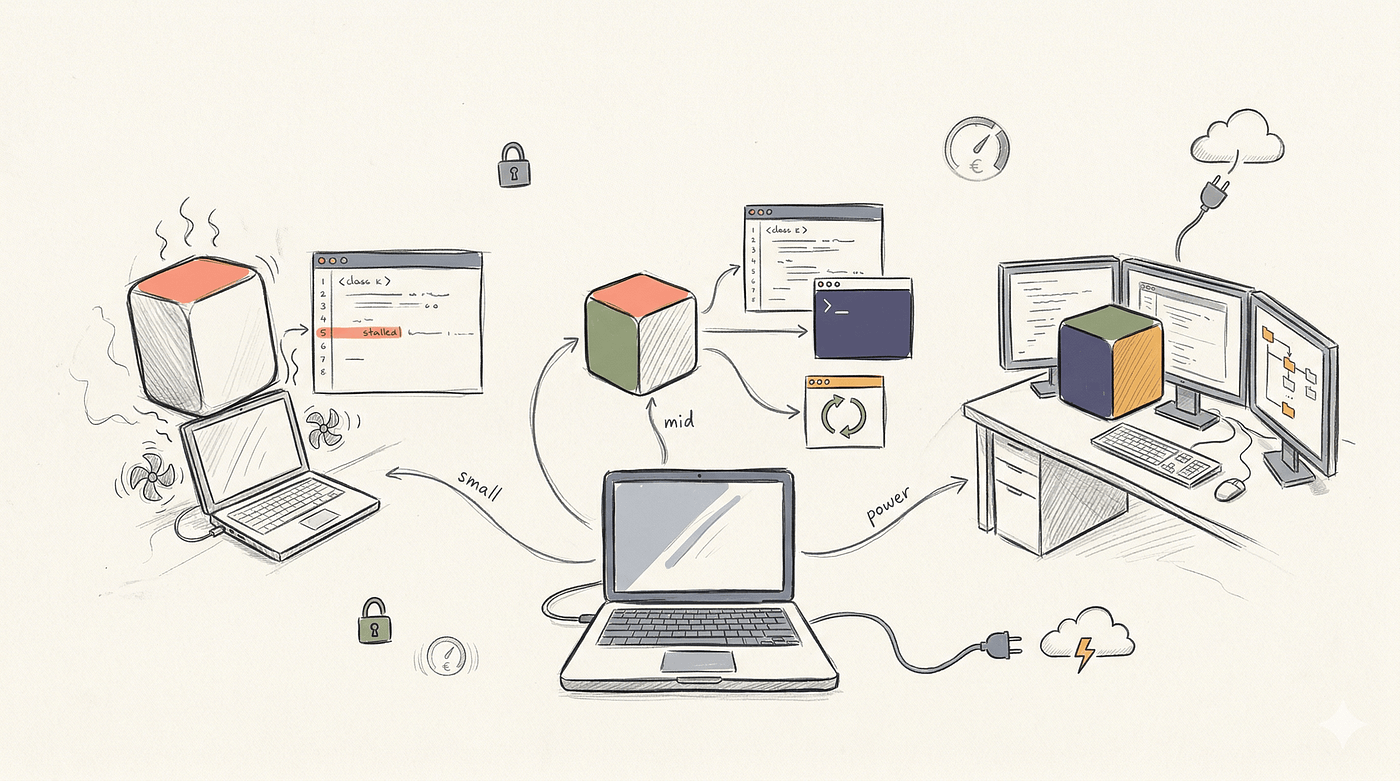
A) Local deployment for fast iteration
The Hugging Face guide recommends Ollama as an easy way to run models locally, with one-line commands. n8n leans into this by integrating Ollama directly into workflow automation, making local models accessible to non-ML engineers building business automations.
B) Server deployment for throughput
For production serving, Hugging Face points to high-throughput frameworks like vLLM and Text Generation Inference (TGI). BentoML also recommends pairing heavyweight models (like DeepSeek) with performance-oriented runtimes such as vLLM.
C) Performance optimization: the difference between “works” and “scales”
BentoML’s article is especially clear here: self-hosting isn’t just “download model, run GPU.” Real workloads often demand optimization techniques such as:
- speculative decoding,
- prefix caching,
- and prefill–decode disaggregation.
It also notes that as models and contexts grow, inference is shifting toward distributed architectures with KV cache bottlenecks and multi-GPU strategies becoming common.
Translation: If you’re serious about production, plan for LLMOps — not just model selection.
8) The workflow angle: open-source LLMs become powerful when they’re connected to tools
A model sitting in isolation is impressive. A model wired into workflows is useful.
This is where n8n’s perspective is refreshingly practical. Their article explains multiple ways to plug open-source models into automations:
- A dedicated Ollama node for local models,
- an OpenAI-compatible node that can point to a custom endpoint (helpful for swapping between providers or routers),
- and integrations via Hugging Face or HTTP requests.
They even walk through an enterprise-friendly pattern: an on-prem workflow that extracts user information into a consistent JSON structure using an LLM chain, an Ollama model node, and structured output parsing — designed for environments where privacy matters.
Why this matters: Many “LLM app failures” aren’t model failures — they’re integration failures. Structured outputs, tool calls, and error handling are where prototypes become production.
9) Trust, privacy, and “who do I send my prompts to?”: what practitioners actually say
When you ask engineers “which LLM provider would you trust with your company’s source code?”, the Reddit thread you shared shows the emotional center of the debate:
- Some users answer “none,” arguing local/offline is the only mostly trustworthy route.
- Others argue enterprise reality is different: you don’t “trust vibes,” you trust contracts, security controls, and the ability to enforce penalties if things go wrong.
- Several comments suggest that if you already trust a large cloud provider with sensitive workloads, using their LLM platform may not add much incremental risk — assuming the contractual and technical controls are real and enforceable.
What’s the practical conclusion?
A sane trust model for teams
- If data sensitivity is extreme (regulated data, crown‑jewel IP, third-party code with strict agreements): self-host or keep inference inside controlled infrastructure.
- If you must use a hosted provider for experimentation: treat it like any other vendor risk — minimize what you send, push for explicit retention terms, and don’t assume “marketing privacy promises” are the same as enforceable obligations.
Open-source LLMs don’t eliminate security work — but they give you an option that doesn’t require shipping your hardest problems to someone else’s servers.
10) A practical “getting started” plan that won’t trap you later
If you want the benefits of open models without drowning in choices, here’s a realistic plan drawn from the common threads across the sources:
- Pick your first job (coding assistant, customer support, RAG Q&A, internal agent). DataCamp recommends starting with “What do you want to do?” and “Why do you need an LLM?” before anything else.
- Shortlist models you can actually run (locally via Ollama or on your current servers). n8n’s shortlist approach — favoring models available in Ollama — keeps evaluation practical.
- License-check early (commercial vs non-commercial, acceptable use policies).
- Evaluate using multiple signals (leaderboards + your own tests + human preference).
- Build the application layer (structured outputs, tool integration, error handling). n8n’s workflow examples highlight this shift from “chat” to “systems.”
- Optimize only after product fit (batching, caching, distributed inference).
Final thoughts: the “best” open LLM is the one you can evolve
The open-source LLM ecosystem is moving at an incredible pace — new models and variants appear constantly, and “best” changes quickly.
So the winning strategy usually isn’t betting everything on a single model. It’s building a flexible stack where you can:
- swap models,
- enforce licensing and privacy constraints,
- measure quality with your own evaluations,
- and continuously optimize inference for your workloads.
That’s how open-source LLMs stop being a research fascination and become a durable product advantage.
References
https://www.bentoml.com/blog/navigating-the-world-of-open-source-large-language-models
https://blog.n8n.io/open-source-llm/
https://www.datacamp.com/blog/top-open-source-llms
https://huggingface.co/blog/daya-shankar/open-source-llms
https://www.reddit.com/r/LocalLLaMA/comments/1dl4mbw/which_llm_providers_would_you_trust_with_your/
메타데이터
- post_id
- 20da74fe528c
- slug
- open-source-llms-2026-choose-evaluate-deploy-self-hosted-models-20da74fe528c
- url
- https://medium.com/@QuarkAndCode/open-source-llms-2026-choose-evaluate-deploy-self-hosted-models-20da74fe528c
- canonical_url
- https://medium.com/@QuarkAndCode/open-source-llms-2026-choose-evaluate-deploy-self-hosted-models-20da74fe528c
- author_url
- https://medium.com/@QuarkAndCode
- status
- ok
- fetched_at
- 2026-06-09 15:37:30